
How to Use People Also Ask for AI Content Strategy
Learn how to leverage Google's People Also Ask feature to create AI-optimized content that ranks in AI search engines and improves brand visibility in AI answer...
9 min read
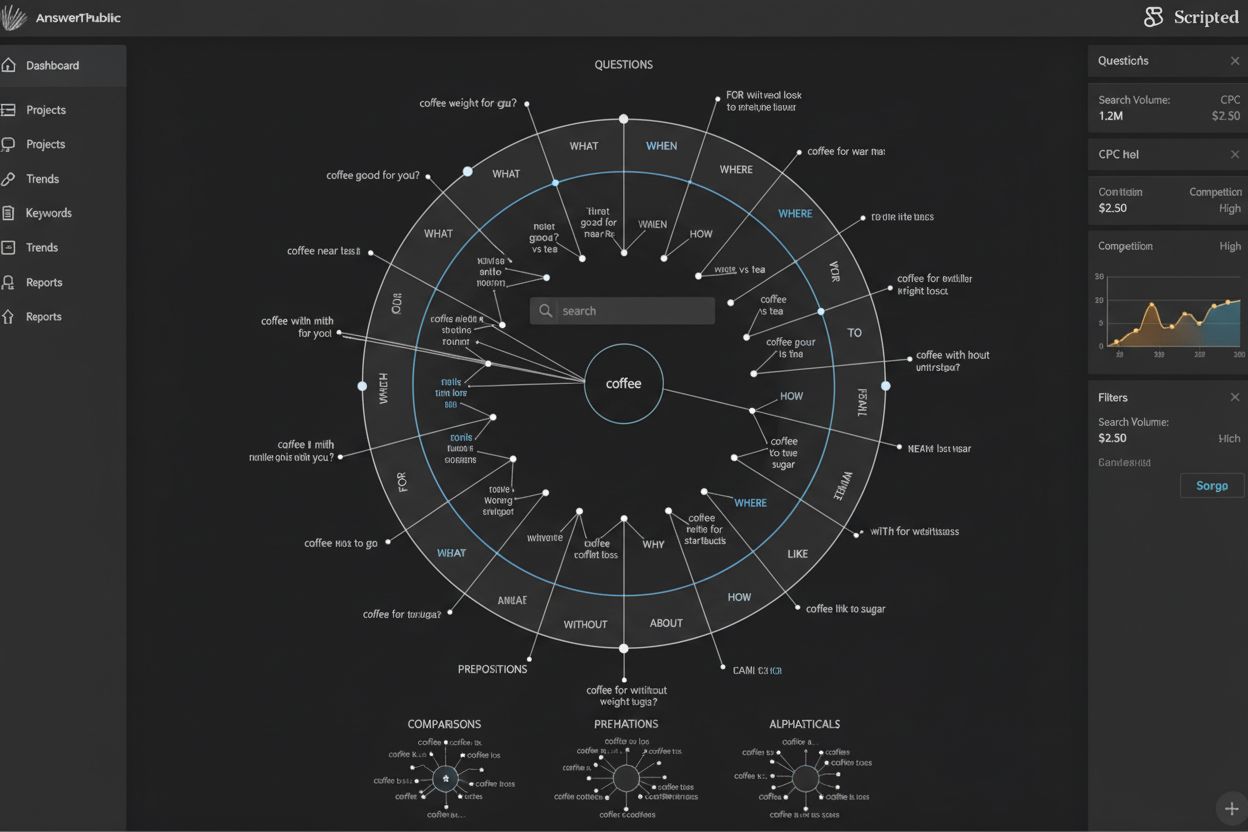
Answer The Public is a visual keyword research and search listening tool that analyzes Google’s autocomplete data to reveal questions, phrases, and search patterns people use when searching for specific topics. It organizes this data into visual wheels and lists, helping marketers discover content ideas, understand search intent, and track brand perception across multiple search engines including Google, Bing, YouTube, Amazon, and TikTok.
Answer The Public is a visual keyword research and search listening tool that analyzes Google's autocomplete data to reveal questions, phrases, and search patterns people use when searching for specific topics. It organizes this data into visual wheels and lists, helping marketers discover content ideas, understand search intent, and track brand perception across multiple search engines including Google, Bing, YouTube, Amazon, and TikTok.
Answer The Public is a visual keyword research and search listening tool that transforms Google’s autocomplete data into actionable insights for marketers, content creators, and SEO professionals. Developed by Neil Patel and his team at NP Digital, the platform “listens in” to search engine autocomplete suggestions and organizes them into intuitive visual wheels and comprehensive lists. By entering a single keyword or phrase, users instantly discover the questions people are asking, the language they use, and the topics they care about most. The tool’s primary strength lies in its ability to reveal search intent and consumer psychology directly from real search behavior, making it an invaluable resource for anyone seeking to understand what their audience genuinely wants to know. Unlike traditional keyword research tools that focus primarily on search volume and competition metrics, Answer The Public prioritizes the discovery of actual user queries and emerging topics that might otherwise remain hidden in keyword databases.
The concept of search listening emerged as digital marketers recognized that Google’s autocomplete feature represented a goldmine of consumer insights. When Google introduced autocomplete suggestions in the early 2000s, it fundamentally changed how people search online—but it also created a new data source that few tools were capturing systematically. Answer The Public was founded to address this gap, recognizing that the 3 billion Google searches conducted daily contain approximately 20% of queries that have never been searched before, representing entirely new consumer interests and pain points. The platform’s development coincided with the growing importance of content marketing and the shift away from keyword stuffing toward search intent optimization. Over the past decade, Answer The Public has evolved from a simple autocomplete scraper into a comprehensive search listening platform trusted by over 2.7 million users worldwide. The tool now integrates data from multiple search engines and platforms, reflecting the broader shift toward omnichannel search optimization where brands must understand search behavior across Google, Bing, YouTube, Amazon, TikTok, and emerging AI search interfaces. This evolution demonstrates how search listening has become essential to modern SEO strategy and content discovery.
Answer The Public operates by continuously harvesting autocomplete suggestions from search engines’ APIs and databases. When a user enters a keyword, the platform retrieves all the autocomplete phrases that search engines would suggest for that term, then applies sophisticated natural language processing algorithms to categorize and organize this data. The tool segments results into several distinct categories: questions (queries beginning with interrogative words like “what,” “how,” “why,” “are,” “can,” “should”), prepositions (phrases using connecting words like “for,” “near,” “without,” “vs.”), alphabetical combinations (all possible keyword phrases organized A-Z), and related searches (semantically similar queries). Each result is assigned a search popularity indicator—represented by color-coded dots ranging from deep red (high volume) to pale pink (lower volume)—allowing users to instantly assess relative search demand. The platform also integrates CPC (cost-per-click) data from advertising networks, providing insight into the commercial value of keywords. This multi-layered approach transforms raw autocomplete data into structured, actionable intelligence that reveals not just what people search for, but the context, intent, and relative importance of different search queries.
| Feature | Answer The Public | SEMRush | Ahrefs | Ubersuggest | Moz Keyword Explorer |
|---|---|---|---|---|---|
| Primary Focus | Search listening & visualization | Comprehensive SEO suite | Backlink analysis & SEO | All-in-one SEO tool | Keyword difficulty & SERP analysis |
| Autocomplete Data | Yes, primary feature | Limited | Limited | Yes, secondary feature | Limited |
| Visual Interface | Circular wheel visualization | Dashboard-based | Dashboard-based | Dashboard-based | Dashboard-based |
| Search Volume Data | Yes, with indicators | Yes, detailed | Yes, detailed | Yes, detailed | Yes, detailed |
| CPC Data | Yes | Yes | No | Yes | No |
| Backlink Analysis | No | Yes, extensive | Yes, extensive | Yes, basic | Yes, basic |
| Competitor Analysis | Limited | Yes, comprehensive | Yes, comprehensive | Yes, basic | Yes, basic |
| Multi-Platform Support | Google, Bing, YouTube, Amazon, TikTok | Google, Bing | Google, Bing | Google, Bing | Google, Bing |
| Free Version | 3 searches/day | Limited features | Limited features | Limited features | Limited features |
| Pricing (Monthly) | $11-$199 | $99-$499 | $99-$999 | $12-$99 | $59-$599 |
| Best For | Content ideation & FAQ discovery | Enterprise SEO | Technical SEO & backlinks | Budget-conscious marketers | Keyword difficulty assessment |
| Learning Curve | Low | Moderate to high | Moderate to high | Low to moderate | Low to moderate |
One of Answer The Public’s most distinctive advantages is its visual representation of search behavior. Rather than presenting keywords as a flat list, the tool organizes them into a circular wheel where the central keyword radiates outward with related queries, creating an intuitive map of the search landscape. This visualization approach serves multiple strategic purposes: it helps marketers quickly identify content clusters (groups of related questions that could be addressed in a single comprehensive article), reveals search intent patterns (whether users are looking for definitions, how-to guides, product reviews, or comparisons), and uncovers long-tail keyword opportunities that might be overlooked in traditional keyword research. The color-coding system—where darker red indicates higher search volume—enables marketers to prioritize content creation efforts toward the most searched questions. For example, a content marketer researching “sustainable fashion” might discover that “how to start a sustainable fashion brand” receives significantly more searches than “sustainable fashion history,” immediately informing content strategy priorities. This visual-first approach reduces cognitive load and accelerates the decision-making process, allowing teams to move from research to content creation faster than with traditional keyword tools. The ability to click directly from the visualization to Google search results provides immediate competitive context, showing exactly how top-ranking pages address each query and revealing gaps where original content could rank.
While Google remains the dominant search engine, Answer The Public recognizes that modern search behavior is fragmented across multiple platforms, each with distinct user intent and content formats. The platform enables users to analyze autocomplete data from Bing, YouTube, Amazon, and TikTok, reflecting the reality that consumers search differently depending on their platform and intent. A user searching for “best running shoes” on Google might be looking for reviews and comparisons, while the same search on YouTube might indicate interest in unboxing videos or performance tests, and on Amazon might signal purchase intent. This multi-platform approach is particularly valuable for brands developing omnichannel content strategies and for e-commerce companies optimizing product discoverability across different marketplaces. The tool’s ability to reveal platform-specific search patterns helps marketers tailor content format and messaging to match where their audience is searching. For instance, discovering that “how to use TikTok for business” receives significant search volume on TikTok itself suggests strong demand for educational content on that platform, while the same query on Google might indicate interest from business professionals seeking guides. This platform-aware search listening capability positions Answer The Public as essential infrastructure for brands managing presence across multiple digital channels and preparing for the rise of AI search interfaces like Perplexity and Google AI Overviews.
Answer The Public’s premium plans include search listening alerts, a feature that transforms the tool from a point-in-time research instrument into a continuous monitoring system. Users can set up automated alerts for specific keywords, receiving weekly email digests highlighting new questions, emerging search patterns, and shifts in how people search around their topics. This capability is particularly valuable for brand reputation management, PR professionals, and content strategists who need to stay ahead of trending topics and emerging consumer concerns. For example, a software company might set up alerts for their product name to immediately identify new use cases or problems customers are searching for, enabling rapid content response. Similarly, a healthcare brand could monitor searches around their industry to identify emerging health concerns and create timely, relevant content. The real-time monitoring aspect of Answer The Public enables organizations to practice reactive content marketing—creating content that addresses trending topics while they’re still gaining momentum, rather than months after the trend has peaked. This is particularly important in fast-moving industries where search trends can shift rapidly based on news events, seasonal changes, or viral moments. The alert system also helps marketers identify seasonal patterns in search behavior, allowing them to plan content calendars that align with predictable spikes in search demand throughout the year.
Answer The Public has become indispensable for content marketers seeking to create content that directly addresses what their audience is searching for. The tool’s question-focused data is particularly valuable for developing FAQ sections, a critical component of modern SEO strategy that helps content rank for featured snippets and position zero results. By identifying the exact questions people ask about a topic, marketers can create FAQ content that matches search intent precisely, dramatically increasing the likelihood of ranking in Google’s featured snippet carousel. Beyond FAQs, Answer The Public informs broader content strategy by revealing the full spectrum of questions and concerns within a topic area. A content marketer researching “remote work” might discover not just obvious questions like “how to work from home” but also specific concerns like “how to stay motivated working from home,” “remote work tax implications,” and “best remote work tools,” each representing distinct content opportunities. This comprehensive topic mapping enables marketers to develop content clusters—groups of related articles that collectively establish topical authority and improve overall site rankings. The tool’s ability to export data as CSV files facilitates integration with content management systems and editorial calendars, allowing teams to systematically plan content production based on actual search demand rather than assumptions about what their audience wants to know.
As AI search platforms like Perplexity, ChatGPT, and Google AI Overviews become increasingly important in the search landscape, Answer The Public takes on new strategic significance. These AI systems rely on understanding what questions people ask and what information they seek, making search listening data invaluable for predicting what content AI systems will reference and cite. For organizations using platforms like AmICited to monitor brand mentions in AI responses, Answer The Public provides crucial context about which topics and questions are most likely to trigger AI citations. By understanding the questions people ask about a topic, brands can optimize their content to address these exact queries, increasing the likelihood that AI systems will cite their content when answering similar questions. This represents a fundamental shift in SEO strategy from optimizing for traditional search rankings to optimizing for AI citation. The tool’s ability to reveal search intent and question patterns becomes even more critical in an AI-driven search environment where understanding the nuances of what people actually want to know—not just the keywords they use—determines visibility. As AI search continues to evolve, Answer The Public’s focus on real user questions and search intent positions it as essential infrastructure for brands seeking to maintain visibility and authority in an increasingly AI-mediated information landscape.
While Answer The Public excels at search listening and content ideation, it has notable limitations that make it most effective when used alongside other tools. The platform does not provide detailed search volume metrics, keyword difficulty scores, or competitive analysis data that full-service SEO platforms offer. It also lacks backlink analysis, rank tracking, and technical SEO capabilities essential for comprehensive SEO strategy. Additionally, Answer The Public relies on autocomplete data, which can be influenced by location bias, personalization, and Google’s algorithm changes, potentially missing some search queries or overrepresenting others. The tool also doesn’t provide contextual information about search trends, such as whether a query is rising or falling in popularity, or whether it represents a temporary spike or sustained interest. For these reasons, most professional marketers use Answer The Public as part of a complementary tool stack, combining it with platforms like SEMRush, Ahrefs, or Moz for comprehensive keyword analysis. The ideal workflow involves using Answer The Public for initial topic discovery and content ideation, then validating findings with traditional keyword research tools to assess search volume, competition, and ranking difficulty. This hybrid approach leverages the strengths of each tool while mitigating individual limitations, resulting in more robust and data-informed content strategies.
The future of Answer The Public and search listening tools generally will likely be shaped by the continued evolution of AI search and conversational interfaces. As users increasingly interact with search through voice queries, chatbots, and AI assistants, the nature of search data itself is changing. Traditional autocomplete data may become less representative of actual search behavior as users shift toward more conversational, multi-turn interactions with AI systems. Answer The Public and similar tools will need to evolve to capture data from these new search modalities, potentially incorporating voice search patterns, conversational query analysis, and AI-generated response tracking. The integration of Answer The Public with AI citation monitoring platforms like AmICited represents an emerging trend where search listening and AI monitoring converge to provide comprehensive visibility into how brands are discovered and cited across both traditional search and AI systems. Additionally, as search intent becomes increasingly sophisticated—with AI systems understanding nuanced, multi-faceted questions rather than simple keyword queries—search listening tools will need to provide deeper semantic analysis and intent classification. The platform’s evolution will likely include more advanced natural language processing, sentiment analysis of search queries, and predictive analytics that forecast emerging topics before they reach peak search volume. These developments will position Answer The Public not just as a keyword research tool but as a comprehensive consumer intelligence platform that reveals what people want to know across all search modalities and AI interfaces.
Answer The Public specializes in search listening and visualization of autocomplete data, focusing on discovering questions and phrases people actually search for. Unlike traditional tools like SEMRush or Ahrefs that provide comprehensive analytics including search volume, competition metrics, and backlink data, Answer The Public excels at content ideation and understanding search intent. Many marketers use it as a complementary tool alongside full-service SEO platforms to identify emerging topics and FAQ opportunities that might be missed by volume-focused keyword research.
Answer The Public analyzes autocomplete data from multiple search engines and platforms including Google, Bing, YouTube, Amazon, and TikTok. For each keyword, it extracts questions (starting with 'what,' 'how,' 'why,' 'are,' 'can,' etc.), prepositions (for, near, without, etc.), alphabetical keyword combinations, and related searches. The tool also provides search volume indicators through color-coded dots and cost-per-click (CPC) data for advertisers, giving marketers a comprehensive view of how people search across different platforms and contexts.
Answer The Public's search listening capabilities enable brands to monitor how their keywords and topics are being searched for over time, track shifts in brand perception, and identify emerging concerns or opportunities. For platforms like AmICited that track brand mentions in AI responses, Answer The Public provides valuable context about what questions and topics are trending around a brand. By monitoring search patterns, brands can understand what information AI systems are likely to reference and optimize their content strategy accordingly to ensure accurate representation in AI-generated responses.
Answer The Public offers a freemium model with three paid tiers. The free version allows 3 searches per day. The Individual plan costs $11/month or $199 lifetime with 100 daily searches. The Pro plan ($99/month or $990 lifetime) includes unlimited searches, projects, and CSV exports. The Expert plan ($199/month or $1990 lifetime) adds unlimited team members. All paid plans include access to educational resources like video masterclasses and eBooks, making it accessible for both individual marketers and enterprise teams.
Answer The Public's circular wheel visualization displays all related keywords and questions around a central search term, making it easy to identify patterns and opportunities at a glance. Color-coded dots indicate search popularity, with darker red indicating higher search volume. This visual approach reduces the time spent manually reviewing keyword lists and helps marketers quickly identify the most relevant content opportunities. Users can click directly from the visualization to Google search results to see how top-ranking content addresses each query, enabling faster content strategy development.
Yes, Answer The Public's premium plans include search listening alerts and monitoring features that track how search behavior changes over time. Users can set up weekly email digests highlighting new questions and suggestions around specific keywords, helping them stay ahead of seasonal trends, emerging topics, and shifts in brand perception. This real-time monitoring capability is particularly valuable for content marketers and PR professionals who need to respond quickly to changing search behavior and consumer interests in their industry.
Answer The Public streamlines content marketing by providing ready-made content ideas directly from real user searches. Marketers can export search data as CSV files for analysis in other tools, create FAQ sections based on actual questions people ask, develop blog post outlines from question clusters, and plan social media content around trending topics. The tool's collaboration features allow teams to work together on projects, and its integration with other marketing platforms makes it easy to incorporate search insights into broader content strategies and editorial calendars.
Start tracking how AI chatbots mention your brand across ChatGPT, Perplexity, and other platforms. Get actionable insights to improve your AI presence.
Learn how to leverage Google's People Also Ask feature to create AI-optimized content that ranks in AI search engines and improves brand visibility in AI answer...
Learn what People Also Ask (PAA) is, how it works, and why it matters for SEO. Discover optimization strategies to rank in PAA boxes and capture first-page SERP...
Discover the best tools to find AI search topics, keywords, and questions people ask in AI search engines like ChatGPT, Perplexity, and Claude. Learn which tool...
Cookie Consent
We use cookies to enhance your browsing experience and analyze our traffic. See our privacy policy.