



How Do AI Assistants Affect Shopping Behavior?
How AI assistants change shopping habits, from personalized recommendations to faster purchase decisions and the future of retail.
9 min read
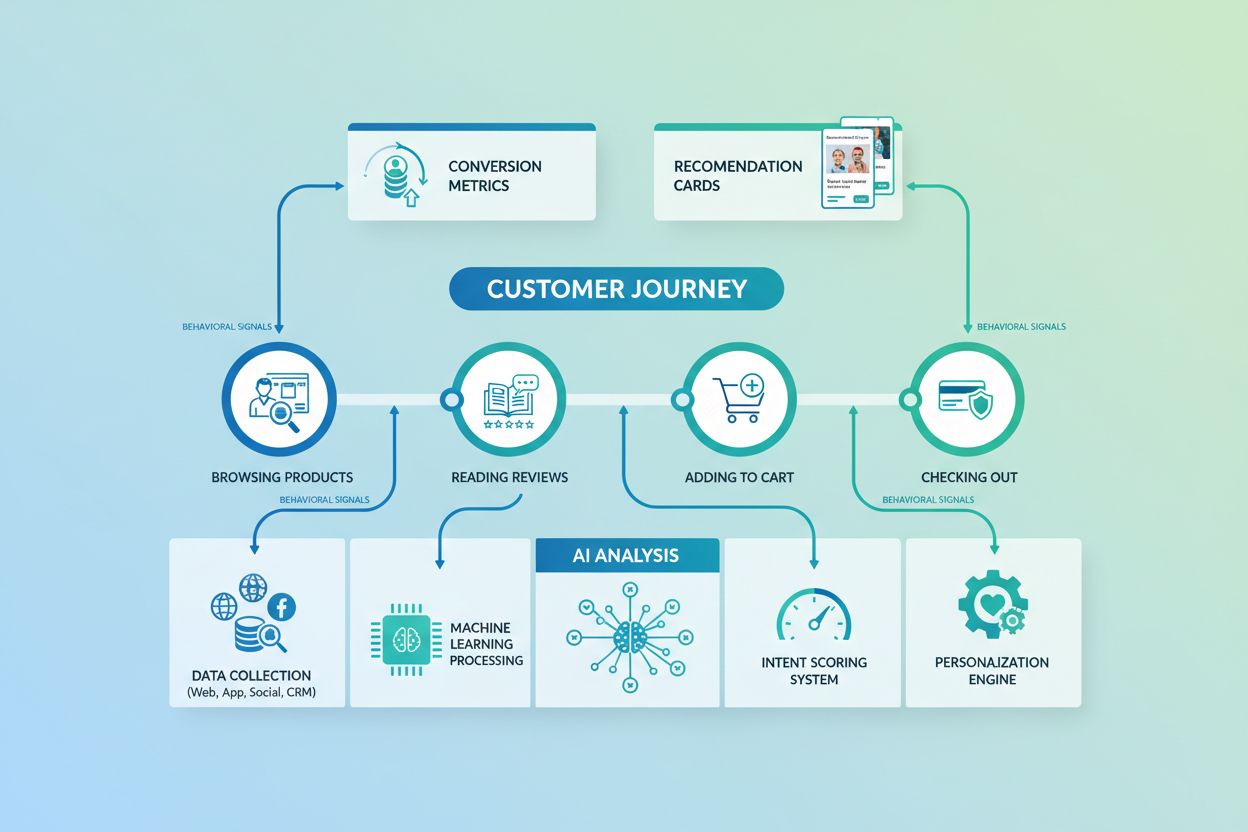
User queries and behavioral signals within AI platforms that indicate purchase consideration or product research activity. AI shopping intent represents the algorithmic detection of when customers are actively evaluating products and preparing to make purchasing decisions. This technology analyzes multiple data streams including browsing patterns, engagement metrics, and conversational signals to predict purchase readiness. By identifying these intent signals, businesses can deliver personalized recommendations and targeted offers at optimal moments in the customer journey.
User queries and behavioral signals within AI platforms that indicate purchase consideration or product research activity. AI shopping intent represents the algorithmic detection of when customers are actively evaluating products and preparing to make purchasing decisions. This technology analyzes multiple data streams including browsing patterns, engagement metrics, and conversational signals to predict purchase readiness. By identifying these intent signals, businesses can deliver personalized recommendations and targeted offers at optimal moments in the customer journey.
AI shopping intent refers to the algorithmic detection and interpretation of signals that indicate a user is actively considering or preparing to make a purchase decision. This concept extends beyond traditional e-commerce analytics to encompass how artificial intelligence systems identify purchase readiness across multiple touchpoints, including search queries, browsing behavior, conversational interactions, and engagement patterns. AI shopping intent represents a fundamental shift in how businesses understand customer motivation, moving from reactive analysis to predictive identification of buying signals. By leveraging machine learning algorithms and natural language processing, companies can now recognize the subtle indicators that precede actual purchase transactions, enabling proactive intervention at critical decision-making moments.

Modern AI systems detect shopping intent by analyzing multiple data streams simultaneously, creating a comprehensive profile of user behavior and motivation. These systems process vast amounts of information in real-time, identifying patterns that correlate with purchase decisions. The detection process relies on sophisticated algorithms that can distinguish between casual browsing and genuine purchase consideration, even when users haven’t explicitly stated their intentions. By combining different data types, AI achieves significantly higher accuracy in predicting which users are most likely to convert. The following table outlines the primary data categories that AI systems analyze:
| Data Type | Examples | Signal Strength |
|---|---|---|
| Behavioral | Click patterns, page dwell time, scroll depth, product comparisons | High |
| Engagement | Add-to-cart actions, wishlist saves, review interactions, video watches | Very High |
| Historical | Previous purchase frequency, category preferences, seasonal patterns, lifetime value | Medium-High |
| Conversational | Search queries, chatbot interactions, voice commands, question specificity | High |

Track how AI chatbots mention your brand across ChatGPT, Perplexity, and other platforms.
The detection of shopping intent relies on a sophisticated stack of machine learning models that work in concert to analyze user behavior. Natural Language Processing (NLP) plays a critical role in understanding the semantic meaning behind search queries and conversational inputs, distinguishing between informational searches (“how to choose a laptop”) and transactional searches (“buy laptop under $1000”). Predictive scoring algorithms assign probability values to each user interaction, creating a dynamic intent score that updates in real-time as new data arrives. Collaborative filtering techniques identify patterns by comparing individual user behavior against millions of similar users, revealing intent signals that might not be obvious in isolation. Additionally, deep learning neural networks can process unstructured data like images and videos to infer purchase intent from visual browsing patterns. These technologies work together to create a multi-dimensional understanding of user motivation that goes far beyond simple keyword matching or basic behavioral rules.
AI shopping intent detection has transformed how businesses engage with customers across the entire purchase journey. Organizations are implementing these capabilities to achieve measurable improvements in conversion rates and customer satisfaction. The following use cases demonstrate the practical applications of this technology:
Personalized Product Recommendations: AI systems identify users showing intent signals and serve dynamically customized product suggestions that align with their demonstrated interests and purchase history, increasing average order value by up to 30%.
Dynamic Pricing Optimization: Intent detection enables real-time price adjustments based on user behavior, offering strategic discounts to high-intent users at risk of abandonment while maintaining margins for less price-sensitive customers.
Targeted Email Campaigns: Marketing teams use intent signals to trigger highly relevant email sequences at optimal moments, such as sending product recommendations immediately after a user views similar items multiple times.
Cart Recovery Strategies: AI identifies users who have added items to their cart but show abandonment signals, triggering personalized recovery campaigns with incentives tailored to their specific hesitation points.
Inventory Allocation: Retailers use intent predictions to optimize stock distribution across locations, ensuring high-demand products are available where customers showing purchase intent are most likely to shop.
Customer Service Prioritization: Support teams receive alerts when high-intent users encounter friction points, enabling proactive intervention before customers abandon their purchase journey.
Get the latest insights on AI mentions, brand monitoring, and optimization strategies.
The implementation of AI shopping intent detection delivers substantial business value across multiple performance metrics. Organizations leveraging these capabilities report conversion rate improvements of up to 4x compared to traditional marketing approaches, as they can focus resources on users most likely to purchase. By identifying genuine purchase intent, businesses dramatically reduce marketing waste, directing advertising spend toward high-probability customers rather than broad audience segments. The technology enables increased average order value (AOV) through intelligent product recommendations that align with demonstrated customer interests and purchasing power. Beyond immediate revenue metrics, intent detection improves customer experience by reducing irrelevant messaging and ensuring users encounter products at the precise moment they’re most receptive. Additionally, businesses gain competitive advantage through faster response times to market signals, allowing them to capture sales before competitors recognize the same opportunities.
Successful AI shopping intent systems recognize a sophisticated array of behavioral signals that collectively indicate purchase readiness. Multiple product visits within a category or price range signal active consideration, particularly when users return to the same products across multiple sessions. Price comparison behavior, such as viewing the same product on different retailers or examining products at different price points, strongly indicates serious evaluation. Review and specification reading demonstrates that users have moved beyond casual browsing into detailed evaluation of product features and quality. Wishlist additions and save-for-later actions represent explicit intent signals, as users are actively curating products for future purchase. Increased engagement velocity, where users accelerate their browsing speed and click frequency, often precedes purchase decisions. Seasonal and contextual signals, such as shopping during promotional periods or near gift-giving occasions, provide additional intent indicators. The most sophisticated AI systems recognize that intent signals vary significantly across product categories, customer segments, and individual user patterns, requiring adaptive algorithms that continuously learn from conversion outcomes.
Despite significant advances, AI shopping intent detection faces several substantial challenges that limit its effectiveness and adoption. Privacy regulations like GDPR and CCPA restrict the collection and use of behavioral data, forcing companies to develop intent detection models with limited information or explicit user consent. Data accuracy and quality issues arise when users engage in research without purchase intent, creating false positives that waste marketing resources and degrade customer experience through irrelevant messaging. Implementation complexity requires significant technical infrastructure, specialized talent, and integration with existing systems, creating barriers for smaller organizations. Cross-device tracking limitations make it difficult to build complete user profiles when customers research on mobile devices but purchase on desktops, or vice versa. Algorithmic bias can emerge when training data reflects historical purchasing patterns that don’t represent current market conditions or diverse customer segments. Organizations must continuously validate their intent models against actual conversion outcomes, as the relationship between signals and purchases can shift due to market changes, competitive dynamics, or evolving consumer behavior.
Treating research behavior as purchase intent. Users comparing prices, reading reviews, or revisiting a product page are often gathering information without any near-term purchase plan. Systems that trigger aggressive retargeting or discount offers based on these signals alone generate false positives that waste marketing spend and can annoy customers who weren’t actually close to buying.
Relying on a single data type instead of combining signal categories. Behavioral data alone (clicks, dwell time) is a weaker predictor than the combination of behavioral, engagement, historical, and conversational signals together — teams that build intent scoring around only one data stream, typically because it’s the easiest to access, sacrifice significant prediction accuracy for implementation convenience.
Ignoring cross-device gaps in the intent model. Because customers frequently research on mobile and purchase on desktop (or vice versa), an intent detection system that only tracks a single device loses the thread of a user’s evaluation process and may misjudge a high-intent shopper as a low-engagement one simply because their activity is split across devices.
Deploying intent detection without ongoing validation against real conversions. Since the relationship between behavioral signals and actual purchases shifts with market conditions, seasonality, and competitive dynamics, a model tuned once at launch and never re-validated will drift out of alignment with reality — what counted as a strong intent signal last year may not hold today.
Underestimating privacy compliance requirements until late in implementation. Retrofitting GDPR- and CCPA-compliant consent flows and data-handling practices after a system is already collecting behavioral signals is far more disruptive than designing for compliance from the start — treating privacy as a legal afterthought rather than a design constraint creates rework and regulatory risk.
Understanding AI shopping intent is critical for brand monitoring and reputation management in the age of AI-driven commerce, as brands must now track how they’re referenced and recommended within AI shopping systems. AmICited.com provides essential visibility into how AI platforms detect and communicate shopping intent related to your brand, monitoring whether your products are being recommended to high-intent users and how your brand compares to competitors in AI-driven shopping contexts. As AI systems become the primary interface between customers and products, brands that don’t monitor their presence in these intent-detection systems risk losing visibility into crucial customer decision-making moments. The platform helps organizations understand not just whether they’re being recommended, but the quality and context of those recommendations—ensuring that AI systems are accurately representing your brand’s value proposition to purchase-ready customers. In an increasingly AI-mediated commerce landscape, AmICited.com serves as the essential tool for ensuring your brand maintains relevance and visibility where shopping intent is being detected and acted upon.
Discover how your brand is being recommended by AI shopping systems. AmICited tracks how AI platforms reference your products and compares your visibility against competitors in AI-driven shopping contexts.
How AI assistants change shopping habits, from personalized recommendations to faster purchase decisions and the future of retail.

What AI-mediated commerce is, how AI agents facilitate transactions between consumers and brands, key protocols like ACP and AP2, and where it is heading.

What conversational commerce is, how AI chatbots and messaging apps change e-commerce, best practices and future trends.
Cookie Consent
We use cookies to enhance your browsing experience and analyze our traffic. See our privacy policy.