


Personalized Recommendations
Personalized recommendations are product suggestions tailored to an individual shopper based on their browsing history, past purchases, or the behavior of similar customers, rather than showing the same generic suggestions to every visitor. They commonly appear as "customers also bought," "recommended for you," or "complete the look" sections on ecommerce sites. The goal is to surface products a specific shopper is statistically likely to want, increasing both conversion rate and average order value.
Definition of Personalized Recommendations
Personalized recommendations are product suggestions shown to a shopper based on signals specific to them — their browsing history, past purchases, items in their cart, or the purchase patterns of customers with similar behavior — rather than a single generic list shown to every visitor. They show up throughout the shopping experience: a “customers also bought” section on a product page, a “recommended for you” module on the homepage, a “complete the look” prompt for a fashion item, or a post-purchase email suggesting a natural next buy. The defining characteristic isn’t where recommendations appear but how they’re generated — a truly personalized system changes its suggestions based on who’s looking, while a merchandised “bestsellers” list showing the same five products to everyone is not personalization, even if it’s a reasonable fallback for new visitors with no browsing history yet.
How Personalized Recommendation Systems Work
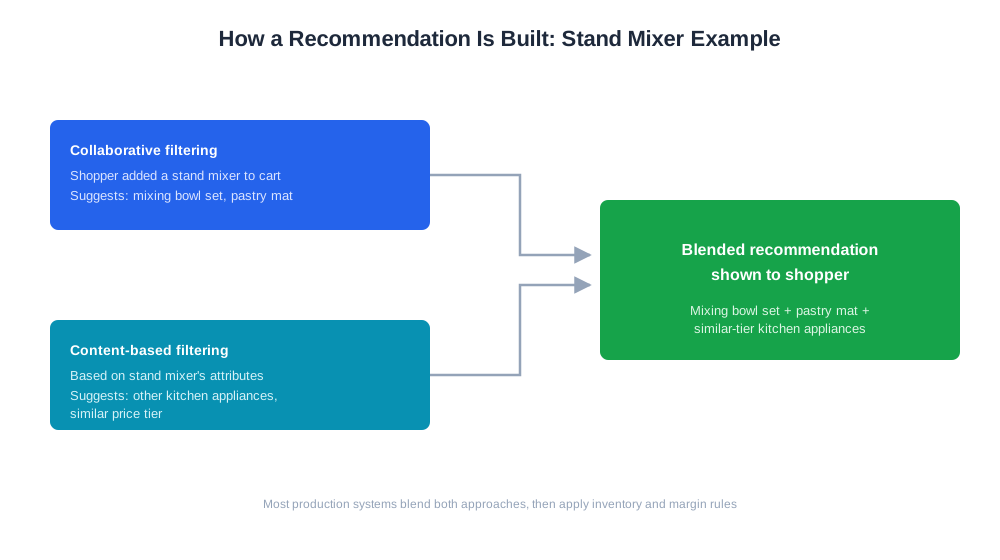
Most recommendation engines combine two underlying approaches. Collaborative filtering looks at the behavior of many customers and identifies patterns — if customers who bought Product A also frequently bought Product B, the system recommends B to a new customer who just bought A, without needing to understand anything about what A or B actually are. Content-based filtering instead looks at product attributes — category, price range, style tags — and recommends items similar to what a shopper has already viewed or purchased, based on shared characteristics rather than other customers’ behavior. Most production systems blend both, then apply business rules on top: filtering out items that are out of stock, deprioritizing low-margin products, or excluding items the shopper has already purchased. Consider a simplified example: a shopper who just added a stand mixer to their cart might see collaborative-filtering suggestions for a mixing bowl set and a pastry mat (because many past customers bought those alongside a mixer), blended with content-based suggestions for other kitchen appliances in a similar price tier — producing a recommendation set more relevant than either method would generate alone.

Ready to Monitor Your AI Visibility?
Track how AI chatbots mention your brand across ChatGPT, Perplexity, and other platforms.
Why Personalized Recommendations Matter for Ecommerce Brands
Recommendations serve two related but distinct purposes: helping shoppers find products they’d genuinely want but might not discover through search or category browsing alone, and increasing average order value by surfacing a relevant add-on at the right moment. A shopper searching for “running shoes” who sees a personalized suggestion for moisture-wicking socks at checkout represents a low-friction opportunity to add a complementary item they may not have thought to look for separately. Over a large customer base, even a modest lift in cart size or conversion rate from relevant recommendations compounds into a meaningful revenue impact, since the incremental cost of surfacing a recommendation is close to zero once the underlying system is built. The inverse is also true — irrelevant recommendations (suggesting products a shopper already owns, or items with no logical connection to their current interest) erode trust in the recommendation module and can make a site feel less attentive rather than more.
Personalized Recommendations vs. Generic Merchandising
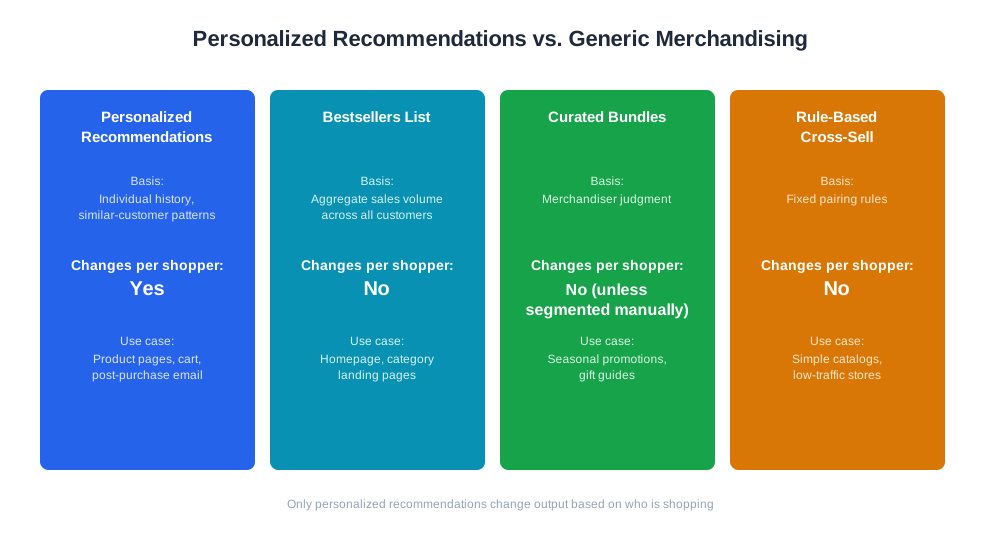
| Approach | Basis for suggestions | Changes per shopper | Typical use case |
|---|---|---|---|
| Personalized recommendations | Individual browsing/purchase history, similar-customer patterns | Yes | Product pages, cart, post-purchase email |
| Bestsellers list | Aggregate sales volume across all customers | No | Homepage, category landing pages |
| Manually curated bundles | Merchandiser judgment | No (unless segmented manually) | Seasonal promotions, gift guides |
| Rule-based cross-sell | Fixed pairing rules (e.g., “always show batteries with this toy”) | No | Simple catalogs, low-traffic stores |
Stay Updated on AI Visibility Trends
Get the latest insights on AI mentions, brand monitoring, and optimization strategies.
Personalized Recommendations and AI-Driven Commerce
AI shopping assistants like ChatGPT Shopping and Amazon’s Rufus are, in effect, a new surface for personalized recommendations — instead of a module on a product page, the recommendation happens conversationally, when a shopper asks an AI assistant what else they might need alongside a purchase. Brands whose product data and purchase-pattern signals are well-structured are better positioned to have their products surfaced accurately in these AI-mediated recommendation moments, much as they benefit from strong personalization on their own storefront. AmICited’s eshop_get_product_affinity tool underlies this kind of recommendation logic directly, analyzing a store’s actual order history to calculate which products are statistically likely to be purchased alongside or shortly after a given item — giving a merchant the same kind of affinity data that powers “customers also bought” modules, without needing to build a recommendation model from scratch.
Best Practices for Personalized Recommendations
- Base recommendations on actual purchase and browsing data specific to your store, not generic industry assumptions about what “goes with” a product
- Filter recommendations by real-time inventory availability — nothing erodes trust faster than recommending an out-of-stock item
- Test recommendation placement (product page, cart, post-purchase) separately, since each serves a different point in the customer journey
- Provide a sensible fallback (bestsellers, category-based suggestions) for new visitors with no personal history yet
- Periodically audit recommendation relevance manually — automated systems can drift toward strange or repetitive suggestions without a human check
Common Personalized Recommendation Mistakes
A frequent mistake is recommending products a customer has already purchased, especially for non-consumable items — nothing signals a system that isn’t paying attention like suggesting a customer buy the exact couch they bought last month. Filtering recent purchases (or in the case of consumables, respecting a reasonable repurchase interval) out of the recommendation set fixes this. Another common issue is recommending out-of-stock or low-stock items, which sends a shopper to a dead end and undermines confidence in every future recommendation the module shows. A third mistake is over-relying on collaborative filtering alone in a small catalog or low-traffic store, where there isn’t enough purchase volume to generate statistically reliable patterns — in these cases, blending in simple rule-based or content-based logic tends to produce more sensible recommendations than a purely data-driven model with too little data to work from. Finally, some stores set recommendation modules once and never revisit them, missing the fact that product mix, pricing, and customer behavior shift over time — a recommendation engine (or a hand-tuned ruleset) benefits from periodic review just like any other part of the site.