Does AI Search Visibility Drive E-Commerce Revenue?
AI-referred shoppers convert at meaningfully higher rates than organic traffic, but last-click attribution hides most of that impact. Here’s why, and a practical framework for measuring the real revenue contribution.
Your analytics dashboard might say AI search drives a rounding error’s worth of revenue. Meanwhile, customers increasingly describe an AI assistant as the first place they looked. Both can be true at once, and the gap between them is mostly a measurement problem, not a reality problem.
Shopify’s platform data gives a useful anchor: AI-referred sessions convert at notably higher rates than organic search sessions, carry a meaningfully higher average order value, and have been growing fast as a share of total referral traffic. Yet last-click attribution, the model most analytics setups default to, was built for a world of clicks and blue links, and it systematically misses a large share of what AI visibility is actually contributing.
Key Takeaways
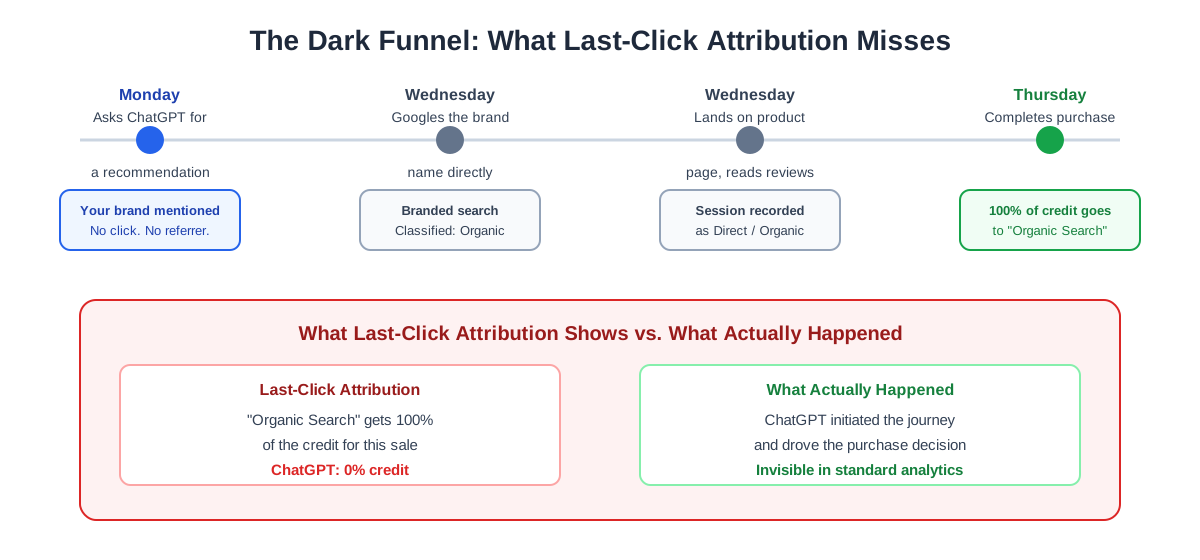
Last-click attribution systematically undercounts AI search’s revenue impact because AI often starts a journey that a different channel gets credit for finishing.
Shopify data shows AI-referred sessions convert at higher rates and carry higher average order value than organic search, and that gap keeps growing.
High-consideration, technical, niche direct-to-consumer, and B2B categories see the biggest lift; commodity and local-service categories see the least.
Multi-touch attribution, post-purchase surveys, and branded-search trends together give a defensible estimate of AI’s real revenue contribution.
Brand mention frequency, product citation frequency, and share of voice move before revenue does, making them useful leading indicators of whether optimization work is paying off.
Bottom line: treat AI visibility as a real, measurable revenue channel and build the measurement muscle before scaling spend; a tool like AmICited that tracks those leading-indicator citation and mention metrics continuously makes it easier to see the trend before it shows up in revenue.
Why Your Dashboard Undercounts AI’s Impact
Three structural issues compound to hide AI’s real influence:
AI is increasingly the front door, not the last step. Shopify’s data shows AI-referred sessions are far more likely to land directly on a product page than organic search sessions are, a signal that the customer already did their research inside the AI conversation and arrived ready to decide. But if their actual purchase journey started with a ChatGPT question on Monday and ended with a branded Google search on Wednesday, last-click attribution credits Wednesday’s search, not Monday’s AI interaction.
Referrer data frequently goes missing. Mobile app-to-web transitions, copied links, and privacy settings all strip referrer information on a meaningful share of AI-assisted visits. When that happens, analytics tools default to labeling the session “Direct,” even though the actual originating touchpoint was an AI assistant. Post-purchase surveys consistently turn up direct traffic that customers themselves attribute to an AI recommendation.
Google AI Overviews get folded into ordinary organic search. Most analytics platforms classify AI Overview-driven clicks the same as any other organic result, so a real shift in how a customer found you is invisible in your channel breakdown.
Ready to Monitor Your AI Visibility?
Track how AI chatbots mention your brand across ChatGPT, Perplexity, and other platforms.
The effect isn’t uniform. It’s strongest where AI’s core strength, synthesizing comparisons and matching specific needs, maps onto how customers actually shop.
High-consideration and technical products (electronics, fitness equipment, specialized tools) benefit most: customers genuinely need to compare specifications and tradeoffs, which is exactly what AI systems are good at summarizing.
Niche, specific direct-to-consumer categories do well because AI can match a very particular query (“organic moisturizer for sensitive skin with hyperpigmentation”) to a smaller brand that traditional keyword search would struggle to surface.
B2B e-commerce sees an outsized effect for a different reason: transaction values are high enough that even a modest volume of AI-influenced deals matters, and B2B buyers are heavy, research-oriented AI users.
Luxury and premium goods see a moderate effect tied closely to how well (and how accurately) AI systems represent brand authority and craftsmanship claims.
Commodity, fast-moving products, and local services see the least benefit, customers in these categories already know what they want and go straight to a marketplace or a map, skipping the research phase where AI visibility matters.
A Practical Measurement Framework
Start with multi-touch attribution. Compare your existing last-click revenue attribution for AI sources against a linear or time-decay model in GA4. The gap between the two is a reasonable floor estimate of what last-click is missing, not the whole picture, but a real, defensible number.
Add a post-purchase survey. A simple “how did you first hear about us” question with an AI-assistant option, placed at checkout or in a post-purchase email, closes a meaningful part of the referrer gap directly from customers rather than inferring it.
Track AI visibility metrics as a leading indicator. Brand mention frequency, product citation frequency, and share of voice against named competitors won’t tell you revenue directly, but they tend to move before referral traffic and branded search do, giving you an early read on whether your optimization work is having any effect at all.
Watch branded search as a proxy. When AI mentions a brand, a share of interested users search for that brand by name shortly afterward. A sustained lift in branded search volume that isn’t explained by paid spend or other campaigns is a reasonable secondary signal that AI visibility is working, even without perfect attribution.
Run incrementality tests where the stakes justify it. For higher-value products, comparing outcomes between customers who were and weren’t exposed to an AI mention (via surveys or cohort analysis) is the most rigorous approach, though it takes more setup than the methods above.
Stay Updated on AI Visibility Trends
Get the latest insights on AI mentions, brand monitoring, and optimization strategies.
Where to Focus Optimization Effort
Get your product data right first. AI systems recommend what they can verify: accurate, current structured data (Product, Review, Organization schema), complete product feeds, and consistent pricing and availability across every channel.
Build authority beyond your own site. AI models weigh third-party signals, reviews, community discussion, press mentions, heavily. A product page alone rarely earns a citation; a product genuinely discussed and reviewed elsewhere on the web does.
Write for the way people actually ask. Comprehensive FAQ sections, honest comparison content, and problem-solving guides map much more closely to how people phrase questions to an AI assistant than traditional keyword-optimized copy does.
Monitor for misrepresentation. AI systems occasionally get pricing, availability, or feature claims wrong. Periodic spot-checks of how your brand is actually described, and prompt correction of your own source content when something’s off, protects both trust and conversion.
The realistic takeaway: AI search visibility is a genuine, measurable revenue channel for most e-commerce categories, one that most teams are currently underestimating because their measurement tools weren’t built for it, not because the underlying customer behavior isn’t real. Treat it as complementary to your existing SEO investment rather than a replacement, and build the measurement muscle before you scale the spend.
Frequently asked questions
It varies enormously by category, but the consistent pattern is that last-click attribution understates it substantially. Multi-touch attribution and post-purchase surveys typically reveal several times more influence than last-click alone shows, with high-consideration, niche, and B2B categories seeing the largest gap.
Three compounding reasons: a large share of AI-referred traffic arrives without referrer data and gets misclassified as direct, AI often starts a journey that ends on a different channel (so last-click credits the wrong touchpoint), and Google AI Overviews are bucketed into ordinary organic search in most analytics tools rather than tracked separately.
Start wherever your category's research-stage queries are most likely to trigger AI Overviews or get asked directly, since that's usually the highest-volume surface. Layer in ChatGPT and Perplexity based on where your buyers actually spend time; B2B and technical categories skew more toward Perplexity and Claude, mainstream consumer categories skew more toward ChatGPT and Google's AI surfaces.
Three complementary methods: compare last-click attribution to multi-touch models (linear or time-decay) and treat the gap as a floor estimate; run a simple post-purchase survey asking how customers first heard about you, with an AI assistant option; and, for higher-value purchases, compare outcomes between customers who were and weren't exposed to an AI mention of your brand.
A modest pilot is a reasonable way to start: a few hundred dollars a month in tooling plus real but bounded content and structured-data work, run for 90 days with a defined baseline. If the multi-touch and survey data show a positive trend, scale it as a percentage of your existing SEO budget rather than treating it as a separate, unbounded initiative.
High-consideration and technical products (electronics, specialized equipment), niche direct-to-consumer categories where AI can match very specific queries to a smaller brand, and B2B e-commerce, where buyers are heavy AI users and transactions are high-value enough that even a modest lift matters. Commodity, fast-moving, and local-service categories see the least benefit.
Arshia is an AI Workflow Engineer at FlowHunt. With a background in computer science and a passion for AI, he specializes in creating efficient workflows that integrate AI tools into everyday tasks, enhancing productivity and creativity.
Arshia Kahani
AI Workflow Engineer
Stop Guessing at Your AI-Driven Revenue
Am I Cited shows you how often your products and brand are cited across ChatGPT, Perplexity, and Google AI Overview, so you have leading indicators before the revenue shows up.
Is AI search traffic actually more valuable? What conversion data are you seeing?
Community discussion on the value of AI search traffic compared to organic search. Real conversion data from marketers measuring AI-referred visitor quality.
What percentage of your traffic comes from AI search? Share your data
Community discussion sharing real data on AI search traffic percentages. Compare your AI referral numbers to others and understand what's normal across differen...
A skeptically-framed look at company case studies reporting revenue growth after improving AI search visibility, what they claim, how the numbers should be read...
15 min read
Cookie Consent We use cookies to enhance your browsing experience and analyze our traffic. See our privacy policy.