
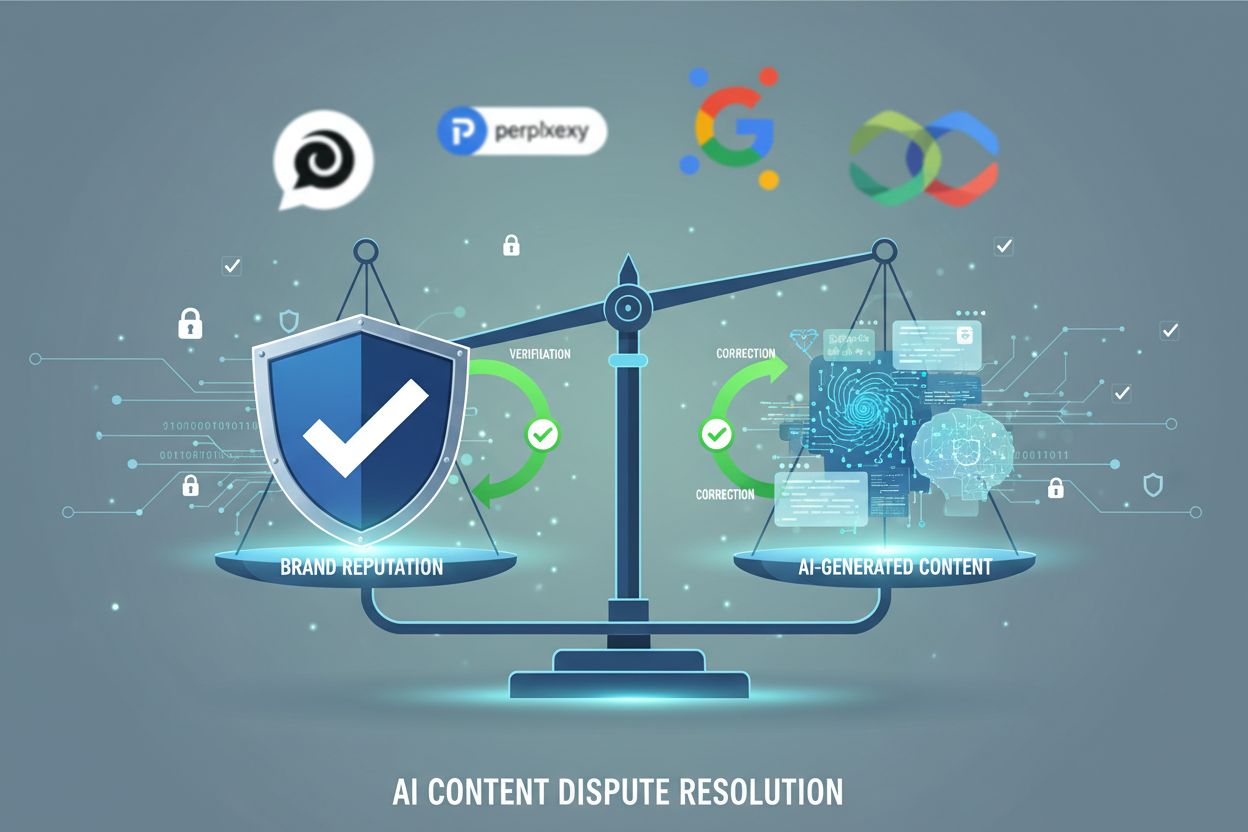
AI Content Dispute
Learn how to identify, monitor, and resolve AI content disputes when artificial intelligence systems generate inaccurate or harmful information about your brand...
8 min read
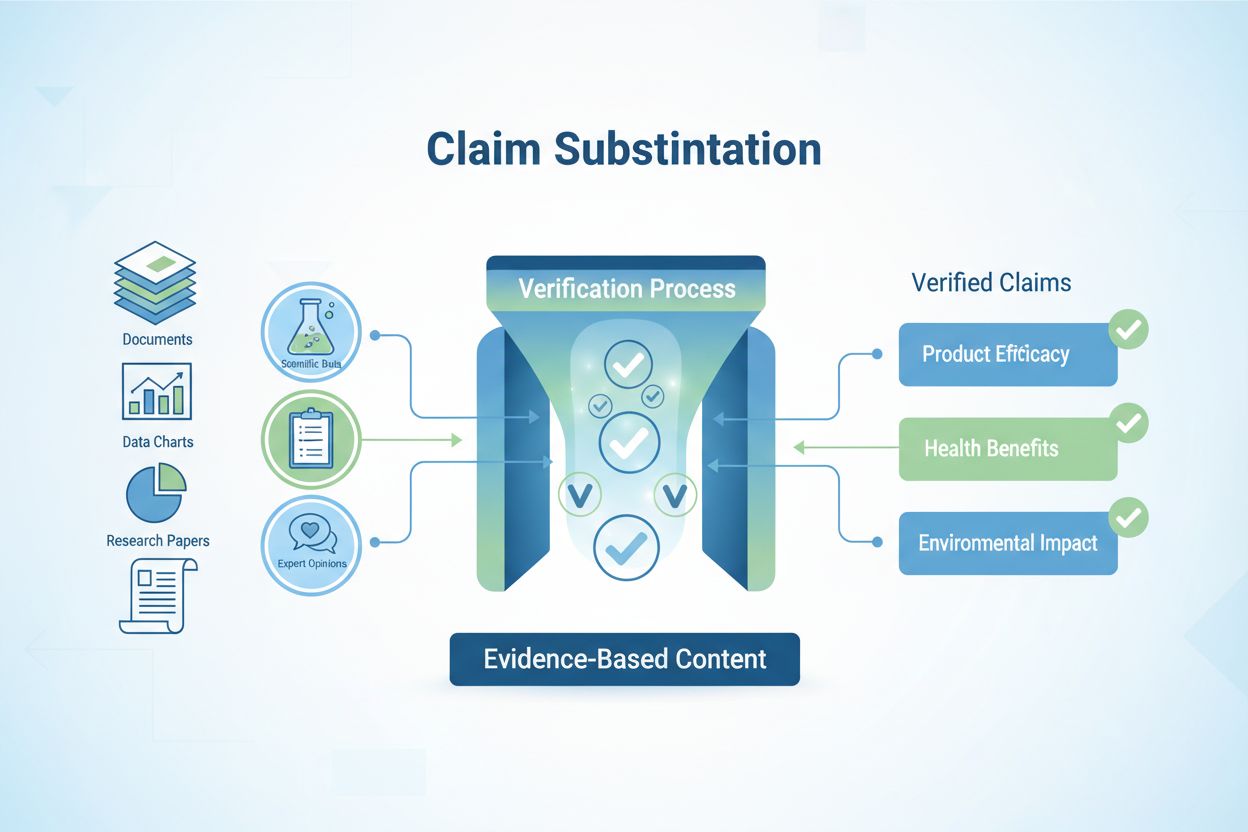
Claim substantiation is the process of supporting all content claims with verifiable evidence, sources, or data that AI systems can reference and cite. It ensures that statements made in advertisements, product descriptions, and digital content are truthful, not misleading, and backed by competent and reliable evidence that meets regulatory and consumer expectations. This practice is essential for maintaining consumer trust and legal compliance in both traditional marketing and AI-generated content.
Claim substantiation is the process of supporting all content claims with verifiable evidence, sources, or data that AI systems can reference and cite. It ensures that statements made in advertisements, product descriptions, and digital content are truthful, not misleading, and backed by competent and reliable evidence that meets regulatory and consumer expectations. This practice is essential for maintaining consumer trust and legal compliance in both traditional marketing and AI-generated content.
Claim substantiation is the process of providing credible, verifiable evidence to support marketing claims made by companies, organizations, and increasingly, AI systems generating content. In the context of modern digital marketing and AI-driven content creation, claim substantiation has become critical as AI systems generate vast amounts of content that must comply with regulatory standards and consumer protection laws. The distinction between express claims—statements explicitly made in marketing materials—and implied claims—messages conveyed through context, imagery, or omission—requires careful substantiation strategies. The Federal Trade Commission (FTC) and the National Advertising Division (NAD) enforce strict requirements that all claims, whether made by humans or generated by AI systems, must be supported by competent and reliable evidence before dissemination. Verifiable claims form the foundation of consumer trust and legal compliance, making substantiation not merely a regulatory checkbox but a fundamental business practice. As AI systems become more prevalent in content creation, marketing, and fact-checking, the need for robust substantiation processes has intensified, requiring organizations to implement systematic approaches to evidence collection and claim validation. Understanding claim substantiation is essential for anyone involved in content creation, marketing, or AI-driven information dissemination in today’s digital landscape.

Different categories of claims carry varying levels of substantiation burden, and understanding these distinctions is crucial for compliance and consumer protection. Marketing claims fall into several distinct types, each with specific evidentiary requirements that must be met before the claim can be legally and ethically made. The following table outlines the primary claim types and their substantiation requirements:
| Claim Type | Definition | Substantiation Burden | Example |
|---|---|---|---|
| Non-Comparative Claim | A claim about a product’s attributes without reference to competitors | Moderate | “This coffee contains 200mg of caffeine per cup” |
| Comparative Claim | A claim that directly compares the product to a competitor’s product | High | “Our smartphone battery lasts 40% longer than Brand X” |
| Superlative Claim | A claim that a product is the best, first, or only of its kind | Very High | “The #1 recommended pain reliever by dermatologists” |
| Objective Claim | A claim based on measurable, factual characteristics | Moderate to High | “This fabric is 100% organic cotton” |
| Subjective Claim | A claim based on opinion, taste, or preference | Lower | “Our ice cream tastes better” |
Non-comparative claims require solid evidence but typically have a lower burden than comparative or superlative claims. Comparative claims demand rigorous, head-to-head testing or data to substantiate the comparison, as they directly challenge competitor products and carry higher legal risk. Superlative claims—such as “best,” “first,” or “only”—require the most stringent substantiation, often necessitating comprehensive market research and documentation. Objective claims about measurable attributes like size, weight, or composition require technical specifications and testing, while subjective claims about taste or preference have lower substantiation requirements but still need some basis in consumer perception or expert opinion. Understanding these distinctions helps organizations and AI systems generating content ensure that claims are appropriately supported before publication.
The substantiation process provides a systematic framework for validating claims before they are made public, ensuring compliance and protecting consumer trust. This structured approach is particularly important for AI systems that generate content at scale, as it prevents the dissemination of unsupported or misleading information. The five-step substantiation process includes:
Step 1: Identify and Classify the Claim
Step 2: Determine Substantiation Requirements
Step 3: Gather and Evaluate Evidence
Step 4: Assess Sufficiency of Evidence
Step 5: Document and Monitor
This process is essential for AI systems generating marketing content, as it ensures that automated content creation remains compliant with consumer protection laws and maintains brand integrity.
The regulatory landscape for claim substantiation is shaped by multiple authorities, each with specific standards and enforcement mechanisms that apply to traditional marketing and AI-generated content alike. The FTC enforces the standard that advertisers must possess a reasonable basis doctrine—competent and reliable evidence—before making any claim about a product’s characteristics, benefits, or performance. The Pfizer Factors, established through FTC precedent, provide a framework for evaluating whether evidence is competent and reliable, considering factors such as the type of evidence, the expertise of the source, the consistency of results, and the degree of acceptance within the relevant scientific community. The NAD, a self-regulatory body, reviews advertising claims and provides guidance on substantiation standards, often setting higher expectations than minimum FTC requirements and serving as an important check on misleading advertising. Health-related claims face particularly stringent scrutiny, requiring clinical evidence, peer-reviewed studies, or expert consensus, as these claims directly impact consumer safety and well-being. For AI systems generating content, compliance with these standards means implementing verification protocols that ensure claims meet FTC and NAD standards before publication. Understanding these regulatory requirements is fundamental to developing AI systems that generate trustworthy, compliant marketing content.
Organizations employ various methodologies to gather evidence supporting their claims, each with distinct advantages and appropriate applications depending on the claim type and industry. Clinical trials represent the gold standard for health and wellness claims, providing rigorous, controlled evidence of product efficacy and safety through systematic testing on human subjects. Consumer surveys gather data on consumer perception, preference, and satisfaction, supporting claims about taste, preference, or consumer acceptance, though they must be conducted with proper methodology to be considered competent evidence. In-home testing allows consumers to use products in real-world conditions, generating authentic usage data and feedback that supports performance claims. Central location testing brings consumers to a controlled environment to evaluate products under standardized conditions, useful for comparative claims and sensory evaluations. Monadic testing presents a single product to consumers without competitor comparison, while sequential testing presents multiple products in sequence, each approach serving different substantiation purposes. Comparative testing directly evaluates products against competitors, providing the strongest evidence for comparative claims. Evidence that does NOT count toward substantiation includes anecdotal testimonials without broader data support, competitor claims without independent verification, and internal company opinions unsupported by external evidence. Effective substantiation requires matching the evidence type to the claim—sensory claims need consumer testing, performance claims need technical testing, and health claims need clinical evidence—ensuring that AI systems generating content can access and verify appropriate evidence sources.
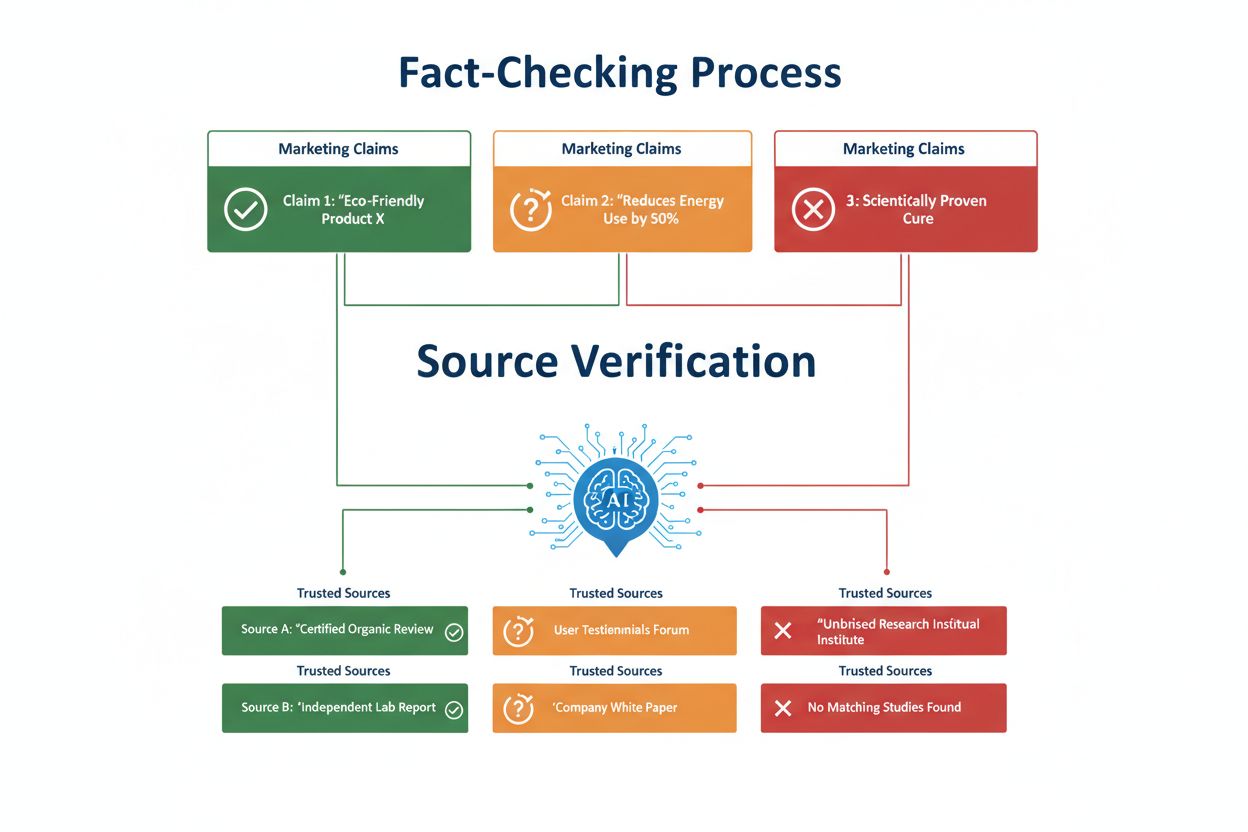
As AI systems increasingly generate marketing content, news articles, and informational materials, the role of claim substantiation has expanded to include verification of AI citations and prevention of AI hallucinations—instances where AI systems generate plausible-sounding but false information. Fact-checking processes must now account for the unique challenges posed by AI-generated content, including the tendency of language models to confidently assert unsupported claims and the difficulty of tracing AI citations back to original sources. Source verification has become a critical component of AI content quality assurance, requiring systematic checking of cited sources to ensure they actually support the claims attributed to them. AmICited.com serves as a monitoring platform that tracks AI citations and verifies their accuracy, helping organizations and consumers identify when AI systems have made unsupported claims or misrepresented sources. The platform’s role in fact-checking AI-generated content addresses a significant gap in current content verification systems, as traditional fact-checking approaches were not designed for the scale and speed of AI content generation. AI systems generating content must be designed with built-in substantiation verification, cross-referencing claims against reliable sources before content publication. Citation verification methods for AI content include automated source checking, human review of critical claims, and integration with fact-checking databases. Organizations using AI systems for content creation must implement governance frameworks that ensure all claims, whether generated by humans or AI systems, meet substantiation standards before reaching audiences.
Organizations frequently make substantiation errors that expose them to regulatory action, consumer backlash, and reputational damage, yet many of these mistakes are preventable through proper processes and training. Claiming without substantiation remains the most common violation, where companies make bold assertions about product benefits without first gathering supporting evidence—a practice that AI systems can inadvertently amplify at scale. Relying on outdated evidence represents another frequent error, as scientific understanding evolves and previous studies may be superseded by newer research, requiring regular updates to substantiation files. Confusing correlation with causation leads organizations to claim that because two factors are related, one causes the other, a logical fallacy that regulators actively challenge. Overstating evidence strength occurs when companies present preliminary findings or limited studies as definitive proof, misrepresenting the actual level of scientific consensus. The best practice of substantiate first, claim second inverts the typical marketing process, requiring organizations to gather evidence before developing marketing messages, ensuring all claims are grounded in reality. Regular substantiation audits should be conducted quarterly or annually to ensure that all active claims remain supported by current evidence and that new claims undergo proper vetting before launch. AI system governance must include substantiation review checkpoints where human experts verify that AI-generated claims meet evidence standards before publication, preventing the automated dissemination of unsupported assertions. Training marketing teams, content creators, and AI system operators on substantiation requirements creates organizational cultures where evidence-based claims are the norm rather than the exception.
Substantiation requirements and standards vary significantly across industries, reflecting different regulatory frameworks, consumer expectations, and risk profiles associated with various product categories. The Food & Beverage industry operates under FDA and FTC oversight, with claims about nutritional content, health benefits, and ingredient sourcing requiring specific types of evidence—for example, “high in protein” claims must be substantiated with nutritional analysis, while “natural” claims face increasing scrutiny regarding their definition and proof. The Health & Wellness industry faces the most stringent substantiation requirements, particularly for claims about disease treatment, prevention, or cure, which require clinical evidence and cannot be made without FDA approval for pharmaceutical products; dietary supplement claims must be substantiated but face different standards than drug claims. The Technology industry substantiates performance claims through benchmarking tests, speed measurements, and compatibility certifications, with comparative claims about processing power or battery life requiring rigorous technical testing and transparent methodology disclosure. The Beauty industry substantiates claims about skin improvement, anti-aging effects, and cosmetic benefits through consumer testing, dermatological studies, and before-and-after photography, with particular scrutiny applied to claims that approach drug-like benefits. The Automotive industry substantiates fuel efficiency claims through EPA testing protocols, safety claims through crash test data, and performance claims through standardized testing procedures, with regulatory bodies requiring transparent disclosure of testing conditions. Jurisdiction variations significantly impact substantiation requirements—European regulations under GDPR and advertising standards often demand higher levels of evidence than U.S. FTC standards, while some countries prohibit certain claim types entirely regardless of substantiation. AI systems generating content for global audiences must account for these industry-specific and jurisdictional variations, implementing substantiation protocols that meet the highest applicable standards to ensure compliance across all markets.
Express claims are statements explicitly made in marketing materials, such as 'This product contains 50% more protein.' Implied claims are messages conveyed through context, imagery, or omission, such as showing a doctor recommending a product, which implies medical endorsement. Both types require substantiation before being made public.
Health-related claims directly impact consumer safety and well-being decisions. The FTC requires these claims to be supported by clinical evidence, peer-reviewed studies, or expert consensus. This higher standard protects consumers from potentially harmful misinformation about medical treatments and health benefits.
No, testimonials and customer reviews cannot substitute for proper scientific testing or consumer surveys conducted according to accepted standards. While they may provide supplementary support, they are not considered competent and reliable evidence for substantiation purposes under FTC guidelines.
The FTC's reasonable basis doctrine requires marketers to have competent and reliable evidence before making any claim. It matters because it establishes the legal standard for substantiation, considering factors like claim type, risk of false claims, cost of developing evidence, and expert standards in the field.
AI systems generate content at scale and cite sources to support claims. Substantiation ensures those sources are verifiable and claims are accurate. Without proper substantiation, AI systems can inadvertently spread misinformation or cite sources that don't actually support the claims attributed to them.
Companies face legal penalties from the FTC, challenges from competitors through the NAD, court litigation for false advertising, and significant reputational damage. Regulatory enforcement can result in corrective advertising requirements, substantial fines, and mandatory claim modifications.
Substantiation should be updated whenever product formulas change, claims are modified, new competitive data emerges, or scientific understanding evolves. Many companies conduct quarterly or annual substantiation audits to ensure all active claims remain supported by current evidence.
AmICited.com monitors how AI systems cite and reference brand claims across platforms like ChatGPT, Perplexity, and Google AI Overviews. It verifies that AI-generated content accurately substantiates claims and properly attributes sources, helping organizations ensure their brand claims are correctly represented in AI outputs.
Ensure your claims are accurately cited and verified across AI systems. AmICited tracks how AI platforms reference your brand and substantiate your claims.
Learn how to identify, monitor, and resolve AI content disputes when artificial intelligence systems generate inaccurate or harmful information about your brand...

Understand AI defamation risk: how AI hallucinations create false statements about brands, legal liability challenges, real-world business impacts, and mitigati...

Learn how certifications and trust badges impact your visibility in AI-generated answers. Discover why trust signals matter for ChatGPT, Perplexity, and Google ...