
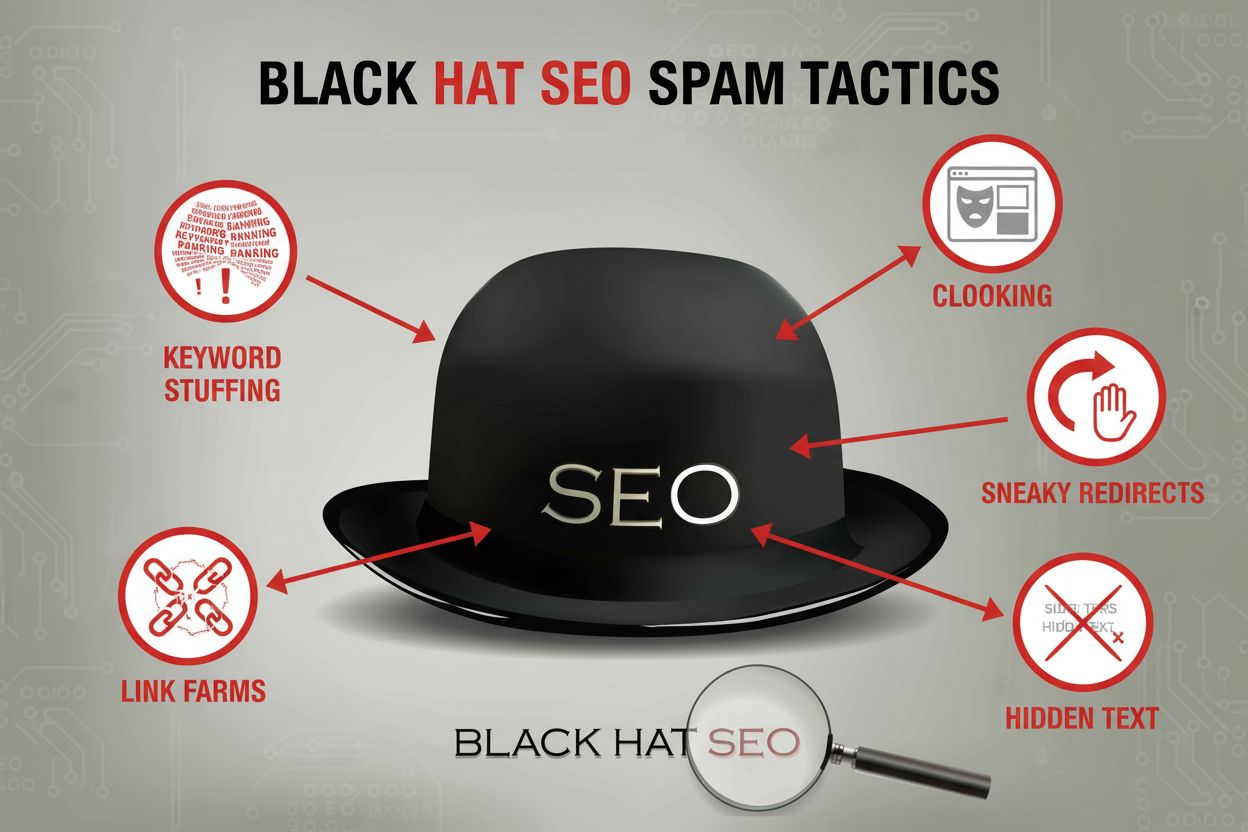
Search Engine Spam
Learn what search engine spam is, including black hat SEO tactics like keyword stuffing, cloaking, and link farms. Understand how Google detects spam and the pe...
10 min read

Cloaking is a deceptive black-hat SEO technique where different content is presented to search engines than to human users, with the intent to manipulate search rankings and mislead both algorithms and visitors. This practice violates search engine guidelines and can result in severe penalties including deindexation.
Cloaking is a deceptive black-hat SEO technique where different content is presented to search engines than to human users, with the intent to manipulate search rankings and mislead both algorithms and visitors. This practice violates search engine guidelines and can result in severe penalties including deindexation.
Cloaking is a deceptive black-hat SEO technique where a website presents different content or URLs to search engine crawlers than it displays to human users. The primary goal of cloaking is to manipulate search engine rankings by showing optimized, keyword-rich content to bots while serving entirely different or inferior content to actual visitors. This practice directly violates search engine guidelines, particularly Google’s Webmaster Guidelines, and represents one of the most serious violations in the SEO landscape. The term “cloaking” itself refers to the act of concealing or disguising the true nature of a webpage’s content, making it appear more relevant to search algorithms than it actually is to real users. When implemented, cloaking typically involves server-side detection mechanisms that identify whether a request originates from a search engine crawler or a human browser, then conditionally serve different responses based on this identification.
Cloaking emerged in the early 2000s as one of the first widespread black-hat SEO techniques, gaining prominence during the era when search engine algorithms were less sophisticated and detection capabilities were limited. Early practitioners discovered that by serving keyword-stuffed, optimized content to Googlebot while showing clean, user-friendly pages to visitors, they could achieve higher rankings without the effort of creating genuinely valuable content. This technique became particularly popular among spammers, adult content sites, and gambling websites seeking quick ranking gains. However, as search engines evolved and developed more advanced detection algorithms, cloaking became increasingly risky. By the mid-2010s, Google had significantly improved its ability to identify cloaking through advanced crawl simulations and machine learning models. A landmark 2012 study by researchers at UC San Diego found that roughly 35% of cloaked search results employed pure user-agent cloaking, demonstrating the technique’s prevalence at that time. Today, cloaking remains far less common due to stricter penalties and better detection, though emerging threats like AI-targeted cloaking have created new variations of this deceptive practice.
Cloaking operates through server-side detection and conditional content delivery, leveraging several technical signals to differentiate between search engine crawlers and human users. The most common detection methods include user-agent analysis, where the server examines the user-agent string sent by the requesting client to identify known search engine bots like Googlebot, Bingbot, or Slurp. Another prevalent mechanism is IP-based detection, which identifies the IP address of the visitor and compares it against known IP ranges belonging to major search engines. The server can also examine HTTP headers, including the Accept-Language header, Referer header, and other request metadata to make routing decisions. Once the server determines whether the request comes from a crawler or a user, it executes conditional logic to serve different content versions. For example, a cloaked site might serve a page filled with target keywords and optimized metadata to Googlebot, while simultaneously serving an image gallery or completely unrelated content to human visitors accessing the same URL. Some sophisticated implementations use JavaScript-based cloaking, where minimal content loads initially for users, but search engines receive pre-rendered HTML containing full, optimized content. Others employ redirect-based cloaking, using HTTP redirects or meta-refresh tags to send crawlers to one URL while redirecting users to another entirely different page.
User-Agent Cloaking represents the most common form of cloaking, accounting for approximately 35% of detected cloaked sites according to research. This technique detects the user-agent string—a text identifier that browsers and crawlers send with every request—and serves different content based on whether the user-agent belongs to a known search engine bot. For instance, a site might detect “Googlebot” in the user-agent string and serve an optimized page, while serving a different version to Chrome, Firefox, or Safari browsers. IP-Based Cloaking identifies the visitor’s IP address and compares it against known IP ranges used by search engines. When a request originates from a search engine’s IP range, the server delivers optimized content; otherwise, it serves alternative content. This method is particularly deceptive because it can target specific competitors’ IPs, showing them different content than what appears in search results. Hidden Text and Links involve using CSS or JavaScript to conceal keyword-rich text or links from users while keeping them visible to crawlers. Developers might match text color to background color, position text off-screen, or use display:none CSS properties to hide content. HTTP Accept-Language Cloaking examines the language preference header in HTTP requests to distinguish crawlers from users, serving localized or optimized content based on language signals. Doorway Pages are thin, keyword-optimized pages designed specifically to rank for particular search queries, which then redirect users to a different, unrelated page. CNAME Cloaking (DNS cloaking) uses DNS records to disguise third-party domains as first-party domains, allowing trackers to collect data while appearing to be part of the legitimate site. Referrer-Based Cloaking alters content based on the referring website, showing different versions to users coming from search results versus those arriving directly or from other sources.
| Aspect | Cloaking | Prerendering | Flexible Sampling | Progressive Enhancement | Personalization |
|---|---|---|---|---|---|
| Intent | Deceptive manipulation | Legitimate optimization | Transparent access | User experience improvement | User-focused customization |
| Content to Crawlers | Different/optimized | Same as users | Full access to content | Core content accessible | Base content identical |
| Content to Users | Different/inferior | Same as crawlers | Same as crawlers | Enhanced experience | Customized but transparent |
| Search Engine Compliance | Violates guidelines | Compliant | Compliant | Compliant | Compliant |
| Detection Risk | High/inevitable | None | None | Low | None |
| Penalty Risk | Severe (deindexation) | None | None | None | None |
| Use Case | Spam/manipulation | JavaScript sites | Paywalled content | Dynamic content | User preferences |
| Recovery Difficulty | Months/years | N/A | N/A | N/A | N/A |
Despite the well-documented penalties and detection risks, some website owners continue to employ cloaking for several reasons. Quick fixes for technical limitations represent a primary motivation—sites with heavy reliance on JavaScript, Flash, or image-heavy layouts sometimes use cloaking to show crawlers a text-based version while users see the visual design. Rather than properly optimizing JavaScript rendering or restructuring content, cloaking offers a shortcut that appears to solve the problem temporarily. Ranking manipulation drives another significant portion of cloaking usage, where site owners deliberately serve keyword-stuffed, optimized content to search engines while showing different content to users, attempting to achieve rankings they haven’t earned through legitimate optimization. Malicious activity concealment occurs when hackers compromise websites and use cloaking to hide redirects, malware, or phishing attempts from site owners and security scanners while still deceiving users. Competitive advantage seeking motivates some practitioners who believe they can outrank competitors by showing search engines artificially optimized content. Lack of awareness about penalties and detection capabilities leads some site owners to implement cloaking without fully understanding the consequences. Research from UC San Diego’s 2012 study revealed that nearly 45% of cloaked sites remained active even after three months of observation, suggesting that some operators believe they can evade detection indefinitely.
Search engines impose severe penalties on websites caught using cloaking, with consequences ranging from ranking loss to complete deindexation. Algorithmic penalties occur automatically when search engine algorithms detect cloaking signals, resulting in significant ranking drops across affected pages or the entire domain. These penalties can manifest within days of detection and often persist for months even after the cloaking is removed. Manual actions involve direct human review by Google’s spam team, which can result in even harsher penalties than algorithmic detection. When Google issues a manual action for cloaking, the affected site receives a notification in Google Search Console, and recovery requires submitting a reconsideration request with detailed evidence of corrections. Full deindexation represents the most severe consequence, where Google removes the entire website from its search index, effectively erasing all organic visibility. Sites that have been deindexed often struggle to regain trust and may need to migrate to a new domain to recover. Domain-wide impact means that penalties often affect not just individual pages but the entire domain, damaging rankings across all keywords and queries. Brand reputation damage extends beyond search rankings—users who discover they’ve been deceived by cloaking lose trust in the brand, leading to increased bounce rates, negative reviews, and long-term credibility loss. Traffic collapse follows deindexation or severe ranking drops, with affected sites experiencing 80-95% traffic loss within weeks. Recovery from cloaking penalties typically requires 6-12 months of consistent, compliant optimization work, and some sites never fully recover their previous rankings.
Detecting cloaking requires comparing content served to search engines with content visible to users through multiple testing methods and tools. Manual comparison involves visiting a page in a regular browser, then checking what Googlebot sees using Google Search Console’s URL Inspection tool or the Fetch as Google feature. Significant discrepancies between these two views indicate potential cloaking. Automated cloaking detection tools like SiteChecker and DupliChecker analyze pages using multiple user-agents and IP addresses, flagging hidden text, suspicious redirects, and content mismatches. Server log analysis reveals patterns in how the server responds to different user-agents and IP addresses, with cloaking typically showing distinct response patterns for crawler vs. user requests. SERP snippet comparison involves checking whether the meta description and title tag in search results actually appear on the live page—mismatches suggest cloaking. Crawl monitoring tools track how search engines interact with your site, identifying sudden indexing changes, blocked resources, or unusual crawler behavior. Security audits detect unauthorized cloaking caused by hacked websites, identifying injected redirects, malware, or hidden content. Google Search Console monitoring alerts site owners to manual actions, indexing issues, and coverage problems that might indicate cloaking. Regular content audits comparing cached versions of pages with current live versions can reveal when content has been altered specifically for crawlers.
A critical emerging threat involves AI-targeted cloaking, where websites serve different content specifically to AI crawlers and language models like ChatGPT, Perplexity, Claude, and Google’s AI Overviews. Recent research from SPLX in 2025 exposed how AI-targeted cloaking can deceive AI browsers into citing false information, poisoning AI training data and generating misinformation at scale. This represents a significant challenge for platforms like AmICited that monitor brand and domain appearances in AI-generated responses. AI-targeted cloaking works by detecting the user-agent strings of AI crawlers and serving them misleading or fabricated content while showing legitimate content to regular users. This allows bad actors to manipulate what AI systems cite and recommend, creating a new vector for spreading misinformation. The threat is particularly concerning because AI systems are increasingly used for research, decision-making, and content generation, making them attractive targets for manipulation. Detection of AI-targeted cloaking requires specialized monitoring that compares content served to AI crawlers with content visible to human users, identifying inconsistencies that indicate deceptive practices. Organizations using AI monitoring tools need to be aware that cloaking can compromise the accuracy of AI citations and recommendations, making it essential to implement robust detection and verification mechanisms.
Organizations should implement comprehensive strategies to prevent cloaking and maintain search engine compliance. Transparent content delivery ensures that all users and crawlers receive identical or substantially similar content, with any variations being legitimate and disclosed. Proper JavaScript implementation uses progressive enhancement and server-side rendering to ensure core content is accessible to crawlers without requiring JavaScript execution. Structured data markup using Schema.org vocabulary helps search engines understand content without relying on visual presentation, reducing the temptation to cloak. Regular security audits identify unauthorized cloaking caused by hacked websites, with immediate remediation of any discovered vulnerabilities. Compliance monitoring involves regular checks using tools like Google Search Console, Screaming Frog, and cloaking detection services to ensure no cloaking is occurring. Staff training educates developers and content managers about cloaking risks and compliant alternatives for solving technical challenges. Documentation and policies establish clear guidelines prohibiting cloaking and specifying approved methods for content optimization. Third-party vendor vetting ensures that any external services, plugins, or tools don’t inadvertently implement cloaking. Incident response planning prepares organizations to quickly identify and remediate any cloaking discovered on their sites, minimizing penalty duration.
The future of cloaking detection will likely involve increasingly sophisticated machine learning models that can identify subtle content variations and deceptive patterns with greater accuracy. Search engines are investing heavily in advanced crawl simulation technology that renders pages exactly as users see them, making it nearly impossible to serve different content to crawlers. AI-powered anomaly detection will identify suspicious patterns in server responses, user-agent handling, and content delivery that indicate cloaking attempts. The emergence of AI-targeted cloaking as a distinct threat category will drive development of specialized detection tools focused on identifying content served specifically to AI crawlers. Blockchain-based verification systems may eventually provide cryptographic proof of content authenticity, making cloaking technically impossible. The integration of behavioral analysis into detection systems will identify sites that show patterns consistent with cloaking even if individual pages appear compliant. As AI systems become more central to information discovery and decision-making, the stakes for detecting and preventing cloaking will increase significantly. Organizations that proactively implement transparent, compliant content delivery practices will maintain competitive advantages in both traditional search and emerging AI search channels. The convergence of traditional SEO penalties and AI monitoring requirements means that cloaking will become even less viable as a strategy, with detection and consequences becoming more severe and immediate.
Cloaking deliberately hides content from search engines with deceptive intent, while legitimate personalization serves the same base content to all users and crawlers, with optional enhancements visible to specific audiences. Personalization is transparent and compliant; cloaking is deceptive and violates guidelines. Search engines can access and evaluate the full content in personalization, whereas cloaking intentionally prevents this access.
Search engines detect cloaking by comparing content served to crawlers with content visible to human users through advanced crawl simulations, machine learning algorithms, and cross-referencing SERP snippets with actual page content. They analyze user-agent strings, IP addresses, and server responses to identify inconsistencies. Modern detection systems flag sudden ranking changes, hidden text, suspicious redirects, and mismatches between metadata and body content.
The most common types include user-agent cloaking (detecting crawler identification strings), IP-based cloaking (serving different content based on visitor IP addresses), hidden text and links (using CSS or JavaScript to conceal content), and HTTP accept-language cloaking (detecting language headers). Research shows approximately 35% of detected cloaked sites use pure user-agent cloaking, making it the most prevalent method despite being easily detectable.
Yes, recovery is possible but requires extensive effort. Site owners must remove all cloaked content, restore identical content for users and crawlers, fix any security vulnerabilities, and submit a reconsideration request to Google with detailed evidence of corrections. Recovery typically takes months and requires ongoing monitoring to prevent recurrence. The process involves auditing all pages, implementing transparent optimization practices, and rebuilding search engine trust.
Cloaking poses a significant threat to AI monitoring platforms like AmICited by deceiving AI crawlers into citing false or misleading information. AI-targeted cloaking specifically serves different content to AI browsers (like OpenAI's Atlas) than to regular users, poisoning AI training data and causing misinformation. This emerging threat requires advanced detection to ensure AI systems cite accurate, authentic content rather than cloaked deceptive versions.
Research indicates that approximately 3% of websites utilize cloaking techniques, though detection rates vary by methodology. Studies show that roughly 35% of detected cloaked sites employ user-agent cloaking specifically. However, the prevalence has declined significantly since 2015 due to improved detection systems and harsher penalties, making cloaking far less common in 2025 than in previous years.
No legitimate uses exist for actual cloaking, but several compliant alternatives serve similar purposes: prerendering for JavaScript sites, flexible sampling for paywalled content, hreflang tags for international content, and progressive enhancement for dynamic pages. These methods provide transparent solutions without deceiving search engines, maintaining compliance with guidelines while solving technical challenges.
Start tracking how AI chatbots mention your brand across ChatGPT, Perplexity, and other platforms. Get actionable insights to improve your AI presence.
Learn what search engine spam is, including black hat SEO tactics like keyword stuffing, cloaking, and link farms. Understand how Google detects spam and the pe...
Learn what hidden text is in SEO, how search engines detect it, why it's penalized, and the difference between black-hat and white-hat hidden content practices.

Learn what keyword stuffing is, why it's harmful to SEO, how Google detects it, and best practices to avoid this black-hat tactic that damages rankings and user...
Cookie Consent
We use cookies to enhance your browsing experience and analyze our traffic. See our privacy policy.