
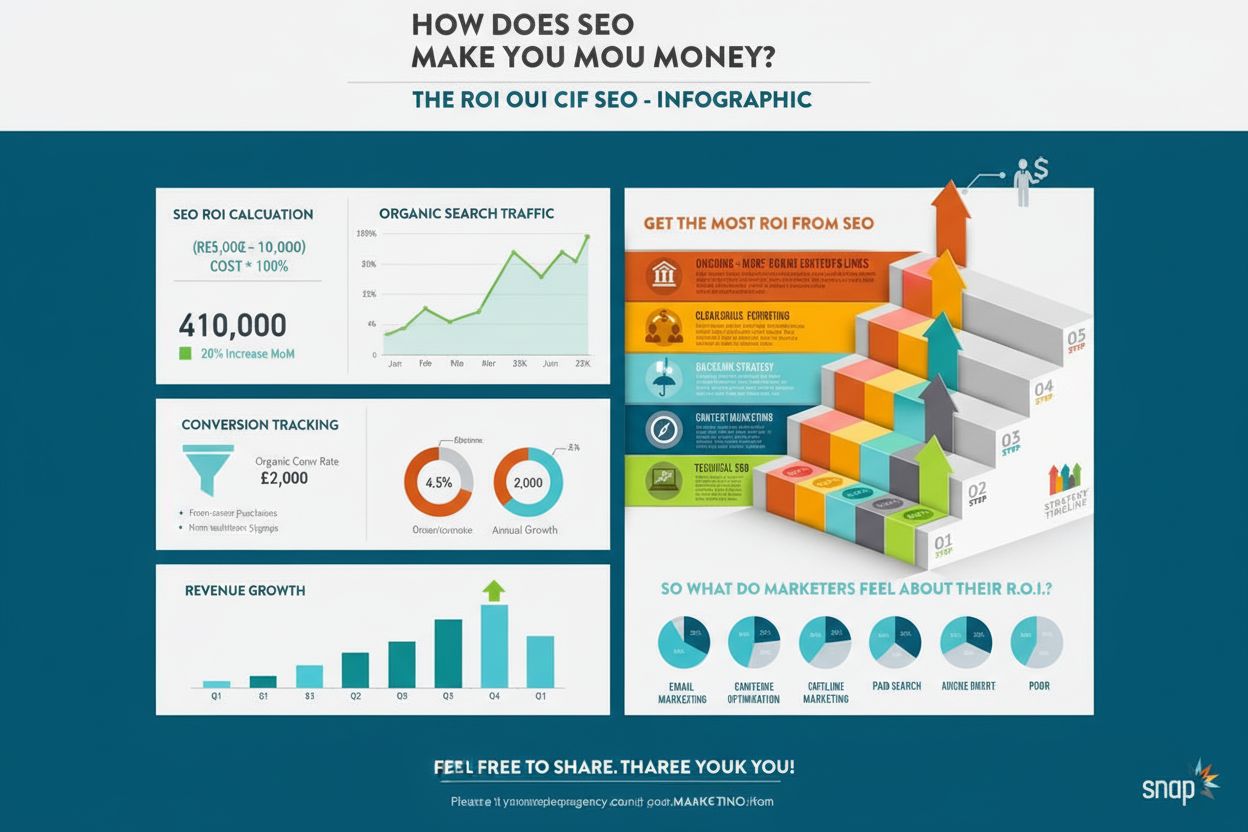
SEO ROI
SEO ROI measures revenue generated from search engine optimization compared to investment costs. Learn how to calculate, track, and optimize SEO return on inves...
10 min read

Content ROI (Return on Investment) is the measurable financial return generated from content marketing investments, calculated by dividing the profit generated by content by the total cost of creating and distributing that content. It demonstrates how much revenue or value is produced for every dollar spent on content marketing activities.
Content ROI (Return on Investment) is the measurable financial return generated from content marketing investments, calculated by dividing the profit generated by content by the total cost of creating and distributing that content. It demonstrates how much revenue or value is produced for every dollar spent on content marketing activities.
Content ROI (Return on Investment) is the measurable financial return generated from content marketing investments, calculated by dividing the profit produced by content by the total cost of creating and distributing that content. In essence, Content ROI quantifies how much revenue or value is produced for every dollar spent on content marketing activities. This metric has become indispensable for marketing leaders who must justify budget allocation and demonstrate the tangible business impact of content strategies. Unlike vanity metrics such as page views or social media followers, Content ROI directly connects content efforts to business outcomes, making it the gold standard for evaluating content marketing effectiveness. The formula—[(Revenue Generated - Total Investment Cost) / Total Investment Cost] × 100—provides a clear percentage that stakeholders can understand and act upon.
Content marketing has evolved dramatically over the past two decades, transforming from a peripheral marketing tactic into a central pillar of modern go-to-market strategies. In the early 2000s, content marketing was largely unmeasured, with companies publishing blog posts and whitepapers without clear attribution to revenue. The shift toward Content ROI measurement accelerated around 2010-2012 when marketing automation platforms emerged, enabling better tracking of content’s influence on lead generation and sales. Today, 83% of marketing leaders prioritize ROI demonstration, yet only 36% of marketers can accurately measure it, revealing a significant gap between aspiration and execution. This measurement challenge has created competitive advantages for organizations that master Content ROI tracking, as they can allocate budgets more effectively and scale high-performing content types. The rise of AI-driven analytics and attribution platforms is now democratizing sophisticated Content ROI measurement, allowing even smaller organizations to compete with enterprise-level content programs.
Organizations that systematically measure Content ROI unlock several critical advantages. First, Content ROI measurement enables data-driven budget allocation—companies can identify which content types, topics, and distribution channels generate the highest returns and concentrate resources accordingly. Second, Content ROI data provides powerful justification for continued or increased investment in content marketing, particularly important when competing for budget against paid advertising channels. Third, understanding Content ROI reveals which content strategies actually drive customer acquisition and retention, allowing teams to refine messaging and targeting. Research shows that content marketing generates $3 for every $1 invested, compared to just $1.80 for paid advertising, representing a 67% performance advantage. Additionally, content marketing costs 62% less than traditional marketing while generating 3x more leads, making Content ROI particularly attractive for resource-constrained organizations. Companies blogging consistently achieve 13x higher ROI than sporadic publishers, demonstrating that consistency and discipline directly impact Content ROI performance.
The fundamental Content ROI formula is straightforward: [(Revenue Generated - Total Investment Cost) / Total Investment Cost] × 100. However, accurate calculation requires comprehensive cost accounting that many organizations overlook. Total Investment Cost includes obvious expenses like freelancer fees and content tool subscriptions, but also less visible costs such as employee salaries for content creation, design, editing, and distribution. Distribution costs encompass paid promotion across social media, email marketing platforms, and advertising networks. Many organizations underestimate Content ROI by excluding these indirect costs, artificially inflating their returns. Conversely, some organizations overstate costs by including overhead expenses not directly attributable to content. The Revenue Generated component presents even greater complexity, particularly in B2B environments with extended sales cycles. Should you count only direct revenue from content-influenced deals, or include assisted conversions where content played a supporting role? This attribution question fundamentally shapes Content ROI calculations and often requires sophisticated multi-touch attribution models to answer accurately.
Measuring Content ROI effectively requires tracking multiple interconnected metrics that collectively reveal content’s business impact. Conversion Rate—the percentage of visitors completing desired actions—directly indicates content’s persuasiveness, with typical content marketing conversion rates falling between 1.5-3%. Customer Acquisition Cost (CAC) measures the total expense of acquiring each customer through content, which when combined with customer revenue reveals Content ROI at the customer level. Customer Lifetime Value (CLV) captures the total revenue a customer generates throughout their relationship with your brand, essential for understanding content’s long-term value. Bounce Rate (ideally 40% or lower) indicates content relevance and engagement quality. Organic Traffic Growth demonstrates content’s ability to attract visitors through search engines, with successful content strategies showing 5% month-over-month growth. Lead Generation Volume tracks how many qualified prospects content produces, while Revenue Attribution connects specific content pieces to closed deals. Social Shares (typically 5-15% for blog posts) indicate content resonance with audiences. These metrics work together to paint a comprehensive picture of Content ROI, with no single metric telling the complete story.
| Metric | Definition | Timeframe | Measurement Complexity | Direct Revenue Link |
|---|---|---|---|---|
| Content ROI | Profit from content divided by content investment cost | 3-6 months to mature | High (requires attribution) | Direct and assisted |
| Marketing ROI | Return from all marketing activities combined | Varies by channel | Medium (channel-specific) | Direct and assisted |
| Cost Per Lead (CPL) | Total marketing spend divided by leads generated | Immediate | Low (straightforward) | Indirect (lead quality varies) |
| Customer Acquisition Cost (CAC) | Total cost to acquire one customer | 3-6 months | Medium (requires sales data) | Direct (customer revenue) |
| Conversion Rate | Percentage of visitors completing desired action | Immediate | Low (analytics-based) | Indirect (depends on action value) |
| Customer Lifetime Value (CLV) | Total revenue from customer over relationship | 12+ months | High (requires historical data) | Direct (actual revenue) |
| Engagement Metrics | Pageviews, time on page, bounce rate | Immediate | Low (analytics-based) | Indirect (engagement ≠ revenue) |
| Brand Awareness Lift | Increase in brand recognition from content | 6-12 months | High (requires surveys/studies) | Indirect (long-term value) |
Content ROI operates differently across various distribution channels and platforms, requiring channel-specific measurement approaches. SEO-driven content generates exceptional Content ROI of 748% for B2B companies, with returns compounding over time as rankings improve and organic traffic grows exponentially. This long-tail benefit means SEO content continues generating returns years after publication, making its true Content ROI difficult to capture in short-term measurements. Email marketing, when powered by quality content, achieves $42 ROI per dollar spent, with 77% of email Content ROI originating from segmented, triggered campaigns rather than broadcast messages. Video content delivers Content ROI 49% faster than text, making it essential for companies needing quicker returns, though production costs are typically higher. Social media content shows more variable Content ROI depending on platform and audience, with LinkedIn delivering 2.7x higher conversion rates for B2B compared to other platforms. Paid content promotion (boosting posts, sponsored content) accelerates Content ROI realization but adds distribution costs that must be factored into calculations. Understanding these platform-specific dynamics allows organizations to optimize Content ROI by matching content types to platform strengths and business timeline requirements.
One of the most significant challenges in measuring Content ROI stems from attribution complexity in modern buyer journeys. Traditional last-click attribution credits only the final touchpoint before conversion, dramatically undervaluing content’s true influence. Research shows that first-touch attribution reveals content initiates 67% of B2B buyer journeys, yet last-click models might attribute those conversions to sales emails or product demos. Multi-touch attribution distributes credit across all content touchpoints in the buyer journey, revealing 23% more attributed revenue than last-click models. This attribution gap means organizations using basic analytics significantly underestimate Content ROI and may make poor budget allocation decisions based on incomplete data. Advanced attribution platforms can track content influence across channels and timeframes, but implementation requires proper tracking infrastructure, CRM integration, and often expert consulting. The complexity explains why only 36% of marketers accurately measure Content ROI—most lack the technical infrastructure and analytical sophistication required for precise attribution. Companies investing in attribution technology gain competitive advantages through better understanding of which content truly drives revenue.
The emergence of AI-powered search and content discovery systems introduces new dimensions to Content ROI measurement that traditional analytics cannot capture. When content appears in AI-generated responses on platforms like Perplexity, ChatGPT, Google AI Overviews, and Claude, it influences user decisions without generating traditional website traffic or conversions. This AI citation impact represents a new form of Content ROI that organizations must monitor and measure. Content that ranks well in AI systems may drive brand awareness and authority without immediate conversion attribution, requiring expanded Content ROI frameworks that account for AI visibility. Additionally, 80% of marketers now use AI tools for content creation, with users reporting 88% efficiency improvements, fundamentally changing the cost side of Content ROI calculations. AI-generated content reduces production costs by 65%, allowing organizations to test more content variations and scale successful formats faster, directly improving Content ROI through increased content velocity. However, AI-generated content quality varies significantly, and poor-quality content can damage Content ROI through low engagement and conversion rates. Organizations must balance AI’s efficiency gains against quality requirements to optimize Content ROI in the AI era.
Understanding Content ROI benchmarks provides context for evaluating your organization’s performance, though benchmarks should serve as reference points rather than absolute targets. A 5:1 Content ROI (500%) is considered strong across industries, while anything below 2:1 (200%) indicates poor performance requiring strategy adjustment. B2B marketing averages 5:1 ROI across all channels, with content marketing at 3:1 being respectable given its long-term compound value and brand-building effects. However, SEO-focused content achieves 748% ROI for B2B companies, demonstrating that content type dramatically impacts Content ROI benchmarks. Video content delivers ROI 49% faster than text, making it essential for companies needing quicker returns. Email marketing achieves $42 ROI per dollar, making it the highest-returning channel when powered by quality content. Successful brands achieve median 4.33:1 revenue returns, providing realistic targets for well-executed content strategies. Industry-specific benchmarks vary significantly—SaaS companies often achieve higher Content ROI than traditional industries due to lower customer acquisition costs and higher customer lifetime values. Rather than chasing benchmarks, organizations should establish baseline Content ROI measurements, track improvements over time, and compare performance against their own historical data and direct competitors.
Organizations seeking to improve Content ROI should implement systematic optimization practices grounded in data analysis. First, establish clear measurement frameworks before launching content initiatives, defining which metrics matter most and how you’ll track them. Second, implement proper attribution infrastructure including CRM integration, marketing automation platforms, and analytics tools that can track content influence across touchpoints. Third, conduct regular content audits analyzing which pieces generate highest Content ROI and why, then replicate successful patterns. Fourth, optimize for high-intent keywords and topics that attract prospects closer to purchase decisions, improving conversion rates and Content ROI. Fifth, repurpose high-performing content across multiple formats and channels, multiplying original investment returns. Sixth, implement A/B testing on content elements like headlines, calls-to-action, and formats to identify optimization opportunities. Seventh, focus on content velocity and consistency—companies blogging consistently achieve 13x higher Content ROI than sporadic publishers. Eighth, leverage AI tools for content creation and optimization to reduce costs while maintaining quality. Ninth, align content with buyer journey stages, ensuring content addresses prospect needs at each stage rather than generic messaging. Tenth, establish feedback loops where sales teams report which content most influenced deals, informing future content strategy.
The definition and measurement of Content ROI continues evolving as marketing technology, AI capabilities, and buyer behavior change. AI-driven content operations are becoming standard, with 80% of marketers adopting AI tools and expecting continued efficiency improvements. This shift will fundamentally alter Content ROI calculations as production costs decline and content velocity increases, allowing organizations to test more variations and scale winners faster. Zero-click content strategies are emerging as search engines display more answers directly in results, requiring Content ROI frameworks that capture value from brand impressions and authority building beyond traditional traffic metrics. Answer engine optimization for AI systems like Perplexity and Claude will become critical for Content ROI measurement, as content visibility in AI responses drives brand awareness and authority. First-party data strategies will enable more sophisticated attribution and Content ROI measurement as third-party cookies disappear. Personalization at scale powered by AI will improve content relevance and conversion rates, directly boosting Content ROI. Content operations at scale will become standard practice, with dedicated teams managing content production, distribution, and measurement systematically. Organizations that master Content ROI measurement and optimization in this evolving landscape will gain significant competitive advantages, as content marketing’s importance continues growing—the industry is projected to reach $1.8 trillion by 2034, indicating sustained confidence in content’s business impact.
+++
B2B companies typically achieve an average Content ROI of 3:1, meaning $3 in revenue for every $1 invested in content marketing. However, when executed with proper SEO strategies, returns can reach 748% ROI. These returns usually materialize over 3-6 months, requiring patience and consistent execution. Leading companies using programmatic SEO and systematic content operations often exceed these benchmarks significantly.
The basic Content ROI formula is: [(Revenue Generated - Total Investment Cost) / Total Investment Cost] × 100. Total investment includes content creation costs, distribution expenses, marketing tools, and employee salaries. Accurate measurement requires tracking all direct and indirect costs against revenue specifically driven by content touchpoints. Many organizations understate costs by excluding employee time or overstate returns by attributing all organic revenue to content without proper attribution.
Critical metrics include conversion rates (percentage of visitors completing desired actions), customer acquisition cost (CAC), customer lifetime value (CLV), organic traffic growth, lead generation volume, and revenue attribution. Additionally, track engagement metrics like bounce rate, time on page, and social shares. Multi-touch attribution reveals content's true influence across buyer journeys, often showing 23% more attributed revenue than last-click models.
Content ROI measurement challenges stem from attribution complexity in multi-touch buyer journeys where prospects consume multiple content pieces before converting. Unlike single-click paid ads, content influences decisions across extended timeframes through various touchpoints. Only 36% of marketers can accurately measure content ROI, and 47% struggle with multi-channel attribution. Proper measurement demands sophisticated tracking systems and integration between CRM, analytics, and marketing automation platforms.
Video content delivers ROI 49% faster than text-based content, while long-form SEO content provides the highest long-term returns at 748% ROI for B2B companies. Email marketing achieves exceptional $42 ROI per dollar spent when powered by quality content. Consistent blogging delivers 13x higher ROI than sporadic publishing. The optimal mix depends on growth timeline needs—video for faster engagement, SEO content for sustained organic growth, and triggered email campaigns for immediate conversions.
AI adoption has reached 80% among global marketers, with users reporting 88% increased efficiency in content production and 84% faster content delivery. AI-powered attribution tools reveal 2x higher content influence than basic analytics, while AI-generated content reduces production costs by 65%. These efficiency gains translate directly to improved ROI through faster testing cycles, better optimization, and ability to scale successful content formats. Companies not adopting AI tools forfeit significant productivity advantages.
A Content ROI of 5:1 (500%) is considered strong, while anything below 2:1 (200%) indicates poor performance. B2B marketing averages 5:1 ROI across all channels, with content marketing at 3:1 being respectable given its long-term compound value. However, benchmarks serve as reference points rather than absolute targets—every business has unique dynamics. Leading SaaS companies often exceed benchmarks significantly through systematic execution and measurement discipline.
Start tracking how AI chatbots mention your brand across ChatGPT, Perplexity, and other platforms. Get actionable insights to improve your AI presence.
SEO ROI measures revenue generated from search engine optimization compared to investment costs. Learn how to calculate, track, and optimize SEO return on inves...
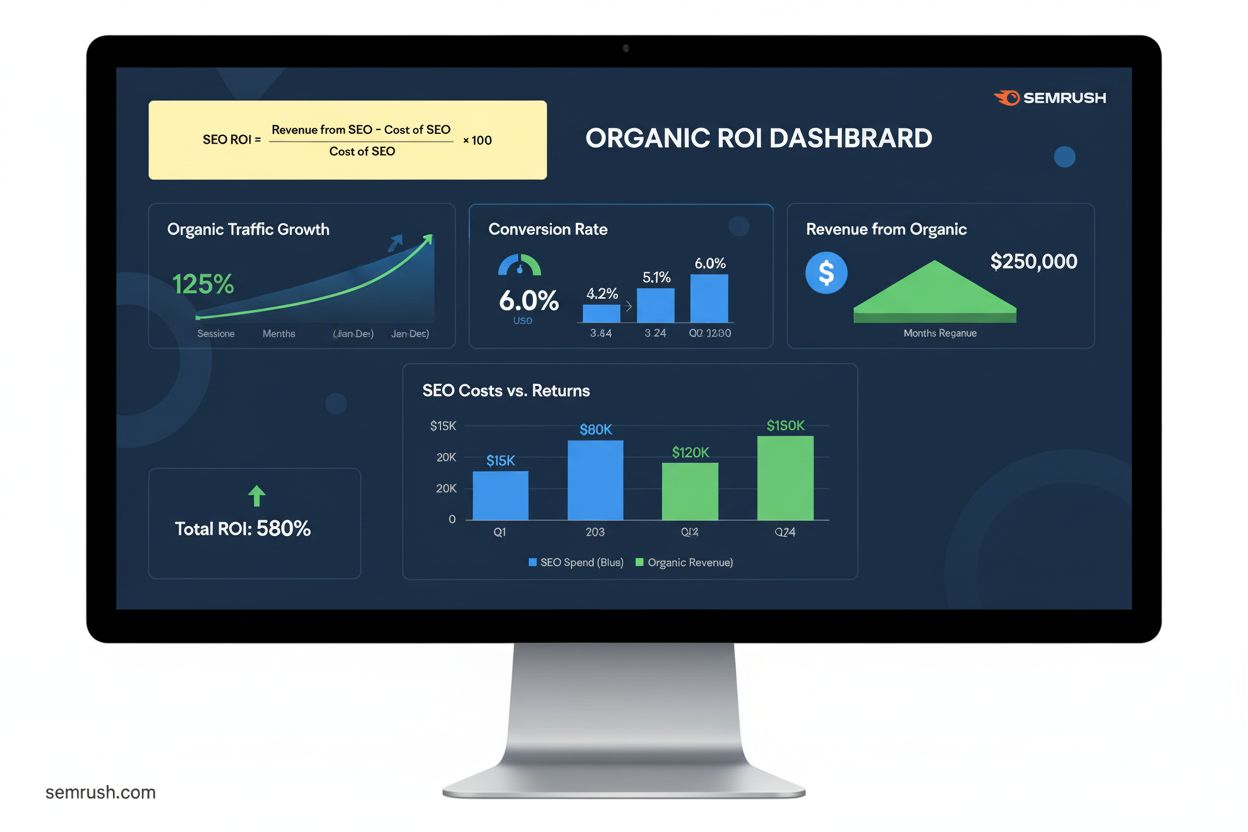
Organic ROI measures financial returns from SEO efforts versus investment costs. Learn how to calculate, track, and optimize organic search return on investment...
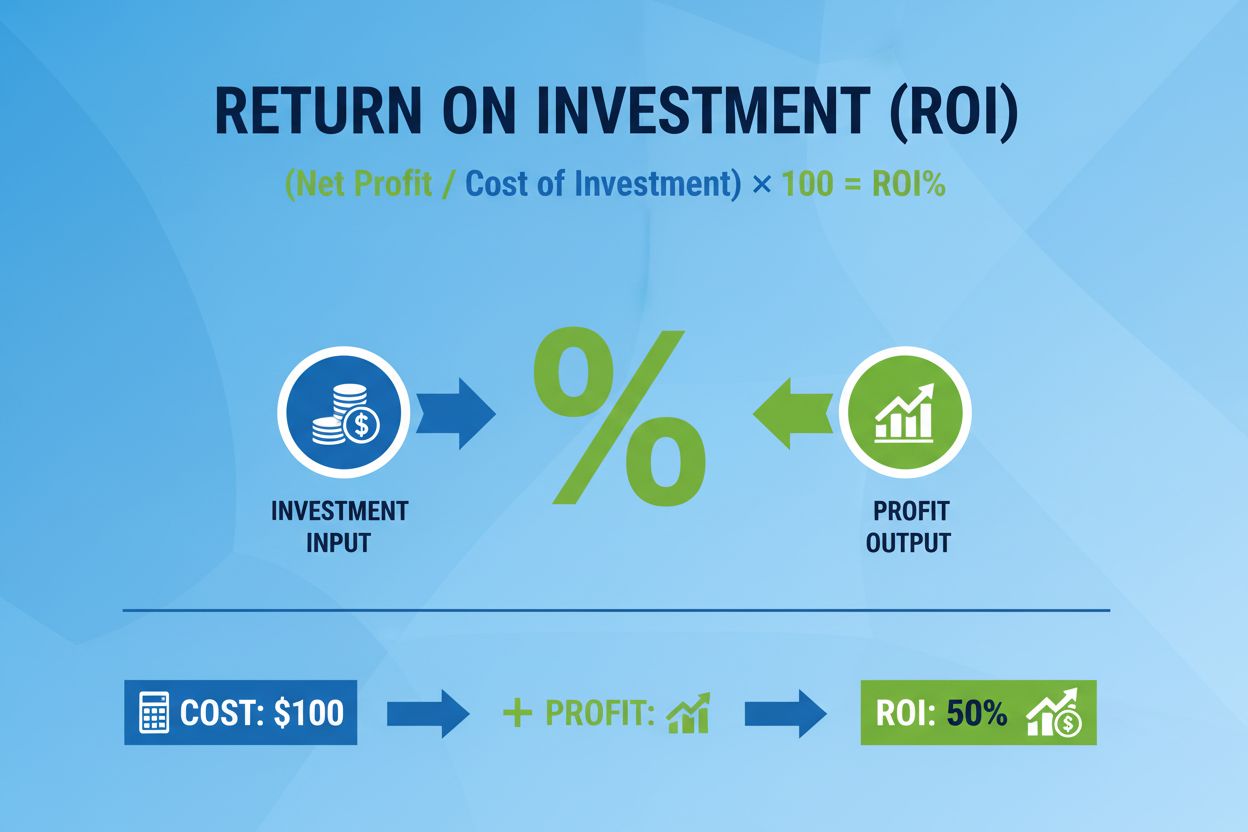
Learn what ROI (Return on Investment) means, how to calculate it, and why it matters for measuring investment profitability. Comprehensive guide with formulas a...
Cookie Consent
We use cookies to enhance your browsing experience and analyze our traffic. See our privacy policy.