


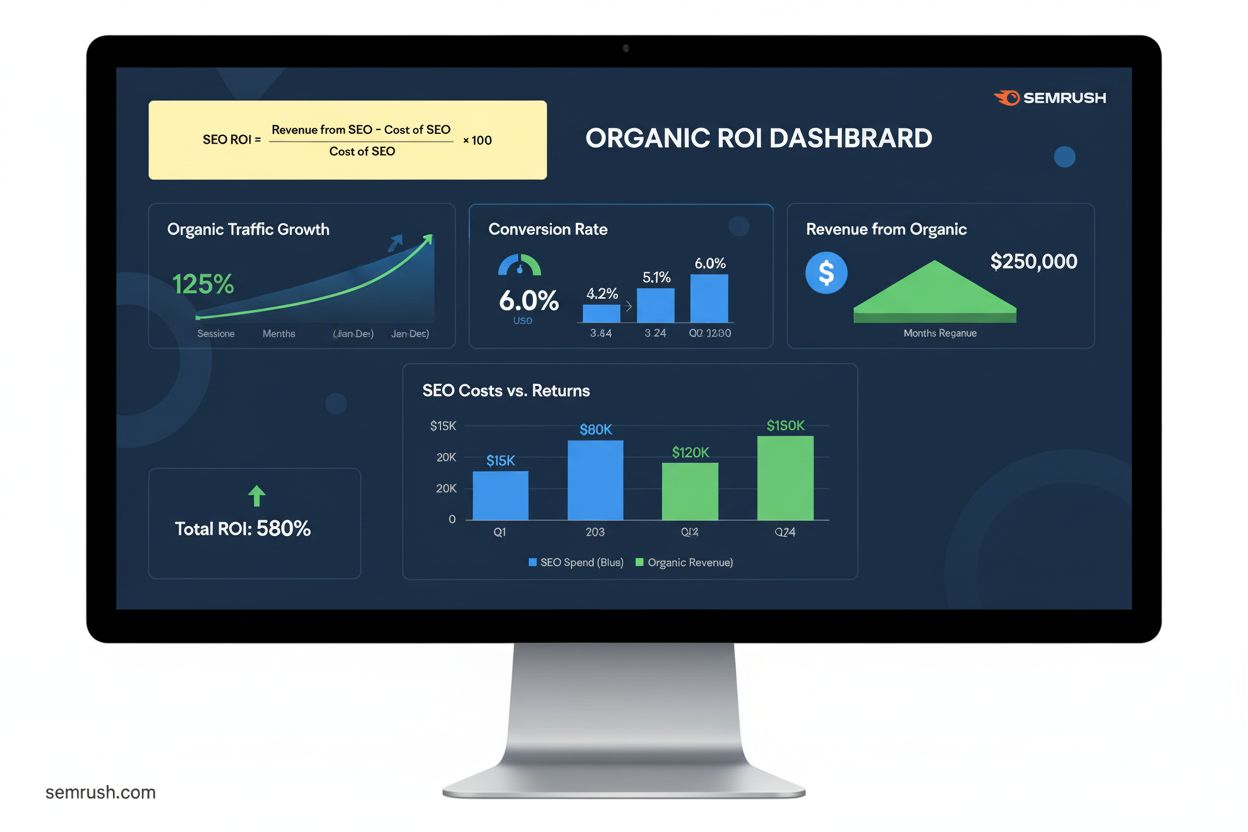
Organic ROI
Organic ROI measures financial returns from SEO efforts versus investment costs. Learn how to calculate, track, and optimize organic search return on investment...
11 min read
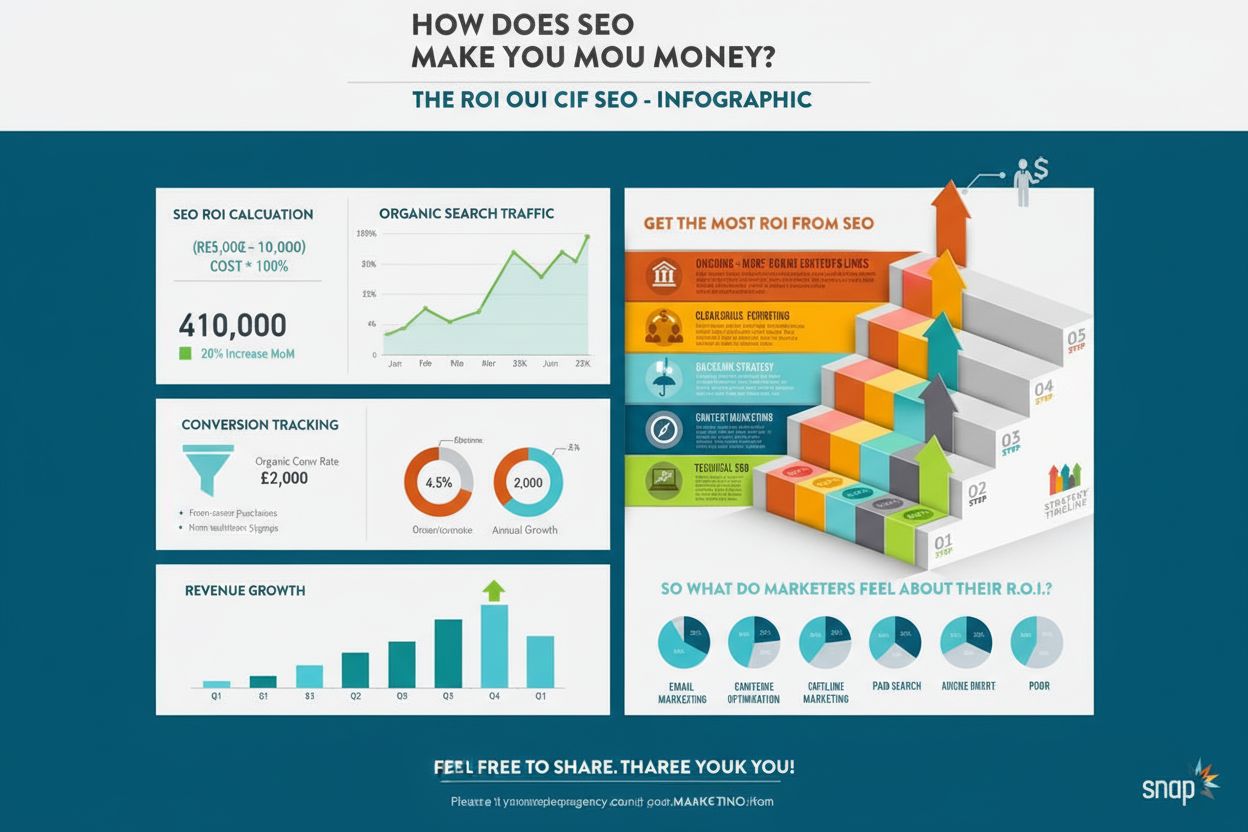
SEO ROI (Return on Search Engine Optimization) measures the financial return generated from SEO investments compared to their costs, calculated using the formula: (Revenue from SEO - SEO Costs) / SEO Costs × 100. It quantifies how much profit a business generates for every dollar spent on organic search optimization efforts.
SEO ROI (Return on Search Engine Optimization) measures the financial return generated from SEO investments compared to their costs, calculated using the formula: (Revenue from SEO - SEO Costs) / SEO Costs × 100. It quantifies how much profit a business generates for every dollar spent on organic search optimization efforts.
SEO ROI (Return on Search Engine Optimization) is a financial metric that measures the profit generated from search engine optimization investments relative to their costs. Expressed as a percentage, SEO ROI quantifies how much revenue a business generates for every dollar spent on organic search optimization efforts. The calculation follows a straightforward formula: (Revenue from SEO - SEO Costs) / SEO Costs × 100. This metric serves as a critical performance indicator for businesses seeking to justify SEO budgets, allocate resources effectively, and demonstrate the tangible business value of organic search strategies. Unlike vanity metrics such as keyword rankings or impressions, SEO ROI directly ties optimization efforts to revenue generation, making it the ultimate measure of SEO profitability and success.
Measuring SEO ROI has become increasingly important as businesses face pressure to demonstrate marketing effectiveness and justify budget allocations. According to industry research, 49% of marketers credit organic search with delivering the highest returns compared to other marketing channels, and organic search generates approximately 40% of business revenue for many organizations. This data underscores why understanding SEO ROI is essential for strategic decision-making. By calculating SEO ROI, businesses can identify which SEO tactics generate the highest returns, make data-driven decisions about resource allocation, and communicate success to stakeholders and leadership teams. Furthermore, SEO ROI enables benchmarking against competitors, revealing whether your organic search performance is outpacing or lagging behind industry standards. The ability to prove positive SEO ROI significantly strengthens arguments for continued investment in SEO initiatives and helps secure budget approvals for expanded optimization efforts.

Track how AI chatbots mention your brand across ChatGPT, Perplexity, and other platforms.
Calculating SEO ROI requires three fundamental steps: determining total SEO investment, tracking revenue generated from organic search, and applying the ROI formula. First, businesses must comprehensively account for all SEO-related costs, including agency or freelancer fees, in-house employee salaries dedicated to SEO work, content creation expenses, technical development costs, link-building investments, and software subscriptions. Many organizations underestimate their true SEO investment by overlooking internal labor costs; if a team member spends 10 hours weekly on SEO tasks, that time must be quantified at an hourly rate and included in the total cost calculation. Second, revenue attribution requires setting up proper tracking in Google Analytics 4 (GA4), which automatically categorizes purchases and conversions by traffic source. For ecommerce businesses, GA4 directly tracks transaction values from organic search. For lead-generation businesses, monetary values must be assigned to conversion goals like form submissions by calculating the average customer lifetime value multiplied by the lead conversion rate. Once both investment and revenue figures are established, the formula becomes straightforward: divide the net profit (revenue minus costs) by the total cost, then multiply by 100 to express the result as a percentage.
SEO ROI varies significantly across industries based on customer lifetime value, competition levels, and average transaction sizes. According to comprehensive industry data from 2021-2025, Real Estate leads with an average SEO ROI of 1,389% within less than a year, followed by Medical Device companies at 1,183% and Financial Services at 1,031%. Manufacturing sectors achieve approximately 813% SEO ROI, while B2B SaaS companies average 702%. Ecommerce businesses typically see lower SEO ROI at 317% due to lower average order values and higher competition. The type of SEO service also dramatically impacts ROI. Technical SEO campaigns—involving technical fixes, keyword research, and title tag optimization—achieve approximately 117% ROI in six months. Basic Content Marketing with standard keyword research and monthly blog articles generates only 16% ROI over 15 months. In contrast, Thought Leadership SEO campaigns, which involve strategic planning, high-quality content production, and focus on marketing KPIs, achieve approximately 748% ROI in less than a year. This variation demonstrates that the comprehensiveness and quality of SEO strategy directly influence ROI outcomes.
Get the latest insights on AI mentions, brand monitoring, and optimization strategies.
| Metric | SEO ROI | PPC ROI | Social Media ROI | Email Marketing ROI |
|---|---|---|---|---|
| Average 3-Year ROI | 702-1,389% (by industry) | 200-400% | 100-300% | 3,600-4,200% |
| Time to Break-Even | 6-14 months | 1-3 months | 3-6 months | 1-2 months |
| Traffic Sustainability | Continues after investment stops | Stops immediately | Requires ongoing engagement | Depends on list quality |
| Cost Per Click | $0.50-$5.00 (organic) | $1.00-$50.00 (paid) | $0.01-$0.10 | $0.001-$0.01 |
| Compounding Effect | Yes (grows over time) | No (linear) | Limited | Yes (list growth) |
| Attribution Complexity | High (multi-touch) | Low (last-click) | Medium | Low (direct) |
| Long-Term Value | Very High | Medium | Medium | High |
| Scalability | High (organic reach) | Limited (budget-dependent) | Medium | High (automation) |
Implementing proper SEO ROI tracking requires integrating multiple tools and establishing clear attribution pathways. Google Analytics 4 (GA4) serves as the foundation, automatically tracking organic search traffic and attributing conversions to the organic channel. For ecommerce platforms like Shopify, GA4 integrates directly to track purchase events and revenue. The setup involves creating a GA4 property, establishing a data stream for your website, obtaining your Measurement ID, and adding it to your website’s tracking code. For businesses with more complex conversion journeys, Google Tag Manager (GTM) enables tracking of micro-conversions—intermediate actions like adding items to cart, signing up for newsletters, or submitting contact forms—that precede final purchases. These micro-conversions provide early indicators of SEO success and help forecast future ROI. Additionally, businesses should implement conversion value tracking by assigning monetary values to each conversion type. For lead-generation businesses, this calculation uses the formula: Customer Lifetime Value × Lead Conversion Rate = Conversion Value. For example, if average customer lifetime value is $20,000 and your sales team converts 15% of leads, each lead should be valued at $3,000 in your analytics system.
Despite its importance, calculating and communicating SEO ROI presents several significant challenges that organizations must navigate. Attribution complexity represents the primary obstacle; customers typically interact with multiple marketing touchpoints before converting, making it difficult to isolate SEO’s specific contribution. A customer might discover your brand through organic search, later click a paid ad, and finally convert through email marketing—determining how much credit SEO deserves requires sophisticated attribution modeling. Time lag challenges also complicate SEO ROI measurement; while PPC campaigns generate immediate results, SEO typically requires 4-12 months before producing measurable revenue impact, making it difficult to justify investment to stakeholders expecting quick returns. Non-financial benefits of SEO—such as improved brand visibility, enhanced user experience, increased domain authority, and long-term competitive positioning—are difficult to quantify in dollar terms yet represent substantial value. Ongoing returns from past efforts create measurement complexity; successful SEO campaigns continue generating revenue from previously published content, making it challenging to calculate ROI for specific time periods. Additionally, industry and competitive variations mean that SEO ROI benchmarks differ dramatically across sectors, making it difficult to establish universal performance standards. Organizations must address these challenges by focusing on longer measurement periods (minimum 6-12 months), implementing proper attribution models, and communicating both quantitative ROI and qualitative benefits to stakeholders.
The emergence of AI search platforms like ChatGPT, Perplexity, Google AI Overviews, and Claude introduces new dimensions to SEO ROI measurement and optimization. Traditional SEO ROI calculations focused exclusively on Google organic search, but as AI systems increasingly influence search behavior and information discovery, businesses must expand their ROI tracking to include visibility across these platforms. AI visibility affects SEO ROI because brand mentions in AI-generated responses drive awareness, credibility, and traffic attribution differently than traditional search results. A business appearing in Google AI Overviews or ChatGPT responses gains exposure to users who may not click through to the website immediately but develop brand awareness that influences future purchasing decisions. This assisted conversion dynamic requires updated ROI models that account for AI-driven brand mentions as part of the customer journey. Furthermore, the rise of Generative Engine Optimization (GEO) strategies—specifically designed to improve visibility in AI search results—represents a new investment category that impacts overall SEO ROI calculations. Organizations must now track not only traditional organic search performance but also their presence across AI platforms, requiring more sophisticated monitoring tools and attribution frameworks. The integration of AI visibility metrics into SEO ROI calculations represents an evolution in how businesses measure search engine optimization effectiveness in an increasingly AI-driven information landscape.
Forecasting SEO ROI enables businesses to set realistic expectations, allocate budgets strategically, and identify optimization opportunities. Effective SEO ROI forecasting begins with analyzing historical performance data, including past traffic trends, conversion rates, and revenue attribution. Tools like Semrush’s Domain Overview and Traffic Analytics provide competitive benchmarking data, showing how your organic performance compares to competitors and revealing market opportunities. By examining competitor traffic patterns, keyword rankings, and content strategies, businesses can estimate their own traffic potential and forecast achievable ROI. Keyword research plays a crucial role in ROI forecasting; identifying high-value keywords with lower competition allows businesses to estimate traffic volume and conversion potential for new content initiatives. The payback period—the time required for SEO revenue to exceed investment costs—provides another critical forecasting metric. Industries with higher customer lifetime values and lower competition typically achieve faster payback periods; real estate and financial services often break even within 9-10 months, while legal services may require 14 months. To optimize SEO ROI, businesses should focus on high-intent keywords that indicate purchase readiness, prioritize content creation for keywords with lower difficulty scores but substantial search volume, and continuously monitor conversion rates by traffic source. Additionally, implementing conversion rate optimization (CRO) strategies—such as improving page load speed, enhancing user experience, and optimizing call-to-action elements—directly increases SEO ROI by improving the percentage of organic visitors who convert.
While SEO ROI serves as the ultimate profitability metric, several supporting KPIs provide insight into SEO performance and help predict future ROI outcomes. Organic traffic represents the volume of visitors arriving through search engines; tracking organic traffic trends reveals whether SEO efforts are successfully increasing visibility. Keyword rankings indicate progress toward visibility for target search terms; monitoring rankings for high-value keywords helps identify optimization opportunities and competitive threats. Conversion rate measures the percentage of organic visitors who complete desired actions (purchases, form submissions, sign-ups); improving conversion rates directly increases SEO ROI without requiring additional traffic investment. Cost per acquisition (CPA) from organic search shows the efficiency of converting organic visitors into customers; lower CPA indicates more efficient SEO ROI. Customer lifetime value (CLV) from organic search reveals the long-term profitability of organic customers; organic customers often have higher CLV than paid traffic customers due to higher intent and trust. Assisted conversions track instances where organic search contributed to conversions even if it wasn’t the final touchpoint; this metric reveals SEO’s full impact on the customer journey. Return on advertising spend (ROAS) for SEO—calculated as gross revenue divided by SEO costs—provides a direct comparison metric against PPC campaigns. By monitoring these supporting metrics alongside SEO ROI, businesses gain comprehensive insight into organic search performance and can make data-driven optimization decisions.
Consider a mid-size B2B SaaS company that spends $6,000 a month on SEO — a mix of a contractor’s retainer, content production, and a Semrush subscription — putting annual investment at $72,000, in line with the $2,500-$10,000 monthly range typical for comprehensive campaigns. At the start of the engagement, the marketing team sets up GA4 to track organic-channel form submissions as the primary conversion event, then assigns each lead a monetary value using the formula from the calculation section: Customer Lifetime Value × Lead Conversion Rate. Their CLV is $15,000 and their sales team converts 12% of qualified leads, so each organic lead is valued at $1,800 in the analytics dashboard. Over the first year, organic search delivered 340 qualified leads, worth $612,000 in modeled revenue against the $72,000 spend — an ROI of roughly 750%, which tracks closely with the 702% average reported for B2B SaaS and edges toward the 748% seen in thought-leadership-driven campaigns, since their strategy leaned heavily on original research content rather than generic blog posts. The team didn’t see meaningful returns until month seven, consistent with the 6-14 month payback window discussed earlier, which is why they tracked leading indicators — organic traffic growth and keyword ranking movement — during the first two quarters instead of judging the campaign on revenue alone before enough data had accumulated.
Start tracking how AI chatbots mention your brand across ChatGPT, Perplexity, and other platforms. Get actionable insights to improve your AI presence.
Organic ROI measures financial returns from SEO efforts versus investment costs. Learn how to calculate, track, and optimize organic search return on investment...

Content ROI measures the financial return from content marketing investments. Learn how to calculate, track, and optimize content ROI with metrics, formulas, an...
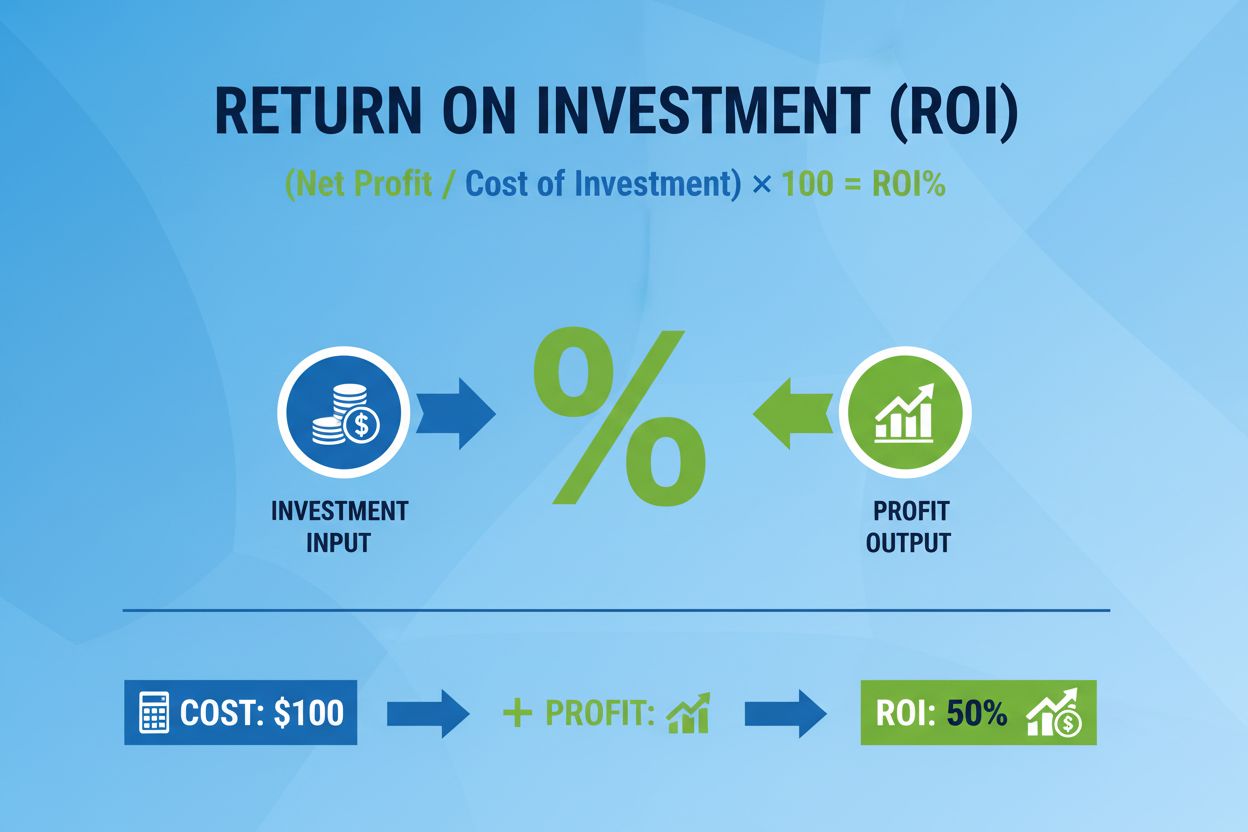
Learn what ROI (Return on Investment) means, how to calculate it, and why it matters for measuring investment profitability. Comprehensive guide with formulas a...
Cookie Consent
We use cookies to enhance your browsing experience and analyze our traffic. See our privacy policy.