
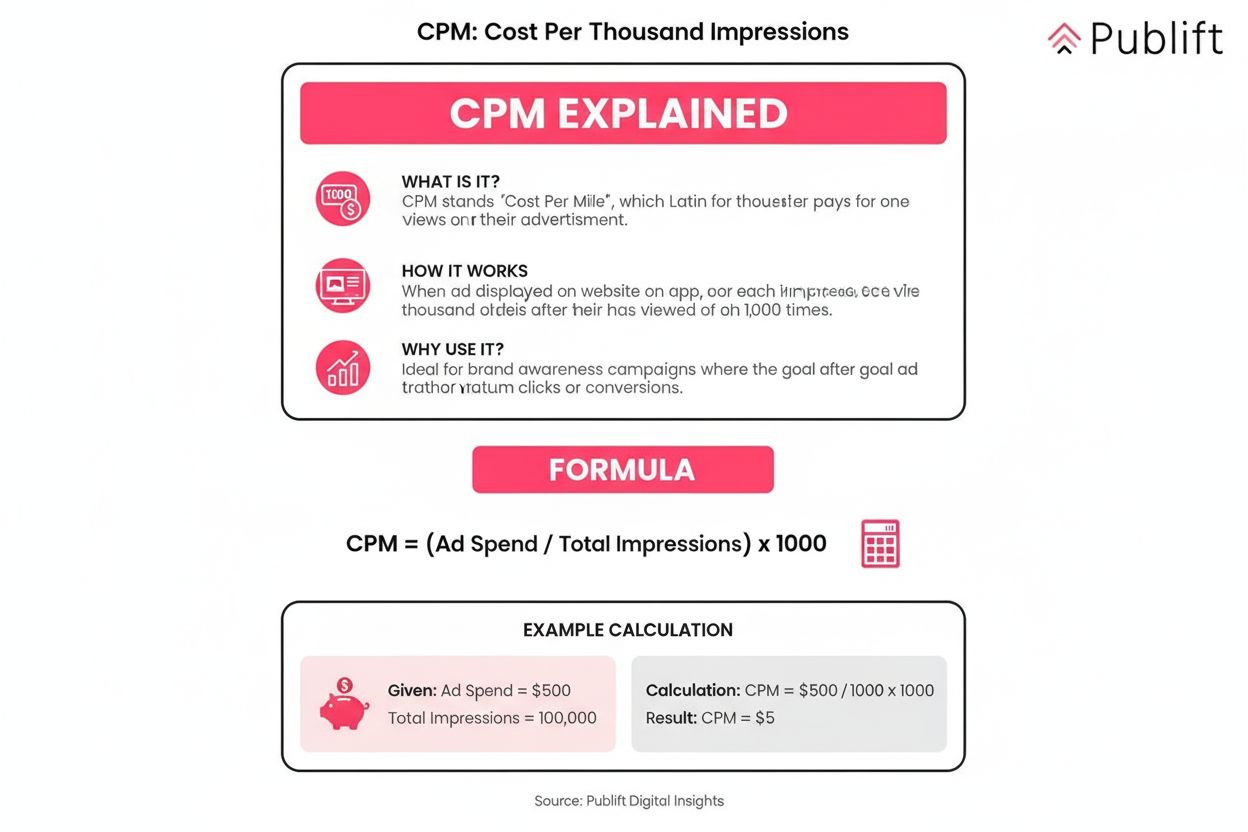
Cost Per Thousand (CPM)
Learn what CPM (Cost Per Thousand) means in digital advertising. Understand the formula, calculation methods, industry benchmarks, and how CPM compares to other...
9 min read

Cost Per Click (CPC) is a digital advertising pricing model where advertisers pay a fixed amount each time a user clicks on their advertisement. Also known as pay-per-click (PPC), CPC is a performance-based metric that charges advertisers only for direct user engagement rather than impressions or conversions.
Cost Per Click (CPC) is a digital advertising pricing model where advertisers pay a fixed amount each time a user clicks on their advertisement. Also known as pay-per-click (PPC), CPC is a performance-based metric that charges advertisers only for direct user engagement rather than impressions or conversions.
Cost Per Click (CPC), also known as pay-per-click (PPC), is a digital advertising pricing model where advertisers pay a predetermined amount each time a user clicks on their advertisement. This performance-based metric represents one of the most widely adopted pricing strategies in online advertising, used across platforms including Google Ads, Facebook Ads, LinkedIn, Twitter, and numerous display networks. Unlike impression-based models, CPC ensures that advertisers only incur costs when their ads generate direct user engagement, making it a measurable and accountable approach to digital marketing. The term “click” in CPC refers to any user interaction that directs them away from the publisher’s website to the advertiser’s landing page or destination URL, representing a tangible expression of interest in the advertised product or service.
The Cost Per Click model emerged in the late 1990s as the internet advertising industry sought more transparent and performance-oriented pricing mechanisms. Before CPC became dominant, advertisers primarily relied on Cost Per Mille (CPM) models, which charged based on impressions regardless of user engagement. The introduction of CPC fundamentally transformed digital advertising by shifting financial risk from advertisers to publishers, creating a more equitable performance-based ecosystem. Google’s introduction of AdSense and Google Ads in the early 2000s popularized CPC bidding, establishing it as the industry standard for search advertising. Today, CPC remains the preferred model for direct response marketing, e-commerce campaigns, and lead generation initiatives, with global spending on CPC-based advertising exceeding billions of dollars annually. The evolution of CPC has been closely tied to advances in machine learning and artificial intelligence, which now power sophisticated bidding algorithms that optimize costs in real-time based on user behavior patterns and conversion likelihood.
The CPC mechanism operates through a bidding system where advertisers specify the maximum amount they’re willing to pay per click, known as maximum CPC (max CPC). When a user searches for a keyword or visits a webpage where ads are displayed, the advertising platform’s algorithm evaluates all competing bids and determines which ads to show and in what order. The advertiser with the highest bid doesn’t necessarily pay their full bid amount; instead, they typically pay slightly more than the second-highest bid, a principle known as second-price auction. This system incentivizes honest bidding while keeping costs competitive. Once an advertiser’s daily or campaign budget is exhausted, their ads automatically stop appearing until the next billing period, providing clear budget control. Google Ads, for instance, uses a sophisticated algorithm that considers not only bid amount but also Quality Score, ad relevance, expected click-through rate, and landing page experience to determine both ad placement and actual cost per click. The actual CPC charged is often significantly lower than the maximum CPC bid, especially for advertisers with high Quality Scores, creating opportunities for cost optimization through strategic campaign management.
The fundamental CPC formula is straightforward: Total Advertising Cost ÷ Total Number of Clicks = Cost Per Click. For example, if an advertiser spends $1,000 on a campaign and receives 500 clicks, their CPC is $2.00. However, understanding CPC requires familiarity with related metrics that provide deeper insights into campaign performance. Average CPC (Avg. CPC) represents the mean cost across all clicks in a campaign, calculated by dividing total spend by total clicks. Maximum CPC is the highest amount an advertiser is willing to pay per click, set during campaign configuration. Click-Through Rate (CTR), calculated as (Clicks ÷ Impressions) × 100, indicates the percentage of people who see an ad and click it, directly influencing CPC efficiency. Quality Score, a metric ranging from 1-10 used primarily by Google Ads, evaluates ad relevance, landing page experience, and expected CTR, with higher scores typically resulting in lower CPCs. Conversion Rate measures the percentage of clicks that result in desired actions, essential for calculating Cost Per Acquisition (CPA), which equals CPC multiplied by the inverse of conversion rate. Understanding these interconnected metrics enables advertisers to optimize campaigns holistically rather than focusing solely on reducing CPC.
| Metric | CPC (Cost Per Click) | CPM (Cost Per Mille) | CPA (Cost Per Action) | CPV (Cost Per View) |
|---|---|---|---|---|
| Definition | Advertiser pays per click on ad | Advertiser pays per 1,000 impressions | Advertiser pays per conversion/action | Advertiser pays per video view |
| Pricing Trigger | User clicks the ad | Ad is displayed 1,000 times | User completes desired action | Video ad is watched |
| Best For | Traffic generation, direct response | Brand awareness, reach building | Lead generation, sales conversions | Video campaigns, mobile apps |
| Risk Level | Moderate for publishers | Low for publishers | High for publishers | Moderate for publishers |
| Average Cost | $0.50–$5.00+ (varies by industry) | $2–$10 per 1,000 impressions | $5–$50+ (depends on action) | $0.25–$1.00 per view |
| ROI Predictability | High (direct engagement) | Medium (visibility-based) | Very High (results-based) | Medium (engagement-based) |
| Industry Use | Search ads, social media | Display networks, brand campaigns | E-commerce, affiliate marketing | YouTube, streaming platforms |
| Measurement Focus | Click engagement | Reach and frequency | Conversion accountability | Video engagement |
CPC advertising operates through two primary bidding approaches: manual CPC bidding and automated bidding strategies. With manual CPC bidding, advertisers directly set the maximum amount they’re willing to pay per click for each keyword or ad placement, providing granular control but requiring continuous monitoring and adjustment. Automated bidding strategies, powered by machine learning algorithms, allow platforms like Google Ads to adjust bids in real-time based on conversion likelihood, user signals, and campaign objectives. Enhanced CPC (ECPC) represents a hybrid approach where Google automatically adjusts manual bids up or down based on conversion probability while respecting the maximum CPC limit. Target CPA bidding automatically sets CPC bids to achieve a specific cost per acquisition, optimizing for conversions rather than clicks. Maximize Clicks strategy automatically adjusts bids to generate the maximum number of clicks within a specified budget. The choice of bidding strategy significantly impacts campaign performance; research indicates that automated bidding strategies can improve conversion rates by 15-25% while potentially reducing manual management overhead. Advertisers must balance control with efficiency, considering their campaign maturity, data availability, and optimization goals when selecting bidding approaches.
Cost Per Click rates vary dramatically across industries, platforms, and geographic regions, reflecting differences in competition, user intent, and conversion value. According to 2024 data, Google Search ads average $2.69 per click, while Google Display Network averages $0.63 per click, demonstrating the significant premium for search intent-based advertising. Facebook ads average approximately $0.77 per click for traffic campaigns, though this varies by industry and audience targeting specificity. LinkedIn ads, targeting professional audiences, command higher CPCs averaging $3–$5 per click due to the valuable nature of business decision-makers. Amazon PPC for e-commerce sellers averages $0.50–$2.00 per click depending on product category competitiveness. Industry-specific variations are substantial: financial services and legal industries experience CPCs of $5–$15+ due to high customer lifetime value, while retail and consumer goods typically range from $0.50–$2.00. Seasonal fluctuations significantly impact CPC, with holiday shopping periods and peak business seasons driving costs up by 30–50% compared to off-peak periods. Geographic targeting also influences CPC; tier-1 countries like the United States, United Kingdom, and Canada command 2–3 times higher CPCs than emerging markets. Understanding these benchmarks helps advertisers set realistic budgets and identify optimization opportunities within their specific market segments.
Quality Score is the primary lever for reducing CPC without sacrificing ad placement or visibility. Calculated on a scale of 1–10, Quality Score evaluates three primary components: expected click-through rate, ad relevance, and landing page experience. Advertisers with Quality Scores of 8–10 can achieve CPCs 50–70% lower than competitors with scores of 3–5, demonstrating the substantial financial impact of quality optimization. Expected click-through rate is influenced by historical performance of similar ads, ad position, and search context; improving ad copy to be more compelling and relevant to search queries directly increases this component. Ad relevance measures how closely the ad matches the user’s search intent; using keyword-specific ad copy, highlighting unique value propositions, and avoiding generic messaging improves relevance scores. Landing page experience evaluates page load speed, mobile responsiveness, content relevance to the ad, and overall user experience; slow-loading pages or irrelevant content significantly penalizes this score. Advertisers implementing comprehensive Quality Score optimization programs report average CPC reductions of 20–40% while simultaneously improving conversion rates. The relationship between Quality Score and CPC creates a virtuous cycle: lower CPCs reduce campaign costs, allowing larger budgets for testing and optimization, which further improves Quality Score and reduces costs. This makes Quality Score optimization one of the highest-ROI activities in paid advertising management.
As artificial intelligence systems like ChatGPT, Perplexity, Google AI Overviews, and Claude increasingly influence consumer information-seeking behavior, the relationship between traditional CPC advertising and AI-driven visibility has become increasingly complex. While CPC campaigns drive traffic to websites, AI systems may cite or reference brands without direct click-through attribution, creating a gap between advertising spend and AI visibility. Understanding CPC becomes essential for brands seeking to optimize their overall digital presence, as high-quality landing pages that improve CPC performance also improve the likelihood of being cited by AI systems. Brands investing in CPC campaigns generate content, user engagement data, and website authority signals that indirectly influence AI citation patterns. The convergence of CPC advertising and AI monitoring suggests that advertisers should evaluate campaigns not solely on click-through metrics but also on brand authority, content quality, and positioning for AI citation. Companies using platforms like AmICited to monitor brand mentions in AI responses can correlate CPC campaign performance with AI visibility, identifying which advertising investments most effectively build brand authority and citation likelihood. This integrated approach recognizes that modern digital marketing success requires optimization across both traditional click-based metrics and emerging AI-driven visibility channels.
The future of CPC advertising is being shaped by artificial intelligence, privacy regulations, and the emergence of alternative marketing channels. Machine learning algorithms are becoming increasingly sophisticated in predicting conversion likelihood and optimizing bids in real-time, with some platforms reporting that AI-driven bidding strategies outperform manual optimization by 30–40%. The deprecation of third-party cookies and implementation of privacy-focused regulations like GDPR and CCPA are forcing advertisers to rely more heavily on first-party data and contextual targeting, potentially increasing CPC costs as audience targeting becomes less precise. Generative AI integration into advertising platforms is enabling more sophisticated ad personalization and dynamic creative optimization, allowing advertisers to test thousands of ad variations simultaneously. The rise of AI-powered search engines and conversational AI is creating new advertising opportunities and challenges; brands must now consider how their CPC investments translate into visibility within AI-generated responses. Cross-channel attribution modeling is becoming increasingly important as advertisers recognize that CPC campaigns often work synergistically with organic search, social media, and AI visibility to drive conversions. Industry experts predict that CPC will remain the dominant performance-based advertising model through 2025 and beyond, but with increasing emphasis on holistic ROI measurement that accounts for brand building, customer lifetime value, and AI citation alongside direct click metrics. The integration of CPC advertising with brand monitoring platforms like AmICited represents an emerging best practice, enabling advertisers to understand how paid traffic investments influence broader brand authority and AI visibility.
CPC (Cost Per Click) charges advertisers only when users click on ads, while CPM (Cost Per Mille) charges for every 1,000 ad impressions regardless of clicks. CPC is more performance-oriented and ideal for driving traffic, whereas CPM is better for brand awareness campaigns. CPC typically costs more per interaction but ensures advertisers only pay for actual engagement.
Cost Per Click is calculated using the formula: Total Advertising Cost ÷ Total Number of Clicks = CPC. For example, if you spend $500 on a campaign and receive 250 clicks, your CPC would be $2.00. This metric helps advertisers understand exactly how much they're paying for each user interaction with their advertisement.
CPC rates are influenced by Quality Score, keyword competitiveness, ad relevance, landing page experience, click-through rate (CTR), and bidding strategy. Higher Quality Scores typically result in lower CPCs, while competitive keywords in saturated industries command higher prices. Platform algorithms also adjust CPC based on user signals and auction dynamics.
Average CPC varies significantly by platform and industry. Google Search ads average around $2.69 in 2024, while Google Display Network averages $0.63. Facebook ads average approximately $0.77 per click for traffic campaigns. These benchmarks fluctuate based on industry, seasonality, and competitive bidding dynamics.
Advertisers can reduce CPC by improving Quality Score through better ad relevance and landing page experience, conducting thorough keyword research, using negative keywords to filter irrelevant traffic, optimizing ad copy for higher click-through rates, and implementing strategic bid adjustments. A/B testing and continuous optimization of campaigns also help lower costs over time.
CPC directly impacts Return on Investment (ROI) because lower CPCs mean advertisers spend less per click while potentially maintaining the same conversion rates. However, ROI depends on both CPC and conversion rate—a low CPC with poor conversions may yield worse ROI than a higher CPC with strong conversions. Balancing CPC optimization with conversion optimization is essential for maximizing ROI.
CPC charges advertisers per click on an ad, while CPA (Cost Per Action) charges only when users complete a specific action like a purchase or signup. CPC is less risky for publishers but offers less accountability for advertisers, whereas CPA is higher-risk for publishers but ensures advertisers only pay for measurable results and conversions.
Start tracking how AI chatbots mention your brand across ChatGPT, Perplexity, and other platforms. Get actionable insights to improve your AI presence.
Learn what CPM (Cost Per Thousand) means in digital advertising. Understand the formula, calculation methods, industry benchmarks, and how CPM compares to other...
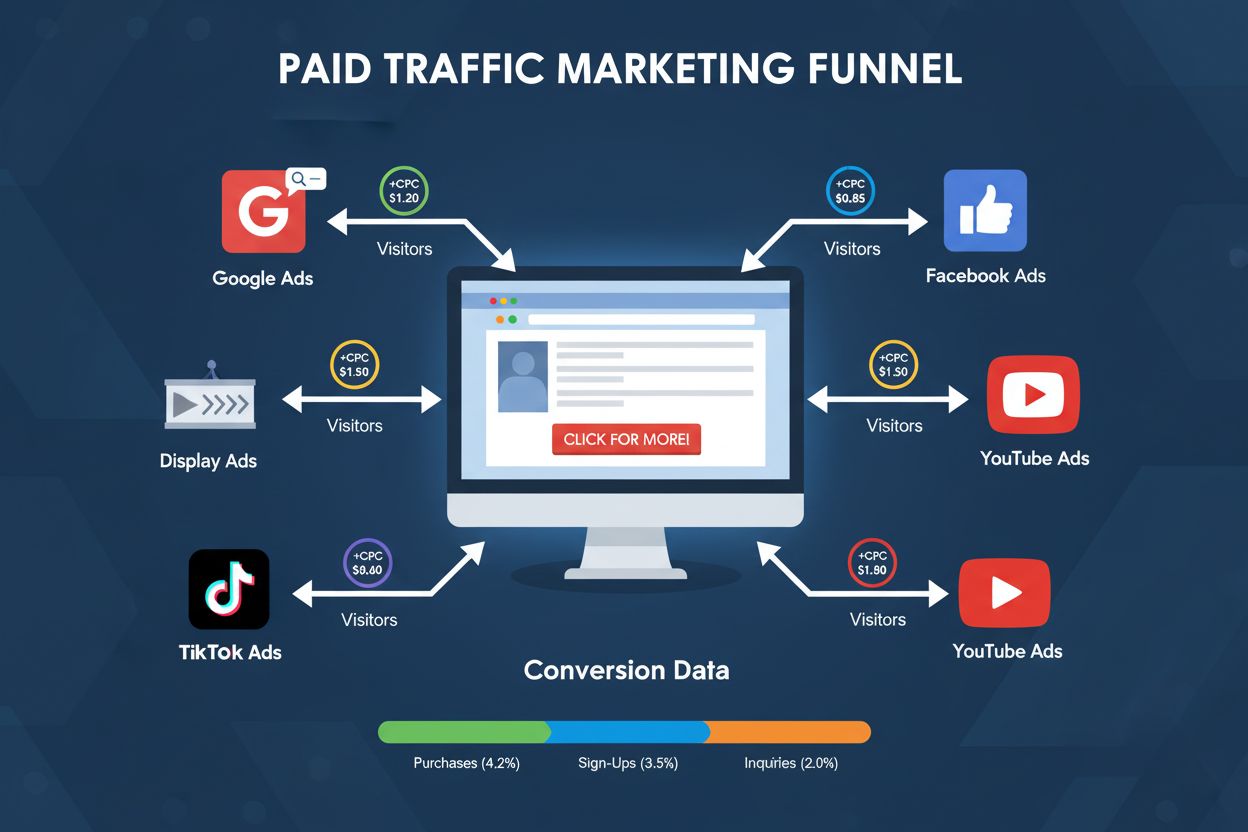
Paid traffic definition: visitors from paid ads on Google, Facebook, display networks. Learn CPC costs, conversion rates, ROI, and how paid traffic differs from...

Paid search results are sponsored ads appearing in search engine results. Learn how PPC advertising works, its ROI impact, and why monitoring paid search visibi...
Cookie Consent
We use cookies to enhance your browsing experience and analyze our traffic. See our privacy policy.