


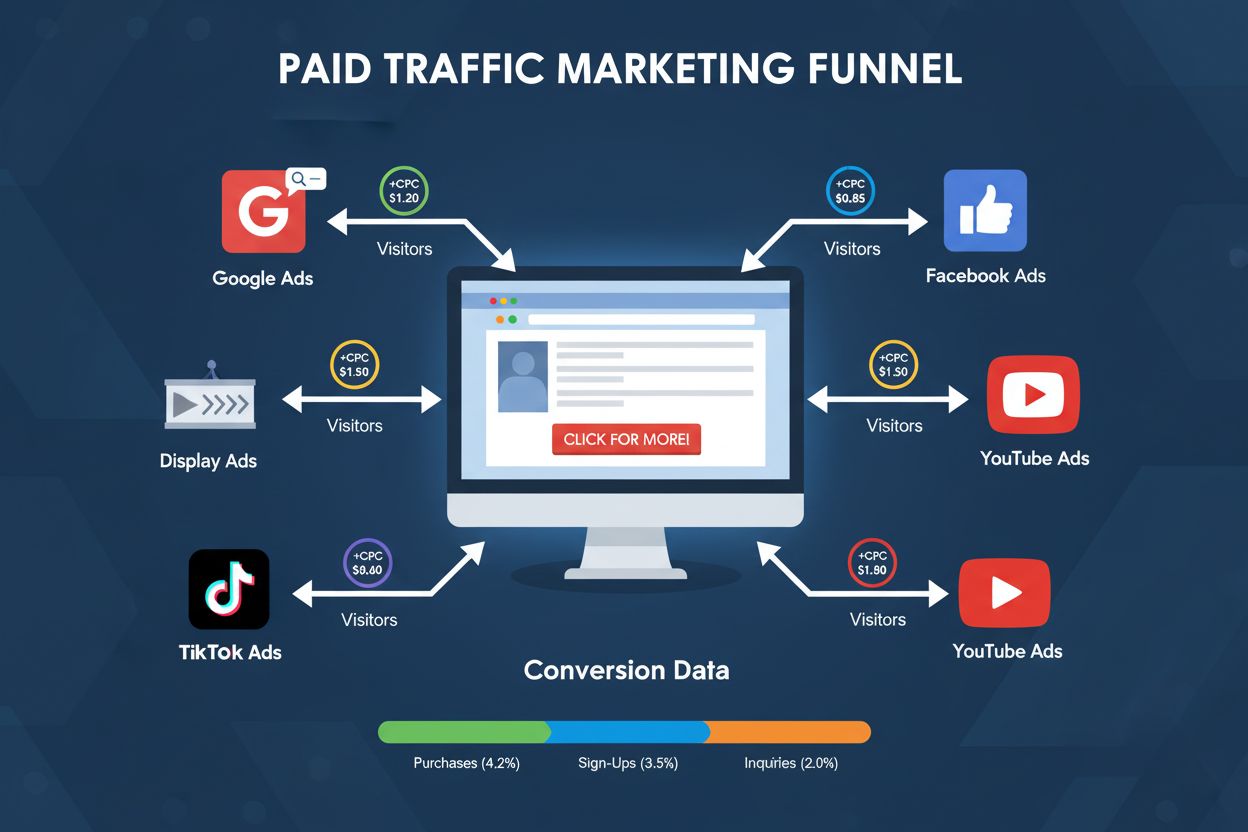
Paid Traffic
Paid traffic definition: visitors from paid ads on Google, Facebook, display networks. Learn CPC costs, conversion rates, ROI, and how paid traffic differs from...
9 min read
Paid search results are sponsored advertisements that appear at the top of search engine results pages (SERPs) when users search for specific keywords. Advertisers bid on keywords and pay a fee each time their ad is clicked, operating on a pay-per-click (PPC) model to drive immediate traffic and visibility.
Paid search results are sponsored advertisements that appear at the top of search engine results pages (SERPs) when users search for specific keywords. Advertisers bid on keywords and pay a fee each time their ad is clicked, operating on a pay-per-click (PPC) model to drive immediate traffic and visibility.
Paid search results are sponsored advertisements that appear prominently at the top of search engine results pages (SERPs) when users search for specific keywords. Also known as pay-per-click (PPC) advertising or search engine marketing (SEM), paid search results represent a digital advertising model where advertisers bid on keywords relevant to their products or services and pay a fee each time a user clicks on their ad. Unlike organic search results, which are earned through search engine optimization (SEO) efforts, paid search results provide immediate visibility and placement control. These ads are clearly marked with an “Ad” label to distinguish them from organic listings, and they appear above organic results on the search results page. The primary purpose of paid search advertising is to drive qualified traffic to a website, generate leads, and increase conversions by placing advertisements directly in front of users who are actively searching for related products or services.
The mechanics of paid search advertising operate through a sophisticated keyword auction system managed by search engines like Google, Bing, and Yahoo. When a user enters a search query, the search engine instantly evaluates all active bids for keywords matching that query and determines which ads will display and in what order. The placement of paid search results is determined by a combination of factors, with the most critical being the ad rank formula: Ad Rank = Bid Amount × Quality Score. This means that advertisers with lower bids can still achieve top positions if they maintain higher quality scores, making optimization essential for cost-effective campaigns. Advertisers set a maximum cost-per-click (CPC) bid, representing the highest amount they’re willing to pay when someone clicks their ad. The actual cost paid is often lower than the maximum bid, determined by the second-price auction model where you pay just enough to maintain your position above the next competitor. This system ensures that advertisers only pay for actual clicks, not for impressions or views, making it a performance-based advertising model that aligns spending with measurable results.

Track how AI chatbots mention your brand across ChatGPT, Perplexity, and other platforms.
| Aspect | Paid Search Results | Organic Search Results |
|---|---|---|
| Cost Model | Pay-per-click (PPC) - pay only when clicked | Free, earned through SEO efforts |
| Placement | Top of SERP, clearly marked with “Ad” label | Below paid ads, ranked by algorithm |
| Time to Results | Immediate visibility once campaign launches | Takes weeks to months to rank |
| Click Distribution | 6% of Google clicks (94% skip paid ads) | 94% of Google clicks, 67.6% to top 5 results |
| Traffic Volume | 15% of total website traffic from paid search | 53.3% of total website traffic from organic |
| Control | Full control over keywords, bids, and messaging | Limited control, dependent on algorithm changes |
| Quality Score | Directly impacts ad rank and cost | Not applicable; ranking based on relevance signals |
| Budget Requirement | Requires ongoing investment to maintain visibility | Minimal ongoing costs after initial optimization |
| Conversion Rate | Average 6.96% for Google Ads | Varies by industry and content quality |
| Best For | Immediate traffic, competitive keywords, seasonal campaigns | Long-term visibility, brand authority, sustainable traffic |
Quality Score is one of the most critical factors determining the success and cost-efficiency of paid search campaigns. Google assigns a Quality Score between 1 and 10 to each keyword in your account, evaluating three primary components: ad relevance (how closely your ads match the keyword), expected click-through rate (CTR) (the likelihood users will click your ad based on historical performance), and landing page experience (how useful and relevant your landing page is to users). Quality Score operates at multiple levels within Google Ads accounts, including account-level quality (based on overall account history), ad group-level quality (average of keywords in that group), and keyword-level quality (visible in the interface). The impact of Quality Score extends beyond just ad placement; it directly affects your cost per click and overall campaign profitability. A higher Quality Score can result in better ad positions at significantly lower costs, while a low Quality Score can make keywords ineligible to enter auctions entirely. Research shows that maintaining a Quality Score of 7 or higher is optimal for most campaigns, as it balances cost efficiency with competitive positioning. Improving Quality Score requires continuous optimization of ad copy, keyword relevance, and landing page quality, making it an ongoing strategic priority for successful paid search management.
Get the latest insights on AI mentions, brand monitoring, and optimization strategies.
The paid search advertising landscape is dominated by Google Ads, which controls approximately 91.54% of the global search engine market share and generated $237.86 billion in ad revenue in 2023 alone. Google Ads allows advertisers to create text-based, shopping, and display ads across Google’s search network, display network, and partner sites, making it the primary platform for most paid search campaigns. Microsoft Ads (formerly Bing Ads) represents the second-largest paid search platform with 2.4% of global search engine market share, offering similar functionality to Google Ads but often with lower competition and cost-per-click rates, particularly for specific demographics and industries. Yahoo Gemini provides native advertising and paid search options through Yahoo’s properties and partner networks, while Amazon Sponsored Products enables sellers to promote items within Amazon’s search results and product pages. The dominance of Google in paid search is reflected in spending patterns, with $137 billion spent on search ads in the U.S. in 2024 alone, and $81.5 billion specifically allocated to mobile search advertising. Despite Google’s overwhelming market share, diversifying across multiple platforms can be strategically valuable, as different platforms reach different user demographics and often have lower competition for specific keywords, potentially offering better ROI for niche markets.
The financial impact of paid search advertising is substantial and measurable, with research demonstrating an average ROI of 250% for search engine marketing campaigns. Businesses typically earn approximately $2 for every $1 invested in Google Ads, making it one of the most cost-efficient marketing channels available. The average conversion rate for Google Ads is 6.96%, significantly higher than many other digital marketing channels, while the average click-through rate stands at 6.42%, indicating strong user engagement with paid search ads. Beyond direct conversions, paid search results enhance brand awareness by 80%, meaning that even users who don’t immediately click on ads are exposed to brand messaging and develop recognition. Research shows that people are 27% more likely to make a purchase after clicking on a Google Search ad before visiting a store, demonstrating the powerful influence of paid search on both online and offline customer behavior. The cost structure varies by industry and competition level, with the average cost per click at $4.66 and average cost per lead at $66.69, though these figures fluctuate significantly based on keyword competitiveness and industry vertical. For B2B companies specifically, Google search drives twice as much revenue compared to any other marketing channel, making paid search an indispensable component of B2B marketing strategies. The ability to track and measure performance in real-time allows advertisers to optimize campaigns continuously, adjusting bids, keywords, and messaging to maximize ROI and improve campaign efficiency.
In the evolving landscape of AI-powered search, monitoring paid search results has become increasingly important for brand visibility and competitive positioning. Traditional paid search results appear on Google, Bing, and other search engines, but brands must now consider how their paid search investments translate to visibility across AI search platforms like ChatGPT, Perplexity, Google AI Overviews, and Claude. These AI-powered search experiences are changing how users discover information and products, creating new opportunities and challenges for paid search advertisers. Brand monitoring tools like AmICited help organizations track when and how their paid search ads appear across these diverse platforms, ensuring that advertising investments generate appropriate visibility in AI search environments. Understanding paid search results in the context of AI search is crucial because traditional paid search metrics may not fully capture brand visibility in these new channels. As AI search platforms grow in adoption, brands that monitor their presence across both traditional and AI-powered search results gain competitive advantages in understanding customer discovery patterns and optimizing their overall search marketing strategy. The integration of paid search monitoring with AI search tracking provides a comprehensive view of brand visibility across the entire search landscape, enabling more informed decisions about budget allocation and campaign optimization.
Deciding how to split budget between paid search and organic SEO comes down to a few concrete criteria rather than a blanket rule. Choose paid search when you need traffic immediately—a product launch, a seasonal promotion, or a new market entry can’t wait the months organic rankings typically take to build, and since paid search delivers visibility as soon as a campaign launches, it’s the right tool when timing outweighs cost efficiency. Choose organic investment when the keyword has durable, long-term commercial value—if a term will matter to your business for years, the compounding nature of organic rankings (once earned, they don’t require ongoing per-click spend) generally produces better long-term ROI than sustaining a paid position indefinitely, especially given that 94% of clicks go to organic results. Use paid search to test keyword and messaging performance before committing to organic content investment—because paid campaigns produce fast, measurable data on which keywords and ad copy actually convert, this data can validate which topics are worth the multi-month investment of building organic content and rankings around. Choose paid search for highly competitive keywords where organic ranking is unrealistic in a reasonable timeframe—if established competitors dominate the organic results for a term and displacing them would take years, paid placement may be the only near-term path to visibility for that specific query. Combine both when budget allows, since the data cited above shows 49% of marketers report organic plus paid together delivers the best ROI of any channel combination—paid search captures immediate demand and reinforces brand presence at the top of the page, while organic captures the 94% of clicks that skip ads entirely. The deciding factor should be whether you’re optimizing for immediate, controllable visibility (paid) or compounding, lower-marginal-cost visibility over time (organic)—most mature search strategies use both simultaneously rather than treating the choice as either/or.
Start tracking how AI chatbots mention your brand across ChatGPT, Perplexity, and other platforms. Get actionable insights to improve your AI presence.
Paid traffic definition: visitors from paid ads on Google, Facebook, display networks. Learn CPC costs, conversion rates, ROI, and how paid traffic differs from...
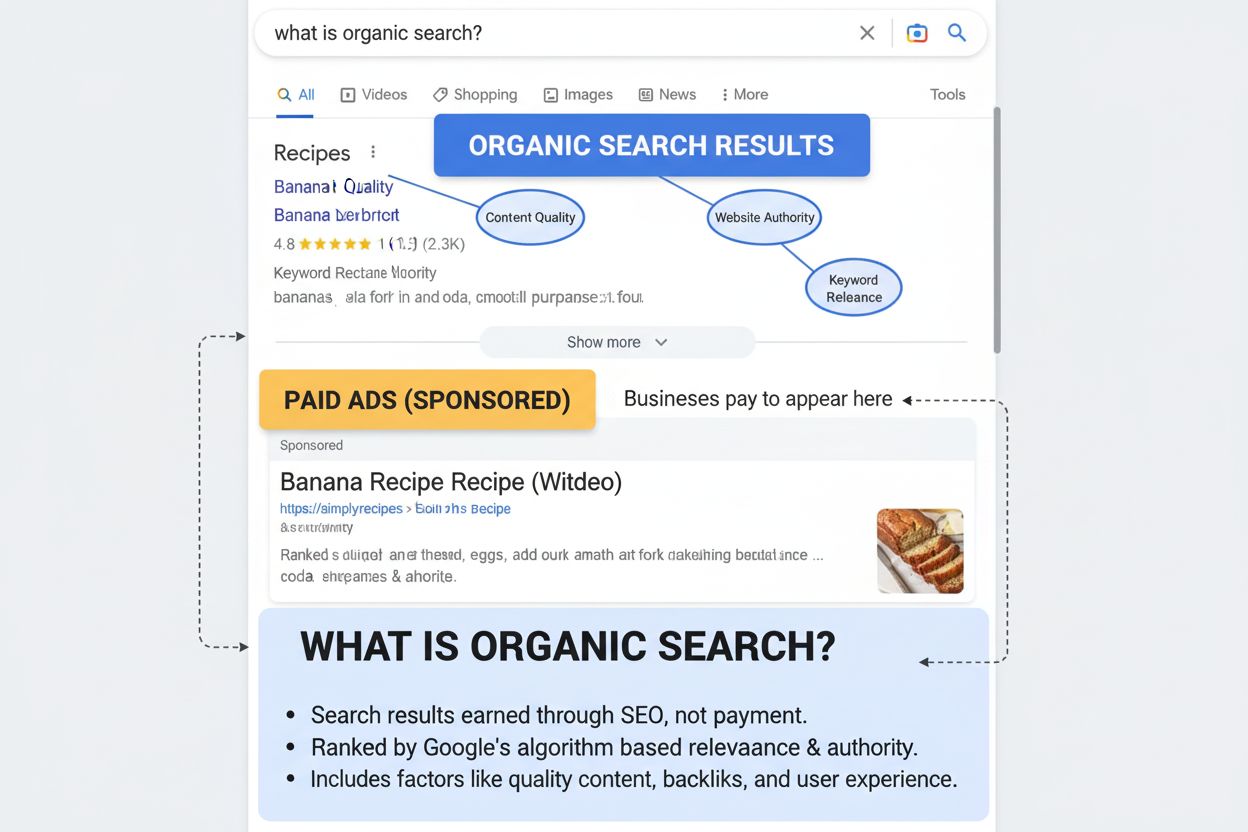
Organic search results are unpaid SERP listings determined by search algorithms based on relevance, quality, and authority. Learn how they differ from paid sear...

Learn what Cost Per Click (CPC) means in digital advertising. Understand CPC calculation, bidding strategies, and how it compares to CPM and CPA models for opti...
Cookie Consent
We use cookies to enhance your browsing experience and analyze our traffic. See our privacy policy.