
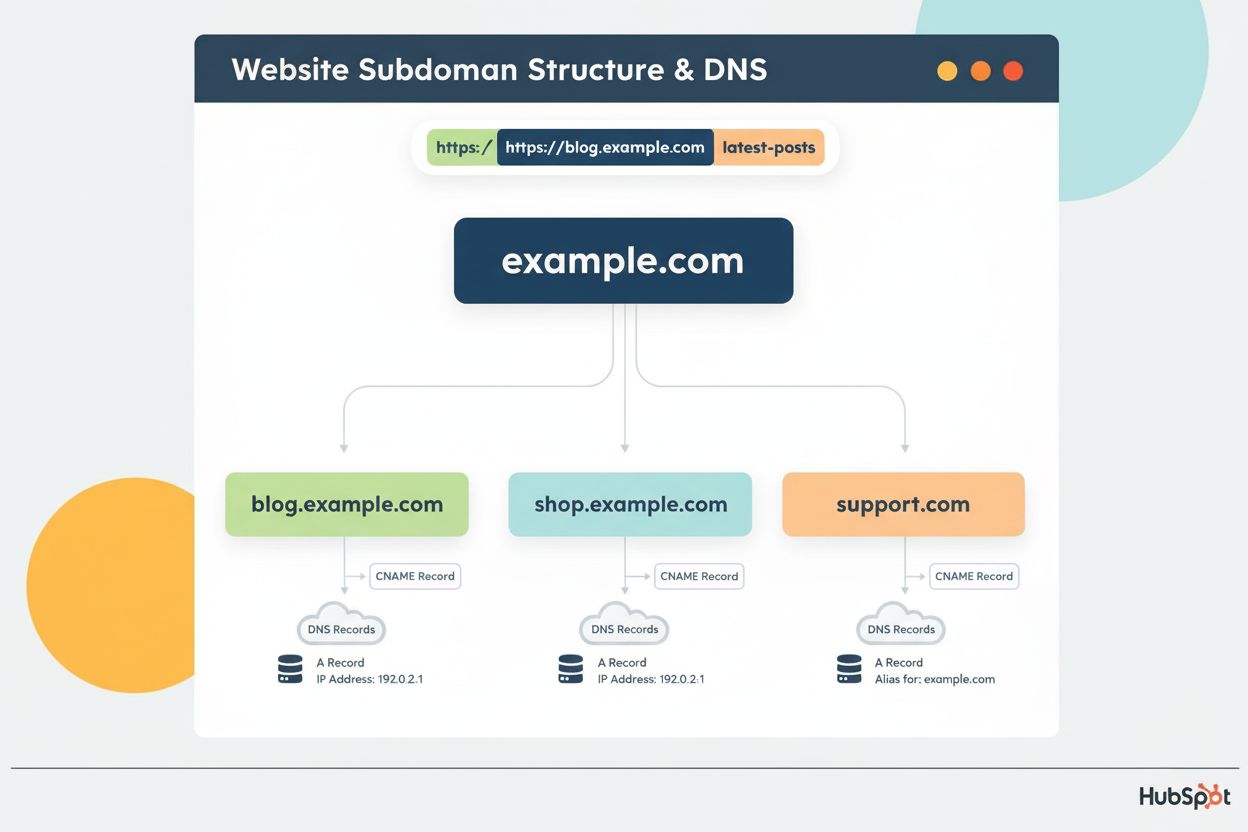
Subdomain
Learn what a subdomain is, how it differs from subfolders, its technical structure via DNS records, and its impact on SEO, brand monitoring, and website organiz...
10 min read

A Country Code Top-Level Domain (ccTLD) is a two-letter internet domain extension assigned to a specific country or geographic territory based on ISO 3166-1 country codes, such as .uk for the United Kingdom or .de for Germany. ccTLDs help identify a website’s geographic location and can improve local search engine rankings and user trust within target regions.
A Country Code Top-Level Domain (ccTLD) is a two-letter internet domain extension assigned to a specific country or geographic territory based on ISO 3166-1 country codes, such as .uk for the United Kingdom or .de for Germany. ccTLDs help identify a website's geographic location and can improve local search engine rankings and user trust within target regions.
A Country Code Top-Level Domain (ccTLD) is a two-letter internet domain extension assigned to a specific country, sovereign state, or dependent territory based on the ISO 3166-1 alpha-2 country codes. Examples include .uk for the United Kingdom, .de for Germany, .fr for France, .cn for China, and .jp for Japan. These domain extensions serve as geographic identifiers that help internet users understand where a website is located or which market it primarily serves. ccTLDs are distinct from generic top-level domains (gTLDs) like .com or .org, which are not associated with any specific country. The primary purpose of a ccTLD is to establish a clear connection between a domain name and a geographic location, thereby enhancing local relevance, search engine optimization, and user trust within target regions.
The concept of country code top-level domains emerged during the early standardization of the internet’s domain name system. In 1985, the Internet Assigned Numbers Authority (IANA) approved the first three ccTLDs: .us for the United States, .uk for the United Kingdom, and .il for Israel. This foundational decision was documented in RFC 1591, a seminal technical document authored by Jon Postel, the pioneering computer scientist who played a central role in establishing the internet’s foundational infrastructure. Postel’s framework outlined the hierarchical structure of the DNS system, which became the constitutional blueprint for how domain names would be organized globally. Over the subsequent three decades, the number of ccTLDs expanded dramatically, reaching 316 by 2020, encompassing countries using both Latin and non-Latin alphabets. A significant milestone occurred in 2018 when the IANA approved internationalized ccTLDs (IDN ccTLDs), enabling non-English character sets such as .中国 (China), .рф (Russia), .日本 (Japan), .السعودية (Saudi Arabia), and .இந்தியா (India). This expansion made the internet more inclusive and accessible to non-English speaking populations worldwide.
As of the end of 2024, ccTLDs represent a substantial portion of the global domain name market, with approximately 140.8 million registered domains, reflecting a 0.6% increase from Q3 2024 and a 1.8% year-over-year growth. This represents roughly 38% of the total global domain market, which comprises approximately 372 million domain names overall. European ccTLDs alone hold 20% of the global market with 77 million domains, demonstrating the significant adoption of country-specific extensions in developed regions. The top-performing ccTLDs by registration volume include .cn (China), .tk (Tokelau), .de (Germany), .uk (United Kingdom), .ru (Russia Federation), .ga (Gabon), .cf (Central African Republic), .ml (Mali), .nl (Netherlands), and .br (Brazil). Notably, some ccTLDs have transcended their original geographic purpose and become globally recognized for specific industries or use cases, such as .io (British Indian Ocean Territory) for technology startups, .tv (Tuvalu) for video content providers, and .fm (Federated States of Micronesia) for radio and music streaming services.
| Characteristic | ccTLD (Country Code) | gTLD (Generic) | sTLD (Sponsored) |
|---|---|---|---|
| Definition | Two-letter domain for specific countries/territories | Generic extensions open to anyone globally | Sponsored by private entities for specific communities |
| Examples | .uk, .de, .fr, .cn, .jp, .au, .ca | .com, .net, .org, .info, .biz | .edu, .gov, .mil, .int |
| Registration Restrictions | Often require local presence or residency | Open to anyone worldwide | Require proof of eligibility or community membership |
| Geographic Targeting | Strong local SEO signals for specific countries | Weak geographic signals; global reach | Community-specific; limited geographic targeting |
| Market Share | ~38% of global domains (140.8 million) | ~48% of global domains | ~2% of global domains |
| SEO Impact | Prioritized in local search results | Neutral; global search visibility | Neutral; community-specific visibility |
| Use Cases | Local businesses, regional expansion, localization | Global brands, startups, general websites | Educational institutions, government, international organizations |
| Cost | Varies widely; some free (.tk), others premium | Generally affordable ($8-15/year) | Varies; often more expensive |
| Renewal Requirements | Varies by country registry | Standard annual renewal | Standard annual renewal |
Understanding the technical composition of a ccTLD is essential for comprehending how domain names function within the internet’s hierarchical structure. A complete domain name consists of three primary components: the subdomain (optional), the second-level domain (SLD), and the top-level domain (TLD). For example, in the domain name www.example.co.uk , the structure breaks down as follows: “www” is the subdomain, “example” is the second-level domain, and .co.uk is the top-level domain, where .uk is the ccTLD. The ccTLD is managed by a ccTLD registry, which is the technical operator responsible for administering domain name resolution services for that specific country code. For instance, the Canadian Internet Registration Authority (CIRA) manages the .ca registry, while Nominet manages the .uk registry. These registries work in conjunction with ICANN-accredited registrars to process domain registrations, maintain DNS records, and ensure compliance with local regulations. The ISO 3166-1 alpha-2 standard provides the authoritative list of country codes used for ccTLD assignment, though some exceptions exist—such as .uk for the United Kingdom (rather than .gb for Great Britain) and .eu for the European Union (a supranational entity rather than a country).
The SEO implications of ccTLDs are substantial and well-documented by major search engines. Google and other search engines recognize ccTLDs as strong geo-targeting signals, which means websites using country-specific extensions receive preferential ranking treatment in local search results. When a user in Germany searches for a product or service, Google’s algorithm prioritizes websites with .de domains, assuming they are more relevant to the local market. This geographic relevance signal can significantly boost visibility in local search engine results pages (SERPs), making ccTLDs particularly valuable for businesses targeting specific countries. However, this benefit comes with a trade-off: ccTLDs may limit global reach compared to gTLDs. A website using .de may rank lower in search results for users in other countries, even if the content is relevant to them. For international businesses, a common strategy involves using a gTLD for global reach (such as .com) while simultaneously registering ccTLDs for major target markets, creating a multi-domain strategy that optimizes for both local and global visibility. Additionally, local hosting requirements for some ccTLDs can affect website performance and SEO, as page load speed is a ranking factor. Businesses must balance the SEO benefits of ccTLDs with the practical considerations of managing multiple domains and ensuring consistent content across different regional versions.
The registration requirements for ccTLDs vary significantly by country, reflecting each nation’s unique regulatory framework and business policies. Some ccTLDs impose strict eligibility criteria that require registrants to demonstrate local presence, such as a physical address, business registration, or residency within the country. For example, registering a .de domain typically requires a local contact address in Germany, while .fr domains require a French address or a local representative. Other ccTLDs, such as .io (British Indian Ocean Territory), .ai (Anguilla), .cc (Cocos Islands), .tv (Tuvalu), and .me (Montenegro), are open to international registrants and have become globally popular for businesses seeking memorable or industry-specific domain names. The .tk domain, representing Tokelau, is notably free to register, making it attractive to budget-conscious individuals and organizations, though it comes with limitations on renewal and support. Some ccTLDs require local hosting on servers within the country, which can impact website performance and compliance with data residency regulations. Additionally, certain ccTLDs mandate trademark registration or proof of legitimate business interest before allowing registration. Understanding these requirements is critical for businesses planning international expansion, as non-compliance can result in domain suspension or loss of registration rights. ICANN-accredited registrars maintain detailed information about specific ccTLD requirements and can guide businesses through the registration process.
ccTLDs serve multiple strategic purposes for businesses operating in international markets or targeting specific geographic regions. The primary use cases include localization and market-specific expansion, where international companies create dedicated websites for major markets using appropriate ccTLDs. For instance, an American technology company expanding into Germany might register a .de domain and create a German-language website with localized content, pricing in euros, and customer support in German. This approach demonstrates cultural sensitivity and local commitment, which builds trust with regional audiences and improves conversion rates. Another significant use case is SEO optimization for local markets, where businesses leverage the geographic targeting benefits of ccTLDs to dominate local search results. A small business serving only the United Kingdom would benefit substantially from using a .co.uk domain, as it signals to search engines that the business is locally relevant. Brand protection and trademark enforcement represent another critical application, as companies must monitor and register their brand names across multiple ccTLDs to prevent competitors or bad actors from registering similar domains in different countries. Additionally, some ccTLDs have become industry-specific branding tools—for example, .io has become synonymous with technology startups and software companies, .tv with video content providers, and .fm with radio stations and music streaming services. These secondary uses demonstrate how ccTLDs have evolved beyond their original geographic purpose to serve as memorable, industry-relevant domain extensions that enhance brand identity and market positioning.
In the context of AI-powered brand monitoring and domain tracking, ccTLDs have become increasingly important for comprehensive brand protection strategies. As AI search engines like Perplexity, ChatGPT, Google AI Overviews, and Claude become more prevalent, businesses must monitor their brand presence across multiple domain extensions and geographic markets. Bad actors frequently register brand names under various ccTLDs to conduct phishing attacks, distribute counterfeit products, or create fraudulent websites targeting specific countries. For example, a cybercriminal might register example.cn to target Chinese users, example.ru for Russian markets, or example.br for Brazilian audiences, each appearing locally legitimate while actually being malicious. AI-driven brand monitoring platforms like AmICited track domain registrations across ccTLDs to detect unauthorized use of brand names, identify potential trademark infringement, and alert businesses to suspicious registrations. These platforms analyze domain registration patterns, WHOIS data, and DNS records to identify threats across all country-specific extensions. Additionally, monitoring how your brand appears in AI-generated responses across different geographic markets requires understanding which ccTLDs are being cited and referenced. Businesses operating internationally must implement comprehensive ccTLD monitoring strategies that cover their primary markets and potential expansion regions, ensuring that their brand reputation remains protected across all geographic domains and AI search platforms.
The landscape of country code top-level domains continues to evolve in response to technological advancement, globalization, and changing internet usage patterns. Several significant trends are shaping the future of ccTLDs. First, the continued expansion of internationalized ccTLDs (IDN ccTLDs) will make the internet more accessible to non-English speaking populations, with more countries adopting domain extensions in their native languages and scripts. Second, the secondary market for ccTLDs is growing, with premium domains commanding high prices as businesses recognize the value of memorable, country-specific extensions. Third, regulatory changes and data sovereignty requirements are increasing the importance of ccTLDs, as governments implement stricter data residency laws requiring websites to use country-specific domains and local hosting. Fourth, the rise of AI search engines and brand monitoring has elevated the importance of tracking ccTLD registrations as part of comprehensive brand protection strategies. Fifth, some ccTLDs are experiencing declining usage as businesses increasingly prefer gTLDs for global reach, while others are experiencing explosive growth due to industry-specific adoption (such as .io for tech startups). Finally, ICANN’s ongoing policy discussions regarding ccTLD management, registration restrictions, and governance structures will likely result in changes to how ccTLDs are administered and regulated globally. As the internet continues to mature and expand into new markets, ccTLDs will remain essential tools for geographic targeting, local SEO optimization, and brand protection in an increasingly complex digital landscape.
A ccTLD (Country Code Top-Level Domain) is assigned to a specific country or region and may have registration restrictions, while a gTLD (Generic Top-Level Domain) like .com or .org is open to anyone globally regardless of location. ccTLDs are typically two characters based on ISO 3166-1 country codes, whereas gTLDs are usually three or more characters. Search engines may prioritize ccTLDs for local searches within their designated country, while gTLDs have broader global reach and recognition.
ccTLDs provide strong geo-targeting signals to search engines, helping websites rank higher in local search results for their designated country. Google and other search engines recognize ccTLDs as indicators of geographic relevance, which can boost visibility for users searching within that region. However, ccTLDs may limit global reach compared to gTLDs, so they're most effective for businesses targeting specific countries rather than international audiences.
Yes, many ccTLDs have specific registration requirements that vary by country. Some require proof of local residency, a physical address in the country, or a local business presence. Others, like .tk (Tokelau) and .io (British Indian Ocean Territory), are open to anyone worldwide. It's important to check the specific requirements of your desired ccTLD with an ICANN-accredited registrar before attempting registration.
As of 2024, ccTLDs account for approximately 140.8 million domain registrations, representing about 38% of the global domain market. The most popular ccTLDs include .cn (China), .de (Germany), .uk (United Kingdom), .ru (Russia), .nl (Netherlands), .br (Brazil), .fr (France), .au (Australia), .jp (Japan), and .ca (Canada). Notably, .io and .ai have gained significant popularity among tech startups despite representing small island nations.
It depends on the specific ccTLD's registration policies. Some ccTLDs like .io, .ai, .cc, and .tv are open to international registrants and have become popular for global businesses seeking memorable domain names. However, many country-specific ccTLDs require local presence or residency. Some countries allow foreign registration if you have a local trademark or business entity. Always verify the eligibility requirements with your domain registrar before purchasing.
ccTLDs are important for comprehensive brand monitoring strategies, as competitors or bad actors may register your brand name under various country-specific extensions to target different markets. AI-powered brand monitoring tools track domain registrations across ccTLDs to detect potential trademark infringement, phishing attempts, or unauthorized use of your brand. Monitoring ccTLD registrations helps protect your brand reputation across multiple geographic markets and AI search engines.
ccTLDs originated in 1985 when the Internet Assigned Numbers Authority (IANA) approved the first three country code domains: .us (United States), .uk (United Kingdom), and .il (Israel). The system was formalized in RFC 1591, authored by Jon Postel, which established the DNS hierarchy structure. By 2020, over 316 ccTLDs existed for countries using both Latin and non-Latin alphabets. In 2018, internationalized ccTLDs (IDN ccTLDs) were introduced, allowing non-English characters like .中国 (China) and .рф (Russia).
Start tracking how AI chatbots mention your brand across ChatGPT, Perplexity, and other platforms. Get actionable insights to improve your AI presence.
Learn what a subdomain is, how it differs from subfolders, its technical structure via DNS records, and its impact on SEO, brand monitoring, and website organiz...

Discover how regional AI search varies globally. Learn optimization strategies for Perplexity, ChatGPT, and Google AI Overviews across different markets.

Learn what a Content Delivery Network (CDN) is, how it works, and why it's essential for fast content delivery. Understand edge servers, caching, and global dis...
Cookie Consent
We use cookies to enhance your browsing experience and analyze our traffic. See our privacy policy.