
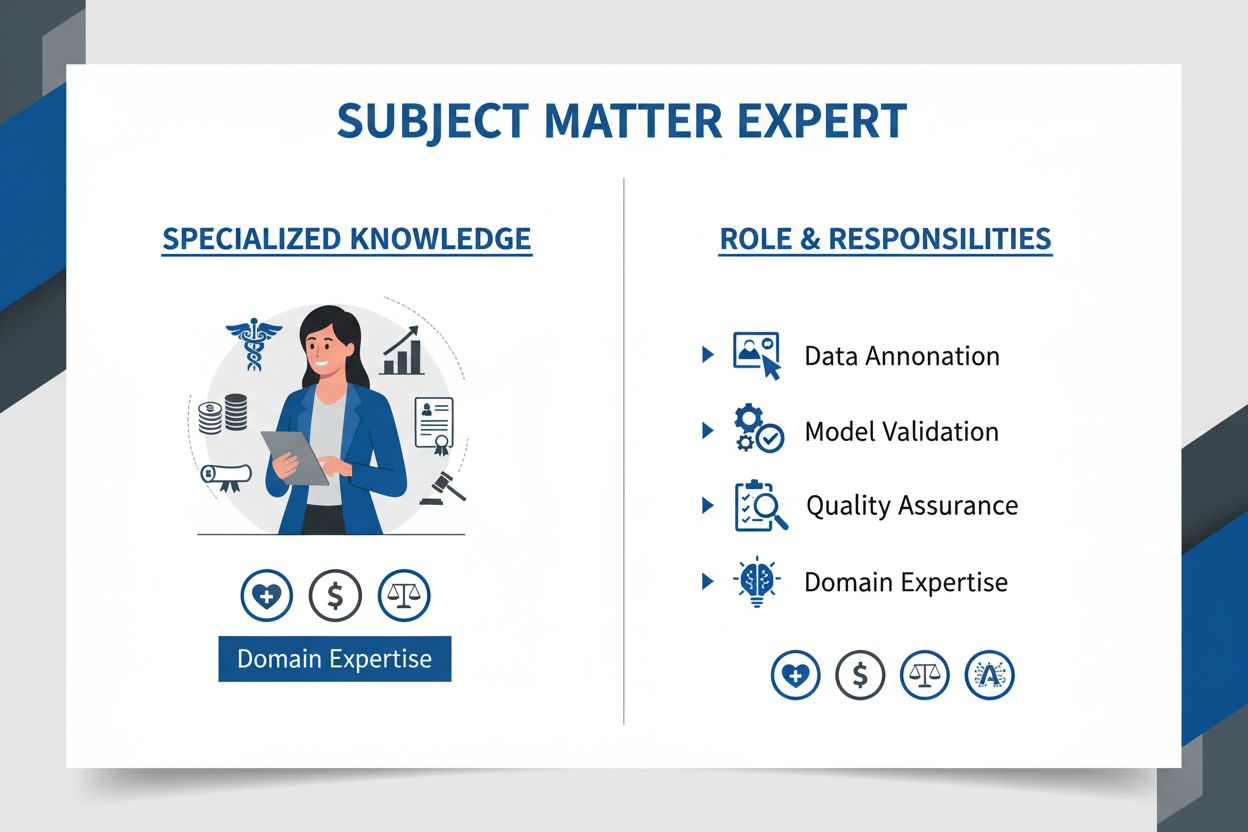
Subject Matter Expert (SME)
Learn what a Subject Matter Expert (SME) is, their critical role in AI model training, data annotation, validation, and how they ensure AI systems are accurate ...
8 min read
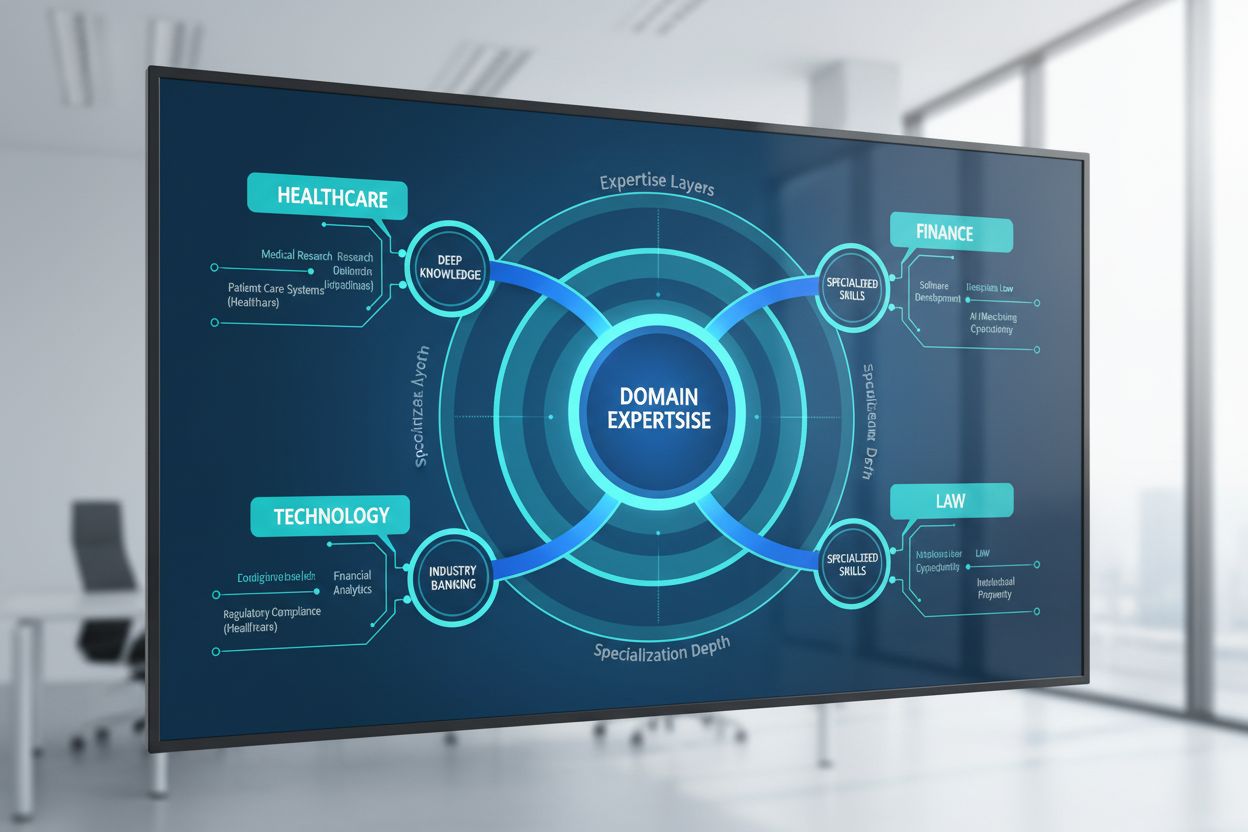
Domain expertise refers to specialized, in-depth knowledge and understanding of a specific field, industry, or subject matter that goes beyond surface-level familiarity. It encompasses the nuances, complexities, and contextual understanding that enable professionals to make informed decisions, solve complex problems, and provide authoritative guidance within their area of specialization.
Domain expertise refers to specialized, in-depth knowledge and understanding of a specific field, industry, or subject matter that goes beyond surface-level familiarity. It encompasses the nuances, complexities, and contextual understanding that enable professionals to make informed decisions, solve complex problems, and provide authoritative guidance within their area of specialization.
Domain expertise is specialized, in-depth knowledge and understanding of a specific field, industry, or subject matter that extends far beyond surface-level familiarity. It encompasses the nuances, complexities, contextual understanding, and practical experience that enable professionals to make informed decisions, solve intricate problems, and provide authoritative guidance within their area of specialization. Unlike general knowledge or basic competency, domain expertise represents a comprehensive mastery of a field’s principles, practices, trends, and unwritten rules. This type of knowledge is acquired through years of focused experience, continuous learning, and deep engagement with the subject matter. Domain expertise is increasingly recognized as a critical differentiator in professional success, organizational performance, and the reliability of AI systems that rely on human-verified information.
The concept of domain expertise has evolved significantly alongside professional specialization and the complexity of modern industries. Historically, expertise was often acquired through apprenticeships and long-term immersion in a craft or profession, with knowledge passed down through generations. In the 20th century, as industries became more specialized and technical, the value of domain knowledge became formalized through credentialing systems, professional certifications, and academic specialization. The rise of knowledge-based economies in the late 20th and early 21st centuries elevated domain expertise to a strategic asset for organizations. Today, with the emergence of artificial intelligence and machine learning, domain expertise has become essential for training, validating, and improving AI systems. Research from leading data science organizations shows that projects incorporating domain expertise in model development achieve 30-40% higher accuracy rates compared to those relying solely on algorithmic approaches. The integration of domain experts into AI workflows represents a fundamental shift in how organizations approach problem-solving and decision-making in specialized fields.
| Concept | Definition | Scope | Acquisition Time | Primary Application |
|---|---|---|---|---|
| Domain Expertise | Deep, specialized knowledge of a specific field with contextual understanding | Narrow and deep within one field | 5-10+ years of focused experience | Strategic decision-making, problem-solving, mentoring |
| Technical Skills | Specific, measurable abilities to perform job-related tasks using particular tools | Focused on tools and processes | 3-12 months of training | Task execution, operational work |
| General Knowledge | Broad, surface-level understanding across multiple fields | Wide but shallow | Ongoing informal learning | General communication, basic competency |
| Subject Matter Expertise (SME) | Recognized authority in a specific domain, often formally credentialed | Narrow and deep, typically recognized professionally | 7-15+ years with formal credentials | Consulting, policy development, training |
| Industry Knowledge | Understanding of trends, competitors, and dynamics within an industry | Industry-wide perspective | 2-5 years of industry experience | Market analysis, strategic planning |
Domain expertise is not a monolithic concept but rather a multidimensional construct that encompasses several interconnected layers of knowledge and capability. The foundational layer includes theoretical knowledge—understanding the principles, frameworks, and scientific foundations underlying the field. The second layer comprises practical experience—hands-on familiarity with how these principles apply in real-world situations, including the ability to recognize patterns and anticipate outcomes. The third layer involves contextual understanding—knowledge of industry trends, regulatory environments, competitive dynamics, and the broader ecosystem in which the domain operates. The fourth layer includes tacit knowledge—the unwritten rules, best practices, and intuitive understanding that comes only through extended immersion in a field. Research from the American Psychological Association indicates that developing true domain expertise typically requires a minimum of 10,000 hours of deliberate practice, though this varies significantly by field complexity. For professionals in fields like medicine, law, and specialized engineering, the development of domain expertise often extends over 15-20 years of continuous learning and practice. This multidimensional nature explains why domain expertise cannot be quickly acquired through training alone and why experienced professionals command premium compensation in specialized fields.
The integration of domain expertise into artificial intelligence systems has become a critical factor in improving model accuracy, reliability, and real-world applicability. When domain experts participate in training data annotation, they provide contextual judgment that algorithms cannot replicate, identifying edge cases, validating assumptions, and ensuring that training data reflects real-world complexity. Studies show that AI models trained with domain expert guidance achieve significantly higher accuracy rates in specialized applications. For example, in medical imaging, radiologists working with AI development teams can identify subtle diagnostic patterns that general annotators would miss, improving model sensitivity and specificity. The role of domain expertise extends beyond initial model training to ongoing validation and refinement. Domain experts serve as quality assurance reviewers, catching hallucinations and factual errors that might otherwise propagate through AI systems. In financial services, domain experts validate AI-generated risk assessments against regulatory requirements and market realities. In legal technology, lawyers review AI-generated contract analyses to ensure compliance with jurisdiction-specific requirements. This human-in-the-loop approach, where domain expertise guides AI development at multiple stages, has become the gold standard for creating reliable AI systems in high-stakes domains. Research from RWS TrainAI demonstrates that organizations using tiered expertise models—where senior domain experts focus on workflow design and edge cases while trained specialists handle routine annotation—achieve 40-60% cost reductions while maintaining accuracy standards.
Organizations that cultivate and leverage domain expertise consistently outperform competitors in strategic decision-making, innovation, and customer satisfaction. Research indicates that 96% of customers identify customer service quality as a significant factor in brand loyalty, and domain expertise is fundamental to delivering exceptional service. Customer Success Managers with deep domain expertise in both their product and customers’ industries can provide proactive solutions, anticipate needs before they become problems, and serve as trusted advisors rather than transactional service providers. This elevated level of service directly correlates with reduced churn rates and increased customer lifetime value. In product development, domain expertise enables teams to identify market opportunities, anticipate customer needs, and create solutions that resonate with target audiences. Companies like Apple and Tesla have built competitive advantages through leadership teams with deep domain expertise in their respective industries. In data science and analytics, professionals with strong domain expertise can interpret data findings in context, identify spurious correlations, and translate technical insights into actionable business recommendations. A data analyst with SQL proficiency but lacking retail industry knowledge might identify a statistical pattern without understanding its business implications, whereas a domain expert would recognize the pattern’s significance and recommend appropriate actions. The financial impact of domain expertise is substantial—organizations that prioritize domain knowledge in hiring and development report 25-35% higher employee productivity and significantly better project outcomes.
Building domain expertise requires a deliberate, multi-faceted approach that combines formal learning, practical experience, mentorship, and continuous engagement with the field. The first step involves establishing a strong foundation through formal education, certifications, and structured learning programs relevant to the chosen domain. This provides the theoretical framework and vocabulary necessary for deeper understanding. The second step requires accumulating practical experience through hands-on work, project involvement, and real-world problem-solving. This experiential learning is where tacit knowledge develops—the intuitive understanding that comes from repeatedly encountering and solving domain-specific challenges. Mentorship accelerates domain expertise development by providing guidance from experienced professionals who can share insights, help avoid common pitfalls, and provide context that might take years to discover independently. Continuous learning through industry publications, conferences, professional networks, and ongoing education ensures that domain expertise remains current as fields evolve. For Customer Success Managers, building domain expertise involves using the company’s own product extensively, learning from colleagues with deeper experience, and conducting research into customers’ industries. For data scientists, developing domain expertise means collaborating with business stakeholders, understanding the data’s business context, and studying how domain-specific factors influence data patterns. Organizations can systematically build domain expertise by creating knowledge-sharing systems, establishing mentorship programs, and allocating time for professional development. Companies that invest in these infrastructure elements report significantly higher retention of experienced professionals and faster development of expertise in emerging team members.
The emergence of AI search platforms like ChatGPT, Perplexity, Google AI Overviews, and Claude has created new dynamics around how domain expertise is recognized and cited. These platforms rely on training data that includes content from across the internet, and they prioritize sources that demonstrate clear domain expertise when generating responses. Research from AI citation tracking platforms shows that across nearly every industry, sources demonstrating strong domain expertise receive disproportionately high citation rates in AI-generated responses. For organizations and professionals, this means that establishing recognized domain expertise directly impacts visibility in AI search results. AmICited and similar monitoring platforms track how often specific domains and URLs are cited by AI systems, providing insights into domain authority in the AI era. Content created by recognized domain experts is more likely to be cited by AI systems, making domain expertise a key factor in AI-driven visibility. This creates an incentive for organizations to invest in content that clearly demonstrates domain expertise, as such content is more likely to be surfaced and cited by AI systems. For professionals, building recognized domain expertise through publications, speaking engagements, and thought leadership increases the likelihood that AI systems will cite their work when generating responses on relevant topics. This shift represents a fundamental change in how authority and credibility are established in the digital age, where AI systems serve as intermediaries between information creators and consumers.
The future of domain expertise is being shaped by several converging trends that will fundamentally alter how specialized knowledge is developed, valued, and applied. The increasing complexity of global challenges—from climate change to pandemic response to financial system stability—demands deeper domain expertise across multiple interconnected fields. Simultaneously, the rapid pace of technological change means that domain expertise must be continuously updated to remain relevant. Organizations are increasingly recognizing that sustainable competitive advantage comes from cultivating deep domain expertise rather than pursuing generic operational efficiency. The integration of domain expertise with artificial intelligence represents a critical frontier, where human judgment and machine learning capabilities combine to solve problems neither could address independently. As AI systems become more sophisticated, the role of domain experts is evolving from task execution to strategic oversight, workflow design, and quality assurance. This shift creates new opportunities for domain experts to amplify their impact while also raising questions about how to scale expertise in specialized domains. The emergence of domain-specific AI models—fine-tuned versions of large language models trained on domain-specific data—represents another evolution in how domain expertise is embedded into technology. These specialized models, guided by domain experts, promise to deliver more accurate and contextually appropriate outputs than general-purpose AI systems. Looking forward, organizations that successfully combine deep domain expertise with technological capability will likely emerge as industry leaders. The strategic imperative is clear: invest in developing and retaining domain expertise, create systems that leverage this expertise effectively, and continuously adapt as domains evolve. For professionals, the message is equally clear: deep domain expertise remains one of the most valuable and defensible career assets in an increasingly automated world.
Domain expertise and technical skills serve complementary but distinct purposes in professional contexts. Technical skills are specific, measurable abilities to perform job-related tasks using particular tools or software, while domain expertise represents broader, contextual understanding of an entire industry or field. A data analyst with SQL proficiency (technical skill) combined with retail industry knowledge (domain expertise) can create more targeted solutions. The strongest candidates blend both, as domain expertise provides the strategic context for applying technical skills effectively.
Domain expertise significantly improves AI model performance by incorporating contextual understanding that algorithms alone cannot achieve. When domain experts guide AI training data annotation and model validation, they catch nuances and edge cases that general annotators might miss. Research shows that integrating domain knowledge into AI systems reduces hallucinations, improves factual accuracy, and ensures models produce outputs aligned with real-world requirements. This is particularly crucial in high-stakes fields like healthcare, finance, and legal services where accuracy directly impacts outcomes.
Domain expertise can absolutely be cultivated and developed over time through deliberate effort and structured learning. While some individuals may have prior experience in a field, professionals can build domain expertise through research, mentorship, formal education, hands-on experience, and continuous learning. The process typically involves understanding industry trends, learning specialized terminology, studying case studies, and gaining practical experience. Most professionals develop deeper domain expertise the longer they work within a specific field, making it an achievable goal for career development.
Domain expertise directly influences how AI systems cite and trust sources for authoritative information. AI models like ChatGPT, Perplexity, and Claude prioritize sources that demonstrate clear domain expertise when generating responses. Platforms like AmICited track how often AI systems cite specific domains, and those with established domain authority receive more citations. Content created by recognized domain experts is more likely to be cited by AI systems, making domain expertise a key factor in AI-driven visibility and authority in the search landscape.
All industries benefit from domain expertise, but it's particularly critical in specialized fields including healthcare and medicine, financial services and investment, legal and compliance, pharmaceutical development, aerospace and engineering, and climate science. In these sectors, domain expertise directly impacts safety, regulatory compliance, and decision quality. However, even in seemingly general fields like customer success, marketing, and product management, domain expertise significantly improves outcomes by enabling professionals to understand customer needs, industry trends, and competitive dynamics more deeply.
Organizations can scale domain expertise through a tiered approach that matches task complexity to expertise level. Rather than requiring senior experts for every task, companies can use trained junior specialists for routine work while reserving senior subject-matter experts for complex edge cases, quality assurance, and workflow design. This human-in-the-loop model, combined with clear guidelines and SME-validated rubrics, maintains quality while improving efficiency. Research shows this approach can reduce costs by 40-60% while maintaining accuracy standards in specialized domains like medical imaging and financial analysis.
Domain expertise is fundamental to customer success, with research showing that 96% of customers say customer service plays a large role in brand loyalty. Customer Success Managers with deep domain expertise in both their product and customers' industries can provide proactive solutions, anticipate needs, and serve as trusted advisors. This expertise enables CSMs to reduce churn, identify expansion opportunities, and deliver personalized experiences. Companies that invest in building domain expertise across their customer-facing teams typically see higher retention rates and increased customer lifetime value.
Start tracking how AI chatbots mention your brand across ChatGPT, Perplexity, and other platforms. Get actionable insights to improve your AI presence.
Learn what a Subject Matter Expert (SME) is, their critical role in AI model training, data annotation, validation, and how they ensure AI systems are accurate ...

Author expertise is demonstrated knowledge of a content creator showing qualifications, experience, and credibility. Learn how it impacts SEO, AI citations, and...

Expert author definition: A credible writer with subject expertise, credentials, and experience. Learn how expert authorship impacts E-E-A-T, AI citations, and ...
Cookie Consent
We use cookies to enhance your browsing experience and analyze our traffic. See our privacy policy.