


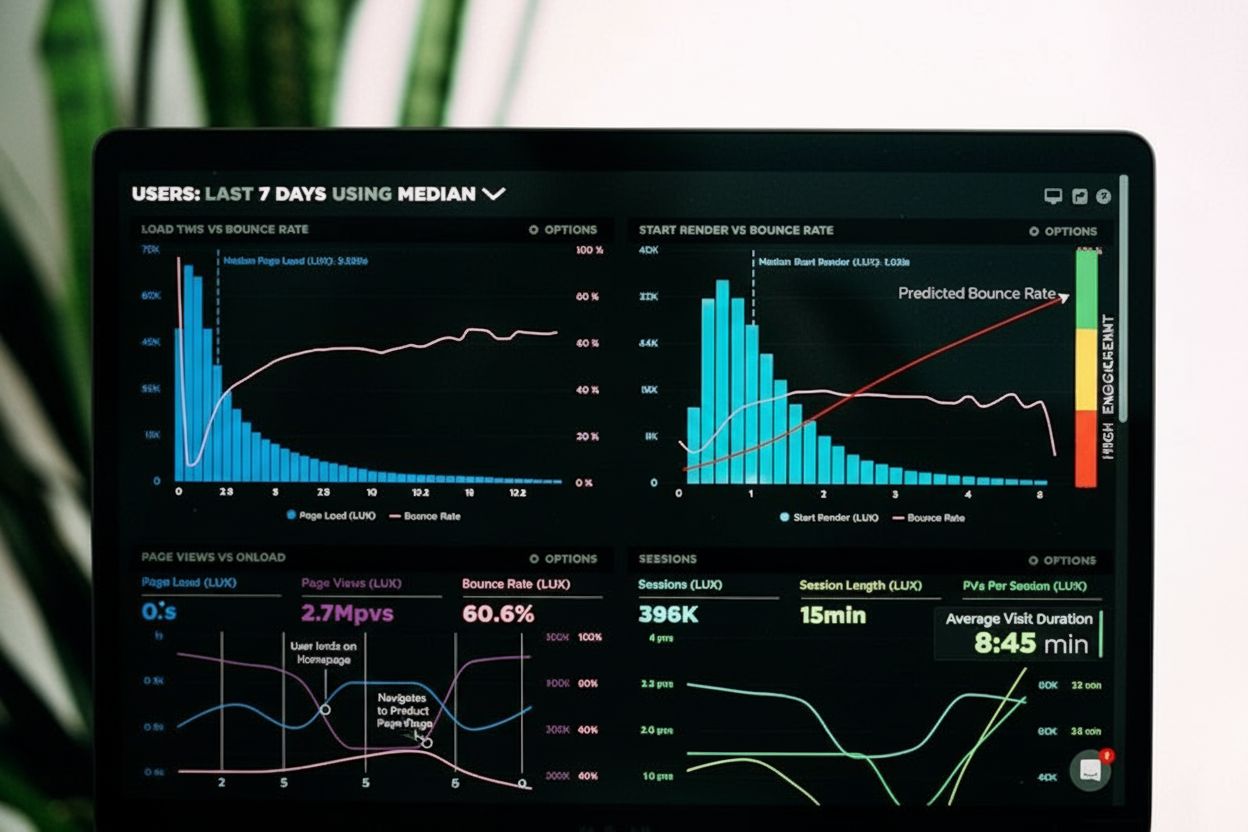
Session Duration
Session duration measures the total time users spend on a website per visit. Learn how to calculate it, why it matters for engagement, and how to improve it wit...
11 min read
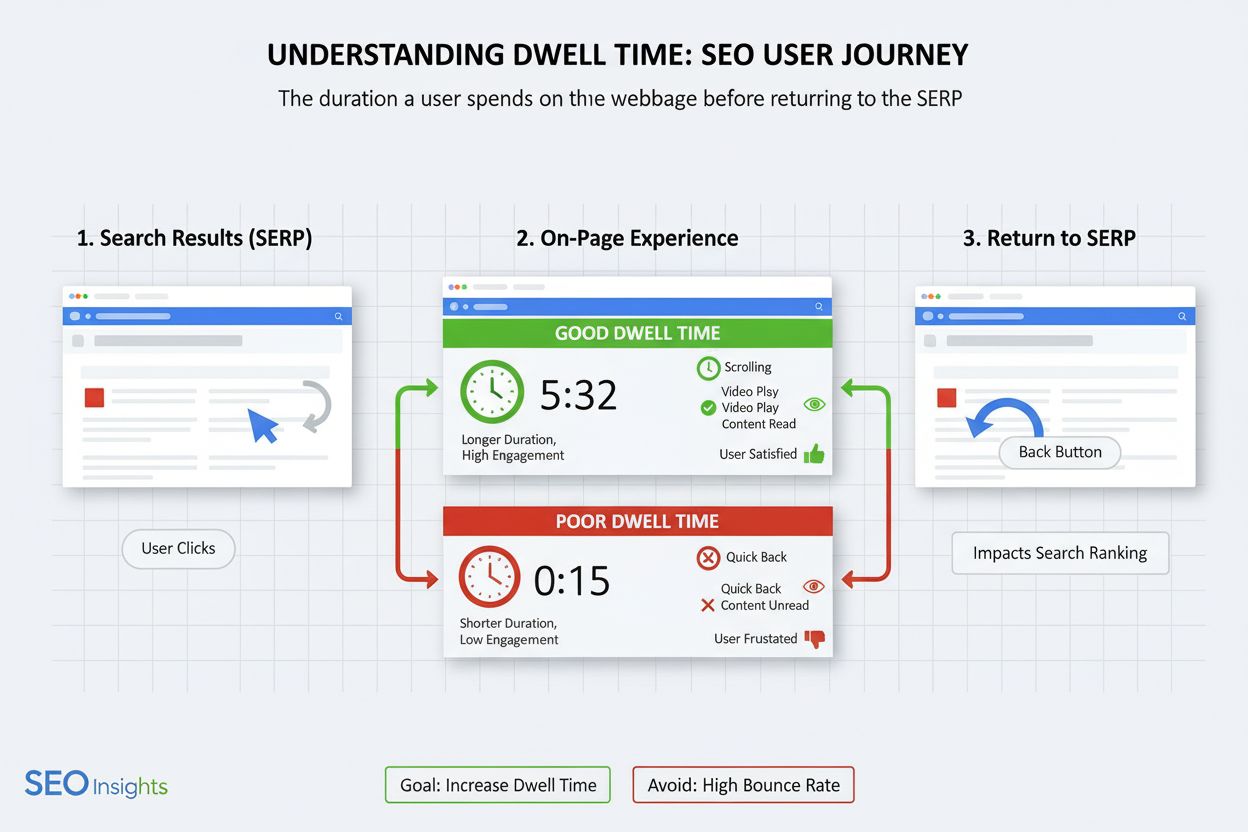
Dwell time is the duration a user spends on a webpage after clicking from search results before returning to the search engine results page (SERP). It measures user engagement and content relevance, serving as an indicator of whether content satisfies search intent and provides value to visitors.
Dwell time is the duration a user spends on a webpage after clicking from search results before returning to the search engine results page (SERP). It measures user engagement and content relevance, serving as an indicator of whether content satisfies search intent and provides value to visitors.
Dwell time is the duration a user spends on a webpage after clicking through from search engine results before returning to the search results page (SERP). It represents a critical engagement metric that indicates whether content successfully satisfies user search intent and provides genuine value. When a user searches for a query, clicks on a result, and spends several minutes reading before returning to search results, that elapsed time is their dwell time. Conversely, if a user clicks a result and immediately returns to the SERP within seconds, that represents a short dwell time. This metric has become increasingly important in the digital marketing landscape as search engines and content platforms seek to understand user satisfaction and content relevance beyond simple click-through rates.
The concept of dwell time was first formally introduced by Bing in 2011, when the search engine published a blog post identifying it as “a signal we watch” in their ranking algorithm. This marked one of the earliest official acknowledgments that search engines were tracking how long users spent on pages after clicking from search results. Since then, the metric has evolved from a theoretical concept to a widely discussed SEO metric, though its exact role in ranking algorithms remains debated. The term gained significant traction in the SEO community following the 2024 Google Search API leak, which revealed internal documents suggesting Google tracks “long clicks”—a metric remarkably similar to dwell time. This discovery reinvigorated discussions about dwell time’s importance, even though Google representatives have consistently denied using it as a direct ranking factor. Over the past decade, dwell time has become a standard metric that SEO professionals monitor through analytics platforms, representing a shift toward measuring user satisfaction as a proxy for content quality.

Track how AI chatbots mention your brand across ChatGPT, Perplexity, and other platforms.
Understanding how dwell time differs from related metrics is essential for accurate performance analysis. The following comparison table clarifies these distinctions:
| Metric | Definition | Scope | Measurement | SEO Relevance |
|---|---|---|---|---|
| Dwell Time | Time spent on page after clicking from SERP before returning | Search results only | Seconds to minutes | Indicates content relevance and user satisfaction |
| Bounce Rate | Percentage of visitors leaving without taking action | All traffic sources | Percentage (%) | Correlates with rankings but not direct factor |
| Average Engagement Time | Average duration users actively engage with content | All traffic sources | Seconds to minutes | Broader engagement indicator across all channels |
| Time on Page | Total time spent on page regardless of actions | All traffic sources | Seconds to minutes | General engagement metric, less precise than dwell time |
| Pogo-Sticking | Users repeatedly jumping between SERP and multiple pages | Search results only | Pattern behavior | Indicates poor content match to search intent |
This distinction matters because dwell time specifically measures satisfaction with search results, making it more relevant for SEO optimization than broader engagement metrics that include direct traffic or referral sources.
Measuring dwell time precisely requires understanding how modern analytics platforms track user behavior. Google Analytics 4 (GA4) does not provide a direct “dwell time” metric, but it offers “Average Engagement Time Per Session” which serves as the closest approximation. To measure dwell time effectively, SEO professionals should filter their analytics to show only organic search traffic, then analyze engagement time by individual page. This filtering is crucial because it isolates visitors arriving specifically from search results, excluding direct traffic, referrals, and other sources that would skew the data. The calculation involves summing all engagement durations for organic visitors and dividing by the number of sessions. According to research from Semrush and Backlinko, pages with average engagement times exceeding 3-4 minutes typically indicate strong content performance, though this varies significantly by industry and content type. For example, a technical guide might have optimal dwell times of 5-7 minutes, while a quick-answer page might perform well with 30-60 seconds. The key is establishing baseline metrics for your specific niche and then tracking improvements over time rather than comparing against arbitrary industry standards.
Get the latest insights on AI mentions, brand monitoring, and optimization strategies.
The question of whether dwell time is a Google ranking factor has generated considerable debate within the SEO community. Google representatives have made explicit statements denying dwell time’s role in rankings. Gary Illyes, Google’s Chief of Sunshine, stated that “dwell time, CTR, whatever Fishkin’s new theory is, those are generally made up crap. Search is much more simple than people think.” Similarly, Martin Splitt from Google confirmed that user interaction metrics like dwell time are not used in their search algorithm. However, this official denial contrasts sharply with evidence from the 2024 Google Search API leak, which revealed that Google internally tracks “long clicks”—a metric measuring how long users remain on pages before returning to search results. This apparent contradiction suggests that while Google may not use dwell time as a direct ranking signal, they definitely monitor it as a quality indicator and user satisfaction proxy. The leaked documents indicate Google’s machine learning systems, particularly RankBrain, analyze user behavior patterns including how long users spend on pages. This means dwell time likely influences rankings indirectly through its correlation with content quality, relevance, and user satisfaction rather than as a standalone ranking factor.
Dwell time serves as a powerful indicator of whether content truly matches user search intent and provides satisfactory answers. When users spend extended periods on a page, it signals that the content addresses their query comprehensively and engages them sufficiently to prevent immediate return to search results. Conversely, short dwell times often indicate content mismatch—users clicked expecting one thing but found something different. This relationship between dwell time and search intent has profound implications for content strategy. Research from Backlinko’s correlation studies found that pages with longer dwell times tend to rank higher in search results, though this correlation likely reflects causation through content quality rather than dwell time being a direct ranking factor. The user experience implications are equally important: pages with high dwell times typically feature clear navigation, fast loading speeds, engaging formatting, and content that directly answers user questions. These same factors independently improve SEO performance, suggesting that optimizing for dwell time naturally leads to better overall content quality and user satisfaction. For brands monitoring their presence across AI search platforms through tools like AmICited, understanding dwell time principles helps create content that not only engages human readers but also gets cited more frequently by AI systems that prioritize relevant, comprehensive information.
Improving dwell time requires a multifaceted approach addressing content quality, user experience, and search intent alignment. Here are essential tactics for increasing how long users remain engaged with your pages:
These strategies work synergistically to create an environment where users naturally spend more time engaging with your content because it genuinely serves their needs.
The emergence of AI search platforms like Perplexity, ChatGPT, Google AI Overviews, and Claude introduces new dimensions to dwell time considerations. While traditional dwell time measures time spent on web pages, AI search platforms operate differently by synthesizing information directly within their interfaces. However, these platforms still track user engagement signals—how long users interact with responses, whether they ask follow-up questions, and whether they click through to source pages. For brands using AmICited to monitor their visibility across AI search platforms, understanding dwell time principles becomes increasingly relevant. Content that generates longer dwell times on traditional search results is more likely to be comprehensive, authoritative, and well-structured—exactly the characteristics that make content attractive for AI citation. When AI systems evaluate sources for inclusion in their responses, they prioritize content that thoroughly addresses user queries, which correlates strongly with pages that achieve high dwell times. Additionally, as AI search traffic grows (currently representing less than 1% of global search traffic but expanding rapidly), the distinction between traditional dwell time and AI engagement metrics will become increasingly important. Brands should optimize content not just for human dwell time but also for the clarity, comprehensiveness, and citation-worthiness that AI systems require.
A software review site notices that its “best project management tools” article ranks on page one for its target keyword but has an unusually short average engagement time in GA4 compared to similar articles on the site. The team pulls the organic-traffic-filtered engagement data and confirms visitors are spending roughly 25 seconds on the page before leaving, well below the 3-4 minute range their other comparison articles typically achieve. Rather than guessing, they check three things in order. First, they compare the meta description and title against the actual page content and find the title promises a current-year pricing comparison while the pricing table is actually from the previous year — a mismatch between promise and delivery that would explain visitors bouncing immediately upon realizing the content is outdated. Second, they check page speed for the article specifically and find it loads in 4.8 seconds on mobile, well past the point where users commonly abandon before the content even renders. Third, they review the content structure and find the actual comparison table is buried below 800 words of generic introduction, meaning even patient visitors have to scroll extensively to reach the information the title promised. The team updates the pricing data, compresses the page’s images to cut load time to under 2 seconds, and moves the comparison table above the fold. Three weeks later, average engagement time on the page rises to roughly 2 minutes, confirming that the original short dwell time reflected genuine content problems rather than an unavoidable characteristic of that keyword or topic.
Start tracking how AI chatbots mention your brand across ChatGPT, Perplexity, and other platforms. Get actionable insights to improve your AI presence.
Session duration measures the total time users spend on a website per visit. Learn how to calculate it, why it matters for engagement, and how to improve it wit...
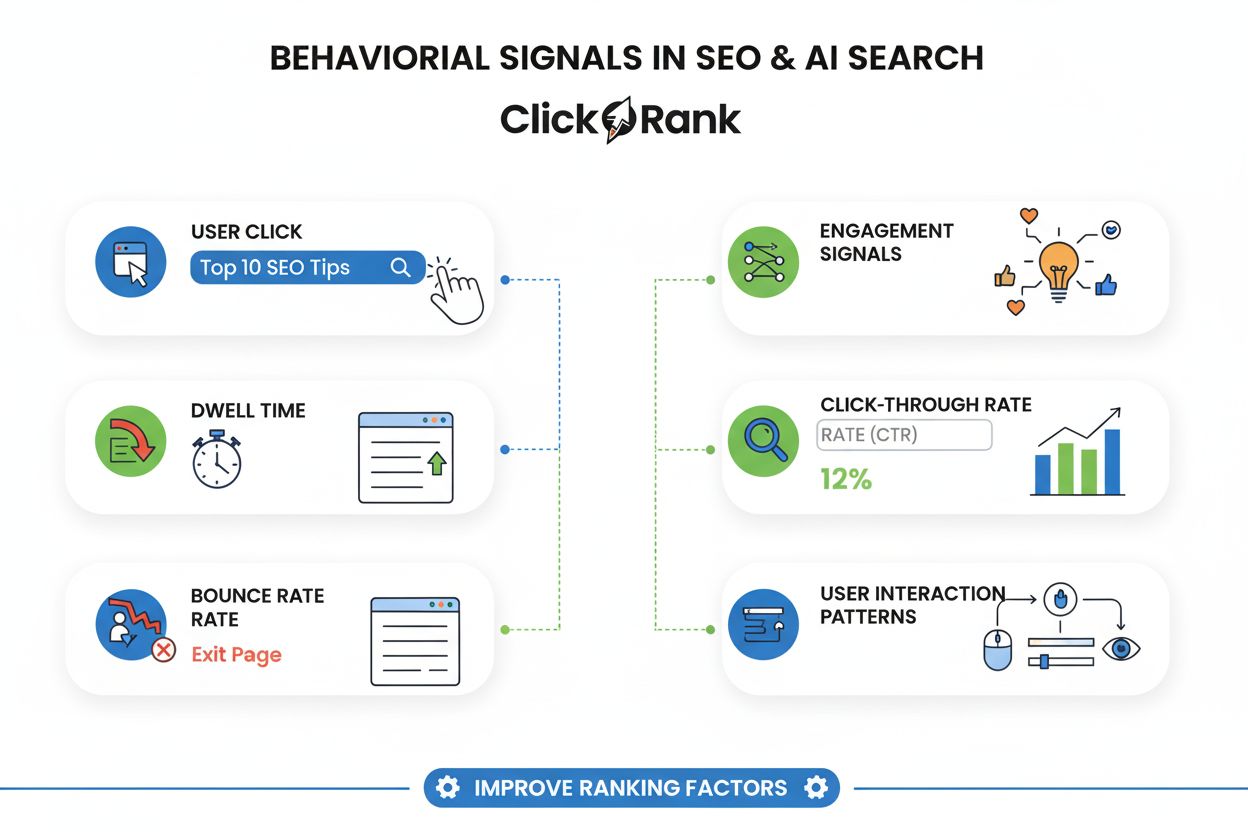
Behavioral signals measure user interactions like CTR, dwell time, and bounce rate. Learn how user action patterns affect SEO rankings and AI search visibility ...

Engagement signals are measurable indicators of user interaction with digital content. Learn how clicks, time spent, shares, and conversions impact SEO, AI moni...
Cookie Consent
We use cookies to enhance your browsing experience and analyze our traffic. See our privacy policy.