
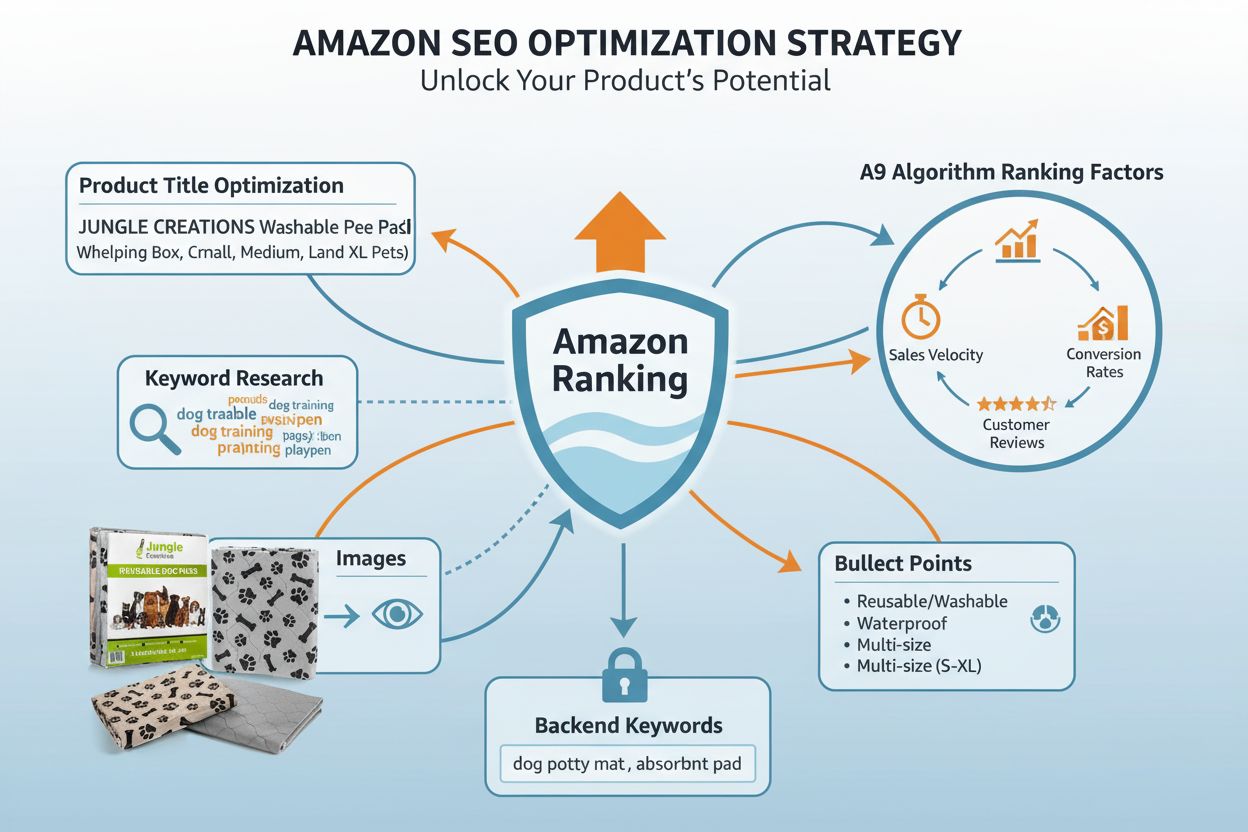
Amazon SEO
Learn what Amazon SEO is, how the A9 algorithm works, and proven strategies to optimize product listings for higher rankings and increased sales on Amazon's mar...
12 min read
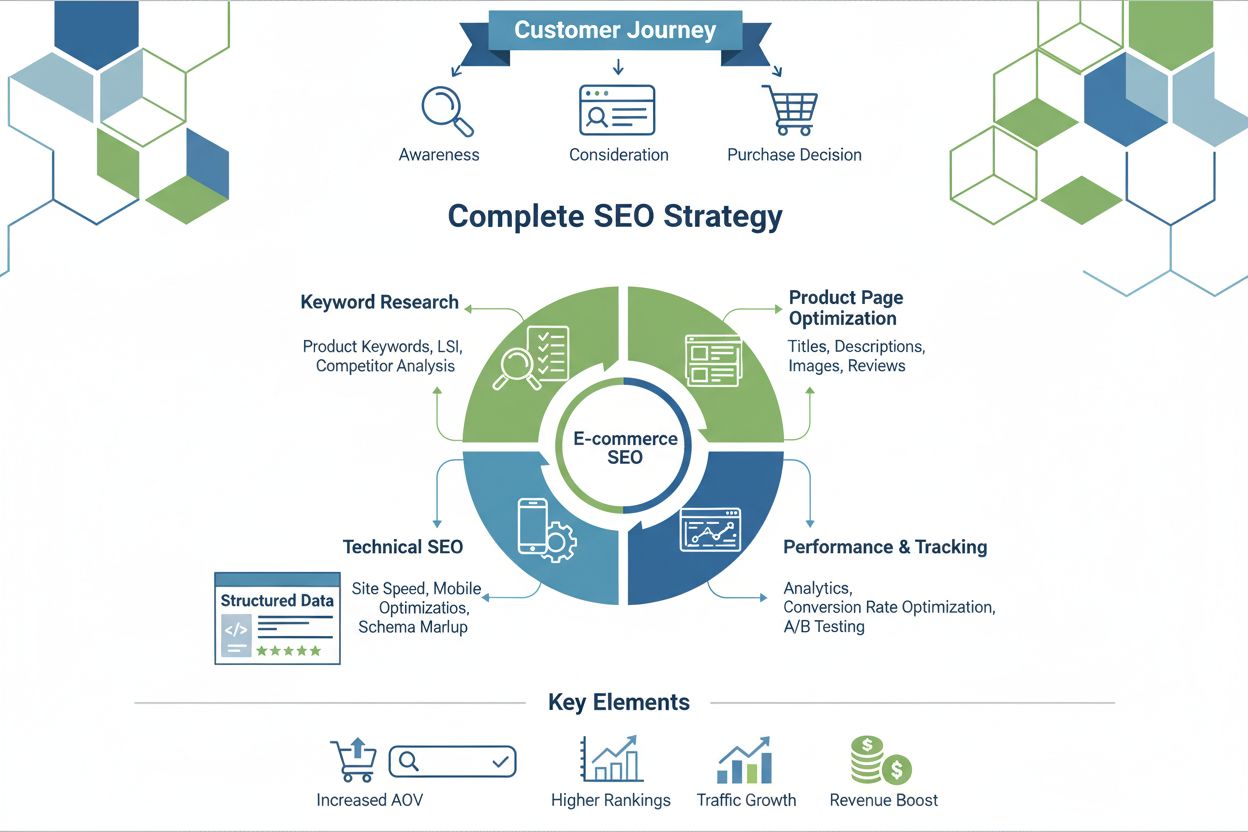
Ecommerce SEO is the process of optimizing an online store to increase its visibility in search engine results pages (SERPs) and drive qualified organic traffic that converts into sales. It encompasses keyword research, product page optimization, technical improvements, and content strategies specifically designed to help shoppers discover products through search engines like Google, Bing, and emerging AI search platforms.
Ecommerce SEO is the process of optimizing an online store to increase its visibility in search engine results pages (SERPs) and drive qualified organic traffic that converts into sales. It encompasses keyword research, product page optimization, technical improvements, and content strategies specifically designed to help shoppers discover products through search engines like Google, Bing, and emerging AI search platforms.
Ecommerce SEO is the specialized practice of optimizing online stores to increase their visibility in search engine results pages (SERPs) and drive qualified organic traffic that converts into purchases. Unlike traditional SEO, which often focuses on brand awareness and informational content, ecommerce SEO is fundamentally oriented toward capturing high-intent commercial keywords and guiding shoppers through the complete purchase journey. The discipline encompasses keyword research, product page optimization, technical site improvements, content strategy, and structured data implementation—all designed to help potential customers discover products through search engines like Google, Bing, and increasingly, AI-powered search platforms like ChatGPT, Perplexity, and Google AI Overviews. According to recent data, at least 43% of ecommerce traffic originates from Google’s organic search, and 23.6% of ecommerce orders are directly linked to organic traffic, making ecommerce SEO a critical revenue driver for online retailers.
The competitive landscape of online retail has made ecommerce SEO indispensable for sustainable business growth. With ecommerce generating $4.12 trillion in global revenue in 2024 and projected to exceed $6 trillion in 2025, the stakes for search visibility have never been higher. The vast majority of online shopping journeys begin with a search engine—93% of online experiences start with a search engine—meaning that retailers without a robust ecommerce SEO strategy are essentially invisible to a massive portion of their potential customer base. Furthermore, 51% of people discover new products or companies online, and 68% of online shoppers in the U.S. search for a product on Google before making a purchase. This underscores the reality that ecommerce SEO is not merely a marketing tactic but a foundational business requirement. The financial impact is substantial: SEO delivers an 8x ROI compared to PPC’s 4x return, and companies implementing ecommerce SEO strategies save up to 400% on ad spending without sacrificing customer acquisition. For online retailers, investing in ecommerce SEO means building a sustainable, long-term revenue stream that compounds over time while reducing dependence on expensive paid advertising channels.
A comprehensive ecommerce SEO strategy operates across multiple interconnected dimensions, each addressing different aspects of search visibility and conversion optimization. Keyword research forms the foundation, requiring retailers to identify both high-volume commercial keywords (such as “buy running shoes”) and long-tail keywords (such as “waterproof trail running shoes for women with arch support”). Long-tail keywords are particularly valuable in ecommerce SEO because they account for 65% of search queries and convert at 2.5 times the rate of broader terms, while facing significantly less competition. Product page optimization is the core execution layer, involving the creation of unique, comprehensive product descriptions, strategic keyword placement in titles and meta descriptions, high-quality product images with descriptive alt text, and the integration of customer reviews and ratings. Technical SEO ensures that search engines can efficiently crawl, index, and rank product pages—this includes optimizing site speed (critical since a one-second delay reduces conversions by 7%), implementing HTTPS security, creating XML sitemaps, and ensuring mobile responsiveness. Structured data implementation using schema markup helps search engines understand product information, pricing, availability, and reviews, enabling rich snippets and enhanced visibility in shopping results. Content strategy extends beyond product pages to include category pages, buying guides, comparison content, and blog posts that address customer questions throughout the purchase journey. Finally, link building and authority development strengthen domain authority, which correlates strongly with higher rankings—the #1 result in Google has an average of 3.8x more backlinks than positions 2-10.
| Aspect | Ecommerce SEO | Traditional SEO | Paid Search (PPC) | Social Commerce |
|---|---|---|---|---|
| Primary Goal | Drive product sales through organic search | Build brand awareness and traffic | Immediate conversions through paid ads | Social discovery and impulse purchases |
| Time to Results | 6-12 months for significant ROI | 3-6 months for initial gains | 1-2 weeks for traffic | Immediate but variable |
| Average ROI | 3.2x at 12 months | 2.1x (varies by niche) | 1.9x (declining over time) | 1.4x (platform-dependent) |
| Keyword Focus | Commercial intent, product-specific | Informational, brand, navigational | High-intent, competitive | Trending, hashtag-driven |
| Content Type | Product pages, category pages, reviews | Blog posts, guides, articles | Ad copy, landing pages | Visual content, videos, stories |
| Cost Structure | Upfront investment, decreasing marginal cost | Content creation, technical work | Per-click bidding, rising CPCs | Content creation, influencer fees |
| Scalability | Highly scalable with content velocity | Scalable but requires consistent effort | Limited by budget and CPC inflation | Limited by platform algorithm changes |
| Conversion Path | Direct product purchase from SERP | Multi-touch, often indirect | Direct from ad click | Often requires off-platform purchase |
| Sustainability | Compounds over time, long-term asset | Requires ongoing maintenance | Stops immediately when budget ends | Dependent on platform algorithm |
| Best For | Retailers with product catalogs | Publishers, SaaS, service providers | Time-sensitive promotions | Fashion, beauty, lifestyle brands |
Keyword research is the strategic foundation of any successful ecommerce SEO campaign, requiring a fundamentally different approach than traditional SEO. While traditional SEO often prioritizes informational keywords (such as “how to choose running shoes”), ecommerce SEO must balance informational keywords with commercial keywords that indicate purchase intent (such as “buy running shoes online” or “best running shoes for marathons”). The most valuable keywords for ecommerce SEO are those that combine high search volume with commercial intent and manageable competition—a combination that drives both traffic and conversions. Long-tail keywords deserve particular emphasis in ecommerce SEO strategy because they represent the sweet spot of opportunity: they have lower competition, higher conversion rates, and often reflect the specific product attributes customers are searching for. For example, a retailer selling athletic wear might target “black moisture-wicking running shirt for women” rather than just “running shirt,” capturing customers with precise needs and higher purchase intent. Keyword research tools like Ahrefs, SEMrush, and Google Keyword Planner help identify search volume, competition levels, and keyword difficulty metrics. Additionally, analyzing competitor websites reveals which keywords they rank for and which gaps exist in the market. Amazon autocomplete and Google autocomplete provide valuable insights into how real customers phrase their searches, often revealing long-tail variations and product-specific terminology that should inform ecommerce SEO strategy. Retailers should also monitor seasonal keyword trends—mobile searches for “best” have increased by over 80% in the past two years, indicating growing consumer reliance on comparative shopping through search. The strategic selection of keywords should consider the retailer’s product catalog, competitive landscape, and realistic ranking potential; attempting to rank for highly competitive head terms immediately is often inefficient compared to building authority through long-tail keyword wins first.
Product pages are the revenue-generating engine of ecommerce SEO, and their optimization directly impacts both search rankings and conversion rates. Each product page should be treated as a unique, valuable asset rather than a template-based placeholder. Title tags should be compelling and keyword-rich, typically following a pattern like “[Product Name] + [Key Attribute] + [Brand]"—for example, “Waterproof Trail Running Shoes for Women | Arch Support | BrandName.” Meta descriptions should highlight unique selling propositions, special offers, or key product benefits within 155-160 characters, as they influence click-through rates from search results. Product descriptions must be original, comprehensive, and benefit-focused rather than generic manufacturer copy; thin or duplicate content significantly harms ecommerce SEO performance. High-quality descriptions should address customer pain points, explain product features in customer-centric language, and naturally incorporate relevant keywords and long-tail variations. Product images are critical for both user experience and SEO—high-resolution images with zoom functionality and multiple angles reduce bounce rates and increase time-on-page, both positive signals to search engines. Alt text for images serves dual purposes: it helps search engines understand image content and improves accessibility for visually impaired users. Customer reviews and ratings provide multiple SEO benefits: they generate fresh, unique content; they create long-tail keyword variations naturally; they build trust signals that reduce bounce rates; and they improve time-on-page metrics. Retailers displaying reviews and ratings can experience conversion rate increases of up to 270%, and 93% of consumers say reviews influence their purchasing decisions. Structured data markup (schema.org) should be implemented to help search engines understand product information, pricing, availability, and review ratings, enabling rich snippets in search results. Internal linking from product pages to related category pages, complementary products, and informational content helps distribute link authority and guides both users and search engines through the site structure. Finally, page speed optimization is non-negotiable—88.5% of visitors abandon websites with slow loading times, and Google explicitly considers page speed a ranking factor, particularly for mobile searches.
Technical SEO provides the infrastructure that enables search engines to efficiently discover, crawl, index, and rank ecommerce content at scale. Site speed is a critical technical SEO factor for ecommerce, as a one-second delay in page load time can reduce conversions by 7%, and the average web page loads in 2.5 seconds on desktop and 8.6 seconds on mobile. Optimization techniques include image compression, lazy loading, content delivery networks (CDNs), and server-side caching. Mobile optimization is equally critical—62.73% of global website traffic comes from smartphones, and 77% of retail site visits occur on mobile devices. Google’s mobile-first indexing means the search engine crawls and ranks websites primarily based on their mobile version, making responsive design and mobile usability essential. HTTPS security is mandatory for ecommerce sites processing payment information; sites without HTTPS are flagged as “not secure” in browsers, damaging credibility and search rankings. XML sitemaps act as a roadmap for search engines, ensuring that important product pages, category pages, and content are discovered and indexed efficiently—particularly valuable for large ecommerce catalogs with thousands of products. Robots.txt files control which pages search engines can crawl, helping manage crawl budget for large sites. Canonicalization prevents duplicate content issues by specifying the “master version” of pages when multiple URLs contain similar content—a common problem in ecommerce with product filters, sorting options, and variant pages. Structured data implementation using schema.org markup helps search engines understand product information, pricing, availability, reviews, and other ecommerce-specific data, enabling rich snippets and enhanced visibility in shopping results. Core Web Vitals—including Largest Contentful Paint (LCP), First Input Delay (FID), and Cumulative Layout Shift (CLS)—are Google ranking factors that measure user experience; only 51.8% of websites currently meet recommended Core Web Vitals standards, representing an opportunity for competitive advantage. Redirect management is important for ecommerce sites undergoing product discontinuations, category restructuring, or platform migrations; improper redirects waste crawl budget and dilute link authority.
The dominance of mobile commerce has fundamentally reshaped ecommerce SEO strategy and priorities. Smartphones account for 77% of retail site visits and 68% of online orders, making mobile optimization not merely a nice-to-have but a business-critical requirement. Mobile users have a 56.8% average bounce rate, higher than desktop users at 50%, indicating that poor mobile experiences directly harm both SEO metrics and conversion rates. Google’s mobile-first indexing means the search engine primarily crawls and ranks the mobile version of websites, making mobile performance the primary ranking consideration. Page speed is particularly critical on mobile—users expect pages to load in under 3 seconds, and 79% of smartphone users have purchased online in the last six months, indicating that mobile commerce is not a future trend but a present reality. Responsive design ensures that websites adapt seamlessly to different screen sizes and orientations, providing an optimal viewing experience across devices. Touch-friendly interfaces with appropriately sized buttons and spacing are essential for mobile usability; small, cramped buttons increase bounce rates and reduce conversions. Simplified checkout processes are critical for mobile commerce—complex, multi-step checkout flows cause cart abandonment, particularly on mobile devices where typing is cumbersome. Mobile searches for “best” have increased by over 80% in the past two years, indicating that mobile users are actively researching and comparing products through search, making mobile-optimized product pages essential for capturing this traffic. Voice search optimization is increasingly important as 32% of consumers use voice search on a daily basis, and 58% of Americans ages 25-34 use voice search daily. Voice searches tend to be more conversational and question-based, requiring ecommerce SEO strategies that target natural language queries and featured snippet opportunities. Local mobile searches are particularly valuable for retailers with physical locations—76% of consumers who search for “near me” visit a business within a day, and 78% of local mobile searches lead to offline purchases.
While product pages are the primary revenue generators in ecommerce SEO, a comprehensive content strategy that includes blog posts, buying guides, comparison articles, and educational content significantly amplifies organic visibility and traffic. 61% of online consumers in the U.S. make purchases based on blog recommendations, demonstrating that content marketing and ecommerce SEO are deeply interconnected. Blog content serves multiple strategic purposes: it targets informational keywords that product pages cannot efficiently rank for, it builds topical authority and domain expertise, it generates internal linking opportunities to product pages, and it provides value that builds customer trust and brand loyalty. Effective ecommerce SEO blog strategies focus on content that addresses customer questions throughout the purchase journey—from awareness-stage content like “how to choose running shoes” to consideration-stage content like “best running shoes for marathons” to decision-stage content like “top-rated running shoes under $150.” Brands that publish 16+ blogs per month experience 3.5 times more traffic, indicating that content velocity matters significantly. However, quality trumps quantity; only 3% of blogs on the internet regularly publish articles that are 2,000+ words, and longer, more comprehensive content tends to rank better and provide more value. User-generated content like customer reviews, testimonials, and photos significantly boosts ecommerce SEO performance—websites featuring user-generated content receive 55% more traffic, and 82% of consumers consider user-generated content extremely valuable when making a purchase. Video content is increasingly important for ecommerce SEO; adding product videos can boost conversions by 17% and engagement by 33%, and 89% of businesses use video in their marketing strategy. Seasonal content aligned with shopping seasons, holidays, and product launches helps capture time-sensitive search traffic; seasonal keywords can see interest spikes of up to 400% during peak times. The strategic integration of blog content with product pages through internal linking helps distribute link authority, improves site structure clarity, and guides customers through the purchase journey.
Backlinks remain one of Google’s most important ranking factors, and ecommerce SEO strategies must include deliberate link-building efforts to compete effectively. The #1 result in Google has an average of 3.8x more backlinks than positions 2-10, and 96% of websites in Google’s top 10 have more than 1,000 links from unique domains, illustrating the importance of link authority for competitive keywords. However, almost 95% of pages have zero backlinks, meaning that even modest link-building efforts can provide competitive advantage. Link building for ecommerce differs from traditional link building because product pages are often less “linkable” than informational content; therefore, successful ecommerce SEO link strategies often focus on building links to informational content, brand pages, and company resources that then pass authority to product pages through internal linking. Guest posting on relevant industry blogs, publications, and media outlets can generate high-quality backlinks while establishing brand authority. Press mentions and media coverage naturally generate backlinks and brand visibility; services like “Help a B2B Writer” connect brands with journalists seeking expert sources. Partnerships and collaborations with complementary brands, influencers, and industry organizations can generate backlinks and co-marketing opportunities. Resource pages and industry directories often link to relevant ecommerce sites; identifying and pursuing these opportunities can yield valuable backlinks. Broken link building—identifying broken links on relevant websites and suggesting your content as a replacement—is an effective, ethical link-building tactic. Unlinked brand mentions represent missed opportunities; tools can identify instances where your brand is mentioned without a link, allowing you to reach out and request linkification. It’s important to note that 92% of surveyed SEO specialists believe that competitors buy links, and while paid links can provide short-term ranking boosts, they violate Google’s guidelines and risk penalties; sustainable ecommerce SEO relies on earning links through content quality and relationship building.
Measuring the return on investment (ROI) of ecommerce SEO is essential for justifying continued investment and optimizing strategy. According to First Page Sage’s comprehensive 2025 research analyzing 80 ecommerce clients across 5 verticals, ecommerce SEO delivers measurable ROI over time: at 6 months, the average ROI is 0.8x (early gains from technical SEO and quick wins); at 12 months, 2.6x; at 18 months, 3.8x; at 24 months, 4.6x; and at 36+ months, 5.2x. This compounding ROI demonstrates that ecommerce SEO is fundamentally a long-term investment that accelerates over time. Ecommerce SEO ROI varies by vertical—specialty retail achieves 4.2x ROI at 12 months, while apparel and fashion achieve 2.8x, reflecting differences in search behavior, competition, and content alignment. Ecommerce SEO ROI also varies by company size—companies with $1M-$10M in annual revenue achieve the highest ROI at 3.3x, while smaller companies often lack resources for aggressive content velocity and larger enterprises may prioritize branding over direct sales attribution. Organic search drives over 53% of traffic to ecommerce websites, and 70-80% of online shoppers ignore paid ads in favor of organic results, indicating that organic visibility directly impacts customer acquisition. Organic search boasts an average conversion rate of 2.8%, outperforming social media and email, though email marketing shows higher ROI when accounting for list quality. Returning visitors convert 15% higher than new visitors, emphasizing the importance of building organic traffic that generates repeat customers. Customer reviews can increase revenue per visitor by 62%, demonstrating that ecommerce SEO investments in review generation and display directly impact revenue. Key performance indicators (KPIs) for ecommerce SEO include organic traffic volume, keyword rankings for target terms, conversion rate from organic traffic, average order value from organic customers, customer acquisition cost (CAC) from organic channels, and lifetime value (LTV) of organic customers.
The emergence of AI-powered search platforms like ChatGPT, Perplexity, Google AI Overviews, and Claude is fundamentally reshaping ecommerce SEO strategy and creating new opportunities for brand visibility and product discovery. Nearly 60% of US shoppers now use AI tools like ChatGPT or Gemini to assist with purchases, indicating that AI search is no longer a future consideration but a present reality affecting customer behavior. AI Overviews now appear on approximately 27.2% of U.S. searches, and 88.1% of queries that trigger an AI Overview are informational, meaning that AI systems are increasingly answering customer questions and providing product recommendations. This shift creates both challenges and opportunities for ecommerce SEO: while 27.2% of U.S. searches now end without a click (up from 24.4% in March 2024) as AI Overviews provide instant answers, ecommerce brands that appear in AI-generated responses gain significant visibility and credibility. Monitoring AI search visibility has become an essential component of modern ecommerce SEO strategy. Tools like AmICited help ecommerce brands track where their products appear in AI search results, monitor competitor mentions, and understand how AI systems are citing and recommending their products. Structured data optimization becomes even more critical in the AI search era, as AI systems rely on schema markup to understand product information, pricing, availability, and reviews. Content quality and E-E-A-T signals (Experience, Expertise, Authoritativeness, Trustworthiness) are increasingly important for AI citation, as AI systems prioritize authoritative, trustworthy sources. Customer reviews and ratings are particularly valuable for AI search visibility, as AI systems often cite reviews when making product recommendations. Brand monitoring across AI platforms helps ecommerce retailers understand how their products are being discovered and recommended by AI systems, enabling optimization of product information and content to improve AI search visibility. The integration of AI search monitoring with traditional ecommerce SEO creates a comprehensive visibility strategy that captures customers across all search channels—traditional search engines, AI-powered search platforms, and emerging search interfaces.
Successful ecommerce SEO implementation requires a systematic, prioritized approach that balances quick wins with long-term strategic investments. The following framework provides a structured approach to ecommerce SEO execution:
The future of ecommerce SEO will be shaped by the continued evolution of AI-powered search, changing consumer behavior, and emerging technologies that transform how customers discover and purchase products. 66% of consumers believe AI will replace traditional search within five years, indicating a fundamental shift in search behavior that ecommerce retailers must prepare for. Generative AI adoption in marketing continues to accelerate—56% of marketers are already using AI, and 65% of companies report better SEO results with AI assistance. This suggests that ecommerce SEO professionals will increasingly leverage AI tools for keyword research, content generation, technical optimization, and performance analysis. Voice search and visual search will continue growing in importance—over 1.5 billion people use Google Lens every month, and 35% of smartphone users use voice search for shopping-related queries, requiring ecommerce SEO strategies that optimize for these emerging search modalities. Personalization and user intent will become increasingly sophisticated, with search engines and AI systems providing highly customized results based on user behavior, location, device, and preferences. Zero-click searches will likely continue increasing as AI systems provide direct answers without requiring users to visit websites, making ecommerce SEO strategies that focus on AI citation and visibility increasingly important. Sustainability and ethical ecommerce may become ranking factors as consumers increasingly prioritize environmentally responsible and socially conscious brands. International and multilingual ecommerce SEO will grow in importance as global ecommerce expands and cross-border shopping increases. The integration of ecommerce SEO with AI search monitoring, brand visibility tracking, and customer experience optimization will become standard practice for competitive online retailers. Ultimately, the future of ecommerce SEO will reward retailers who combine technical excellence, content quality, user experience optimization, and strategic adaptation to emerging search technologies—creating comprehensive visibility strategies that capture customers across all search channels and conversion pathways.
While both follow core SEO principles, ecommerce SEO is specifically tailored for online stores and focuses on product discovery and sales conversion. Ecommerce SEO emphasizes product pages, category pages, and transactional keywords with buying intent, whereas traditional SEO often targets informational content and brand awareness. Ecommerce SEO also requires optimization for product feeds, structured data for shopping results, and strategies to capture high-intent commercial keywords that drive immediate purchases.
Ecommerce SEO typically shows initial results within 3-6 months, with more significant gains appearing between 6-12 months. According to First Page Sage's 2025 research, ecommerce sites achieve an average ROI of 0.8x at 6 months, 2.6x at 12 months, and 3.8x at 18 months. The timeline depends on competition level, site authority, content velocity, and the competitiveness of your target keywords. Specialty retail niches often see faster results than highly competitive categories like fashion or electronics.
The top ecommerce SEO ranking factors include site speed and mobile optimization (Google's Core Web Vitals), product page quality and uniqueness, structured data implementation, backlink authority, user experience signals, and keyword relevance. Mobile optimization is particularly critical since 77% of retail site visits come from smartphones. Additionally, customer reviews, product images with alt text, and clear site architecture significantly impact rankings. Technical SEO elements like HTTPS security, XML sitemaps, and proper canonicalization are also essential for ecommerce success.
As AI-powered search platforms like ChatGPT, Perplexity, and Google AI Overviews grow in prominence, ecommerce SEO is evolving to include visibility in AI search results. Nearly 60% of US shoppers now use AI tools like ChatGPT or Gemini to assist with purchases. Ecommerce brands must now monitor their appearance in AI-generated responses and ensure their product information is cited by AI systems. Tools like AmICited help track brand mentions and product visibility across AI platforms, making AI search monitoring an emerging component of comprehensive ecommerce SEO strategy.
Ecommerce SEO delivers superior long-term ROI compared to paid advertising. First Page Sage's 2025 data shows SEO achieves 3.2x average ROI at 12 months, compared to 1.9x for Google Ads and 1.4x for Meta Ads. While email marketing shows 4.5x ROI, it depends on upstream traffic generation often sourced from SEO. Importantly, SEO's ROI compounds over time with decreasing marginal costs, whereas paid channels plateau quickly. For every $1 spent on SEO, ecommerce brands can expect approximately $3 in return when executed as a long-term strategy.
Product reviews and user-generated content are critical for ecommerce SEO success. Over 99% of consumers read reviews when shopping online, and 93% of consumers say reviews influence their purchasing decisions. Ecommerce websites displaying reviews and ratings can experience conversion rate increases of up to 270%. From an SEO perspective, reviews provide fresh, unique content that search engines value, improve time-on-page metrics, and build trust signals. Customer reviews also generate long-tail keyword variations naturally, helping pages rank for diverse search queries related to product features and benefits.
Mobile optimization is absolutely critical for ecommerce SEO. Smartphones account for 77% of retail site visits and 68% of online orders globally. Google uses mobile-first indexing, meaning it crawls and ranks websites primarily based on their mobile version. A one-second delay in mobile page load time can reduce conversions by 7%, and 88.5% of visitors abandon websites with slow loading times. Mobile users have a 56.8% average bounce rate, higher than desktop users at 50%. Responsive design, fast loading speeds, simplified checkout processes, and touch-friendly interfaces are essential for both SEO rankings and conversion optimization.
Start tracking how AI chatbots mention your brand across ChatGPT, Perplexity, and other platforms. Get actionable insights to improve your AI presence.
Learn what Amazon SEO is, how the A9 algorithm works, and proven strategies to optimize product listings for higher rankings and increased sales on Amazon's mar...

Enterprise SEO is the practice of optimizing large, complex websites with thousands of pages for search engines. Learn strategies, challenges, and best practice...
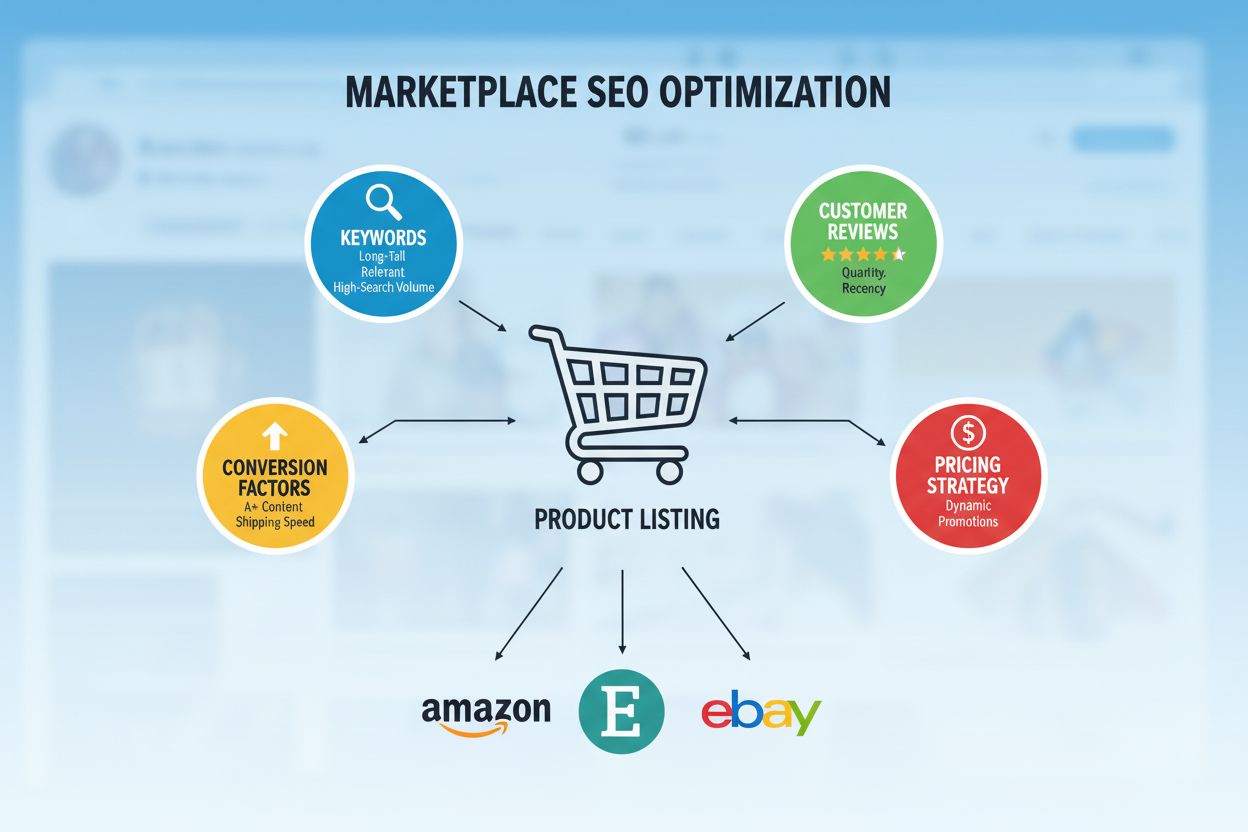
Marketplace SEO optimizes product listings on platforms like Amazon, Etsy, and eBay for higher visibility and conversions. Learn strategies, algorithms, and bes...
Cookie Consent
We use cookies to enhance your browsing experience and analyze our traffic. See our privacy policy.