
What is Evergreen Content for AI Search?
Learn how evergreen content stays relevant for AI search engines like ChatGPT and Perplexity. Discover why timeless content matters for AI citations and visibil...
9 min read
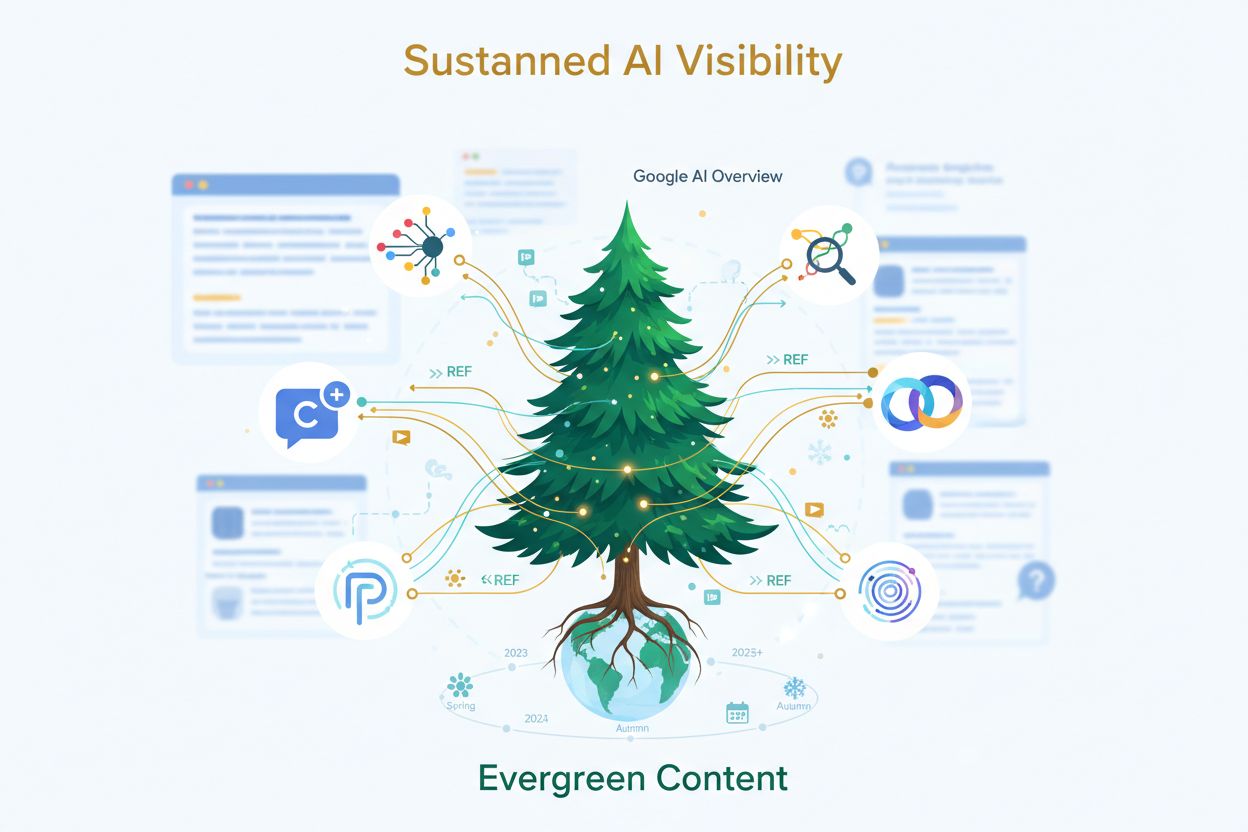
Content designed for sustained AI visibility over extended time periods through structured, modular optimization for LLM extraction and citation. Unlike traditional evergreen content, AI evergreen content prioritizes entity relationships, chunk-level answerability, and freshness signals to maintain influence across AI systems, chat interfaces, and answer engines for years after publication.
Content designed for sustained AI visibility over extended time periods through structured, modular optimization for LLM extraction and citation. Unlike traditional evergreen content, AI evergreen content prioritizes entity relationships, chunk-level answerability, and freshness signals to maintain influence across AI systems, chat interfaces, and answer engines for years after publication.
Evergreen AI content represents a fundamental evolution of traditional evergreen content, designed specifically for extraction and citation by large language models, AI overviews, and answer engines. While traditional evergreen content focuses on timeless topics that maintain search engine rankings over extended periods, AI evergreen content must be structured, modular, and optimized for LLM ingestion and answer generation. This content type prioritizes entity relationships, conceptual clarity, and chunk-level answerability—ensuring that individual sections can be extracted and cited independently by AI systems. The core distinction lies in how visibility is achieved: rather than relying solely on SERP rankings, AI evergreen content maintains influence across multiple AI interfaces, chat systems, and knowledge synthesis platforms. Sustained visibility in the AI era means your content continues to be referenced, extracted, and attributed by AI systems months or years after publication.
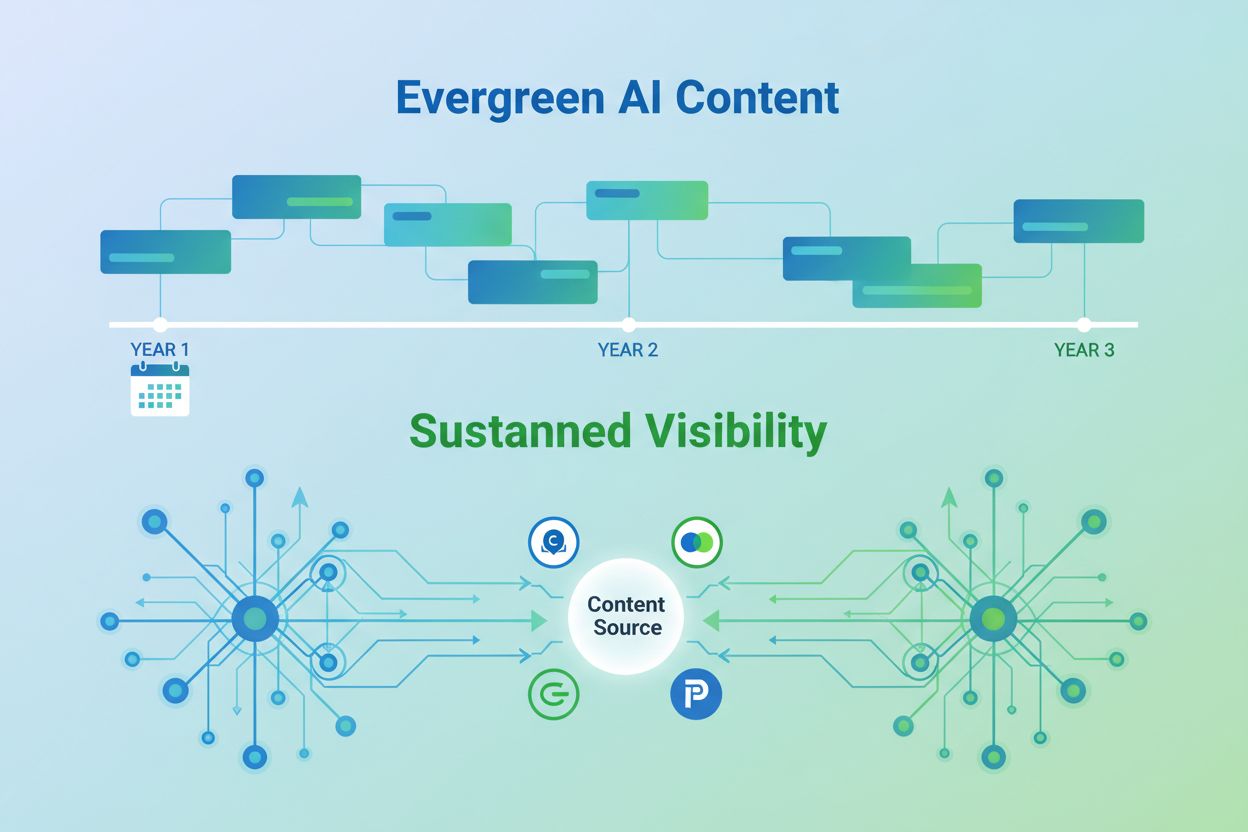
The business value of evergreen AI content extends far beyond traditional SEO metrics, offering compounding returns through continuous AI citations and brand visibility. As AI systems become primary discovery mechanisms for users, content that appears in AI answers generates sustained traffic, authority signals, and brand mentions without requiring constant promotional effort. The shift from search rankings to answer extraction fundamentally changes how content performs over time, creating opportunities for brands willing to optimize for AI consumption patterns. Unlike traditional evergreen content with a 24-36 month relevance window, properly structured AI evergreen content can influence AI training datasets and retrieval systems for years. This extended lifespan translates to lower content production costs per impression and higher lifetime value per article.
| Aspect | Traditional Evergreen | AI Evergreen |
|---|---|---|
| Discovery | Ranked pages in search results | Answer extraction from multiple sources |
| Focus | Single-page keyword targeting | Entity relationships and concepts |
| Visibility | SERP rankings | Chat interfaces, AI overviews, answer engines |
| Lifespan | Weeks to months of relevance | Years of influence in training data |
Evergreen AI content rests on four foundational pillars that distinguish it from conventional evergreen approaches. Entity-first modeling means organizing content around clearly defined entities, relationships, and conceptual hierarchies rather than keyword phrases, allowing AI systems to understand and extract contextual information. Question completeness requires that your content anticipates and thoroughly answers the full spectrum of questions users might ask AI systems about your topic, from basic definitions to advanced implementation scenarios. Chunk-level answerability ensures that individual paragraphs, sections, or data points can stand alone as complete answers without requiring readers to consume the entire article. Stable URLs with modular updates allows you to refresh specific sections without breaking citations or forcing AI systems to re-index entire pages. Additional characteristics include:
The decay curve for evergreen AI content differs significantly from traditional search, with most content losing primary visibility within 6-9 months rather than the traditional 24-36 month window. This accelerated decay occurs because AI training datasets are updated more frequently than search engine indexes, and LLMs prioritize freshness signals differently than traditional ranking algorithms. Recency indicators—such as publication dates, update timestamps, and references to current data—carry disproportionate weight in AI answer generation, making older content less likely to be selected for extraction. Structural signals matter equally: content with clear update histories, version control indicators, and explicit freshness markers performs better in AI systems than static, never-updated content. External validation through citations, backlinks, and third-party references helps counteract decay, signaling to AI systems that your content remains authoritative despite age. The practical implication is that evergreen AI content requires more frequent governance and refresh cycles than traditional evergreen content to maintain visibility in AI answers.
The architecture of AI-optimized evergreen content follows a deliberate blueprint designed for extraction, comprehension, and citation by language models. Information architecture should organize content around clear entity definitions and conceptual relationships, using consistent naming conventions and hierarchical structures that help AI systems understand how ideas connect. On-page structure matters tremendously: AI systems extract content more effectively from well-organized pages with clear heading hierarchies, modular paragraphs, and explicit answer statements. Metadata—including structured data, alt text, and semantic markup—provides crucial context that helps AI systems understand content relationships and entity types. The optimal structure follows this seven-step blueprint:
Maintaining evergreen AI content requires a tiered governance model that allocates refresh resources based on content performance and decay risk. Tier 1 content (high-traffic, high-citation pieces) should be reviewed and refreshed every 60-90 days to maintain freshness signals and ensure accuracy in AI answers. Tier 2 content (moderate performance, foundational topics) requires quarterly or semi-annual reviews to catch outdated information and update structural elements. Tier 3 content (niche topics, reference material) can operate on annual refresh cycles while still maintaining AI visibility. The governance model should include clear ownership, defined refresh triggers (performance drops, outdated information, structural improvements), and measurement KPIs that track AI citations, extraction frequency, and answer engine visibility. Documentation of refresh activities—including update dates, change logs, and version histories—provides crucial freshness signals that AI systems use to evaluate content recency. This systematic approach prevents content from decaying into irrelevance while distributing refresh work across your content calendar.

Implementing evergreen AI content requires a workflow that balances initial optimization with ongoing maintenance and monitoring. Begin by auditing existing evergreen content against the AI evergreen checklist: entity clarity, question completeness, chunk-level answerability, and structural optimization. Use tools like Schema.org validators, readability analyzers, and AI extraction simulators to identify gaps before publication. Establish a content calendar that maps refresh activities to your tiered governance model, assigning specific team members responsibility for each content tier. Implement version control systems that track changes, update dates, and refresh rationales—this metadata helps both your team and AI systems understand content evolution. Create templates for common content types (definitions, how-tos, comparisons) that embed AI optimization principles from the start, reducing the effort required for future content. Monitor performance through AI-specific metrics: track which pieces appear in AI answers, measure extraction frequency, and monitor citation patterns across different AI systems. Regular audits of your content’s appearance in AI overviews, ChatGPT answers, and Perplexity responses provide direct feedback on what’s working and what needs improvement.
Maintaining evergreen AI content visibility requires understanding how AI systems actually reference and cite your work—a challenge that AmICited.com solves as the leading AI citation monitoring platform. AmICited.com tracks how your brand, content, and expertise appear across GPTs, Perplexity, Google AI Overviews, and other AI systems, providing visibility into which evergreen pieces are being extracted and cited. This monitoring capability is essential for evergreen content strategy because it reveals which of your optimized pieces are actually reaching AI audiences and generating citations. By knowing exactly which evergreen content appears in AI answers, you can identify high-performing pieces worth deeper investment, spot gaps where content isn’t being cited despite optimization efforts, and adjust your refresh strategy based on real AI citation data. AmICited.com transforms evergreen content from a “set and forget” strategy into a data-driven discipline where you continuously optimize based on actual AI system behavior and citation patterns.
Traditional evergreen content focuses on maintaining search engine rankings through keyword optimization and timeless topics. AI evergreen content, however, must be structured for extraction and citation by language models, prioritizing entity relationships, chunk-level answerability, and freshness signals. While traditional evergreen content has a 24-36 month relevance window, AI evergreen content can influence AI training datasets and retrieval systems for years.
AI systems prioritize recency indicators like publication dates, update timestamps, and references to current data. Structural signals also matter: content with clear update histories, version control indicators, and explicit freshness markers performs better. External validation through citations, backlinks, and third-party references helps counteract decay and signals to AI systems that your content remains authoritative.
Refresh frequency depends on content tier. Tier 1 content (high-traffic, high-citation pieces) should be reviewed every 60-90 days. Tier 2 content (moderate performance) requires quarterly or semi-annual reviews. Tier 3 content (niche topics) can operate on annual refresh cycles. Most evergreen AI content loses primary visibility within 6-9 months without updates, compared to 24-36 months for traditional evergreen content.
Structured data (Schema.org markup) helps AI systems understand entity types, relationships, and content context. It provides crucial metadata that improves extraction accuracy and helps language models comprehend how concepts connect. Proper schema implementation increases the likelihood that your content will be selected for AI answers and cited correctly across different AI systems.
Brands can manually check ChatGPT, Perplexity, and Gemini for their content citations, or use AI citation monitoring tools like AmICited.com. AmICited.com tracks how your brand, content, and expertise appear across multiple AI systems, revealing which evergreen pieces are being extracted and cited. This data is essential for understanding which optimized pieces actually reach AI audiences.
The optimal structure includes: context and stakes (why it matters), canonical definition (clear, extractable definition), conceptual model (how it relates to other ideas), step-by-step implementation (discrete, extractable steps), decision support (frameworks and comparisons), structured FAQs (anticipated questions), and reference section (citations and sources). This blueprint ensures content can be extracted and understood independently by AI systems.
AI systems update their training datasets more frequently than search engines update indexes, and LLMs prioritize freshness signals differently. Recency indicators carry disproportionate weight in AI answer generation, making older content less likely to be selected for extraction. Additionally, AI systems value structural signals like update histories and version control, which traditional search engines don't emphasize as heavily.
AmICited.com tracks how your evergreen content appears across GPTs, Perplexity, Google AI Overviews, and other AI systems. This monitoring reveals which optimized pieces are actually reaching AI audiences, identifies gaps where content isn't being cited despite optimization, and provides data to adjust refresh strategies. It transforms evergreen content from a 'set and forget' approach into a data-driven discipline based on actual AI system behavior.
Track how AI systems reference your evergreen content across ChatGPT, Perplexity, Google AI Overviews, and other AI platforms. Understand which pieces are being cited and optimize your content strategy based on real AI behavior.
Learn how evergreen content stays relevant for AI search engines like ChatGPT and Perplexity. Discover why timeless content matters for AI citations and visibil...
Evergreen content is timeless, search-optimized material that remains relevant for years. Learn how it drives 38% of organic traffic, generates 4x higher ROI th...
Community discussion on the role of evergreen content in AI search. Balancing timeless content value with AI systems' preference for fresh information.
Cookie Consent
We use cookies to enhance your browsing experience and analyze our traffic. See our privacy policy.