

Last-Click Attribution
Last-click attribution credits the final customer interaction for conversions. Learn how this single-touch model works, its limitations, and why marketers are s...
12 min read
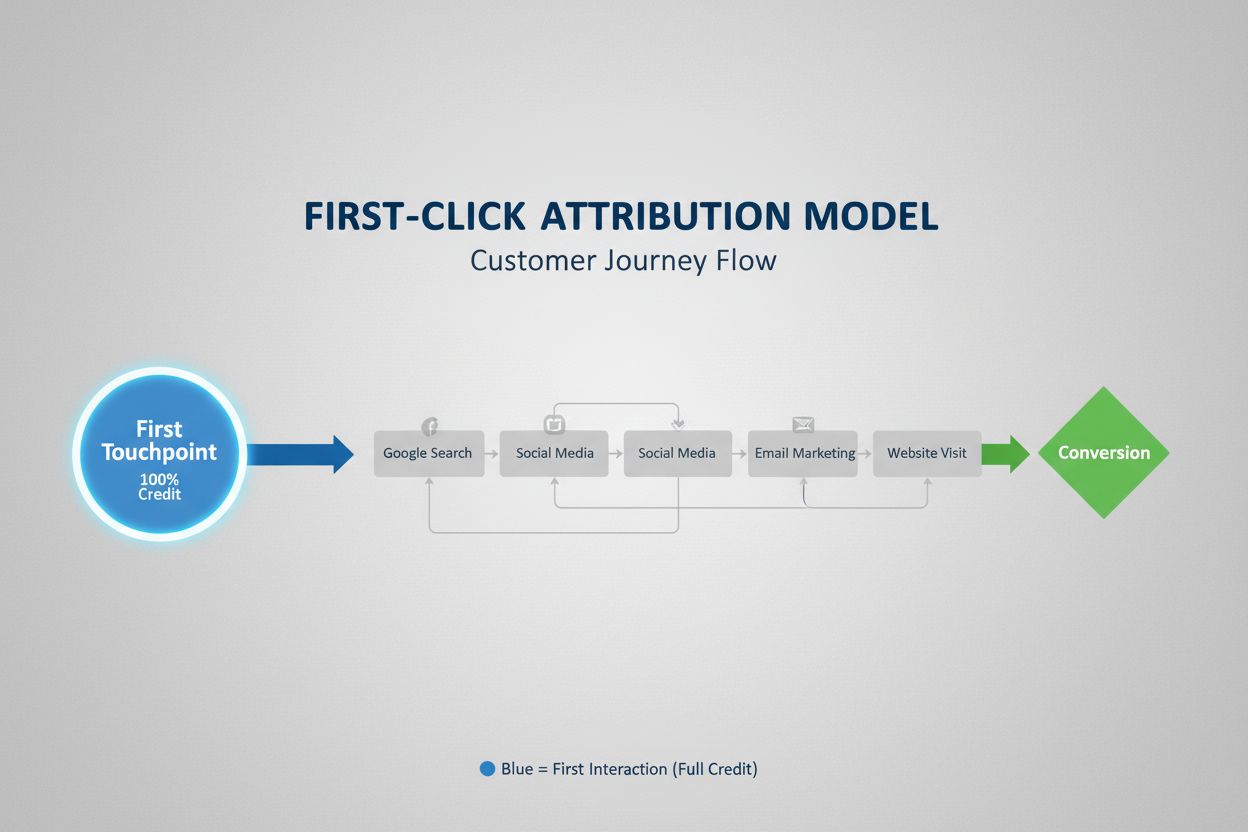
First-click attribution is a marketing measurement model that assigns 100% of the conversion credit to the first touchpoint a customer interacts with before making a purchase or completing a desired action. This single-touch attribution approach helps marketers identify which channels and campaigns are most effective at generating initial brand awareness and attracting new customers.
First-click attribution is a marketing measurement model that assigns 100% of the conversion credit to the first touchpoint a customer interacts with before making a purchase or completing a desired action. This single-touch attribution approach helps marketers identify which channels and campaigns are most effective at generating initial brand awareness and attracting new customers.
First-click attribution is a marketing measurement model that assigns 100% of the conversion credit to the first touchpoint a customer interacts with before making a purchase or completing a desired action. This single-touch attribution approach focuses exclusively on the initial interaction, whether it occurs through a paid search ad, social media post, organic search result, email, referral link, or any other marketing channel. The model operates on a fundamental principle: without that first moment of engagement, the entire customer journey would never begin. By crediting the first interaction with full conversion value, marketers gain clear visibility into which channels and campaigns are most effective at generating initial brand awareness and attracting new customers to their business.
The concept of attribution modeling emerged in the early 2000s as digital marketing matured and companies sought to understand which channels drove conversions. Initially, marketers relied on simple last-click attribution, which credited only the final interaction before a purchase. However, as customer journeys became increasingly complex with multiple touchpoints across various channels, the limitations of single-touch models became apparent. First-click attribution gained prominence as marketers recognized the need to understand not just what closes sales, but what initiates customer relationships. According to industry research, 56% of marketers believe attribution is important to their work, yet only 41% of marketers use last-touch attribution, indicating growing adoption of diverse attribution approaches. The evolution toward multi-touch attribution and sophisticated measurement frameworks has made first-click attribution a critical component of comprehensive marketing analytics strategies, particularly as organizations seek to optimize spending across awareness, consideration, and conversion channels.
First-click attribution operates through a systematic process of tracking, identifying, and crediting the initial customer interaction. When a user first arrives at a website or engages with a brand, the analytics system captures critical data points including the traffic source, channel, campaign, keyword, and timestamp. This information is typically encoded through UTM parameters (Urchin Tracking Module parameters) that marketers append to URLs, allowing platforms to distinguish between different campaigns and channels. The system maintains this first-touch data throughout the entire customer journey, even as the user interacts with multiple additional touchpoints over days, weeks, or months. When a conversion finally occurs—whether a purchase, sign-up, form submission, or other desired action—the attribution system automatically credits the original first touchpoint with 100% of the conversion value. This requires robust user identification systems that can recognize the same individual across multiple sessions and devices, a challenge that has become increasingly complex with privacy regulations and cookie restrictions. Modern attribution platforms employ cookieless tracking solutions and first-party data strategies to maintain accurate first-click attribution even in privacy-restricted environments.
| Attribution Model | Credit Distribution | Best Use Case | Strengths | Limitations |
|---|---|---|---|---|
| First-Click Attribution | 100% to first touchpoint | Brand awareness, top-of-funnel performance | Simple to implement, clear awareness insights, easy budget allocation | Ignores nurturing touchpoints, may undervalue conversion channels |
| Last-Click Attribution | 100% to final touchpoint | Conversion optimization, sales channel effectiveness | Identifies closing channels, straightforward implementation | Overlooks awareness efforts, credits only final interaction |
| Linear Attribution | Equal credit to all touchpoints | Balanced funnel view, multi-channel analysis | Recognizes all touchpoints equally, comprehensive perspective | Doesn’t reflect actual influence of each touchpoint |
| Time Decay Attribution | More credit to recent touchpoints | Shorter sales cycles, immediate conversions | Emphasizes recent interactions, realistic for quick decisions | May undervalue early awareness efforts |
| Position-Based (U-Shaped) | 40% first, 40% last, 20% middle | Balanced awareness and conversion focus | Values both discovery and closing, moderate complexity | Arbitrary credit distribution, requires customization |
| Multi-Touch Attribution | Distributed based on influence model | Complex customer journeys, long sales cycles | Most comprehensive, data-driven credit distribution | Complex implementation, requires sophisticated tools |
In today’s omnichannel marketing landscape, where 73% of consumers use multiple channels to shop, understanding the initial touchpoint has become strategically critical. First-click attribution provides marketers with essential insights into which channels and campaigns are most effective at generating initial awareness and attracting new audiences. This is particularly important as 49% of marketers cite increasing customer acquisition as their primary objective, making top-of-funnel performance measurement essential. The model helps organizations answer fundamental questions: Which content pieces first introduce potential customers to the brand? Which advertising channels generate the highest-quality initial impressions? Which marketing campaigns successfully break through the noise to capture attention? By answering these questions, marketers can optimize their awareness campaigns, refine their content strategy, and allocate budgets more effectively toward channels that excel at customer acquisition. Furthermore, 53% of marketing decisions are influenced by marketing analytics, underscoring the importance of accurate attribution data in strategic decision-making.
As artificial intelligence increasingly influences customer discovery and brand visibility, first-click attribution principles have become relevant to AI monitoring and brand tracking. Platforms like AmICited track when and where brands first appear in AI-generated responses across systems like ChatGPT, Perplexity, Google AI Overviews, and Claude. Understanding the initial touchpoint that leads to a brand’s inclusion in AI responses—whether through specific content pieces, keywords, or brand mentions—helps marketers optimize their strategy for AI visibility. By monitoring which content first triggers AI citations, marketers can identify high-performing content that establishes brand authority and credibility within AI systems. This first-interaction data becomes critical as AI systems increasingly influence customer discovery, making it essential to track and credit the initial content or interaction that leads to AI visibility. The principles of first-click attribution extend naturally to this emerging channel, where the first appearance of a brand in an AI response can significantly influence customer perception and subsequent conversion behavior.
Successful first-click attribution implementation requires a comprehensive tracking infrastructure and disciplined execution. Organizations must establish consistent UTM parameter conventions across all marketing campaigns, ensuring that every promotional link includes properly structured parameters that identify the source, medium, campaign, and content. This standardization prevents data discrepancies and ensures accurate first-touch identification. Persistent user identification systems are essential, as they must recognize the same individual across multiple sessions, devices, and time periods—sometimes spanning weeks or months between first interaction and conversion. Modern implementations increasingly rely on cookieless tracking solutions that use first-party data, server-side tracking, and privacy-compliant identification methods to maintain accuracy despite cookie restrictions. Regular data audits help identify tracking gaps, missing UTMs, or unusual traffic patterns that indicate attribution errors. Organizations should also implement cross-device tracking capabilities to ensure that users who discover a brand on mobile but convert on desktop are properly attributed to their first touchpoint. Finally, first-click attribution should be reviewed alongside other attribution models—linear attribution, time decay attribution, and multi-touch attribution—to provide a balanced view of marketing performance and inform strategic budget allocation.
Despite its strategic value, first-click attribution faces significant practical challenges in modern marketing environments. The model’s fundamental limitation is that it ignores all touchpoints after the initial interaction, potentially undervaluing channels that nurture prospects and drive conversions. This can lead to budget misallocation, where awareness channels receive disproportionate investment while conversion-focused channels like email marketing and retargeting are underfunded. For organizations with long sales cycles—particularly in B2B industries—the first interaction may have minimal impact on the final purchase decision, making first-click attribution less relevant. Privacy regulations and cookie restrictions complicate accurate tracking, as 83% of marketers remain reliant on cookies while 97% are concerned about the loss of third-party cookies’ impact on marketing effectiveness. Additionally, offline interactions like word-of-mouth, events, podcasts, and traditional media cannot be tracked unless they include trackable elements like QR codes or custom URLs. The model also struggles with direct traffic, which often represents users returning to a site through bookmarks or typed URLs, potentially misattributing conversions to direct traffic rather than the original awareness channel.
The future of first-click attribution is being shaped by several converging trends in marketing technology and consumer behavior. As AI systems increasingly influence customer discovery, first-click attribution principles are extending to track brand appearances in AI-generated responses, creating new measurement opportunities and challenges. The shift toward cookieless tracking is driving innovation in attribution technology, with platforms developing sophisticated solutions using first-party data, server-side tracking, and privacy-compliant identification methods. Multi-touch attribution and data-driven attribution models are becoming more accessible and affordable, suggesting that organizations will increasingly use first-click attribution as one component of a comprehensive measurement framework rather than as a standalone model. The rise of AI-powered attribution tools that use machine learning to distribute credit more intelligently across touchpoints may eventually supplement or replace traditional first-click models. Additionally, as 80% of marketers believe attribution will become more important following the removal of third-party cookies, investment in sophisticated attribution infrastructure will accelerate. Organizations that master first-click attribution while simultaneously implementing complementary models will gain competitive advantages in understanding customer journeys, optimizing marketing spend, and adapting to the evolving digital landscape where AI, privacy regulations, and omnichannel customer behavior continue to reshape marketing measurement.
First-click attribution assigns 100% credit to the initial touchpoint that introduces a customer to your brand, making it ideal for measuring brand awareness and top-of-funnel performance. Last-click attribution, conversely, credits the final interaction before conversion, which is better for understanding which channels drive immediate sales. While first-click reveals how customers discover you, last-click shows what convinces them to buy. Most sophisticated marketing teams use both models together to understand the complete customer journey and optimize different stages of the funnel.
First-click attribution tracks the very first interaction a customer has with your brand across all channels—whether through a Google search ad, social media post, email, or organic content. Once that initial touchpoint is recorded, it receives 100% of the conversion credit, regardless of how many other marketing interactions occur afterward. For example, if a customer first discovers your brand through a Facebook ad, then later engages with email campaigns and retargeting ads before purchasing, the Facebook ad receives full credit for the conversion. This requires proper tracking infrastructure using UTM parameters, analytics platforms, and consistent user identification across sessions.
First-click attribution is most valuable when your primary goal is understanding brand awareness and top-of-funnel performance. It works best for campaigns focused on customer acquisition, new product launches, market expansion, and content marketing strategies designed to attract new audiences. Industries with shorter buying cycles, such as ecommerce and retail, benefit significantly from this model. However, for B2B companies with long sales cycles or businesses focused on conversion optimization, multi-touch or last-click attribution may provide more actionable insights. The ideal approach is using first-click alongside other attribution models to gain a comprehensive view of marketing effectiveness across all funnel stages.
First-click attribution ignores all touchpoints that occur after the initial interaction, potentially undervaluing channels that nurture and convert customers mid-funnel and at the bottom of the funnel. This can lead to budget misallocation, where awareness channels receive disproportionate investment while conversion-focused channels are underfunded. The model also struggles with long sales cycles where the first interaction may have minimal impact on the final purchase decision. Additionally, first-click attribution cannot track offline interactions like word-of-mouth, events, or podcast mentions unless they're tagged with trackable elements like QR codes or custom URLs. Privacy regulations and cookie restrictions further complicate accurate first-click tracking in modern digital environments.
In the context of AI monitoring platforms like AmICited, first-click attribution principles apply to tracking how brands first appear in AI-generated responses across platforms like ChatGPT, Perplexity, Google AI Overviews, and Claude. Understanding the initial touchpoint that leads to a brand's inclusion in AI responses helps marketers optimize their content strategy for AI visibility. By monitoring which content pieces, keywords, or brand mentions first trigger AI citations, marketers can identify high-performing content that establishes brand authority. This first-interaction data becomes critical as AI systems increasingly influence customer discovery, making it essential to track and credit the initial content or interaction that leads to AI visibility and subsequent conversions.
Major analytics platforms including Google Analytics, Adobe Analytics, HubSpot, and Usermaven offer built-in first-click attribution capabilities. These tools track initial touchpoints through UTM parameters, user identification systems, and multi-channel funnel reports. Modern attribution platforms like Corvidae, Ruler Analytics, and Emotive provide more sophisticated first-click tracking with cookieless solutions and cross-device user identification. For AI monitoring and brand visibility tracking, platforms like AmICited, Keyword.com's AI Visibility Tracker, and Sparktoro help monitor first appearances of brands in AI-generated responses. Selecting the right tool depends on your specific needs, budget, and the complexity of your marketing ecosystem.
Effective implementation requires consistent UTM parameter usage across all marketing campaigns to identify traffic sources accurately. Marketers must establish persistent user identification systems that track customers across multiple sessions and devices, ensuring the first touchpoint isn't lost when users return days or weeks later. Regular data audits help identify tracking gaps, missing UTMs, or unusual traffic patterns that indicate attribution errors. Integration with analytics platforms that support cookieless tracking becomes increasingly important as privacy regulations restrict traditional cookie-based tracking. Finally, first-click attribution should be reviewed alongside other attribution models—linear, time decay, and multi-touch—to provide a balanced view of marketing performance and inform more strategic budget allocation decisions.
Start tracking how AI chatbots mention your brand across ChatGPT, Perplexity, and other platforms. Get actionable insights to improve your AI presence.
Last-click attribution credits the final customer interaction for conversions. Learn how this single-touch model works, its limitations, and why marketers are s...

Learn what attribution models are, how they work, and which model best fits your business. Explore first-touch, last-touch, multi-touch, and algorithmic attribu...
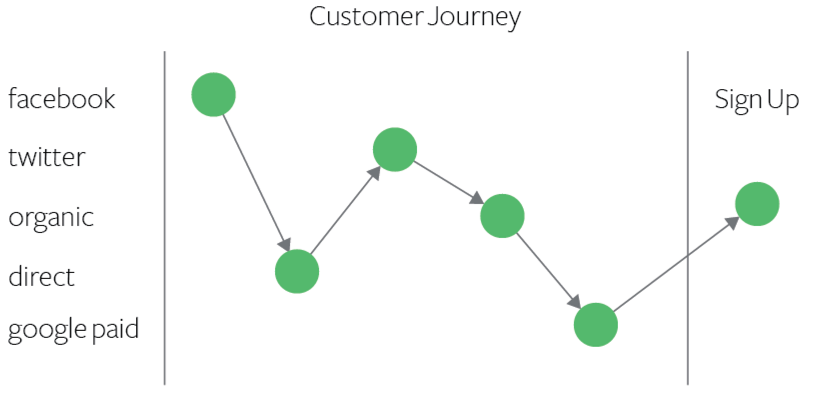
Multi-touch attribution assigns credit to all customer touchpoints in the conversion journey. Learn how this data-driven approach optimizes marketing budgets an...
Cookie Consent
We use cookies to enhance your browsing experience and analyze our traffic. See our privacy policy.