



Attribution Model
Learn what attribution models are, how they work, and which model best fits your business. Explore first-touch, last-touch, multi-touch, and algorithmic attribu...
9 min read
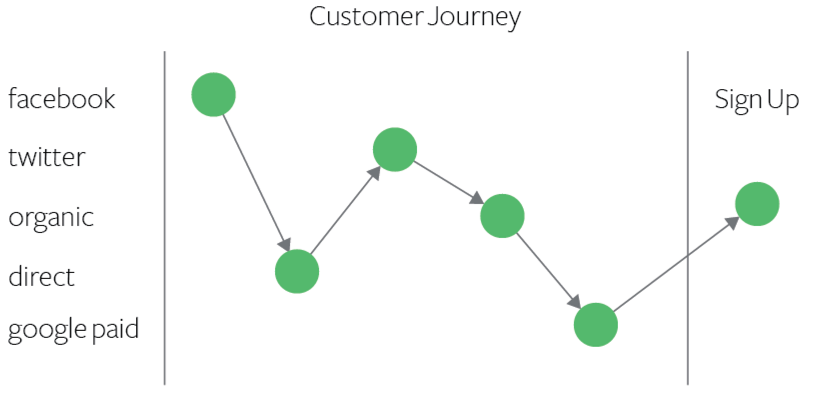
Multi-touch attribution is a data-driven marketing methodology that assigns credit to multiple customer touchpoints throughout the conversion journey, rather than crediting only a single interaction. This approach enables marketers to understand how each marketing channel and interaction contributes to conversions and revenue.
Multi-touch attribution is a data-driven marketing methodology that assigns credit to multiple customer touchpoints throughout the conversion journey, rather than crediting only a single interaction. This approach enables marketers to understand how each marketing channel and interaction contributes to conversions and revenue.
Multi-touch attribution is a data-driven marketing methodology that assigns credit to multiple customer touchpoints throughout the conversion journey, rather than crediting only a single interaction like the first or last click. This approach recognizes that modern customer journeys are complex, involving numerous interactions across multiple channels—including social media, email, paid search, organic search, display ads, and direct visits—before a conversion occurs. Unlike single-touch attribution models that oversimplify the customer path to purchase, multi-touch attribution distributes conversion credit proportionally across all meaningful touchpoints based on their relative contribution to the final outcome. By understanding how each interaction influences the customer’s decision to convert, marketers can make more informed budget allocation decisions, optimize campaign performance, and accurately measure return on investment (ROI) across their entire marketing ecosystem.
The concept of multi-touch attribution emerged from the recognition that traditional attribution models were fundamentally flawed in their oversimplification of customer behavior. For decades, marketers relied on last-click attribution, which credited only the final touchpoint before conversion, or first-touch attribution, which credited only the initial interaction. However, these single-touch models failed to capture the reality of modern consumer behavior. According to research from MMA Global, over 52% of marketers were using multi-touch attribution in 2024, with 57% of surveyed marketers stating it is crucial as part of their measurement solutions. This widespread adoption reflects a fundamental shift in how the marketing industry understands customer journeys. The multi-touch attribution market itself demonstrates this importance, valued at USD 2.43 billion in 2025 and projected to reach USD 4.61 billion by 2030, growing at a 13.66% compound annual growth rate (CAGR). This explosive growth underscores the critical role that multi-touch attribution plays in modern marketing strategy and budget optimization.
Multi-touch attribution operates through several standardized models, each designed to weight touchpoints differently based on business objectives and customer journey characteristics. The linear attribution model assigns equal credit to every touchpoint in the customer journey, providing a straightforward introduction to multi-touch methodology but offering limited insight into which interactions are most influential. The U-shaped attribution model concentrates credit on the first and last touchpoints—typically allocating 25% to each—while distributing the remaining 50% among middle interactions, making it ideal for businesses focused on lead capture and conversion optimization. The W-shaped attribution model extends this approach by emphasizing three critical stages: initial awareness, lead generation, and final conversion, each receiving approximately 25% of credit, with the remaining 25% distributed across other touchpoints. This model works particularly well for complex, multi-channel campaigns spanning extended consideration periods. The time decay attribution model, advocated by analytics expert Avinash Kaushik, assigns the most credit to touchpoints closest to conversion while progressively reducing credit for earlier interactions, based on the logic that if earlier touchpoints were truly effective, they would have converted the customer immediately. Beyond these standardized models, custom multi-touch attribution models allow sophisticated marketers to tailor credit distribution based on their specific business dynamics, historical performance data, and strategic priorities.
| Attribution Model | Credit Distribution | Best Use Case | Key Advantage | Key Limitation |
|---|---|---|---|---|
| Linear Attribution | Equal across all touchpoints | Simple, short customer journeys | Easy to understand and implement | Doesn’t identify high-value touchpoints |
| U-Shaped Attribution | 25% first, 25% last, 50% middle | Lead generation and conversion focus | Emphasizes top and bottom funnel | Undervalues mid-funnel nurturing |
| W-Shaped Attribution | 25% first, 25% middle, 25% last, 25% distributed | Complex multi-channel campaigns | Balanced view of full journey | More complex to implement |
| Time Decay Attribution | Increasing credit toward conversion | Bottom-funnel optimization | Recognizes conversion proximity | May undervalue awareness stage |
| Custom Attribution | Business-specific weighting | Mature marketing organizations | Tailored to specific business needs | Requires extensive data analysis |
| Last-Click Attribution | 100% to final touchpoint | Platform-specific reporting | Simple to track | Ignores entire customer journey |
| First-Touch Attribution | 100% to initial touchpoint | Top-funnel awareness campaigns | Shows acquisition channel value | Ignores conversion drivers |
Implementing multi-touch attribution requires sophisticated data collection and integration infrastructure that captures customer interactions across all marketing channels and devices. The foundation of effective multi-touch attribution rests on three primary data collection methods: JavaScript tracking embedded in web pages to monitor user behavior through page views, event tracking, and user identification; UTM parameters (Urchin Tracking Modules) appended to URLs to identify campaign sources, mediums, and content; and API integrations with advertising platforms, CRM systems, and marketing automation tools to capture proprietary customer data. A critical challenge in multi-touch attribution implementation is the integration of offline touchpoints, particularly phone calls, which represent some of the highest-value conversions for many businesses. According to research, customers considering high-stakes purchases like insurance, healthcare services, or automotive products frequently convert through phone interactions, yet these conversions are often overlooked in attribution models that focus exclusively on digital touchpoints. Advanced call tracking and analytics platforms now digitize phone conversation data and integrate it with online conversion data, enabling marketers to create a complete picture of the customer journey. Additionally, cross-device tracking presents a significant technical challenge, as 90% of multi-device users switch between screens to complete tasks, requiring sophisticated identity resolution and data consolidation to accurately attribute conversions across devices.
The adoption of multi-touch attribution delivers substantial strategic benefits that extend far beyond simple reporting. By accurately understanding how each touchpoint contributes to conversions, marketing teams can make data-driven budget allocation decisions that maximize ROI and reduce wasted spending on ineffective channels. Organizations implementing multi-touch attribution gain visibility into which channels drive high-quality leads versus low-quality traffic, enabling them to shift resources toward the most productive marketing activities. This capability is particularly valuable in complex B2B environments where multiple stakeholders participate in extended buying cycles spanning months or even years. Multi-touch attribution also enables marketers to optimize campaign timing and sequencing by revealing which touchpoint combinations are most effective at moving customers through the consideration funnel. For example, a marketer might discover that customers who see a display ad followed by an email followed by a retargeting ad convert at significantly higher rates than those exposed to only one or two touchpoints, informing future campaign orchestration strategies. Furthermore, multi-touch attribution provides the foundation for closed-loop attribution, which connects marketing activities directly to revenue outcomes, enabling marketing teams to demonstrate their contribution to business growth and justify marketing investments to executive leadership and finance teams.
Despite its significant advantages, multi-touch attribution faces substantial implementation and operational challenges that can limit its effectiveness. Data quality and completeness represent the most fundamental challenge, as gaps in data collection across channels, devices, and offline touchpoints create incomplete customer journey visibility. Privacy regulations including GDPR, CCPA, and similar frameworks increasingly restrict the collection and use of user-level data, making it difficult to track individual customers across multiple touchpoints and devices. Cross-device tracking remains technically complex, as users frequently switch between smartphones, tablets, laptops, and other devices during their customer journey, requiring sophisticated identity resolution to accurately connect these interactions. Data integration complexity arises from the need to consolidate information from dozens of disparate marketing platforms, each with different data formats, update frequencies, and API capabilities. Additionally, attribution modeling uncertainty persists because no single model perfectly captures the true contribution of each touchpoint—different models can produce significantly different credit distributions for the same customer journey, leading to conflicting optimization recommendations. The time and resource investment required to implement and maintain multi-touch attribution systems is substantial, requiring skilled data engineers, analysts, and marketing technologists. Finally, machine learning model bias can occur when AI-driven attribution models are trained on historical data that reflects past market conditions, potentially leading to suboptimal recommendations in rapidly changing market environments.
In the emerging landscape of AI-generated content and responses, multi-touch attribution takes on new significance for brand monitoring and visibility tracking. Platforms like ChatGPT, Perplexity, Google AI Overviews, and Claude increasingly influence customer awareness and consideration, yet traditional attribution models often fail to capture these touchpoints. Multi-touch attribution frameworks enable brands to understand how mentions and recommendations in AI-generated responses contribute to customer awareness, consideration, and ultimately conversion. When a customer encounters a brand mention in an AI response, this represents a critical touchpoint that should be integrated into the overall attribution model. Brands using AI monitoring platforms like AmICited can track when and how their brand appears in AI responses, then correlate these appearances with downstream customer behavior and conversions. This integration of AI touchpoints into multi-touch attribution models provides a more complete understanding of the modern customer journey, which increasingly includes interactions with AI systems. As AI systems become more prevalent in customer research and decision-making processes, the ability to attribute conversions to AI-mediated touchpoints becomes increasingly important for marketing effectiveness and budget optimization.
Successfully implementing multi-touch attribution requires a structured, phased approach that begins with clear business objective alignment. The first critical step involves selecting the appropriate attribution model based on your specific customer journey characteristics, business goals, and marketing complexity. Organizations should start with a standardized model rather than attempting to build a custom model immediately, allowing teams to develop expertise and gather performance data before customization. The second step requires integrating comprehensive data collection across all marketing channels, ensuring that online and offline touchpoints are captured with equal rigor. This includes implementing proper UTM parameter conventions, deploying JavaScript tracking consistently across web properties, and establishing API connections with all major marketing platforms. The third step involves mapping the complete customer journey by visualizing all touchpoints from initial awareness through conversion, identifying any gaps in data collection or tracking. The fourth step requires aligning attribution insights with business objectives, ensuring that the metrics and insights generated by the attribution model directly support strategic business goals and KPIs. The fifth step involves establishing cross-channel tracking infrastructure using unique identifiers, cookies, and tracking pixels to connect customer interactions across multiple touchpoints and devices. The sixth step requires continuous analysis and optimization, regularly reviewing attribution data to identify high-performing channels and touchpoints, then reallocating budget accordingly. The seventh and final step involves testing and refining the attribution strategy through A/B testing of different models and continuous experimentation to identify the approach that best predicts conversion outcomes for your specific business.
A mid-market SaaS company notices a demo signup and wants to understand what actually drove it before deciding where to increase spend. Pulling the customer’s full interaction history, the marketing team reconstructs six touchpoints over five weeks: a LinkedIn ad click (first touch), a blog post visited two days later via organic search, a whitepaper download after providing an email address, three separate email nurture opens over the following weeks, a comparison page visit from a retargeting ad, and finally a direct visit to the pricing page where the demo was booked (last touch). Under last-click attribution, the retargeting ad gets 100% of the credit — but that ignores that the prospect had no idea the product existed until the LinkedIn ad three weeks earlier. Applying a W-shaped model instead, the team assigns roughly 25% credit each to the LinkedIn ad (first touch, driving awareness), the whitepaper download (lead-generation touch, capturing contact information), and the pricing page visit (conversion touch), with the remaining 25% split across the blog visit and email opens. This redistribution reveals that LinkedIn, which last-click attribution had valued at zero, is actually responsible for nearly a quarter of this conversion’s credit — prompting the team to test increased LinkedIn spend rather than pouring more budget into the retargeting campaign that last-click had over-credited.
Start tracking how AI chatbots mention your brand across ChatGPT, Perplexity, and other platforms. Get actionable insights to improve your AI presence.
Learn what attribution models are, how they work, and which model best fits your business. Explore first-touch, last-touch, multi-touch, and algorithmic attribu...

Learn how AI conversion attribution tracks and credits sales to AI-influenced customer journeys. Discover how machine learning algorithms analyze multi-touch cu...

Last-click attribution credits the final customer interaction for conversions. Learn how this single-touch model works, its limitations, and why marketers are s...
Cookie Consent
We use cookies to enhance your browsing experience and analyze our traffic. See our privacy policy.