

What is the FLIP Framework for AI Search?
Learn how the FLIP framework helps your content get discovered and cited by AI search engines like ChatGPT, Perplexity, and Claude. Understand Freshness, Local ...
8 min read
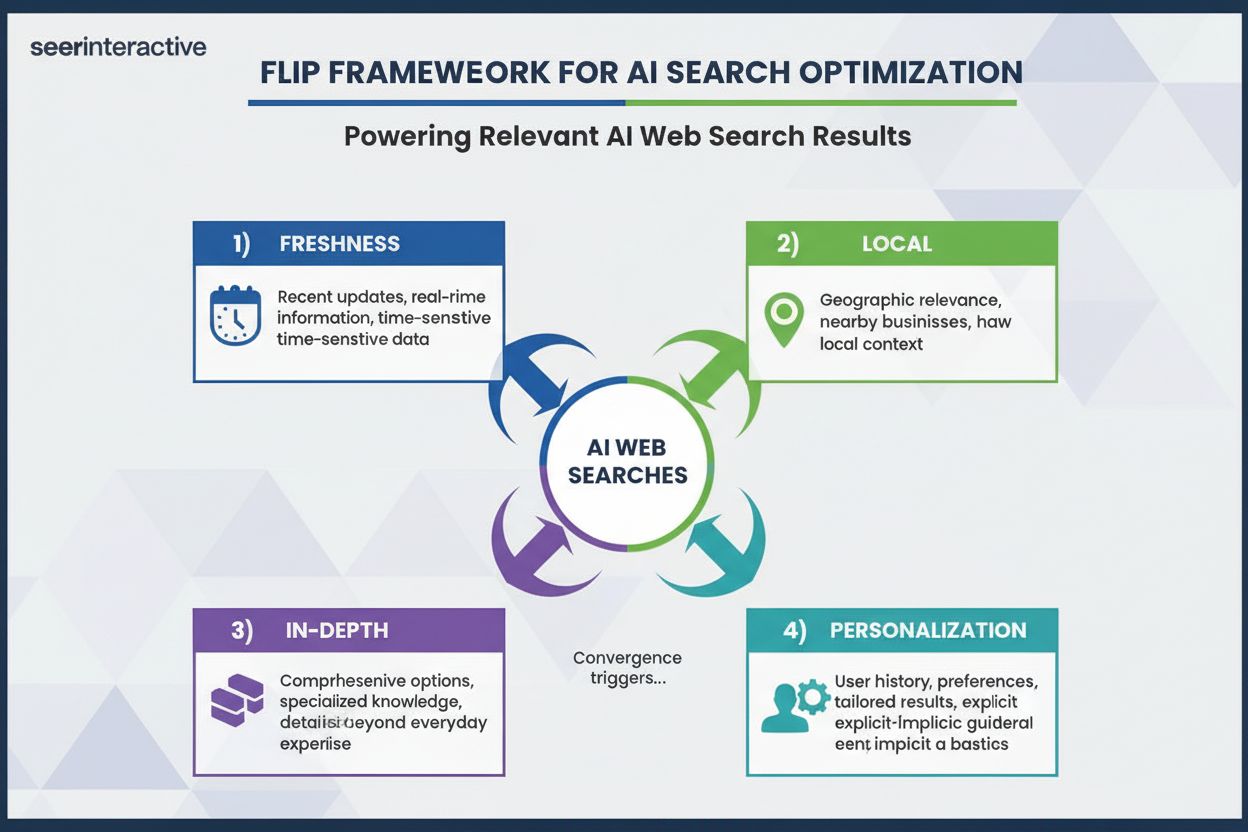
The FLIP Framework is a strategic model for AI search optimization that identifies four key query triggers—Freshness, Local intent, In-depth context, and Personalization—that determine when AI systems like ChatGPT, Perplexity, and Google AI Overviews perform web searches to supplement their training data with current information.
The FLIP Framework is a strategic model for AI search optimization that identifies four key query triggers—Freshness, Local intent, In-depth context, and Personalization—that determine when AI systems like ChatGPT, Perplexity, and Google AI Overviews perform web searches to supplement their training data with current information.
The FLIP Framework is a strategic model developed by Seer Interactive that identifies the four primary factors determining when AI search systems like ChatGPT, Perplexity, Google AI Overviews, and Claude decide to perform web searches rather than relying solely on their training data. FLIP stands for Freshness, Local intent, In-depth context, and Personalization. This framework represents a fundamental shift in how Generative Engine Optimization (GEO) professionals approach content strategy, moving beyond traditional keyword rankings to focus on the decision-making logic of large language models. Understanding FLIP is essential for any organization seeking to maximize visibility in AI-powered search results, as it directly influences whether AI systems will cite your content when answering user queries. The framework emerged from research into how AI systems evaluate the necessity of web searches, revealing that most queries are still answered from training data, but specific patterns trigger real-time web retrieval.
The FLIP Framework was introduced in early 2025 as AI search platforms gained mainstream adoption and marketers recognized that traditional SEO strategies were insufficient for AI visibility. Prior to this framework, the industry lacked a clear model for understanding when AI systems would search the web versus relying on pre-trained knowledge. Gartner forecasted a 25% drop in traditional search engine volume by 2026, with platforms like ChatGPT capturing significant market share from Google. This shift prompted researchers and marketing professionals to study the decision-making processes of AI systems, leading to the development of FLIP as a practical framework for optimization. The framework builds on earlier concepts like Query Deserves Freshness (QDF) from traditional SEO, but extends them to address the unique characteristics of generative AI systems. Research from Seer Interactive’s testing revealed that only 35% of ChatGPT paid queries trigger web searches, while 65% are answered from training data, establishing the critical importance of understanding which queries fall into each category. This data-driven approach has made FLIP the foundational framework for Generative Engine Optimization strategies across enterprises.
Freshness represents the first pillar of the FLIP Framework and addresses the reality that AI systems have knowledge cutoff dates. ChatGPT’s GPT-4o model has a training data cutoff of October 2023, meaning any query requiring information beyond that date will likely trigger a web search. Freshness is not just about current events; it applies to any query where recent information provides significantly more value than historical data. Examples include “best data visualization tools in 2025,” “latest AI search trends,” or “current mortgage rates.” When users include temporal modifiers like “this year,” “latest,” “new,” or “recent,” they signal to AI systems that freshness is required. Content creators can optimize for freshness by maintaining regular update cycles, adding publication dates and last-modified timestamps, and creating content that explicitly addresses current conditions. The freshness signal is particularly powerful because it’s one of the most reliable triggers for web searches—AI systems recognize that their training data cannot answer time-sensitive questions accurately.
Local intent refers to queries where geographic location or proximity is a critical factor in the answer. These include questions like “which campus library is open late tonight,” “best plumbers in Fort Myers,” or “restaurants near me.” AI systems understand that local information changes frequently and varies by location, making web searches essential for providing accurate, current answers. Local intent optimization requires maintaining accurate business information across multiple platforms, including Google Business Profile, local directories, and citation networks. Businesses must ensure their NAP (Name, Address, Phone) information is consistent everywhere, keep operating hours updated, and create location-specific content pages. For service-based businesses, local intent represents a significant opportunity, as AI systems increasingly provide location-aware recommendations. The framework recognizes that local queries often combine with other FLIP factors—a query might be both fresh and local, such as “best restaurants in my area this week,” requiring optimization across multiple dimensions.
In-depth context addresses the AI system’s preference for comprehensive, detailed content that thoroughly explores a topic. When users ask complex questions requiring nuanced answers, AI systems search for sources that provide complete context rather than surface-level information. Examples include “how many credits do I need to graduate with a dual degree in biology and environmental science” or “what are the best practices for implementing schema markup for AI visibility.” Content optimized for in-depth context should include step-by-step explanations, prerequisite information, related concepts, and supporting data. Research from the Princeton GEO study found that adding citations, quotations, and statistics significantly boosted source visibility by over 40% in AI-generated responses. In-depth content performs better when it’s well-structured with clear headings, bullet points, and organized information that AI systems can easily extract and synthesize. This component of FLIP rewards comprehensive content creation and penalizes thin, surface-level pages that don’t adequately address user intent.
Personalization represents the fourth pillar and addresses queries where individual user preferences, history, or context significantly influence the answer. Examples include “based on my GPA and career interests, which electives should I take next semester” or “recommend a CRM tool for my team’s specific workflow.” AI systems increasingly incorporate user data, conversation history, and contextual information to provide customized responses. Personalization optimization requires creating content that addresses different user segments, skill levels, use cases, and preferences. Businesses should develop content that serves multiple personas and use cases, maintain detailed user profiles where applicable, and create preference-based recommendation frameworks. The personalization factor is particularly important for B2B companies, SaaS platforms, and educational institutions where different users have different needs. Unlike the other FLIP factors, personalization is somewhat dependent on the AI system’s access to user data, but content creators can still optimize by making their content adaptable to different contexts and clearly addressing multiple use cases.
| Factor | FLIP Framework Focus | Traditional SEO Focus | Optimization Approach |
|---|---|---|---|
| Freshness | Triggers web searches for time-sensitive queries | Boosts rankings for recent content | Regular updates, timestamps, temporal keywords |
| Local Intent | Determines location-based web search necessity | Improves local pack rankings | NAP consistency, local citations, GBP optimization |
| In-Depth Context | Influences citation selection in AI answers | Improves SERP rankings for informational queries | Comprehensive content, citations, structured data |
| Personalization | Enables customized AI responses | Improves CTR through relevance | Multi-persona content, preference signals |
| Primary Goal | Maximize AI citations and visibility | Achieve high SERP rankings | Different metrics and measurement approaches |
| Measurement | Citation count, visibility score, share of voice | Organic traffic, keyword rankings, CTR | AI monitoring tools vs. Google Search Console |
| Content Type | Answer-first, structured, extractable | Keyword-optimized, link-worthy | Different content architecture requirements |
AI systems evaluate FLIP signals through a process called Retrieval-Augmented Generation (RAG), which augments the model’s training data with real-time web search results. When a user submits a query, the AI system first determines whether the query requires current information beyond its training data cutoff. If the query matches FLIP criteria—indicating freshness, local, in-depth, or personalization needs—the system triggers a web search through platforms like Bing (for ChatGPT) or its own search infrastructure. The AI then retrieves relevant sources, evaluates their authority and relevance, and synthesizes information from multiple sources into a coherent answer. E-E-A-T signals (Experience, Expertise, Authoritativeness, Trustworthiness) play a critical role in this evaluation process, with AI systems prioritizing sources that demonstrate clear expertise and credibility. The framework recognizes that AI systems don’t simply rank pages like traditional search engines; instead, they evaluate content for citation-worthiness based on how well it addresses the specific query intent and how trustworthy the source appears. This distinction is crucial for content creators, as optimizing for FLIP requires understanding AI decision-making rather than traditional ranking algorithms.
The FLIP Framework applies across virtually all industries, though the emphasis on each component varies by sector. In higher education, freshness applies to enrollment trends and program updates, local intent covers campus-specific information, in-depth context addresses degree requirements and academic planning, and personalization relates to student-specific academic paths. In healthcare, freshness is critical for treatment options and medical research, local intent applies to provider availability and clinic hours, in-depth context covers detailed medical information, and personalization addresses patient-specific health considerations. For e-commerce and retail, freshness covers product availability and pricing, local intent applies to store locations and inventory, in-depth context includes detailed product specifications and comparisons, and personalization addresses customer preferences and purchase history. In financial services, freshness is essential for interest rates and market conditions, local intent covers branch locations and local regulations, in-depth context provides comprehensive financial guidance, and personalization addresses individual financial situations. Understanding how FLIP applies to your specific industry enables more targeted optimization strategies that align with how your customers actually use AI search systems.
Measuring FLIP optimization success requires different metrics than traditional SEO, focusing on AI visibility rather than organic rankings. The primary metrics include citation count (how many times your content is cited in AI responses), visibility score (a composite measure of how often your brand appears in AI answers), share of voice (your citations compared to competitors), and sentiment analysis (whether mentions are positive, neutral, or negative). Tools like Profound, Seer Interactive’s SeerSignals, and AmICited provide specialized tracking for AI citations across platforms like ChatGPT, Perplexity, Google AI Overviews, and Claude. Research indicates that 71% of Americans already use AI search to research purchases or evaluate brands, making AI visibility increasingly important for business outcomes. Brands should track AI-attributed conversions by adding “How did you hear about us?” questions to lead forms and monitoring referral traffic from AI platforms. Quarterly benchmarking against competitors reveals whether your FLIP optimization efforts are gaining ground or falling behind. Unlike traditional SEO where rankings can fluctuate daily, AI visibility tends to show trends over longer periods, making consistent measurement and quarterly reviews essential for understanding strategy effectiveness.
Implementing the FLIP Framework effectively requires a systematic approach across content creation, technical optimization, and ongoing measurement. First, conduct a FLIP audit of your existing content to identify which queries your audience asks and which FLIP factors apply to each. Second, structure content for AI extraction by using clear headings, bullet points, tables, and FAQ sections that make it easy for AI systems to identify and cite key information. Third, implement comprehensive schema markup including FAQPage, HowTo, LocalBusiness, and Service schemas that help AI systems understand your content structure. Fourth, maintain content freshness through regular update cycles—at minimum every six months, or quarterly for rapidly changing industries. Fifth, optimize for local signals by ensuring NAP consistency, maintaining accurate Google Business Profile information, and creating location-specific content pages. Sixth, develop in-depth, authoritative content that thoroughly addresses topics with citations, statistics, and expert perspectives. Seventh, create personalization-ready content that addresses multiple user segments and use cases. Finally, monitor and iterate based on AI visibility metrics, adjusting your strategy quarterly as AI systems evolve and user behavior changes.
The FLIP Framework will continue to evolve as AI systems become more sophisticated and user behavior adapts to AI search. Emerging trends suggest deeper personalization, with AI systems increasingly incorporating real-time user context, conversation history, and preference data to customize responses. Multimodal answers combining text, images, video, and interactive elements will become more common, requiring content creators to optimize across multiple formats. Real-time data integration will make freshness even more critical, with AI systems potentially accessing live data feeds for pricing, availability, and current events. Agent-oriented optimization is emerging as AI systems move beyond conversational search to autonomous agents that take actions on behalf of users, requiring new optimization approaches. The framework itself may expand to include additional factors as researchers identify new patterns in AI decision-making. Voice search and conversational queries will continue to grow in importance, requiring content optimized for natural language patterns rather than traditional keywords. Organizations that understand and adapt to these evolving trends will maintain competitive advantage in AI search visibility. The FLIP Framework provides a foundation for this evolution, but successful optimization requires continuous learning, testing, and adaptation as the AI search landscape matures.
The FLIP Framework is one component of a comprehensive Generative Engine Optimization (GEO) strategy that also includes E-E-A-T optimization, citation authority building, structured data implementation, and content distribution across multiple platforms. While FLIP addresses when AI systems search the web, GEO addresses how to ensure your content is selected and cited when those searches occur. The framework works in conjunction with traditional SEO, as many FLIP optimization tactics (like content freshness, local optimization, and comprehensive content) also improve traditional search rankings. However, GEO requires additional considerations beyond SEO, such as optimizing for AI citation patterns, building authority through thought leadership and media mentions, and distributing content across platforms like Reddit and LinkedIn where AI systems source information. Research from Profound found that Reddit is the top-sourced URL in AI citations, highlighting the importance of multi-platform distribution strategies. Organizations should view FLIP as a decision-making framework that informs content strategy, while GEO represents the broader optimization discipline that ensures visibility across all AI search platforms. This integrated approach maximizes both traditional search visibility and AI citation opportunities.
The FLIP Framework represents essential knowledge for anyone involved in digital marketing, content strategy, or brand visibility in the AI era. By understanding when AI systems decide to search the web—based on Freshness, Local intent, In-depth context, and Personalization—organizations can create more targeted, effective content strategies that maximize visibility across ChatGPT, Perplexity, Google AI Overviews, and other AI platforms. The framework acknowledges that most queries are still answered from training data, but identifies the specific patterns that trigger web searches, enabling strategic optimization. As Gartner forecasts continued decline in traditional search volume and AI search adoption accelerates, mastering FLIP becomes increasingly critical for maintaining brand visibility and capturing customer attention. Organizations that implement FLIP-based optimization strategies early will establish competitive advantages in AI search visibility, driving increased brand awareness, citations, and ultimately, business outcomes. The framework provides a clear, actionable model for understanding AI search behavior, making it an indispensable tool for modern digital marketing strategy.
FLIP stands for Freshness, Local intent, In-depth context, and Personalization. These four factors represent the primary triggers that determine whether AI systems like ChatGPT will perform web searches to supplement their training data. Understanding FLIP helps marketers and content creators optimize their content strategy for AI-powered search engines and ensure their information is cited in AI-generated responses.
While traditional SEO focuses on backlinks, domain authority, and keyword density, the FLIP Framework addresses the specific decision-making process of AI systems. FLIP determines when AI engines decide to search the web versus relying on training data. Traditional SEO optimizes for visibility in search results pages, whereas FLIP optimizes for citation and inclusion in AI-generated answers, representing a fundamental shift in how content visibility is achieved.
Freshness is critical because AI systems recognize that their training data has a knowledge cutoff date. For queries requiring current information—such as 'best tools in 2025' or 'latest market trends'—AI engines will trigger web searches to provide users with up-to-date answers. Content that is regularly updated and timestamped signals to AI systems that it contains recent, relevant information worth citing in responses.
Local intent optimization involves creating content that addresses location-specific queries and maintaining accurate, current information about local services, hours, and offerings. Businesses should ensure their Google Business Profile is complete, keep local listings updated across directories, and create location-specific content pages. When users ask AI systems location-based questions like 'best restaurants near me' or 'plumbers in my area,' optimized local content increases the likelihood of being cited.
In-depth context refers to comprehensive, detailed content that thoroughly addresses a topic from multiple angles. AI systems prioritize content that provides complete answers to complex questions. This means creating long-form guides, detailed service pages, and content that covers prerequisites, step-by-step processes, and related concepts. Content with greater depth and breadth is more likely to be selected by AI systems when generating comprehensive answers to user queries.
Personalization in the FLIP Framework refers to content that can be tailored to individual user preferences, history, and context. AI systems increasingly consider user data to provide customized responses. Businesses can optimize for personalization by creating content that addresses different user segments, skill levels, and use cases. Maintaining accurate user profiles and preference data helps AI systems deliver more personalized recommendations that cite your content.
Research from Seer Interactive found that approximately 35% of ChatGPT paid version queries trigger web searches, while 65% are answered using training data. In the free version, about 30% trigger web searches and 70% rely on training data. This variation highlights the importance of optimizing for both pre-trained knowledge and web search scenarios, as most queries are still answered without web searches.
Content strategy should shift to address both AI-triggered and non-triggered queries. For queries likely to trigger web searches (those with freshness, local, in-depth, or personalization signals), create regularly updated, location-specific, comprehensive content. For queries answered from training data, focus on establishing authority and presence in high-quality sources. A balanced approach that covers both scenarios ensures maximum visibility across AI search platforms.
Start tracking how AI chatbots mention your brand across ChatGPT, Perplexity, and other platforms. Get actionable insights to improve your AI presence.
Learn how the FLIP framework helps your content get discovered and cited by AI search engines like ChatGPT, Perplexity, and Claude. Understand Freshness, Local ...
Community discussion on the FLIP framework for AI search optimization. Real implementation experiences and results from marketers using structured content frame...

Master the BLUF technique to optimize your content for AI visibility. Learn how answer-first content gets cited in ChatGPT, Perplexity, and Google AI Overviews.
Cookie Consent
We use cookies to enhance your browsing experience and analyze our traffic. See our privacy policy.