
Local SEO
Local SEO is the practice of optimizing a business's online presence for location-based search results. Learn how to rank higher in Google Maps, local pack, and...
15 min read
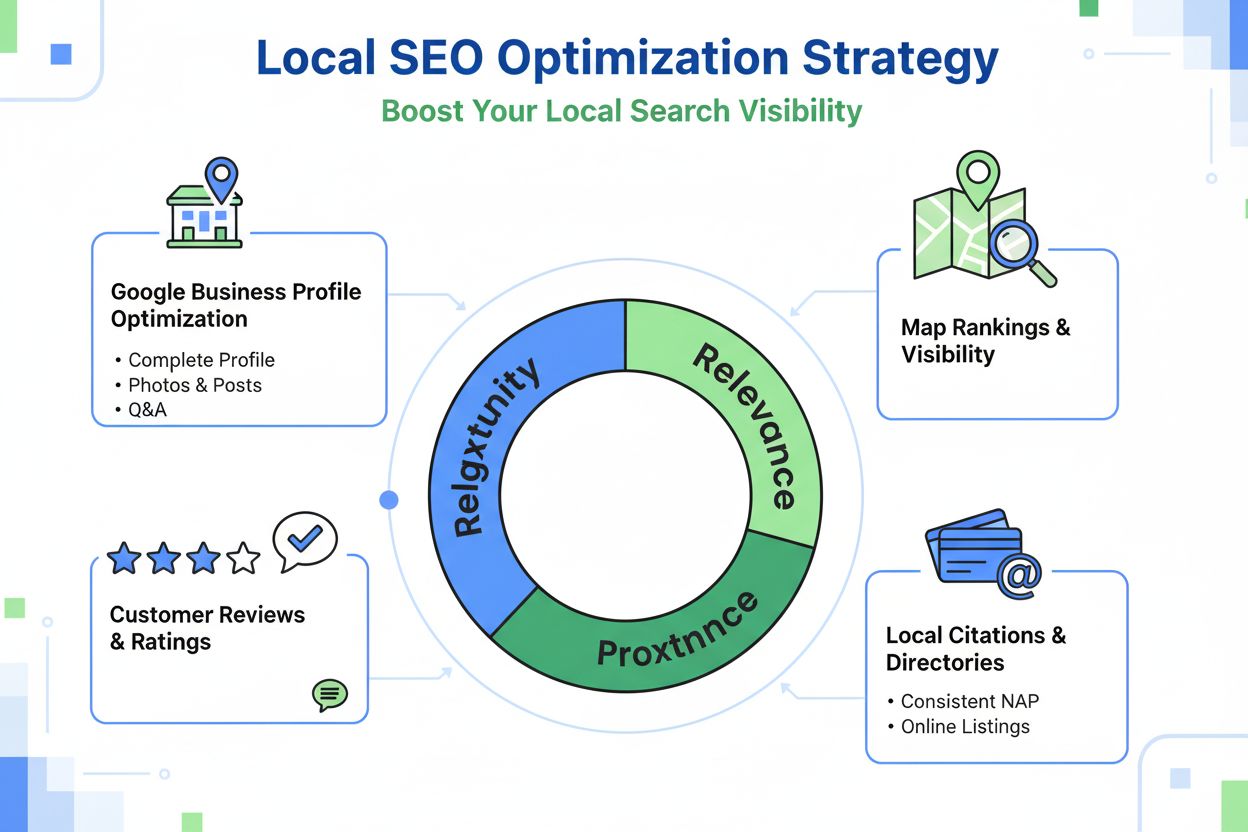
Google Maps SEO is the process of optimizing a business’s Google Business Profile and online presence to improve visibility and ranking in Google Maps search results and the local 3-pack. It involves optimizing business information, managing reviews, building citations, and implementing local search strategies to help potential customers discover and engage with a business through Google’s mapping platform.
Google Maps SEO is the process of optimizing a business's Google Business Profile and online presence to improve visibility and ranking in Google Maps search results and the local 3-pack. It involves optimizing business information, managing reviews, building citations, and implementing local search strategies to help potential customers discover and engage with a business through Google's mapping platform.
Google Maps SEO is the strategic process of optimizing a business’s online presence to improve visibility and ranking within Google Maps search results and the local 3-pack (the three business listings that appear at the top of Google Search results for location-based queries). Unlike traditional SEO, which focuses on organic website rankings, Google Maps SEO specifically targets the Google Business Profile, local citations, review management, and location-based signals to help potential customers discover and engage with a business through Google’s mapping platform. This specialized optimization approach recognizes that over 1.8 billion people use Google Maps monthly, with nearly 90% of consumers relying on the platform to find local businesses. Google Maps SEO encompasses both on-listing optimizations (such as profile completeness and review management) and off-listing strategies (such as building local citations and backlinks) to establish business prominence and relevance in local search results.
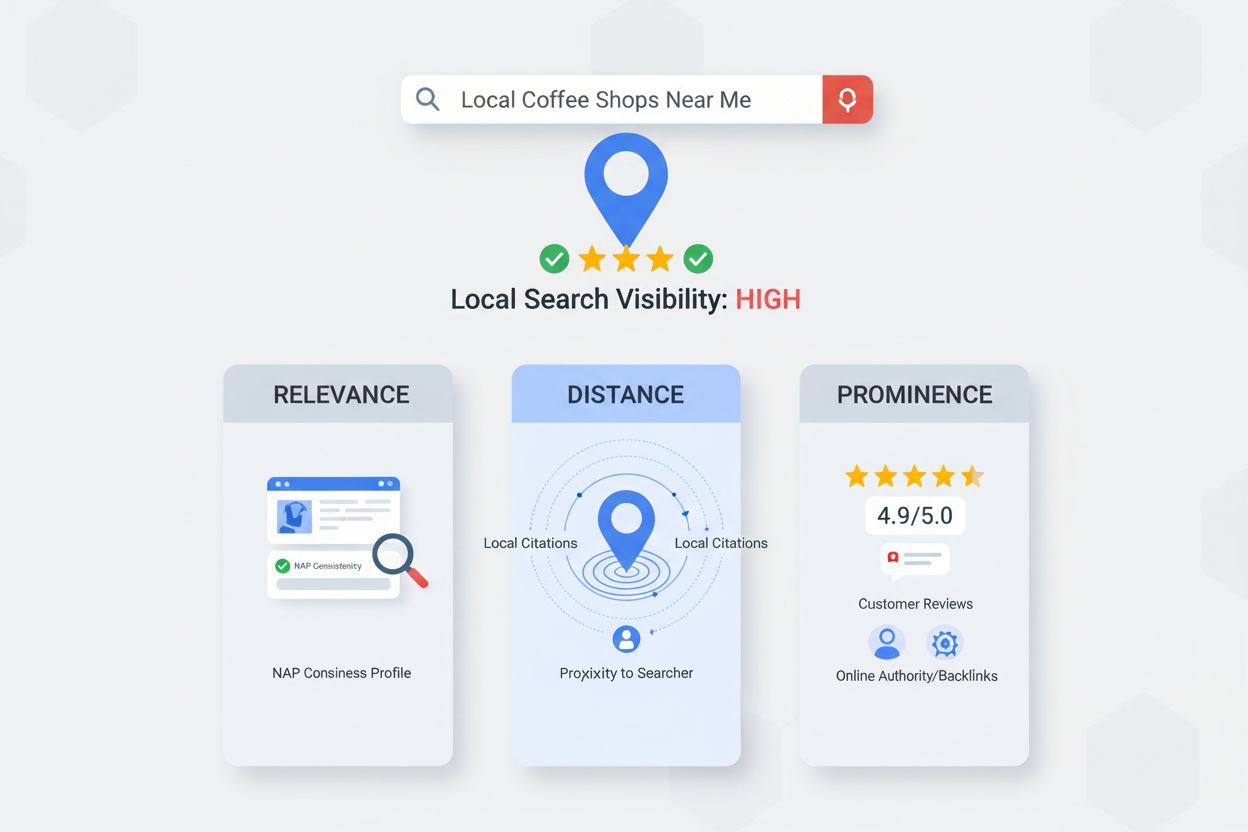
Google’s local search algorithm evaluates businesses based on three primary factors that work in concert to determine rankings: Relevance, Distance, and Prominence. Relevance measures how well a business matches what someone is searching for, determined by analyzing business categories, descriptions, website content, and customer reviews. When a user searches for “emergency plumber,” Google prioritizes businesses with plumbing as their primary category and those that mention emergency services in their content. Distance refers to how far each business is located from the searcher’s location or the location mentioned in their search query. This factor became significantly more important after Google’s December 2021 “Vicinity Update,” which prioritized businesses with actual physical presence in the searched area, making it much harder for service-area businesses to rank in multiple locations without a physical office. Prominence reflects how well-known a business is both online and offline, evaluated through multiple signals including the number and quality of reviews, backlinks to the website, citations across the web, and how frequently the business is mentioned online. These three factors don’t operate independently; a business that’s slightly farther away can still outrank a closer competitor if they have significantly better relevance and prominence signals.
The Google Business Profile (formerly known as Google My Business) is the central hub for all Google Maps SEO efforts and serves as the primary tool for managing how your business appears in Google Maps and local search results. Creating and claiming your business profile is the essential first step, as it allows you to control the information displayed to potential customers and implement optimization strategies. A claimed and verified profile signals to Google that you are authorized to represent the business, making it more likely to appear in search results. The profile must include accurate and complete information including your business name (exactly as it appears on your storefront signage), address, phone number, website URL, business hours (including special holiday hours), business categories, description, photos, and videos. Research shows that businesses with complete Google Business Profiles receive significantly more engagement than those with incomplete profiles—specifically, customers are 42% more likely to request directions and 35% more likely to click through to the website when photos are present. The profile also serves as a platform for publishing posts, managing customer reviews, answering questions, and showcasing products or services, all of which contribute to improved visibility and customer engagement in local search results.
| Factor | Google Maps SEO | Traditional Local SEO | Integrated Approach |
|---|---|---|---|
| Primary Focus | Google Business Profile optimization and Maps visibility | Website ranking and organic search results | Both Maps and website rankings |
| Key Ranking Signals | Reviews, citations, profile completeness, proximity | Backlinks, content quality, technical SEO | All factors combined |
| Customer Discovery | 84% from discovery searches (category/service) | Keyword-based organic search | Multiple discovery pathways |
| Optimization Platform | Google Business Profile Manager | Website CMS and SEO tools | Integrated management system |
| Review Importance | Critical ranking factor | Supporting factor | Essential for both |
| Citation Building | Directory listings and local citations | Backlinks and mentions | Comprehensive citation strategy |
| Mobile Optimization | Maps app and mobile search | Mobile-responsive website | Mobile-first approach |
| Time to Results | Faster (weeks to months) | Slower (months to years) | Balanced timeline |
| Cost | Free (profile management) | Variable (content, tools, services) | Minimal to moderate |
| Visibility Impact | Local 3-pack and Maps results | Organic search results page | Maximum local visibility |
The business implications of Google Maps SEO are substantial and measurable. Research demonstrates that approximately 42% of all clicks from local searches go to Google Maps pack listings, with the #1 ranked business receiving over 20% of those clicks. This concentration of traffic at the top positions makes ranking in the local 3-pack extraordinarily valuable for customer acquisition. Businesses with optimized Google Maps listings experience significantly higher engagement metrics compared to competitors with unoptimized profiles. For example, businesses with more than 100 high-quality photos receive 520% more phone calls, 2,717% more direction requests, and 1,065% more website clicks than the average business. The impact extends beyond immediate customer actions; strong Google Maps SEO performance builds brand credibility and trust, as potential customers perceive businesses appearing in the local 3-pack as more authoritative and trustworthy than those appearing lower in results. Additionally, since approximately 46% of Google searches have local intent, optimizing for Google Maps directly impacts visibility in regular Google Search results, creating a multiplier effect for local business visibility. For service-based businesses, home services, retail stores, and restaurants, Google Maps SEO often represents the highest-ROI marketing investment available, as it drives qualified local traffic at minimal cost compared to paid advertising channels.
NAP consistency—ensuring your business Name, Address, and Phone number are identical across all online platforms—is a foundational element of Google Maps SEO that many businesses overlook with costly consequences. Google uses NAP information to verify business legitimacy and match listings across the web, and even minor inconsistencies can dilute your ranking authority. Common NAP inconsistencies include abbreviated versus spelled-out street names (St. vs Street), suite number variations (Suite 100 vs Ste 100 vs #100), and different phone number formats. These seemingly minor differences signal to Google’s algorithm that your business information may be unreliable, potentially harming your local search visibility. Conducting a thorough NAP citation audit reveals where your business information appears online and identifies inconsistencies that could hurt performance. Free tools like Google Search and Bing Places can help identify major citations, while paid platforms like Moz Local or BrightLocal provide comprehensive audits. Most small businesses have 15-25 citation sources, while larger businesses often have 50 or more listings across various platforms. The correction process requires starting with the highest-authority sites first, such as major directories (Yelp, Yellow Pages, Better Business Bureau) and industry associations, as these carry the most weight with Google’s algorithm. Many directories allow you to claim your listing and make corrections directly, while others require contacting support teams with documentation proving business ownership. Services like Yext can streamline this process by acting as a “single source of truth” for your business information across multiple platforms.
Customer reviews represent one of the most powerful and multifaceted ranking factors in Google Maps SEO, influencing both visibility and conversion rates. Google considers multiple review-related signals including the total number of reviews, average star rating, review velocity (the rate at which reviews are received), review recency, and the quality of business responses to reviews. Businesses with more reviews and higher star ratings consistently rank higher in local search results, and this effect is particularly pronounced in competitive markets. Research shows that 62% of customers will write a review if asked, yet most businesses fail to systematically request reviews from satisfied customers. The strategic approach involves starting with long-time loyal customers to build momentum, then making the review process as easy as possible through review shortcut links and multiple request channels (email, text, social media, in-person). Google also pays close attention to review velocity, the rate at which reviews arrive over time. Sudden spikes in reviews can trigger spam detection algorithms, particularly if multiple reviews come from new Google accounts or contain similar language patterns. The recommendation is to encourage 2-4 reviews per week for most small businesses rather than launching aggressive campaigns that might backfire. Reviews from verified Google accounts with established review histories carry more weight than those from brand-new accounts, and Google can detect when accounts are created solely for leaving reviews, which can actually harm rankings. Beyond ranking impact, responding to reviews—both positive and negative—demonstrates business attentiveness and can significantly influence potential customers’ purchasing decisions. Professional responses to negative reviews often do more to convince prospects to choose your business than dozens of 5-star reviews, as they demonstrate your commitment to customer satisfaction and problem resolution.
While Google Maps SEO primarily focuses on business profile optimization, Google has confirmed that Core Web Vitals metrics—measuring page loading speed, interactivity, and visual stability—are used in determining Map Pack rankings. This connection exists because Google evaluates the user experience when searchers click through from your Maps listing to your website. Core Web Vitals include Largest Contentful Paint (LCP), which measures page loading speed, First Input Delay (FID), which measures interactivity, and Cumulative Layout Shift (CLS), which measures visual stability. Since 2021, businesses with faster, more stable websites have consistently gained an edge in local search visibility, as Google wants to send users to websites that provide good experiences, especially on mobile devices. A potential customer who clicks through to a slow, jumpy website is likely to bounce back to search results, which signals to Google that your business wasn’t a good recommendation. You can check your Core Web Vitals scores in Google Search Console under the “Experience” section, and addressing red or yellow indicators should be part of your comprehensive Maps SEO strategy. Mobile-first indexing means Google primarily looks at the mobile version of your website for both indexing and ranking purposes, making mobile optimization particularly critical for Maps SEO since the vast majority of Google Maps searches happen on mobile devices. Your website must be built with mobile users in mind from the ground up, including large touch targets (at least 48 pixels in height and width), readable text without zooming (typically at least 16px for body text), simplified navigation menus, and avoidance of intrusive interstitials that block content. Page load speed is even more important on mobile than desktop, as mobile connections can be less reliable, and each second of load time increases bounce rates dramatically.
Creating location-specific content on your website directly supports your Google Maps SEO efforts by signaling to Google that your business is prominent in specific geographic areas. This strategy involves developing dedicated content around local keywords relevant to your industry and service areas, such as “moving companies near me,” “best Italian restaurant San Ramon,” or “top rated plumber in San Francisco.” Many businesses create city pages or location landing pages dedicated to each city or area where they have a physical presence, allowing potential customers to easily find information about specific services in their area. Including geo-targeted keywords like “San Francisco Bay Area Restaurants” or “Restaurants Near Me In San Francisco Bay Area” encourages Google to give your Google Business Profile relevance for those search terms. Even Google’s recent “location spam” update hasn’t drastically affected this tactic when location pages are sufficiently detailed and provide genuine value to users. The strategy extends to your website’s overall content structure, where local keywords should be incorporated into main pages (homepage, about us, contact us, products and services) and blog posts, not just in page titles but also in headings, body text, image tags, captions, and URLs. This comprehensive approach emphasizes to Google that your business is prominent in your local area, helping Google feel more confident in ranking your business listing on Google Maps for that area. Additionally, embedding a Google Map on your website (typically on the contact page) serves as another signal to Google that your business is located where your listing says it is, reinforcing location consistency and relevance.
Effective Google Maps SEO requires systematic optimization of every section of your Google Business Profile. The most critical elements to complete immediately include your business name (exactly matching your storefront signage), address, phone number (preferably a local number rather than toll-free), website URL, and business hours including special holiday hours. Sections requiring more thought and strategy include business categories and attributes, products and services descriptions, and the “from the business” description section. The “from the business” description should use all 750 available characters, with key information in the first 250 characters, and should repurpose content from your “About Us” page while incorporating keywords your audience uses to find businesses like yours. Choosing the correct business category is crucial, as it determines which searches trigger your listing and which category-specific features become available. Google offers over 4,000 categories organized hierarchically, and your primary category has the most impact on which searches display your listing. Different categories unlock specific attributes and features; for example, restaurants can add menus and reservation buttons, while retail stores might get “Wheelchair Accessible” or “In-store Shopping” options. Selecting the wrong primary category could lock you out of features that competitors are using to their advantage. Secondary categories should be chosen carefully to help you appear for related searches without diluting your main focus. Uploading high-quality photos is essential, with businesses having 20+ photos typically receiving 40% more profile views than those with fewer images. Photos should include exterior shots showing your storefront and signage, interior views, team photos, and product or service images, all at least 720 pixels wide and tall with a 1:1 aspect ratio. Avoid heavily filtered or manipulated images that don’t accurately represent your business, as Google’s image recognition technology can identify when photos don’t match reality.
The landscape of Google Maps SEO continues to evolve as Google refines its algorithms and introduces new features to improve local search experiences. Recent algorithm updates have fundamentally changed how local search works, with the December 2021 “Vicinity Update” prioritizing businesses with actual physical presence in searched areas, making it nearly impossible for service-area businesses to rank in multiple locations without physical offices. The 2022 “Neighborhood Update” refined how Google understands districts and neighborhoods within cities, allowing businesses in popular neighborhoods to better target location-specific searches. The aggressive “Spam Update” from 2022-2023 targeted fake listings and keyword stuffing in business names, forcing businesses that had stuffed keywords into their profiles (like “Joe’s Plumbing – Best Emergency Plumber San Francisco 24/7”) to use their actual legal business names. These updates collectively signal Google’s commitment to authentic, proximity-based local results, making legitimate optimization more important than ever. Looking forward, Google Maps SEO will likely continue emphasizing authenticity, user experience, and genuine business information. The integration of AI and machine learning into Google’s ranking systems suggests that factors like user behavior patterns, click-through rates, and engagement metrics will become increasingly important. Local Service Ads (LSAs), which appear above the traditional Map Pack in certain industries, represent another evolution in local search, requiring verification processes including background checks and license verification. As Google continues expanding LSAs to new industries, early adoption can provide competitive advantages before markets become crowded. The future of Google Maps SEO will also likely involve greater integration with voice search, as more users rely on voice assistants to find local businesses. Optimizing for conversational keywords and question-based queries will become increasingly important as voice search adoption grows. Additionally, the rise of AI-powered search engines like Perplexity and Claude means that businesses need to ensure their information is accurate and consistent across all platforms, as these AI systems pull information from Google Business Profiles and other sources to answer user queries about local businesses.
Google Maps SEO has become an essential component of local business marketing, representing one of the highest-ROI investments available for businesses seeking to attract local customers. With 42% of local search clicks going to Google Maps pack listings and 84% of profile views coming from discovery searches, the importance of optimization cannot be overstated. The three-pillar approach of Relevance, Distance, and Prominence provides a clear framework for understanding how Google ranks businesses, while the practical optimization strategies—from profile completeness to review management to local content creation—offer actionable pathways to improved visibility. As Google’s algorithms continue to evolve toward rewarding authenticity and user experience, businesses that invest in legitimate, comprehensive Google Maps SEO strategies will maintain competitive advantages in their local markets. The integration of Google Maps SEO with traditional website SEO, combined with systematic review management and citation building, creates a powerful ecosystem for local business visibility. For businesses monitoring their online presence across AI search platforms and traditional search engines, understanding and implementing Google Maps SEO best practices is critical to ensuring that potential customers can discover and engage with their business through the channels where they’re actively searching.
Google Maps rankings are primarily determined by three core factors: Relevance (how well your business matches search queries), Distance (proximity to the searcher's location), and Prominence (how well-known your business is based on reviews, citations, and backlinks). These factors work together to determine which businesses appear in the local 3-pack and how they rank relative to competitors in the same area.
Google Business Profile optimization is critical for local search visibility. Businesses with complete, accurate, and regularly updated profiles receive significantly more visibility in Google Maps and local search results. Studies show that profile completeness directly correlates with higher rankings, more customer actions (calls, website clicks, direction requests), and increased engagement compared to incomplete or poorly optimized profiles.
Research indicates that approximately 42% of local search clicks go to Google Maps pack listings, with over 20% of those clicks going to the #1 ranked business. Additionally, 84% of Google Business Profile views come from discovery searches (searching for a service or category) rather than direct searches for the business name, highlighting the importance of optimization for keyword visibility.
Customer reviews are a significant ranking factor for Google Maps SEO. Businesses with more reviews and higher star ratings rank higher in local search results. Google also considers review velocity (the rate at which reviews are received), review quality, and business responses to reviews. Verified reviews from established Google accounts carry more weight than reviews from new accounts, and responding to reviews signals engagement and trustworthiness.
NAP stands for Name, Address, and Phone number—the core business information that must be consistent across all online platforms. NAP consistency is crucial because Google uses this information to verify business legitimacy and match listings across the web. Inconsistencies (such as using 'St' vs 'Street' or different phone number formats) can dilute ranking authority and confuse Google's algorithm, potentially harming your local search visibility.
Local citations—mentions of your business name, address, and phone number on other websites—are important ranking signals for Google Maps SEO. Citations from authoritative local directories, industry associations, and geographically relevant websites help establish your business's credibility and local prominence. The quality and consistency of citations across platforms directly influence how Google ranks your business in local search results.
Yes, Google Maps SEO directly impacts your visibility in regular Google Search results. The top three Google Maps listings appear in the 'local 3-pack' at the top of Google Search results for location-based queries. Since approximately 46% of Google searches have local intent, optimizing for Google Maps can significantly increase your visibility on the main Google Search results page, driving more traffic and customer engagement.
Website quality significantly influences Google Maps rankings because Google evaluates the user experience when searchers click through from your Maps listing to your website. Core Web Vitals (page speed, interactivity, visual stability), mobile responsiveness, and overall site quality are ranking factors. A slow, poorly designed website can negatively impact your Maps ranking even if your business profile is optimized, as it signals poor user experience to Google.
Start tracking how AI chatbots mention your brand across ChatGPT, Perplexity, and other platforms. Get actionable insights to improve your AI presence.
Local SEO is the practice of optimizing a business's online presence for location-based search results. Learn how to rank higher in Google Maps, local pack, and...

YouTube SEO is the process of optimizing videos and channels to rank higher in YouTube search results. Learn ranking factors, optimization strategies, and best ...
Understand the critical differences between GEO (Generative Engine Optimization) and SEO (Search Engine Optimization). Learn how AI search differs from traditio...
Cookie Consent
We use cookies to enhance your browsing experience and analyze our traffic. See our privacy policy.