
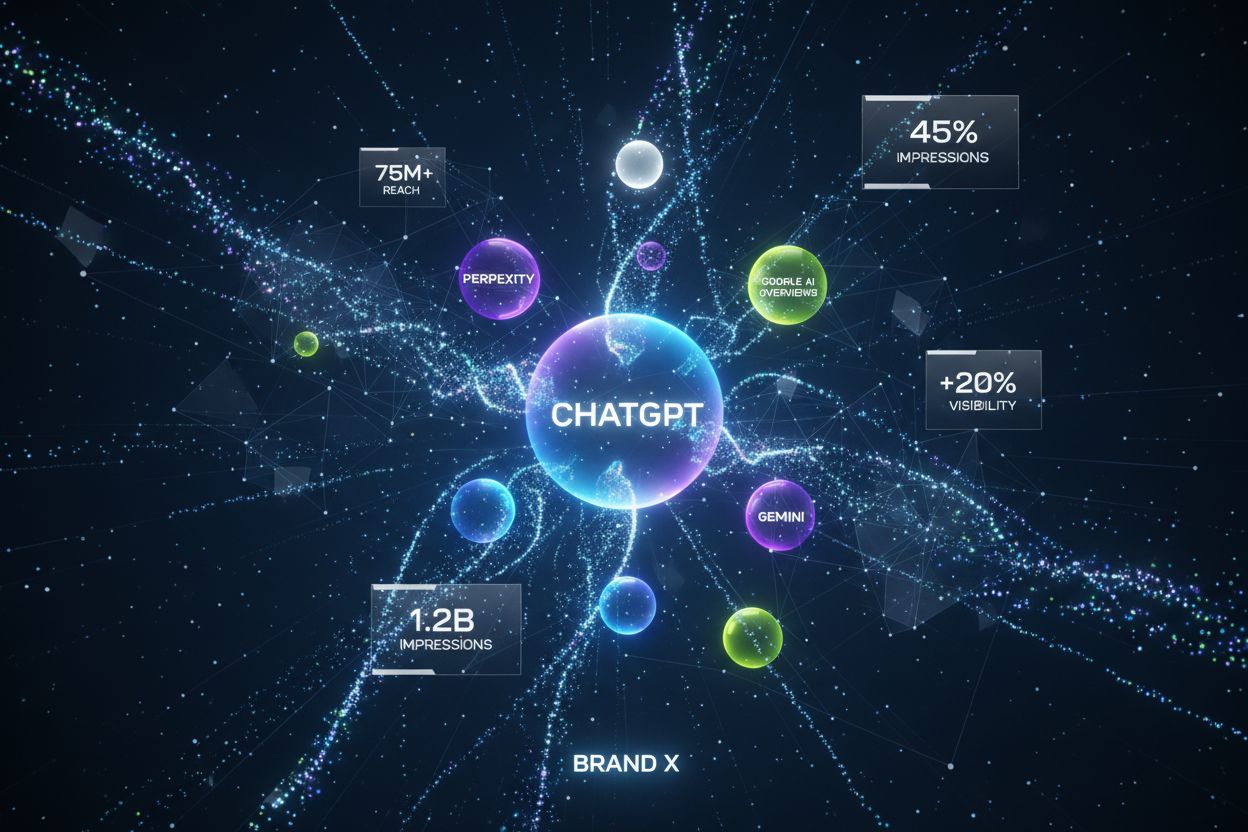
Impressions in AI Search: Understanding Potential Reach Metrics
Learn how AI impressions differ from traditional search impressions, key metrics to track, and how to measure your brand's visibility across ChatGPT, Perplexity...
11 min read
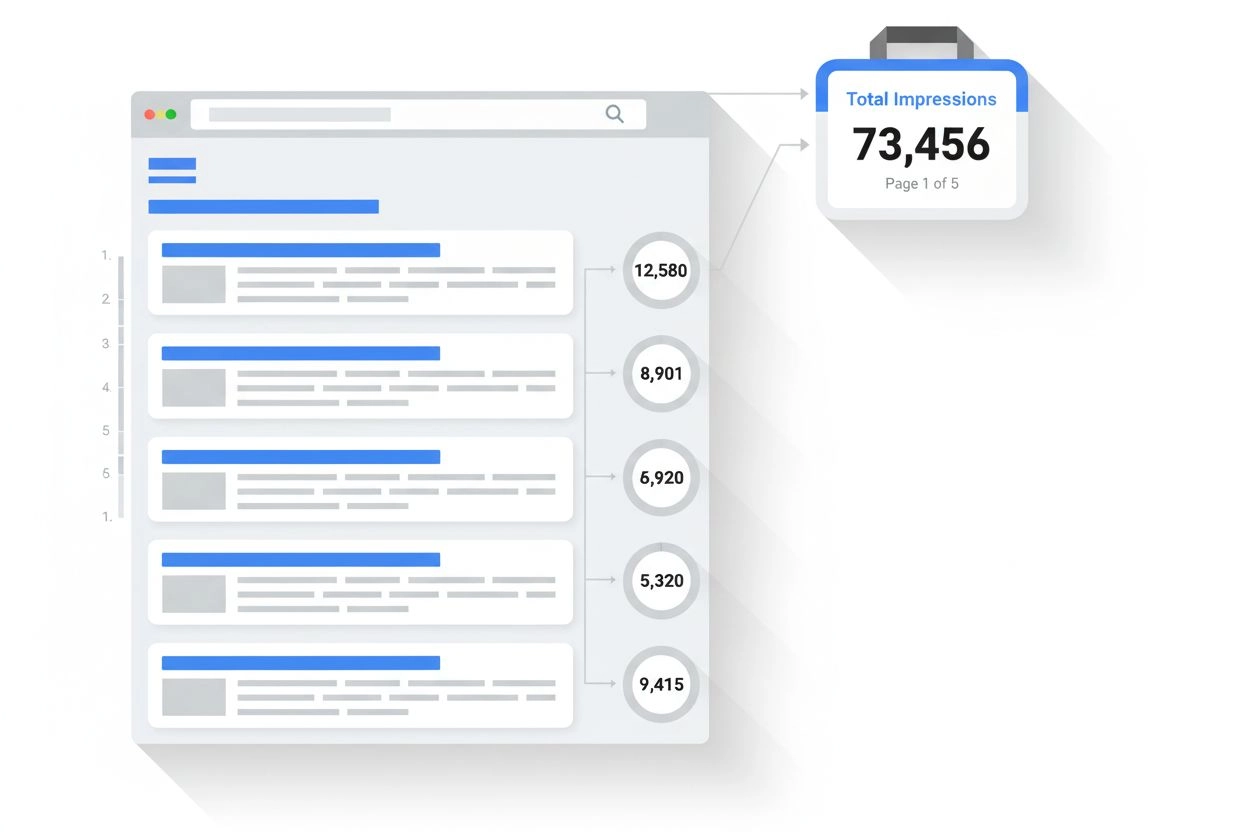
An impression is a single display of content in search results, counted whenever a user sees a link to a website in Google Search, Discover, News, or AI-powered search platforms, regardless of whether the user clicks on it. Impressions measure visibility and reach rather than engagement.
An impression is a single display of content in search results, counted whenever a user sees a link to a website in Google Search, Discover, News, or AI-powered search platforms, regardless of whether the user clicks on it. Impressions measure visibility and reach rather than engagement.
An impression is a single display of content in search results or AI-powered platforms, counted whenever a user views a link to your website or content, regardless of whether they click on it. According to Google Search Console, an impression means that a user has seen (or potentially seen) a link to your site in Search, Discover, or News. The fundamental principle is straightforward: visibility is measured independently from engagement. Impressions represent the first critical step in the user journey—they measure how often your content appears in front of potential visitors before any interaction occurs. This metric has become increasingly important as search behavior evolves, particularly with the rise of AI-powered search platforms like Google AI Overviews, Perplexity, ChatGPT, and Claude, where impressions now signal algorithmic relationships and content trustworthiness rather than just traditional search visibility.
The concept of impressions originated in traditional advertising and digital marketing, where it represented the number of times an advertisement was displayed to an audience. When Google Search Console was introduced, impressions became a core SEO metric, allowing webmasters to understand their content’s visibility in organic search results. For decades, impressions were considered a vanity metric—interesting to track but less valuable than clicks or conversions. However, the landscape shifted dramatically with the emergence of generative AI and large language models (LLMs). Today, impressions have become what industry experts call “the new clicks” because they represent visibility in AI systems that increasingly mediate how users discover information. Research from BrightEdge shows that since Google launched AI Overviews in May 2024, total search impressions have skyrocketed by 49% year-over-year, while click-through rates have simultaneously dropped by 30%. This decoupling of impressions from clicks represents a fundamental shift in how brands should measure SEO success. The rise of AI monitoring platforms like AmICited reflects this new reality, as organizations now need to track impressions across multiple AI platforms simultaneously to understand their true brand visibility in the AI-driven web.
Understanding the technical mechanics of impression counting is essential for accurate performance measurement. In Google Search Console, an impression is recorded whenever your URL appears on a search results page that a user loads, with specific rules depending on the result type. For standard “plain blue links,” impressions are counted when the result appears on the current page of results, whether or not the user scrolls to see it. However, for independently scrolling or expanding elements like carousels, FAQ results, or expandable sections, the item must typically be scrolled into view within the carousel or expanded by a click to register an impression. For image search results, impressions are counted differently depending on the search view: in the combined results tab, image impressions are counted whether or not scrolled into view, but in the dedicated image search tab, images must be scrolled into view to count. AI Overviews follow standard impression rules, meaning the link must be scrolled or expanded into view to register an impression. The critical distinction is that scrolling away and returning during a single query does not count as multiple impressions—it remains a single impression per session. This technical precision matters because it affects how you interpret your data and understand your actual visibility.
The relationship between impressions and clicks has become one of the most important concepts in modern SEO, particularly in the AI era. Impressions measure visibility—how many times your content appears in front of users—while clicks measure engagement—how many times users actually interact with your content by clicking through. Historically, marketers focused heavily on clicks because they represented the beginning of the conversion funnel. However, recent data reveals a dramatic shift: impressions are increasing while clicks are decreasing. According to research from Optimizely, this trend reflects a fundamental change in user behavior driven by AI platforms. Users increasingly prefer to stay within AI interfaces like ChatGPT, Perplexity, and Google’s AI Mode rather than clicking through to external websites. The average ChatGPT user spends 7 minutes and 46 seconds per session, and the entire interface is optimized to provide complete answers without requiring external navigation. This means your content can be highly valuable to users and AI systems—appearing in responses and being cited as a source—without generating traditional clicks. Click-through rate (CTR) is calculated as clicks divided by impressions, so when impressions increase while clicks remain flat or decrease, CTR appears to decline. However, this doesn’t indicate poor performance; rather, it reflects the changing nature of how information is consumed in an AI-mediated attention economy. A high impression count with lower CTR may actually indicate strong brand visibility and content authority, as AI systems are citing your work without users needing to leave the AI platform.
| Platform/Context | Impression Definition | Counting Method | Visibility Requirement | Key Metric Relationship |
|---|---|---|---|---|
| Google Search (Organic) | URL appears on SERP user views | Loaded on current page | Not required to scroll | Position, CTR, Clicks |
| Google AI Overviews | Content cited in AI-generated response | Must be scrolled/expanded into view | Scrolling required | Position, AI citations, Clicks |
| Google Discover | Topic card scrolled into view | Scrolled into feed | Must scroll into view | Engagement, Clicks (no position) |
| Perplexity AI | Content cited in AI response | Inline citation surfaced | Visible in response | Citation count, Source authority |
| ChatGPT/Claude | Content referenced in response | Platform-dependent tracking | Depends on platform | Citation frequency, Brand mentions |
| Google Ads (PPC) | Ad displayed on search/network | Ad served to user | Not required to view | Impressions, Clicks, CPC |
| Social Media Ads | Ad delivered to user feed | Served impression | Not required to view | Reach, Engagement, CTR |
| Served vs. Viewable | Ad loaded for user | Served when loaded | 50% visible for 1 second | Viewability rate, Quality |
The emergence of AI-powered search platforms has fundamentally transformed the importance of impressions as a metric. When Google integrated AI Overviews into Search Console in 2024, it created a new category of impressions that operate differently from traditional organic search. In AI Mode and AI Overviews, your content can appear as a citation or reference within an AI-generated response, and this appearance counts as an impression even though the user experience is radically different from clicking a traditional blue link. Perplexity, which prioritizes transparency in its citation methodology, surfaces citations inline as answers load, making impressions highly visible and trackable. ChatGPT and Claude track impressions through their own monitoring systems, though with less transparency than Google or Perplexity. The critical insight is that AI systems are not just crawling content; they are building relationships with it. When your content consistently helps AI systems provide better answers or insights, it gets integrated into the AI’s knowledge graph and gains more impressions over time. This represents a shift from algorithmic ranking (where position determines visibility) to algorithmic trust (where content authority and relevance determine how often AI systems reference your work). Research shows that Google AIO leans towards deep pages (minimum 2 links removed from the homepage) when surfacing citations, indicating that AI systems reward comprehensive, authoritative content that serves as a reliable source. For brands monitoring their presence across multiple AI platforms, impressions have become the primary visibility metric because they indicate whether AI systems consider your content trustworthy enough to cite or reference.
Understanding impressions has direct business implications that extend beyond vanity metrics. Impressions generate brand awareness, and research consistently shows that it takes 5-7 impressions for brand recall. In the AI context, these impressions are often more concentrated and contextually rich than traditional search impressions because they appear within AI-generated responses that users are actively engaging with. When a user asks ChatGPT a question and your content is cited in the response, that impression occurs in a high-attention context where the user is actively seeking information. Impressions create opportunities for clicks, even if the immediate click-through rate is lower. Users who see your brand mentioned multiple times across different AI platforms develop familiarity and trust. When they eventually search for your brand directly or click through from an AI platform, it’s often the culmination of multiple AI impression exposures that made that action feel natural and trustworthy. Impressions indicate content quality and authority. If your content is appearing frequently in AI responses, it signals to both users and search algorithms that your content is authoritative, accurate, and valuable. This correlation between high AI impressions and improved traditional search rankings has been documented by multiple research organizations. Impressions enable competitive analysis. By tracking how often your competitors’ content appears in AI responses compared to your own, you can identify content gaps and opportunities. If a competitor is receiving significantly more impressions for a particular topic, it indicates that their content is being perceived as more authoritative or relevant by AI systems. For B2B SaaS companies and enterprises, impressions have become critical because they directly impact brand visibility in the AI-driven discovery process that increasingly influences purchasing decisions.
Tracking impressions effectively requires understanding where and how to measure them across different platforms. Google Search Console remains the primary source for organic search impressions, providing detailed data broken down by query, page, country, device, and search appearance type. The Performance report in GSC shows impressions alongside clicks, CTR, and average position, allowing you to analyze the relationship between visibility and engagement. For AI platform impressions, the tracking landscape is more fragmented. Google’s integration of AI Overviews into Search Console means you can now see AI impression data mixed with traditional organic impressions, though Google doesn’t yet provide separate labeling. Perplexity provides more transparent citation tracking, allowing you to see exactly when and how your content is cited. ChatGPT and Claude require third-party monitoring tools to track impressions effectively. This is where AI monitoring platforms like AmICited become essential. AmICited aggregates impression data across Google Search, Google AI Overviews, Perplexity, ChatGPT, Claude, and other AI platforms in a single unified dashboard. Rather than manually checking each platform, you can see your total impression count, track trends over time, and identify which platforms are driving the most visibility for your brand. The platform also tracks impression velocity—how quickly your impressions are growing—and provides alerts when your brand appears in new AI contexts. For organizations serious about understanding their presence in the AI-driven web, centralized impression tracking has become as important as traditional SEO analytics.
The definition and importance of impressions will continue to evolve as AI systems become more sophisticated and integrated into the search experience. Google’s roadmap includes further integration of AI capabilities into Search, with AI Mode expanding to more users and becoming the default search experience for many. This means impressions in AI contexts will likely become the dominant visibility metric, potentially surpassing traditional organic search impressions in importance. Perplexity and other AI search engines are gaining market share, particularly among younger users and professionals seeking more conversational, source-rich answers. As these platforms mature, impressions on Perplexity may become as important as Google impressions for many brands. Enterprise AI platforms like Claude and specialized LLMs are being integrated into business workflows, creating new impression opportunities in professional contexts. A software company’s content might appear in Claude responses used by enterprise customers, representing high-value impressions even if they don’t generate website clicks. Impression quality metrics will likely become more sophisticated. Rather than simply counting impressions, future tools may measure impression context (was the impression in a featured position? was it cited as a primary source?), impression sentiment (was the citation positive or neutral?), and impression conversion (did the impression lead to downstream engagement?). AmICited and similar platforms will become increasingly essential as the impression landscape fragments across multiple AI platforms. Organizations will need real-time visibility into where their brand appears, how often, and in what context across the entire AI ecosystem. The companies that win in this new landscape will be those that understand impressions not as a vanity metric, but as a fundamental signal of algorithmic trust and brand authority in the AI-mediated attention economy.
Impressions measure how many times your content appears in search results, while clicks measure how many times users actually click on your content. A user can see your result (impression) without clicking it. According to recent data, Google search impressions are up 49% year-over-year, but click-through rates have dropped 30%, showing that impressions and clicks are increasingly decoupled metrics in the AI era.
Google Search Console counts an impression whenever your URL appears on a search results page that a user views. The impression is recorded when the result loads on the page, regardless of whether the user scrolls to see it or clicks it. For carousels and expandable sections, the item must typically be scrolled into view to register an impression.
Impressions are critical for AI monitoring because they indicate when your content appears in AI-generated responses across platforms like ChatGPT, Perplexity, Claude, and Google AI Overviews. In the AI era, impressions represent algorithmic relationships and brand visibility signals that determine your content's trustworthiness to AI systems, often more important than traditional clicks.
Served impressions are counted when an ad or content is loaded for a user, regardless of whether they actually see it on their screen. Viewable impressions only count when the content is at least 50% visible to the user for at least one second. Viewable impressions provide a more accurate measure of actual exposure and engagement.
Impressions work differently across AI platforms. In Google AI Overviews, impressions are counted when your content appears in the AI-generated response. On Perplexity, citations are surfaced inline as the answer loads. ChatGPT and Claude track impressions through their own monitoring systems. AmICited helps track these impressions across all major AI platforms in one unified dashboard.
Yes, impressions are almost always higher than clicks because users see your content without necessarily clicking it. In fact, recent data shows that impressions have increased 49% while clicks have decreased 30%, indicating a significant gap between visibility and engagement in the AI-driven search landscape.
According to benchmark data from Google Search Console, a good number of organic impressions is around 122,000 per month for average companies. However, the ideal impression count depends on your industry, target audience, and business goals. More importantly, focus on the quality of impressions from relevant users rather than just the quantity.
Search position and impressions are closely related. Higher positions (closer to the top of search results) typically generate more impressions because users are more likely to see results at the top of the page. However, position is calculated as an average across all queries, while impressions count each individual display of your content.
Start tracking how AI chatbots mention your brand across ChatGPT, Perplexity, and other platforms. Get actionable insights to improve your AI presence.
Learn how AI impressions differ from traditional search impressions, key metrics to track, and how to measure your brand's visibility across ChatGPT, Perplexity...
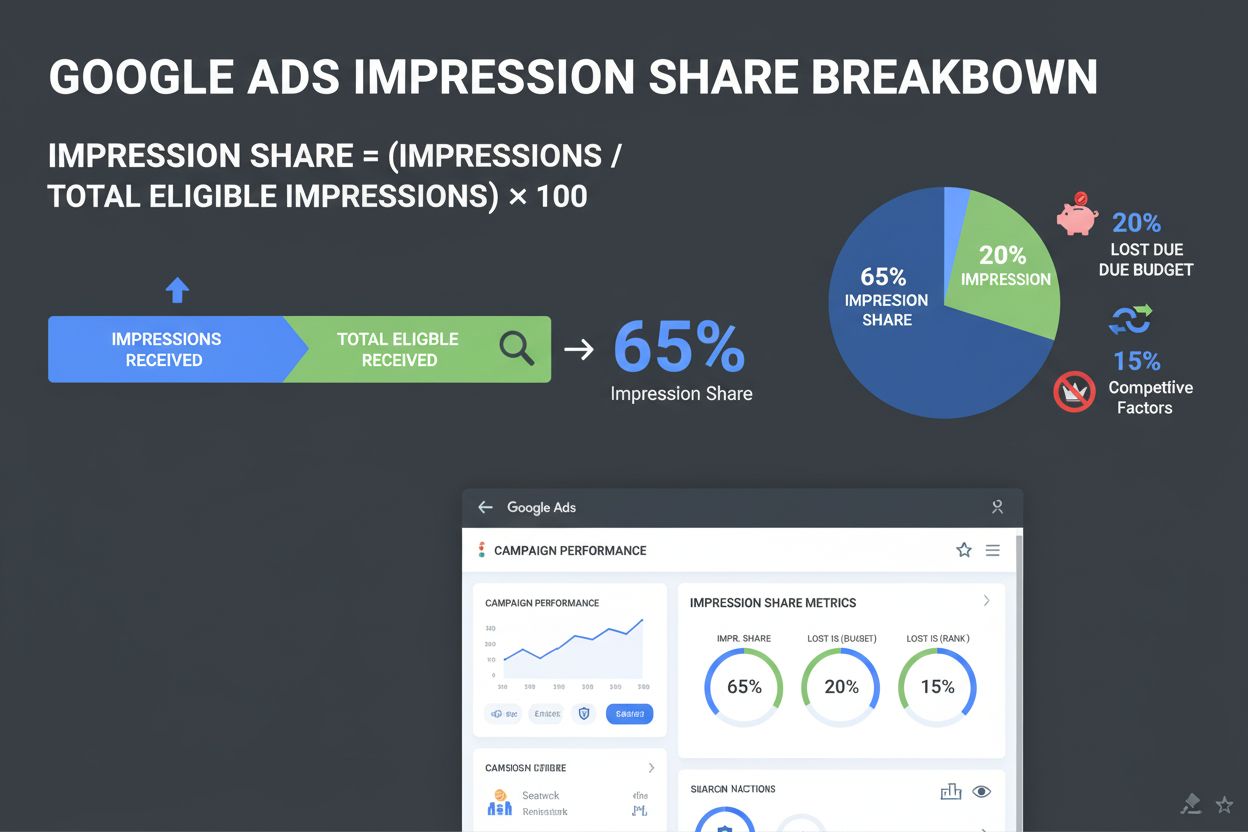
Impression Share measures the percentage of available impressions your ads received. Learn how to calculate, benchmark, and optimize this critical PPC metric fo...
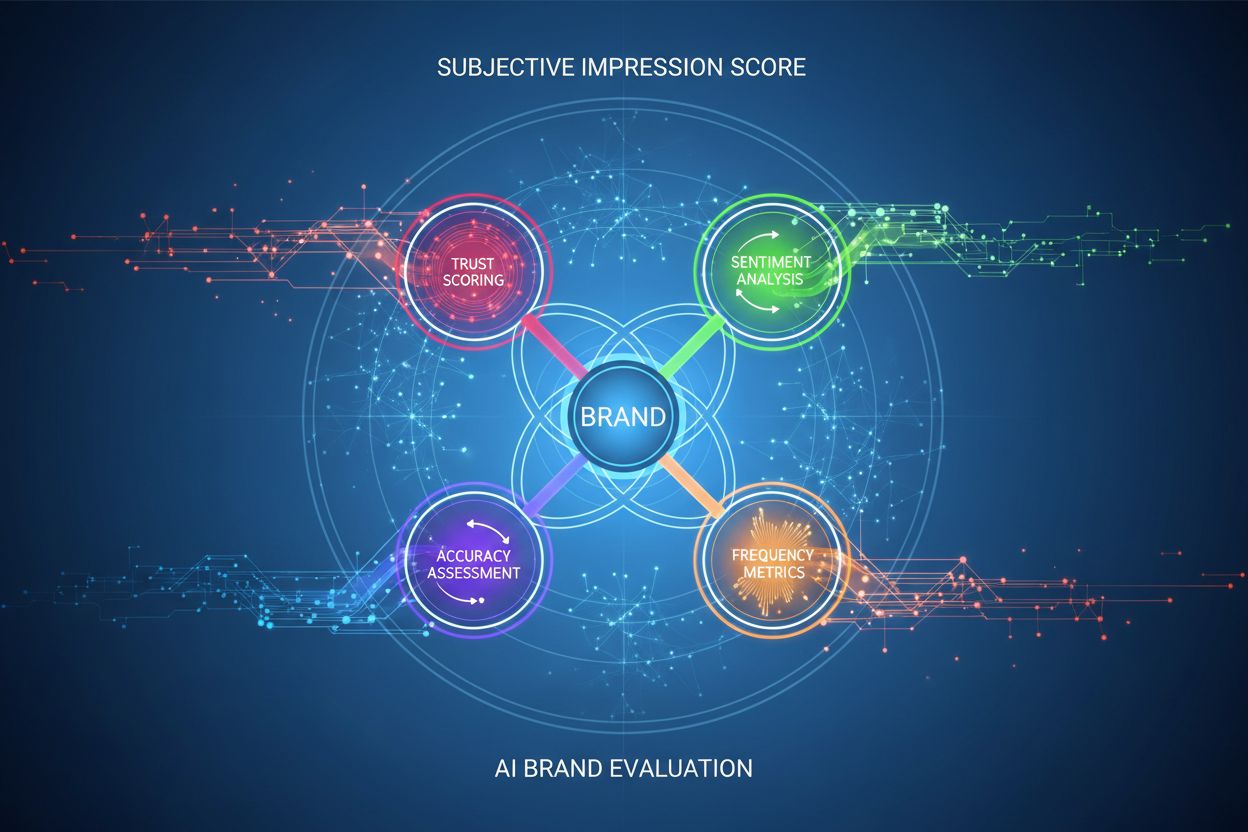
Learn what Subjective Impression Score is and how it measures brand favorability in AI-generated responses. Discover why this metric matters for brand visibilit...
Cookie Consent
We use cookies to enhance your browsing experience and analyze our traffic. See our privacy policy.