

Brand Authority
Brand Authority is the cumulative trust and expertise a brand earns that determines visibility in AI search. Learn how to build and measure brand authority for ...
8 min read
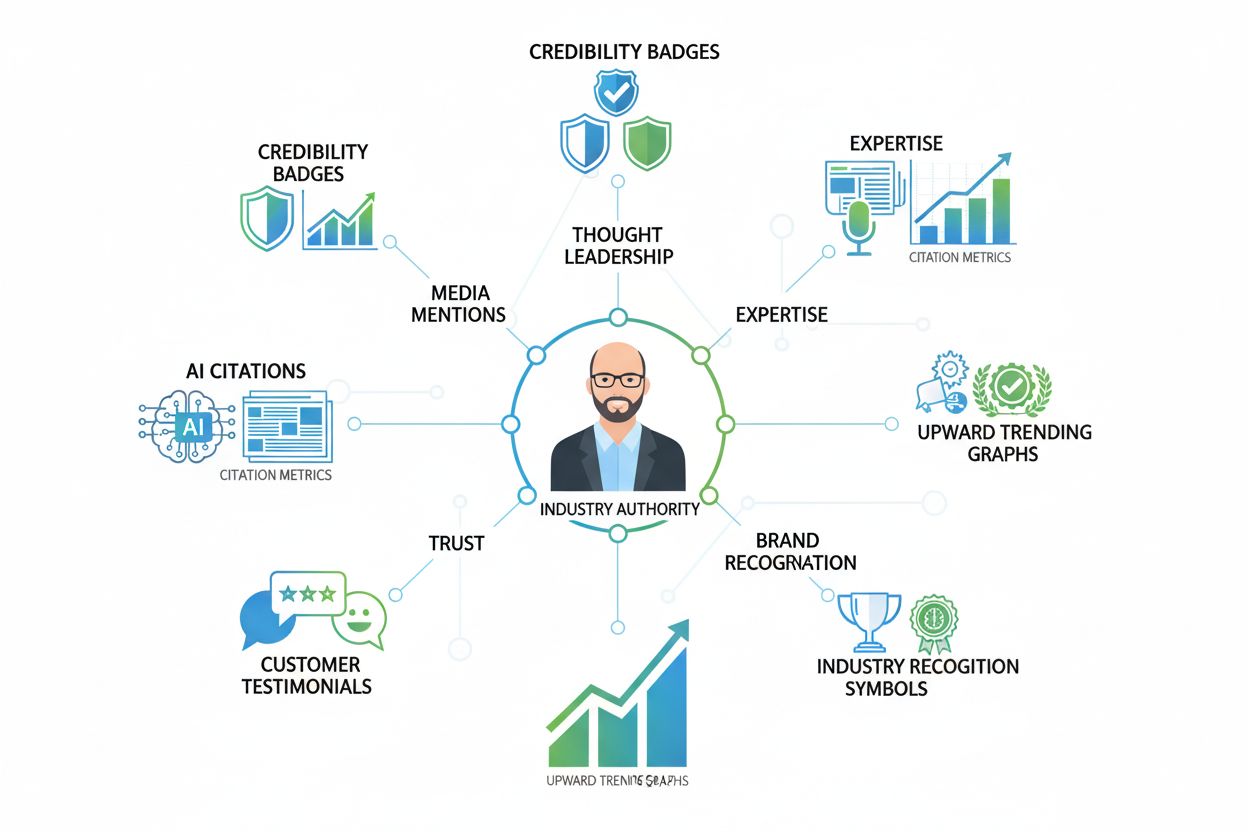
Industry authority refers to recognized leadership and expertise within a specific business sector, where an individual, brand, or organization is widely acknowledged as a trusted, credible source of knowledge and innovation. It is established through consistent demonstration of expertise, thought leadership, and influence that shapes industry conversations and buyer decisions.
Industry authority refers to recognized leadership and expertise within a specific business sector, where an individual, brand, or organization is widely acknowledged as a trusted, credible source of knowledge and innovation. It is established through consistent demonstration of expertise, thought leadership, and influence that shapes industry conversations and buyer decisions.
Industry authority is the recognized leadership and credibility that an individual, brand, or organization achieves within a specific business sector. It represents more than just expertise—it encompasses the widespread acknowledgment by peers, customers, competitors, and increasingly, AI systems, that an entity is a trusted, authoritative source of knowledge, innovation, and guidance. An industry authority shapes conversations, influences buyer decisions, and sets standards within their field. This recognition is built through consistent demonstration of expertise, thought leadership, strategic content creation, and meaningful engagement with industry communities. In today’s AI-driven landscape, industry authority has become even more critical, as AI systems preferentially cite and reference domains recognized as authoritative sources when generating responses to user queries.
The concept of industry authority has evolved significantly over the past two decades. Historically, authority was primarily established through traditional channels: academic credentials, published books, speaking engagements at major conferences, and media appearances. However, the digital revolution and the rise of AI-powered search have fundamentally transformed how authority is recognized and measured. Today, industry authority is determined by a complex interplay of factors including content quality, AI citations, social media influence, backlink profiles, organic search visibility, and community engagement. Research from Conductor Academy reveals that 50% of B2B buyers now use generative AI as their primary source for research, fundamentally shifting where authority is demonstrated and recognized. This means that brands must now optimize for visibility not just in traditional search engines, but across multiple AI platforms including ChatGPT, Perplexity, Google AI Overviews, and Claude.
The shift toward AI-driven discovery has created what industry experts call the “known three phenomenon.” According to research analyzing thousands of RFPs, buyers typically evaluate four vendors, but they already know three of them before starting their formal search process. This underscores the critical importance of establishing industry authority early—before potential customers even begin their evaluation journey. Brands that fail to build authority find themselves competing for the fourth position, fighting for scraps rather than being considered as a primary option.
Industry authority is not a monolithic concept but rather a multifaceted construct built on several interconnected pillars. The first pillar is expertise and knowledge depth. True authority requires genuine mastery of a subject area, demonstrated through original research, innovative solutions, and the ability to address complex industry challenges. The second pillar is consistent visibility and presence. Authority cannot exist in isolation; it must be recognized and acknowledged by relevant audiences. This requires strategic content distribution, media relations, speaking opportunities, and active participation in industry conversations. The third pillar is trust and credibility signals. These include third-party validations such as awards, certifications, media mentions, backlinks from reputable sources, and positive customer testimonials. The fourth pillar is influence and impact. True industry authorities don’t just comment on trends—they shape them. They drive conversations, inspire action, and influence how others in the industry think and operate.
Google’s E-E-A-T framework—Experience, Expertise, Authoritativeness, and Trustworthiness—provides a useful lens for understanding how authority is evaluated in the digital age. Experience refers to the practical, hands-on knowledge an entity brings to their field. Expertise encompasses the depth of knowledge and skill. Authoritativeness is the recognition and credibility granted by peers and the broader industry. Trustworthiness is the confidence that an entity will deliver on its promises and provide accurate, reliable information. All four elements work together to establish industry authority, and all four are increasingly important for visibility in AI search results.
| Concept | Definition | Scope | Recognition | Impact on AI Citations |
|---|---|---|---|---|
| Industry Authority | Recognized leadership and expertise within a sector; shapes industry conversations and buyer decisions | Broad industry-wide recognition | Acknowledged by peers, customers, competitors, and AI systems | High—AI systems actively cite authoritative domains |
| Thought Leadership | Positioning as an expert and visionary; leading conversations and driving innovation | Specific topic or niche within industry | Recognized by engaged audiences and media | Medium—Thought leaders gain citations through content |
| Subject Matter Expertise | Deep, specialized knowledge in a specific area | Narrow, focused domain | Recognized by specialists and professionals | Low—Expertise alone doesn’t guarantee AI visibility |
| Brand Reputation | Overall perception and sentiment toward a brand | General public and customer base | Measured through reviews, sentiment, and brand perception | Medium—Reputation influences but doesn’t guarantee authority |
| Domain Authority (SEO) | Metric predicting ranking potential based on backlink profile | Search engine visibility | Measured by tools like Moz and Ahrefs | Medium—Correlates with AI visibility but isn’t determinative |
| Influencer Status | Ability to drive engagement and action through social media | Social media platforms | Measured by followers and engagement rates | Low—Social influence doesn’t directly translate to AI citations |
The relationship between industry authority and AI search visibility is direct and measurable. Research analyzing 800+ websites across 11 industries revealed that AI visibility and AI mentions show a strong 0.87 correlation, meaning domains with higher authority consistently receive more citations from AI systems. This correlation varies by sector—it’s strongest in technology, finance, and entertainment, where authority signals are most concentrated. The analysis also found that organic keyword breadth correlates more strongly with AI visibility (0.41) than backlinks (0.37), suggesting that comprehensive topical coverage is increasingly important for AI recognition.
The implications are significant: brands that establish industry authority are not just gaining traditional SEO benefits—they’re positioning themselves to be cited and referenced by AI systems that billions of users rely on for information. When an AI system cites your domain in response to a user query, it’s essentially endorsing your authority and directing attention to your content. This creates a powerful feedback loop: more citations increase visibility, which attracts more audience engagement, which further reinforces your authority status. Conversely, brands without established authority risk becoming invisible in AI responses, losing potential customers before they even know your company exists.
Establishing industry authority requires a deliberate, multi-step approach. The first step is strategic topic ownership—deciding which specific topics and categories you want to be known for. This requires organizational alignment and focus. Many companies struggle here because they want to be everything to everyone. True authority requires choosing your battles and committing to dominate specific conversations. Once you’ve identified your core topics, the second step is building a content moat. This means creating consistent, high-quality content that establishes you as the definitive source on your chosen topics. This content should be original, well-researched, and provide genuine value that others will want to reference and cite.
The third step is targeting topic adjacencies. In the age of AI and zero-click searches, users won’t browse your site casually to discover related content. Instead, you must create content on related topics so your brand appears across broader conversations. If your core topic is “data management,” your adjacencies might include “database technology,” “data cleansing,” “data governance,” and “data privacy.” This strategy casts a wider net and ensures your brand shows up in related conversations within AI systems. The fourth step is measuring and repeating. Track how your authority grows over time, monitor your AI citations, and continuously refine your strategy based on what’s working. Most importantly, repeat your core message relentlessly—weave your brand promise into every piece of content you create.
Thought leadership is a critical component of industry authority. Thought leaders are individuals or organizations that position themselves as experts and visionaries in their field, leading conversations and driving innovation. There are several types of thought leaders: Innovators who pioneer new ideas and push boundaries; Educators who share wisdom and mentor others; Advocates who champion causes and drive change; and Researchers who lead with data and evidence. Each type brings distinct value to their industry.
Implementing thought leadership requires multiple channels and consistent effort. Maintaining a blog with regular, high-quality content is foundational. Speaking opportunities at industry conferences, webinars, and workshops provide platforms to reach engaged audiences. Social media engagement allows you to participate in broader conversations and build community. Publishing books and articles in well-known publications demonstrates depth of expertise and reaches new audiences. The key is aligning your content format with your message and your audience’s preferences. For example, case studies showcase how your strategies drive results, while industry analyses provide trend insights. Research and original data are particularly valuable—they give others something to cite and reference, which directly boosts your authority and AI visibility.
Industry authority manifests differently across sectors, reflecting the unique trust models and information needs of each industry. In healthcare, authority is heavily concentrated among academic institutions, government agencies like the CDC, and peer-reviewed sources. This reflects the critical importance of evidence-based information in medical contexts. In finance, media brands like Forbes and Bloomberg dominate citations, but specialized experts like NerdWallet achieve high visibility through deep, evergreen guides and comparison content. In technology, review sites like CNET and The Verge hold significant authority, reflecting the importance of hands-on testing and expert evaluation. In entertainment, user-generated content platforms like Reddit and YouTube rank highly, showing how community-driven content influences authority in this sector.
These sector-specific patterns have important implications for brands building authority. A healthcare company must prioritize peer-reviewed research and partnerships with medical institutions. A fintech startup should focus on creating comprehensive guides and comparison content. A software company should pursue media coverage and expert reviews. Understanding the authority model of your specific sector is critical for building a strategy that resonates with both your audience and AI systems.
As AI systems become increasingly central to how people discover information and make decisions, industry authority will continue to evolve. Several trends are emerging. First, AI citation tracking will become standard practice. Just as companies monitor their search rankings and backlink profiles, they’ll increasingly monitor their AI citations across multiple platforms. Tools like AmICited are pioneering this space, allowing brands to track where they appear in AI responses and how their visibility compares to competitors. Second, authority will become more democratized. While traditional gatekeepers (media, academia, industry associations) will remain important, AI systems are increasingly citing diverse sources including user-generated content, niche blogs, and emerging voices. This creates opportunities for new entrants to build authority faster than was previously possible.
Third, content comprehensiveness will matter more than ever. AI systems reward domains that provide thorough, well-structured coverage of topics. Brands that create layered content addressing different user intents—informational, transactional, and comparative—will gain visibility advantages. Fourth, real-time authority measurement will drive strategy. As brands gain visibility into their AI citations and can see exactly which content is being referenced, they’ll be able to optimize their strategies in real-time rather than waiting months for traditional SEO results. Finally, authority will become increasingly important for competitive differentiation. As AI systems compress answers and cite fewer sources, being included in those citations will deliver disproportionate visibility and influence. The brands that win will be those that establish authority before their competitors do.
Measuring industry authority requires tracking multiple metrics across different platforms and channels. AI citation tracking is now critical—monitoring how often your domain appears in responses from ChatGPT, Perplexity, Google AI Overviews, and Claude. Organic search visibility remains important, measured through keyword rankings and organic traffic. Backlink profile quality indicates how other authoritative sources view your content. Media mentions and PR coverage demonstrate third-party validation of your expertise. Social media engagement and reach show how your content resonates with audiences. Customer testimonials and case studies provide social proof of your impact. Speaking engagements and conference appearances signal industry recognition. Award nominations and industry recognition validate your authority status.
The most sophisticated brands create dashboards that integrate data from multiple sources, providing a holistic view of their authority across channels. This allows them to identify which strategies are driving the most impact and where to focus their efforts. For example, if you notice that your AI citations are increasing but your organic rankings are stagnant, you might shift resources toward content optimization for AI systems. If your media mentions are high but your AI citations are low, you might focus on creating more structured, citable content.
In an increasingly competitive business landscape where AI systems mediate how information is discovered and decisions are made, industry authority has become a strategic imperative. It’s no longer sufficient to be good at what you do—you must be recognized as a leader in your field by your audience, your peers, and the AI systems that influence buyer behavior. Building industry authority requires sustained effort, strategic focus, and a commitment to creating genuine value. It requires choosing your battles, building a content moat around your core topics, expanding into adjacent conversations, and measuring your progress over time. Most importantly, it requires consistency—repeating your core message until it becomes impossible to ignore.
The brands that will thrive in the AI era are those that understand that authority is not something you claim—it’s something you earn through demonstrated expertise, consistent delivery of value, and recognition by the communities and systems that matter most. By following the strategic framework outlined in this glossary entry and committing to the long-term work of building authority, your brand can position itself as a trusted, influential leader in your industry—visible not just to your immediate audience, but to the AI systems that increasingly mediate how the world discovers information.
While expertise refers to deep knowledge in a specific area, industry authority encompasses expertise combined with recognition, influence, and the ability to shape industry conversations. An expert may possess knowledge, but an industry authority is widely acknowledged and trusted by peers, customers, and AI systems as a go-to source. Industry authority requires consistent visibility, credibility signals, and demonstrated impact on industry trends and buyer decisions.
In AI-driven search environments like ChatGPT, Perplexity, and Google AI Overviews, industry authority directly impacts visibility and citations. Research shows that 50% of B2B buyers now use AI for primary research, and AI systems preferentially cite domains recognized as authoritative. Brands without established authority risk being invisible in AI responses, losing potential customers before they even visit a website. Authority signals help AI systems identify trustworthy sources to reference.
Building industry authority requires four core elements: strategic topic ownership (deciding what you want to be known for), consistent high-quality content creation around those topics, engagement with adjacent topics to broaden reach, and continuous measurement of authority growth. Additionally, thought leadership through speaking engagements, media appearances, and collaboration with other recognized authorities accelerates the process. E-E-A-T signals—Experience, Expertise, Authoritativeness, and Trustworthiness—are essential for establishing credibility.
AI citations are a direct measure of industry authority in the modern search landscape. When AI systems cite your domain in responses, it signals recognition of your expertise and trustworthiness. Research analyzing 800+ websites across 11 industries found that domains with strong authority signals receive significantly more AI citations. Being cited by AI systems creates a virtuous cycle: more citations increase visibility, which attracts more audience engagement and further reinforces authority status.
While building industry authority typically requires sustained effort over time, new brands can accelerate the process through strategic positioning. Focusing on a specific niche, creating exceptional content that solves real problems, collaborating with established thought leaders, and leveraging PR and media relations can compress the timeline. However, authentic authority cannot be rushed—it requires consistent delivery of value and genuine expertise. Most successful new authorities invest 12-24 months of focused effort before achieving widespread recognition.
Content is the primary vehicle for demonstrating expertise and building authority. High-quality, original content—including research, guides, case studies, and thought pieces—establishes credibility and attracts citations from other sources and AI systems. Content that addresses industry gaps, provides unique insights, and solves specific problems is more likely to be referenced and shared. Consistent content creation across multiple formats (blogs, videos, whitepapers, podcasts) amplifies authority signals and ensures visibility across different audience segments.
Backlinks and organic keyword rankings are traditional authority signals that remain relevant in the AI era. Research shows a 0.79 correlation between keywords and backlinks, and both correlate with AI visibility (0.41 for keywords, 0.37 for backlinks). However, the relationship is sector-dependent. In technology and finance, backlink scale strongly predicts AI citations, while in food and beverage sectors, topical coverage breadth matters more. Building authority requires balancing traditional SEO signals with content comprehensiveness and relevance.
Start tracking how AI chatbots mention your brand across ChatGPT, Perplexity, and other platforms. Get actionable insights to improve your AI presence.
Brand Authority is the cumulative trust and expertise a brand earns that determines visibility in AI search. Learn how to build and measure brand authority for ...

Learn proven strategies to build industry authority in the AI era. Master content optimization, technical excellence, and entity authority to get cited by ChatG...
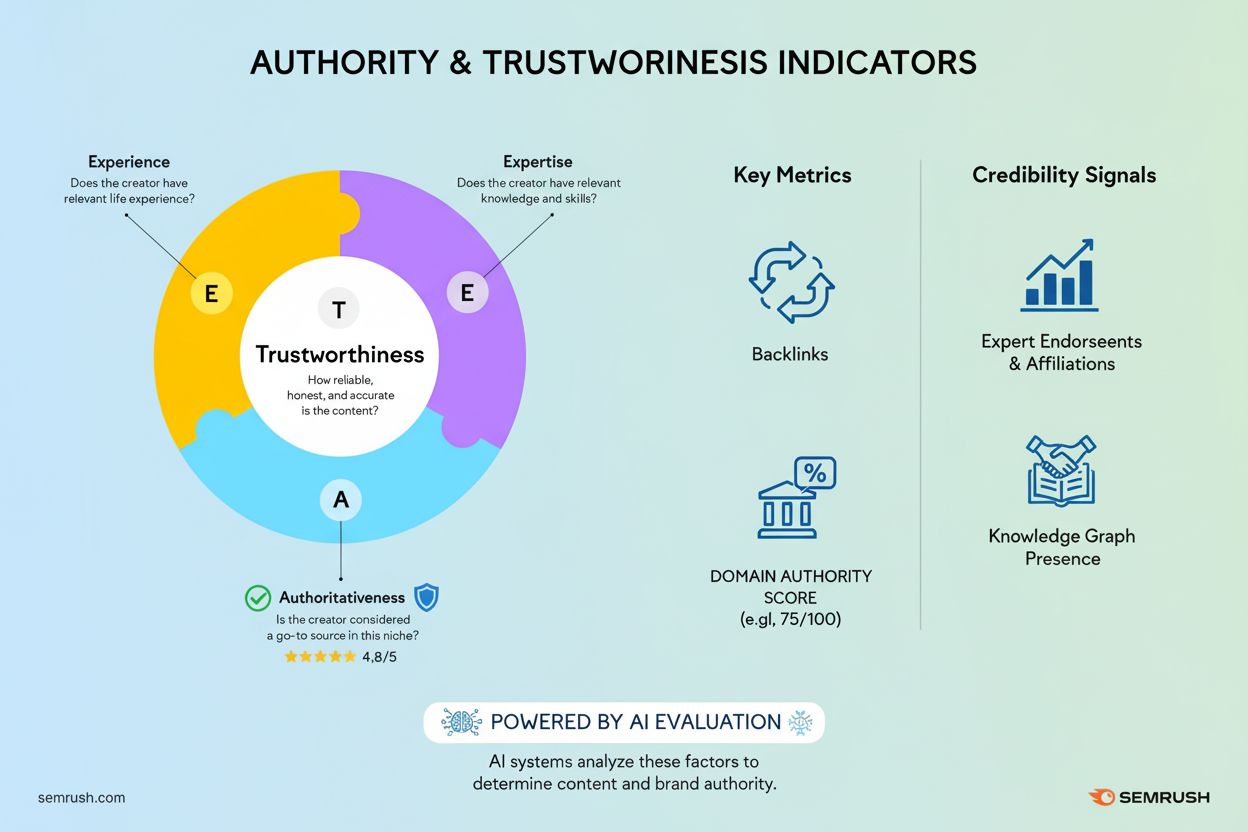
Authority signals measure content credibility through backlinks, domain authority, E-E-A-T factors, and verified credentials. Learn how AI systems and search en...
Cookie Consent
We use cookies to enhance your browsing experience and analyze our traffic. See our privacy policy.