
Local SEO
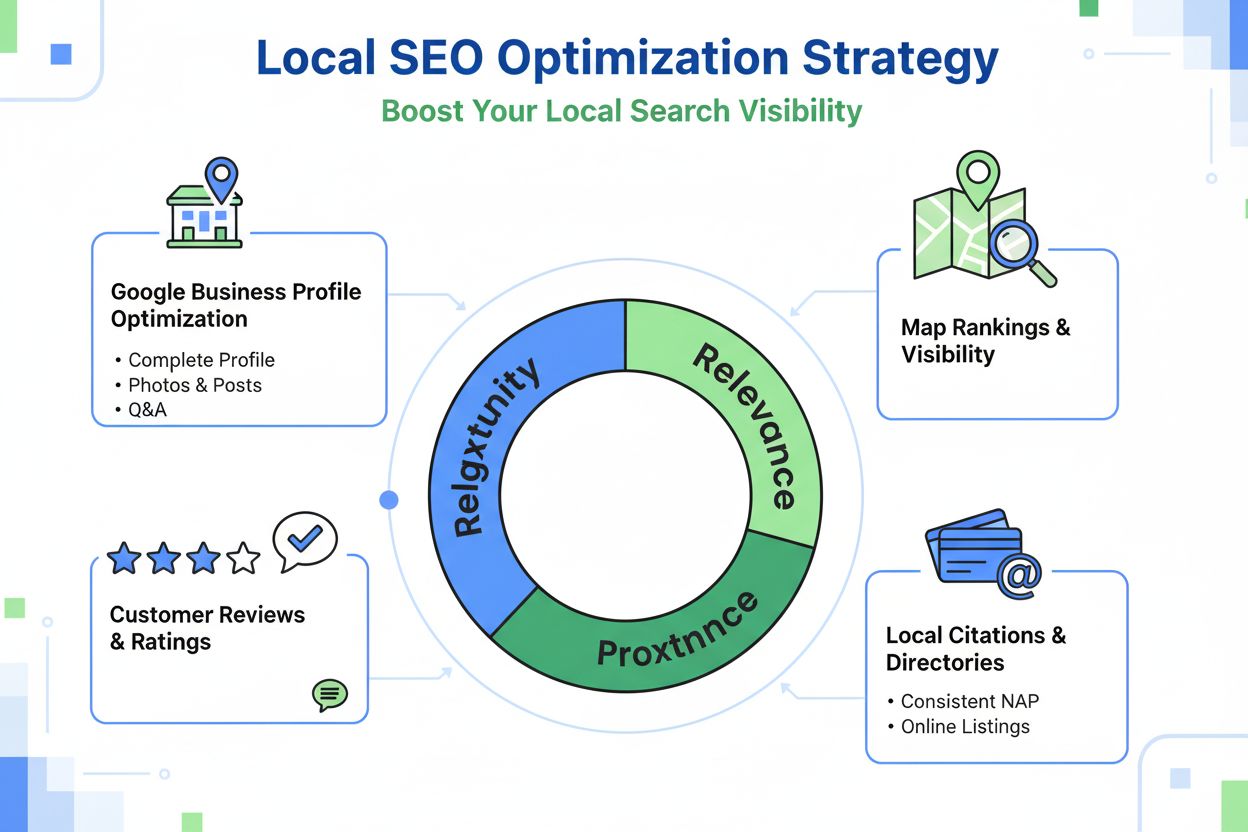
Local SEO is the practice of optimizing a business's online presence for location-based search results. Learn how to rank higher in Google Maps, local pack, and...
15 min read
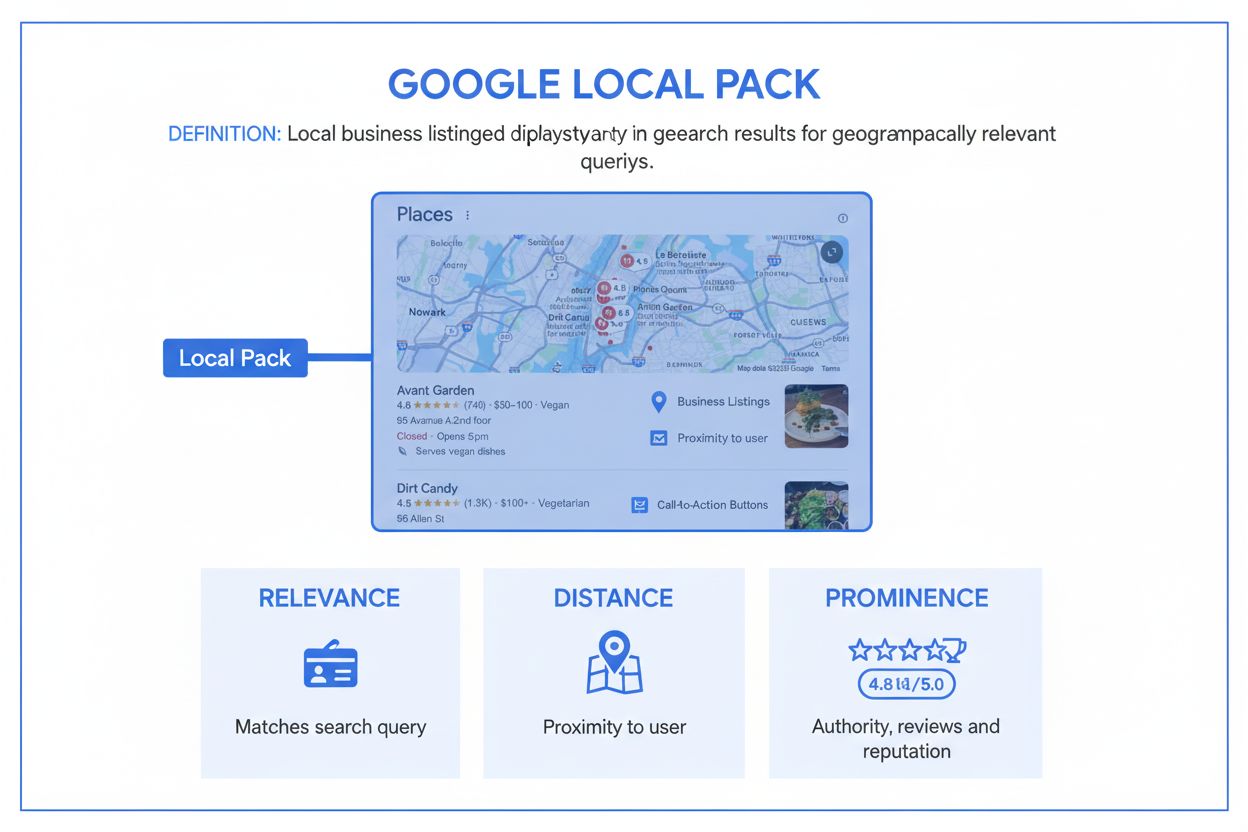
The Local Pack is a Google search feature displaying the top three local business listings prominently at the top of search results when users perform location-based queries. It includes an interactive map, business information, ratings, and direct call-to-action buttons, serving as a critical visibility tool for local businesses seeking to attract nearby customers.
The Local Pack is a Google search feature displaying the top three local business listings prominently at the top of search results when users perform location-based queries. It includes an interactive map, business information, ratings, and direct call-to-action buttons, serving as a critical visibility tool for local businesses seeking to attract nearby customers.
The Local Pack is a prominent Google search feature that displays the top three local business listings at the top of search engine results pages (SERPs) when users perform searches with local intent. Also known as the 3-Pack, Map Pack, or colloquially as the Snack Pack, this feature combines an interactive map showing business locations with concise business information including names, addresses, phone numbers, star ratings, review counts, and direct call-to-action buttons. The Local Pack represents one of the most valuable real estate positions in Google’s search results, as it appears above traditional organic listings and provides users with immediate, actionable information about nearby businesses. For local enterprises, appearing in the Local Pack is a critical objective because it directly influences consumer behavior, driving foot traffic, phone calls, website visits, and online transactions. The feature fundamentally changed how consumers discover and evaluate local businesses, making it an indispensable component of modern local search marketing strategy.
The Local Pack emerged as a distinct feature in Google’s search results around 2015, representing a significant evolution in how Google displays location-based business information. Prior to this transformation, Google displayed seven local business results in a simple list format without an integrated map, making it less intuitive for mobile users seeking nearby services. The reduction from seven results to three listings, combined with the addition of an interactive map, dramatically improved the mobile user experience and aligned with Google’s mobile-first indexing strategy. This evolution reflected broader industry trends toward location-based services and the increasing prevalence of mobile search, with approximately 46% of all Google searches now containing local intent. The Local Pack’s development paralleled the growth of Google Business Profiles (formerly Google My Business), which became the primary data source for Local Pack information. Over the past decade, Google has continuously refined the Local Pack’s appearance, adding features like local justifications (review quotes), business images, scheduling buttons, and service area information. The feature has become so integral to local search that approximately 93% of searches with local intent now include a Local Pack in the results, demonstrating its ubiquity and importance in the search ecosystem.
Google’s Local Pack algorithm operates on a sophisticated system that evaluates businesses based on three primary factors: Relevance, Distance, and Prominence. Relevance measures how closely a business’s Google Business Profile matches the user’s search query, determined by the business category, keywords, description, and services listed in the profile. When a user searches for “Italian restaurants near me,” Google prioritizes businesses with Italian restaurant categories and relevant keywords in their profiles. Distance calculates the physical proximity between the searcher’s location (determined via GPS, IP address, or explicit location input) and the business’s address, with closer businesses generally receiving ranking preference. However, Google may display a more distant business if it significantly outperforms closer competitors in relevance and prominence. Prominence reflects how well-known and reputable a business is, influenced by factors including the number and quality of customer reviews, average star rating, website authority, backlink profile, local citations across directories, and mentions across the web. These three factors work synergistically rather than independently, meaning a business with exceptional prominence can sometimes outrank a geographically closer competitor with weaker prominence signals. The algorithm continuously processes real-time data, meaning Local Pack results are highly personalized and location-specific—the same search query will produce different results depending on where the user is located.
| Feature | Local Pack | Google Maps | Local Service Ads | Organic Results |
|---|---|---|---|---|
| Display Location | Top of SERP | Standalone app/website | Above Local Pack | Below Local Pack |
| Number of Results | 3 (typically) | Unlimited | 3-5 (varies) | 10+ per page |
| Primary Data Source | Google Business Profile | Google Business Profile + Maps data | Google Business Profile + verification | Website content |
| Cost to Rank | Free (organic) | Free (organic) | Paid ads model | Free (organic) |
| Information Shown | Name, rating, address, hours, map | Detailed business info, reviews, photos | Business name, rating, verification badge | Title, meta description, URL |
| Call-to-Action | Call, directions, website, booking | Directions, call, website | Call, booking, message | Click to website |
| Mobile Optimization | Highly optimized | Highly optimized | Highly optimized | Standard |
| User Intent Match | Location-based queries | Exploratory/navigation | Service-based queries | Broad informational queries |
Relevance serves as the foundational ranking factor, ensuring that Google displays businesses genuinely matching user search intent. A business’s relevance score is determined by multiple profile elements: the primary business category (the most important), secondary categories, business description, services offered, keywords naturally incorporated into the profile, and the alignment between the business name and common search terms. For example, a dental practice with “cosmetic dentistry” in its description and secondary categories will rank higher for “cosmetic dentist near me” searches than a general dentistry practice without this specialization. Google’s algorithm analyzes the relationship between search query terms and business profile information, using natural language processing to understand semantic meaning beyond exact keyword matches. Businesses can improve relevance by ensuring their Google Business Profile is comprehensive, accurate, and strategically optimized with relevant keywords that reflect how potential customers actually search for their services.
Distance represents the geographic component of the algorithm, though its influence is more nuanced than simple proximity. Google calculates distance from the user’s current location (via GPS on mobile devices) or from an explicitly stated location in the search query. Interestingly, distance is not always the determining factor—a business 10 miles away with exceptional prominence and relevance may outrank a business 2 miles away with weaker signals. This flexibility allows Google to prioritize quality and relevance over pure proximity, ensuring users find the best-matching business rather than merely the closest one. The distance calculation also considers Google’s understanding of city boundaries and business districts, meaning a business’s position relative to the geographic center of a city or neighborhood can influence rankings. Businesses cannot directly control distance, but they can influence how Google perceives their service area by accurately listing their address and defining service areas in their Google Business Profile.
Prominence encompasses a business’s overall reputation and authority, drawing from multiple online signals. Review count and average star rating are prominent factors—businesses with more reviews and higher ratings generally rank better, as these signals indicate customer satisfaction and business legitimacy. However, prominence extends beyond reviews to include the business’s broader web presence: backlinks from authoritative websites, mentions in local news outlets, citations in business directories, social media presence, and the authority of the business’s website. A well-established business with a strong website, numerous quality backlinks, and consistent citations across directories will demonstrate higher prominence than a newer business with minimal online presence. Google also considers offline prominence—famous landmarks, well-known brands, and established institutions receive prominence boosts because they’re recognized in the offline world. Building prominence requires a long-term strategy involving review generation, local citation building, link acquisition, and consistent brand development across digital channels.
The Local Pack fundamentally shapes how consumers discover and choose local businesses, with measurable impacts on business performance. Research from SOCi reveals that businesses appearing in the Local Pack receive 126% more traffic and 93% more user actions (including calls, clicks, and direction requests) compared to businesses ranked 4-10 in local search results. This dramatic difference underscores the value of securing one of the three top positions. Approximately 50% of users making local searches on mobile devices visit a nearby business within 24 hours of their search, and 78% of local searches result in offline sales in the near future, demonstrating the direct connection between Local Pack visibility and revenue generation. The Local Pack’s prominent placement and rich information display (ratings, reviews, hours, direct call buttons) reduce friction in the customer journey, enabling users to make quick decisions without visiting additional websites. The inclusion of customer reviews and star ratings in the Local Pack serves as a powerful trust signal, with consumers significantly more likely to choose businesses with higher ratings and positive review excerpts visible in the search results. Additionally, the Local Pack’s interactive map helps users visualize business locations relative to their current position, making it easier to assess convenience and accessibility. For businesses, this means that Local Pack visibility directly translates to increased customer acquisition, making optimization efforts a high-priority marketing investment.
Securing a position in the Local Pack requires a comprehensive optimization strategy addressing all three ranking factors. First, businesses must claim and verify their Google Business Profile, ensuring they have complete ownership and control over their listing information. The profile should be filled out completely with accurate business name, address, phone number (NAP), business category, description, hours, website, and high-quality photos. Second, local keyword optimization involves researching and incorporating location-specific keywords throughout the profile and website content. Businesses should identify keywords their target customers use when searching for their services in their area, such as “best Italian restaurant in [city]” or “emergency plumber near [neighborhood],” and naturally incorporate these terms into their profile description and website content. Third, review generation and management is critical—businesses should actively encourage satisfied customers to leave reviews on their Google Business Profile through follow-up emails, in-store signage, and direct requests. Responding professionally to all reviews, both positive and negative, demonstrates engagement and commitment to customer satisfaction, which Google’s algorithm rewards. Fourth, local citation building involves ensuring the business’s NAP information is consistent and listed across major online directories, review sites, and local business listings. Inconsistent information confuses Google’s algorithm and harms rankings, so maintaining accuracy across all platforms is essential. Fifth, link building from local sources strengthens prominence—businesses should seek backlinks from local news outlets, community organizations, and industry-relevant websites. Finally, regular profile updates with fresh content, new photos, and Google Posts keep the profile active and signal to Google that the business is engaged and current.
Tracking Local Pack performance requires monitoring specific metrics that indicate visibility and user engagement. Local Pack rankings can be tracked using specialized tools that simulate searches from different geographic locations, showing whether a business appears in the top three results for target keywords. Click-through rate (CTR) from the Local Pack indicates how compelling a business’s listing is—higher CTRs suggest effective use of images, ratings, and profile information. Call volume from the Local Pack can be tracked using call tracking numbers or by monitoring call patterns in Google Business Profile insights, which show calls originating from the profile. Direction requests are another key metric, indicating users’ intent to visit the physical location. Website clicks from the Local Pack show how many users are visiting the business’s website from the search results. Review velocity (the rate at which new reviews are generated) is important because recent reviews signal active business operations and customer engagement. Average star rating directly influences Local Pack visibility, making review quality management essential. Google Business Profile Insights provides native access to many of these metrics, while third-party tools like Semrush’s Position Tracking, BrightLocal’s Local Rank Tracker, and Local Falcon’s Map Rank Tracker offer more detailed competitive analysis and geographic tracking capabilities. Businesses should establish baseline metrics, set improvement targets, and regularly review performance data to inform optimization decisions.
The Google Business Profile (GBP) serves as the primary data source for Local Pack listings, making profile optimization the foundation of any Local Pack strategy. Every piece of information displayed in the Local Pack—business name, address, phone number, hours, category, rating, review count, and images—comes directly from the GBP. Google’s algorithm analyzes GBP completeness and accuracy as ranking signals; profiles with all fields filled out and regularly updated rank higher than incomplete or outdated profiles. The business category selection is particularly important, as it’s the primary relevance signal Google uses to match businesses to search queries. Businesses should select the most specific primary category available and add relevant secondary categories to capture a broader range of search queries. The business description field allows for keyword incorporation and should clearly communicate the business’s unique value proposition and services. High-quality photos in the GBP significantly impact Local Pack performance—businesses with professional photos of their storefront, products, and services receive more clicks and higher engagement than those with poor-quality or missing images. The GBP also allows businesses to add attributes (like “wheelchair accessible” or “outdoor seating”), which help Google match businesses to specific user needs and improve relevance. Regular updates to the GBP, including new photos, Google Posts, and service updates, signal to Google that the business is active and engaged. Additionally, the GBP’s Q&A section, where customers ask questions and business owners respond, provides fresh content that Google’s algorithm values. Businesses that actively manage their GBP—responding to reviews, updating information, adding photos, and posting regular updates—consistently outrank competitors with neglected profiles.
As artificial intelligence increasingly influences search behavior, the Local Pack’s role in business visibility is evolving. AI-powered search platforms like Perplexity, ChatGPT, Google AI Overviews, and Claude are beginning to reference and cite local business information, including data from Local Packs. When users ask AI systems for local business recommendations, these platforms may cite businesses that rank well in Google’s Local Pack, effectively extending the value of Local Pack visibility beyond traditional Google Search. This emerging trend means that businesses optimizing for Local Pack visibility are simultaneously improving their chances of appearing in AI-generated responses. AmICited and similar AI monitoring platforms track where businesses appear in AI responses, revealing that Local Pack rankings correlate with AI citation frequency. Businesses that maintain strong Local Pack positions benefit from increased visibility across multiple search and AI platforms, multiplying the return on their local SEO investments. As AI search continues to mature, the importance of Local Pack optimization will likely increase, as AI systems rely on authoritative, well-structured business information—exactly what the Local Pack provides. This convergence of traditional search and AI search creates a compelling case for businesses to prioritize Local Pack visibility as a foundational element of their digital marketing strategy.
The Local Pack continues to evolve as Google refines its search algorithms and responds to changing user behavior. Recent trends suggest Google is experimenting with diversity updates that aim to reduce duplication between Local Pack results and organic search results, ensuring users see a broader range of businesses and information sources. This shift may require businesses to develop more sophisticated SEO strategies that address both local and organic ranking factors independently. Personalization is becoming increasingly sophisticated, with Google using more granular location data, search history, and user preferences to customize Local Pack results. This means the same search query will produce increasingly different results for different users, making it harder for businesses to achieve consistent rankings. Mobile-first optimization remains critical, as the vast majority of local searches occur on mobile devices, and Google continues to prioritize mobile user experience in its ranking algorithms. Review authenticity is receiving greater scrutiny, with Google implementing stronger measures to detect and filter fake reviews, making genuine review generation more important than ever. Voice search optimization is emerging as a factor, as more users perform local searches using voice assistants, requiring businesses to optimize for conversational search queries. Integration with emerging technologies like augmented reality and location-based services may eventually enhance the Local Pack experience, allowing users to visualize businesses in their physical environment. Additionally, as AI search platforms mature and gain market share, Google may adapt the Local Pack to compete with AI-generated business recommendations, potentially adding new features or information types. Businesses that stay informed about these trends and continuously adapt their Local Pack optimization strategies will maintain competitive advantages in local search visibility.
Achieving a Local Pack position is only the beginning; maintaining and improving that position requires ongoing effort and strategic management. Consistency is paramount—ensuring that business information (name, address, phone number) is identical across the Google Business Profile, website, and all online directories prevents confusion and strengthens Google’s confidence in the business’s legitimacy. Review management should be an ongoing priority, with businesses systematically requesting reviews from satisfied customers and responding professionally to all feedback. Content freshness matters; regularly updating the GBP with new photos, Google Posts, and service information signals active business operations. Citation building should continue beyond the initial optimization phase, with businesses seeking new citations from relevant directories and local sources as opportunities arise. Link acquisition from local and industry-relevant websites strengthens prominence and should be pursued through partnerships, sponsorships, and content marketing. Monitoring and analysis using tools like Google Business Profile Insights and third-party rank tracking platforms help businesses understand what’s working and identify areas for improvement. Competitive analysis reveals what competitors are doing well and where opportunities exist to differentiate. Adaptation to algorithm changes requires staying informed about Google updates and adjusting strategies accordingly. Finally, integration with broader marketing efforts—ensuring that Local Pack optimization aligns with website SEO, content marketing, paid advertising, and social media strategies—creates a cohesive digital presence that reinforces business visibility across all channels. Businesses that treat Local Pack optimization as an ongoing process rather than a one-time project consistently achieve better results and maintain competitive advantages in their local markets.
The Local Pack is a search results feature that appears at the top of Google's SERP when users search with local intent, displaying three business listings with a map. Google Maps, by contrast, is a standalone application and service where users can search for locations, get directions, and explore businesses in greater detail. While the Local Pack links to Google Business Profiles and can direct users to Maps, they are distinct services serving different purposes in the user journey.
Typically, the Local Pack displays three business listings, which is why it's also called the '3-Pack' or 'Map Pack.' However, the number can occasionally vary depending on the search query, location, and Google's algorithm adjustments. In some cases, fewer than three results may appear if there aren't enough relevant businesses in the area, or additional paid listings may be included above the organic local results.
Google's Local Pack algorithm primarily considers three factors: Relevance (how well your business matches the search query based on your Google Business Profile information), Distance (how close your business is to the searcher's location), and Prominence (how well-known and reputable your business is based on reviews, citations, and online mentions). These factors work together to determine which businesses appear in the top three positions for any given local search.
No, you cannot directly pay Google to improve your Local Pack rankings. Google explicitly states there is no way to request or pay for better local rankings. However, you can invest in Google Local Service Ads, which appear above the Local Pack with a 'Google Verified' badge. For organic Local Pack visibility, you must optimize your Google Business Profile, gather reviews, build citations, and implement local SEO best practices.
The Local Pack significantly impacts visibility because it occupies prime real estate at the top of search results for location-based queries. Studies show that businesses appearing in the Local Pack receive 126% more traffic and 93% more user actions (calls, clicks, directions) compared to businesses ranked 4-10. Approximately 46% of all Google searches have local intent, making Local Pack visibility crucial for attracting nearby customers ready to make purchasing decisions.
Each Local Pack listing typically displays the business name, star rating, number of reviews, address, phone number, partial business hours, website link, directions link, and sometimes a featured image or local justification (review quote). Some listings may include additional features like scheduling buttons, menu links, or service area information. The specific information displayed can vary based on the business type and Google's current display preferences.
The Local Pack updates dynamically and continuously as Google's algorithm processes new information about businesses. Changes in reviews, ratings, business hours, citations, and other signals can affect rankings relatively quickly. However, significant ranking changes typically take time to manifest as Google needs to verify information and assess the overall prominence and relevance of businesses. Regular monitoring and optimization of your Google Business Profile helps maintain or improve your Local Pack position.
Start tracking how AI chatbots mention your brand across ChatGPT, Perplexity, and other platforms. Get actionable insights to improve your AI presence.
Local SEO is the practice of optimizing a business's online presence for location-based search results. Learn how to rank higher in Google Maps, local pack, and...
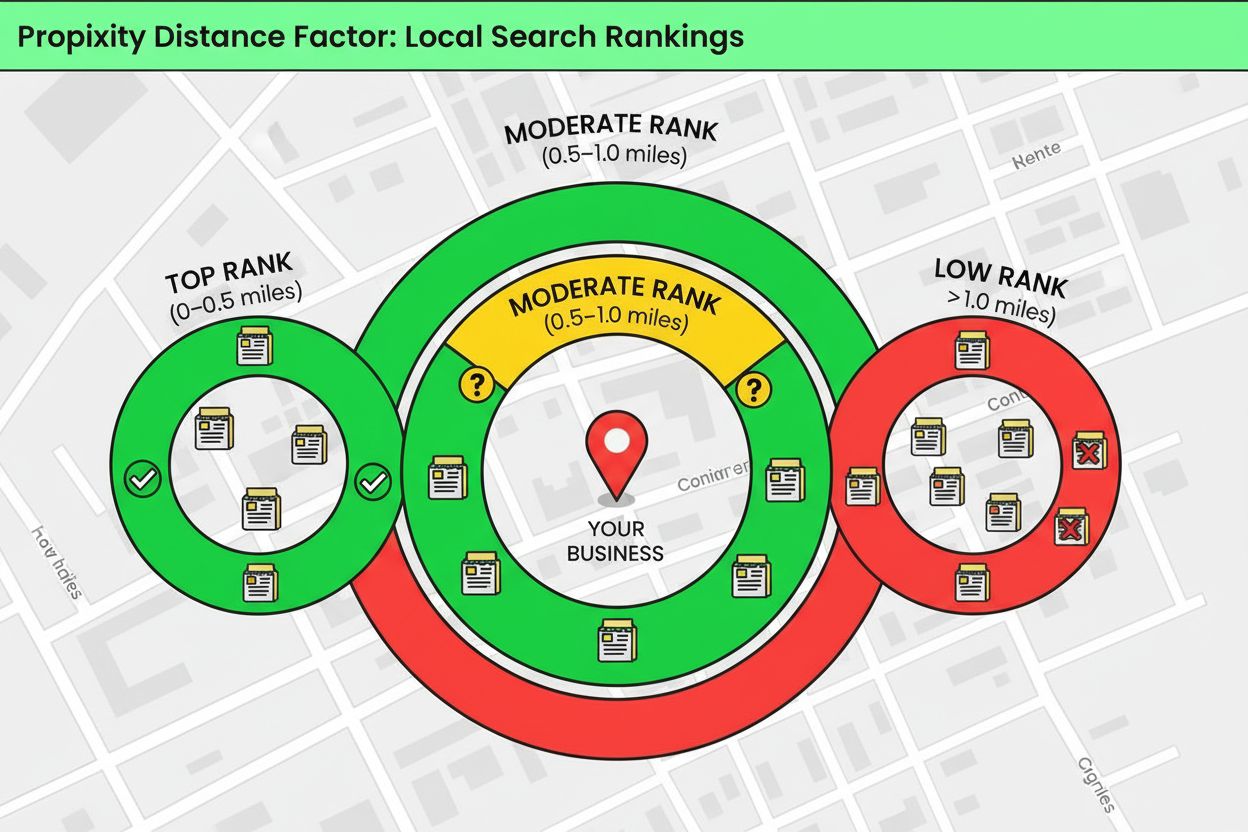
Proximity is the physical distance between a searcher and a business location, one of Google's three core local ranking factors. Learn how distance impacts loca...
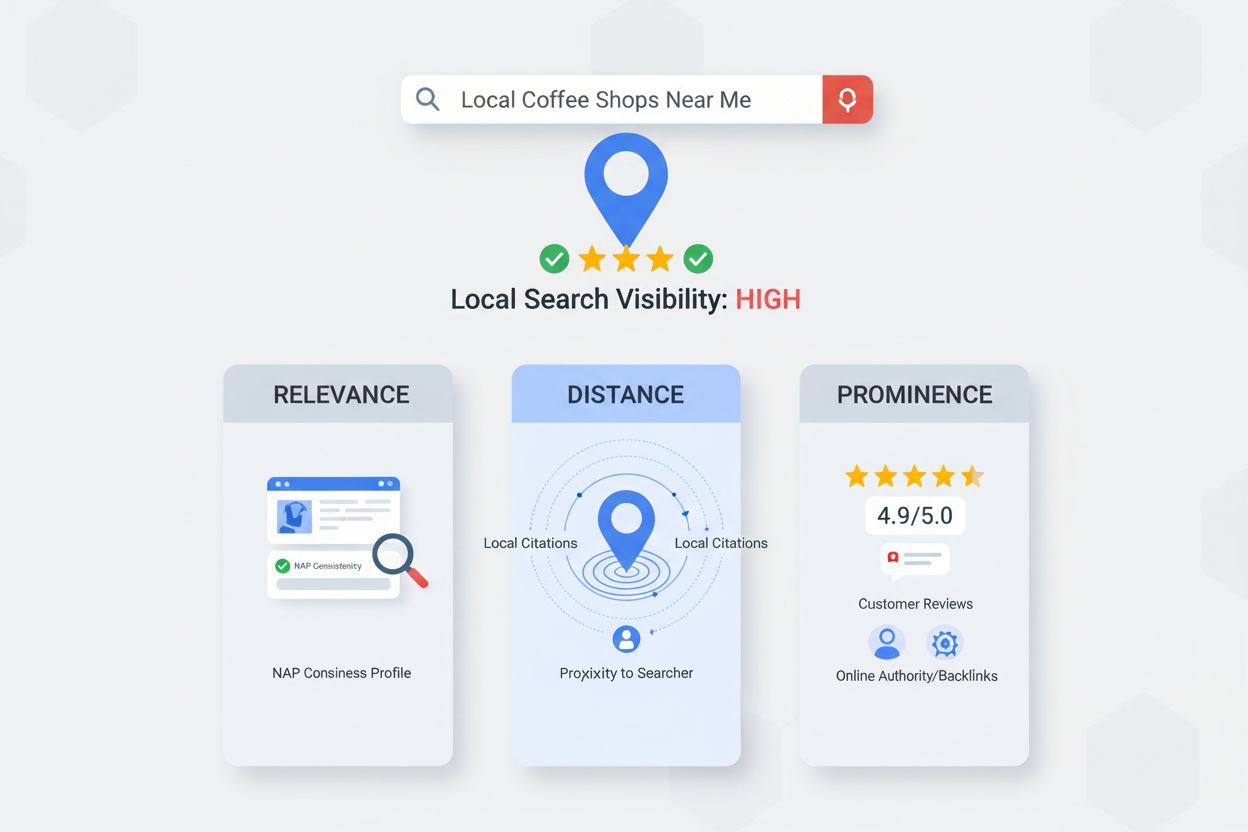
Learn what Google Maps SEO is, how it works, and why it's critical for local business visibility. Discover ranking factors, optimization strategies, and best pr...
Cookie Consent
We use cookies to enhance your browsing experience and analyze our traffic. See our privacy policy.