
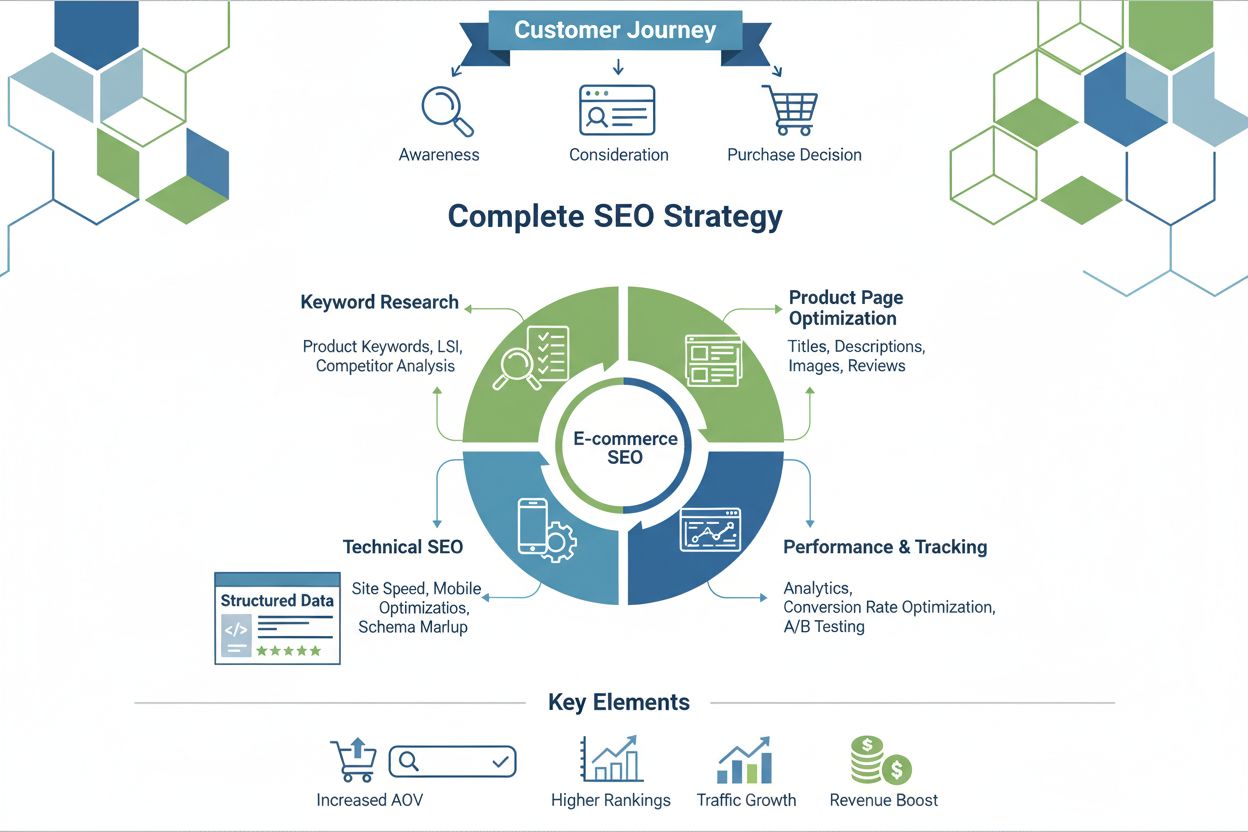
Ecommerce SEO
Ecommerce SEO is the optimization of online stores for search visibility. Learn keyword research, product page optimization, technical SEO, and conversion strat...
19 min read

Marketplace SEO is the practice of optimizing product listings and vendor pages within e-commerce platforms like Amazon, Etsy, and eBay to improve search visibility and increase conversions. Unlike traditional SEO that targets Google rankings, marketplace SEO focuses on platform-specific algorithms to help products rank higher in internal marketplace search results.
Marketplace SEO is the practice of optimizing product listings and vendor pages within e-commerce platforms like Amazon, Etsy, and eBay to improve search visibility and increase conversions. Unlike traditional SEO that targets Google rankings, marketplace SEO focuses on platform-specific algorithms to help products rank higher in internal marketplace search results.
Marketplace SEO is the specialized practice of optimizing product listings, vendor pages, and marketplace content to improve search visibility and increase conversions within e-commerce platforms such as Amazon, Etsy, eBay, Airbnb, and other multi-vendor marketplaces. Unlike traditional search engine optimization that targets Google or Bing rankings, marketplace SEO focuses on platform-specific algorithms designed to rank products based on buyer behavior, purchase intent, and platform-specific metrics. The primary goal is to ensure that products appear prominently in marketplace search results when potential customers search for relevant terms, ultimately driving traffic and sales. Marketplace SEO encompasses keyword optimization, listing quality, customer reviews, pricing strategy, seller performance metrics, and technical elements specific to each platform’s unique algorithm.
The emergence of marketplace SEO as a distinct discipline reflects the dramatic shift in how consumers discover and purchase products online. In 2025, 47% of shoppers begin their buying journey directly on online marketplaces rather than traditional search engines, fundamentally changing the landscape of digital commerce. This represents a significant departure from the early 2000s when Google dominated product discovery. As marketplaces like Amazon, Etsy, and eBay grew exponentially, they developed proprietary search algorithms optimized for their specific user bases and business models. Amazon’s A9 algorithm, eBay’s Cassini search engine, and Etsy’s proprietary ranking system each evolved to prioritize different factors based on their respective marketplace dynamics. The global B2C ecommerce market reached $5.2 trillion in 2024 and is expected to grow to $9.8 trillion by 2033, making marketplace optimization increasingly critical for sellers competing in crowded product categories. The rise of marketplace SEO as a professional discipline reflects the recognition that success on these platforms requires specialized knowledge distinct from traditional website SEO.
| Aspect | Marketplace SEO | Traditional SEO |
|---|---|---|
| Target Search Engine | Platform-specific algorithms (A9, Cassini, Etsy algorithm) | Google, Bing, other external search engines |
| Primary Goal | Rank products in marketplace search results | Rank website pages in Google SERPs |
| Content Control | Multiple vendors with varying content quality | Single website with full content control |
| Ranking Factors | Keywords, reviews, conversions, pricing, seller metrics | Content quality, backlinks, domain authority, E-A-T |
| User Intent | Purchase-ready buyers searching within platform | Information seekers and buyers across web |
| Optimization Focus | Product listings, titles, descriptions, backend fields | Blog posts, pages, technical SEO, link building |
| Competition Level | Thousands of vendors selling identical products | Broader competition across entire internet |
| Listing Volume | Potentially millions of listings per platform | Fewer pages per website |
| Crawl Budget Concerns | Significant due to massive listing volume | Less critical for smaller sites |
| Review Impact | Critical ranking and conversion factor | Minimal direct ranking impact |
Each major marketplace operates a proprietary algorithm designed to maximize buyer satisfaction and platform revenue. Amazon’s A9 algorithm represents the most sophisticated marketplace search system, prioritizing keyword relevance, conversion rates, product reviews and ratings, click-through rates, seller performance metrics, and product listing completeness. The A9 algorithm fundamentally optimizes for buyer satisfaction, meaning that factors directly improving customer experience—such as fast shipping, low return rates, and high-quality products—indirectly improve search rankings. eBay’s Cassini search engine takes a different approach, weighing seller trustworthiness, pricing competitiveness, delivery times, return policies, response speed to inquiries, and auction activity alongside keyword relevance. Cassini notably gives preference to auction listings over “Buy It Now” listings because auctions generate more buyer-seller interaction and platform activity. Etsy’s algorithm emphasizes listing recency, relevance to search terms, shop history and performance, product quality indicators, and customer satisfaction metrics. Understanding these algorithmic differences is essential because optimization strategies that work on Amazon may not translate directly to Etsy or eBay success. Each platform’s algorithm reflects its unique business model and user base, requiring tailored optimization approaches.
Keyword research forms the foundational pillar of any successful marketplace SEO strategy, but marketplace keyword research differs significantly from traditional SEO keyword research. Rather than using Google Keyword Planner or Ahrefs, marketplace sellers should leverage platform-specific tools like Amazon Suggest, eRank for Etsy, Helium 10, Jungle Scout, and Sellics to identify search terms that buyers actually use within each marketplace. These tools reveal search volume, competition levels, and buyer intent specific to each platform’s ecosystem. Keywords should be strategically incorporated into multiple listing elements: the product title (where they carry the most weight), product descriptions, backend search terms or keywords fields, and category selections. The most effective marketplace keyword strategy places the primary keyword first in the title, followed by secondary keywords and product attributes, all written from the buyer’s perspective using natural language they would actually search for. Long-tail keywords are particularly valuable in marketplace SEO because they indicate higher purchase intent and face less competition than broad, generic terms. For example, “stainless steel kitchen knife set 6-piece” outperforms “kitchen knives” because it targets buyers with specific needs and higher conversion probability.
Product listing optimization encompasses all elements of a marketplace product page that influence both search ranking and conversion rates. The product title is the single most important element, carrying the highest weight in marketplace algorithms while also serving as the primary factor influencing click-through rates. Effective titles balance keyword inclusion with clarity and persuasiveness, typically following a structure like: [Brand] [Product Type] [Key Features] [Material/Color] [Size/Quantity]. The product description should provide comprehensive information about features, benefits, use cases, and specifications while naturally incorporating relevant keywords without keyword stuffing. High-quality product images are essential, as they directly influence both buyer confidence and conversion rates; multiple images showing different angles, close-ups of details, and lifestyle shots demonstrating product use significantly improve performance. Product pricing affects both ranking and conversion, with competitive pricing favoring higher visibility on most platforms. Bullet points (available on Amazon and some other platforms) should highlight key features and benefits in scannable format, addressing common buyer questions and objections. Backend fields like search terms, keywords, and attributes provide additional opportunities to include relevant terms that don’t appear in customer-facing content, improving relevance scoring without affecting readability.
Customer reviews and ratings represent one of the most powerful ranking factors across all major marketplaces, simultaneously influencing algorithmic rankings and conversion rates. Products with 4+ star ratings typically rank significantly higher in marketplace search results compared to lower-rated alternatives, even when other factors are equal. This preference reflects marketplace algorithms’ fundamental optimization for buyer satisfaction—highly-rated products indicate satisfied customers, repeat purchases, and lower return rates. Beyond ranking impact, reviews serve as critical social proof that reduces purchase hesitation and increases conversion rates. Studies consistently show that products with numerous positive reviews convert at substantially higher rates than products with few or no reviews. The quantity of reviews also matters; products with hundreds of reviews typically outrank those with only a handful, even at similar rating levels. User-generated content in the form of customer photos and videos further enhances listing credibility and provides additional content for search algorithms to index. Marketplace sellers should actively encourage reviews through follow-up emails, simplified review processes, incentives (where permitted), and excellent customer service. Responding to negative reviews professionally and constructively demonstrates commitment to customer satisfaction and can improve overall rating perception.
Technical marketplace SEO addresses the infrastructure and performance factors that influence both search rankings and user experience. Page load speed is a critical ranking factor across all platforms; research indicates that 70% of online shoppers abandon pages that take over 3 seconds to load, directly impacting both conversion rates and algorithmic rankings. Slow-loading marketplace pages increase bounce rates, reduce time-on-site metrics, and lower conversion rates—all negative signals to marketplace algorithms. Marketplace operators should optimize image file sizes, minimize HTTP requests, implement lazy loading, and leverage content delivery networks to ensure fast page performance. Mobile optimization is equally critical, as the majority of marketplace traffic now originates from mobile devices. Responsive design, touch-friendly interfaces, and mobile-optimized checkout processes are essential for both user experience and ranking performance. Site architecture and navigation influence crawlability and user experience; clear category hierarchies, logical URL structures, and effective breadcrumb navigation help both search algorithms and users understand site organization. Schema markup and structured data provide additional context to search algorithms about products, pricing, availability, and reviews, enabling rich snippets and enhanced search result displays. Implementing Product schema, Offer schema, Review schema, and Aggregate Rating schema improves indexing and can enhance visibility in both marketplace and external search results.
Successful marketplace SEO requires a comprehensive, multi-faceted approach addressing all ranking factors simultaneously:
Each major marketplace requires tailored optimization approaches reflecting its unique algorithm and user base. Amazon SEO focuses heavily on the A9 algorithm’s preference for conversion rates, reviews, and seller performance; sellers should prioritize winning the “Buy Box” through competitive pricing, FBA fulfillment, and excellent customer service. Etsy SEO emphasizes shop history, listing recency, and customer satisfaction; Etsy sellers benefit from regularly renewing listings and maintaining consistent shop quality. eBay SEO through the Cassini algorithm rewards seller trustworthiness, auction activity, and fast response times; eBay sellers should consider auction listings for competitive products and maintain excellent seller ratings. Airbnb SEO prioritizes booking history, guest reviews, response rates, and listing completeness; Airbnb hosts should maintain high response rates and encourage positive guest reviews. Understanding these platform-specific nuances prevents wasted optimization effort and ensures strategies align with each platform’s algorithmic priorities.
The marketplace SEO landscape continues evolving as platforms implement increasingly sophisticated algorithms and as consumer behavior shifts. Artificial intelligence and machine learning are becoming more central to marketplace ranking algorithms, enabling more nuanced understanding of buyer intent and product relevance. Voice search optimization is emerging as important as more consumers use voice assistants to search marketplaces. Personalization is increasing, with algorithms showing different results to different users based on browsing history, purchase behavior, and preferences. Video content is gaining importance across marketplaces, with platforms increasingly prioritizing listings that include product videos. Sustainability and ethical sourcing are becoming ranking factors as consumers increasingly prioritize these attributes. Cross-platform visibility is becoming critical as brands need to maintain consistent presence across multiple marketplaces simultaneously. The integration of AI monitoring tools to track brand visibility across marketplaces and AI search systems represents a new frontier in marketplace optimization, allowing sellers to understand how their products appear across different discovery channels. As marketplaces continue to evolve and competition intensifies, successful sellers will need to stay current with algorithm changes, monitor competitor strategies, and continuously optimize their listings based on performance data and emerging best practices.
Marketplace SEO targets platform-specific algorithms (like Amazon's A9, eBay's Cassini, or Etsy's search engine) rather than Google's algorithm. While traditional SEO focuses on creating content to answer search queries, marketplace SEO optimizes product listings for commercial intent and purchase behavior. Marketplace SEO also deals with multiple vendors competing on the same platform, whereas traditional SEO typically involves a single website competing across the broader internet.
Amazon's A9 algorithm prioritizes keyword relevance, conversion rates, product reviews and ratings, click-through rates, seller performance metrics, and product listing completeness. The algorithm also considers pricing competitiveness, stock availability, fulfillment method (FBA preference), and customer satisfaction indicators like return rates. Amazon fundamentally optimizes for buyer satisfaction, so factors that improve customer experience directly impact ranking.
Reviews and ratings serve as social proof that directly influence both search rankings and conversion rates on marketplaces. Products with 4+ star ratings typically rank higher in marketplace search results, and customer reviews provide fresh, user-generated content that search algorithms favor. Reviews also reduce purchase hesitation, leading to higher conversion rates and more sales, which further improves algorithmic rankings.
Page speed is a critical ranking factor across all marketplaces and significantly impacts user experience. Studies show that 70% of online shoppers abandon pages that take over 3 seconds to load, directly affecting conversion rates. Slow-loading marketplace pages increase bounce rates and reduce time-on-site metrics, both of which negatively impact search rankings and overall marketplace visibility.
Keyword research is foundational to marketplace SEO success, but it differs from traditional keyword research. Marketplace keyword research focuses on terms users actually search within the platform using tools like Amazon Suggest, eRank, or Helium 10. These keywords should be incorporated into product titles, descriptions, and backend fields to improve relevance scores and visibility in marketplace search results.
Effective product titles should include the primary keyword first, followed by relevant secondary keywords, brand name, key features, material, color, size, and packaging information. Titles should be written from the buyer's perspective using language they would naturally search for. Avoid keyword stuffing and repetition, and keep titles within character limits while maximizing information density to improve both ranking and click-through rates.
Marketplace SEO directly impacts revenue by increasing product visibility, driving organic traffic, and improving conversion rates without paid advertising costs. In 2025, 47% of shoppers begin their buying journey directly on online marketplaces rather than traditional search engines, making marketplace SEO essential for revenue growth. Optimized listings generate higher click-through rates and conversions, leading to increased sales and improved seller performance metrics.
Schema markup helps search engines understand product information and enables rich snippets to display in marketplace search results. Structured data for products, offers, reviews, and ratings improves indexing and can enhance visibility with additional information like pricing, availability, and customer ratings. This enhanced presentation increases click-through rates and helps both internal marketplace algorithms and external search engines better understand and rank product listings.
Start tracking how AI chatbots mention your brand across ChatGPT, Perplexity, and other platforms. Get actionable insights to improve your AI presence.
Ecommerce SEO is the optimization of online stores for search visibility. Learn keyword research, product page optimization, technical SEO, and conversion strat...

Learn what Amazon SEO is, how the A9 algorithm works, and proven strategies to optimize product listings for higher rankings and increased sales on Amazon's mar...

Enterprise SEO is the practice of optimizing large, complex websites with thousands of pages for search engines. Learn strategies, challenges, and best practice...
Cookie Consent
We use cookies to enhance your browsing experience and analyze our traffic. See our privacy policy.