


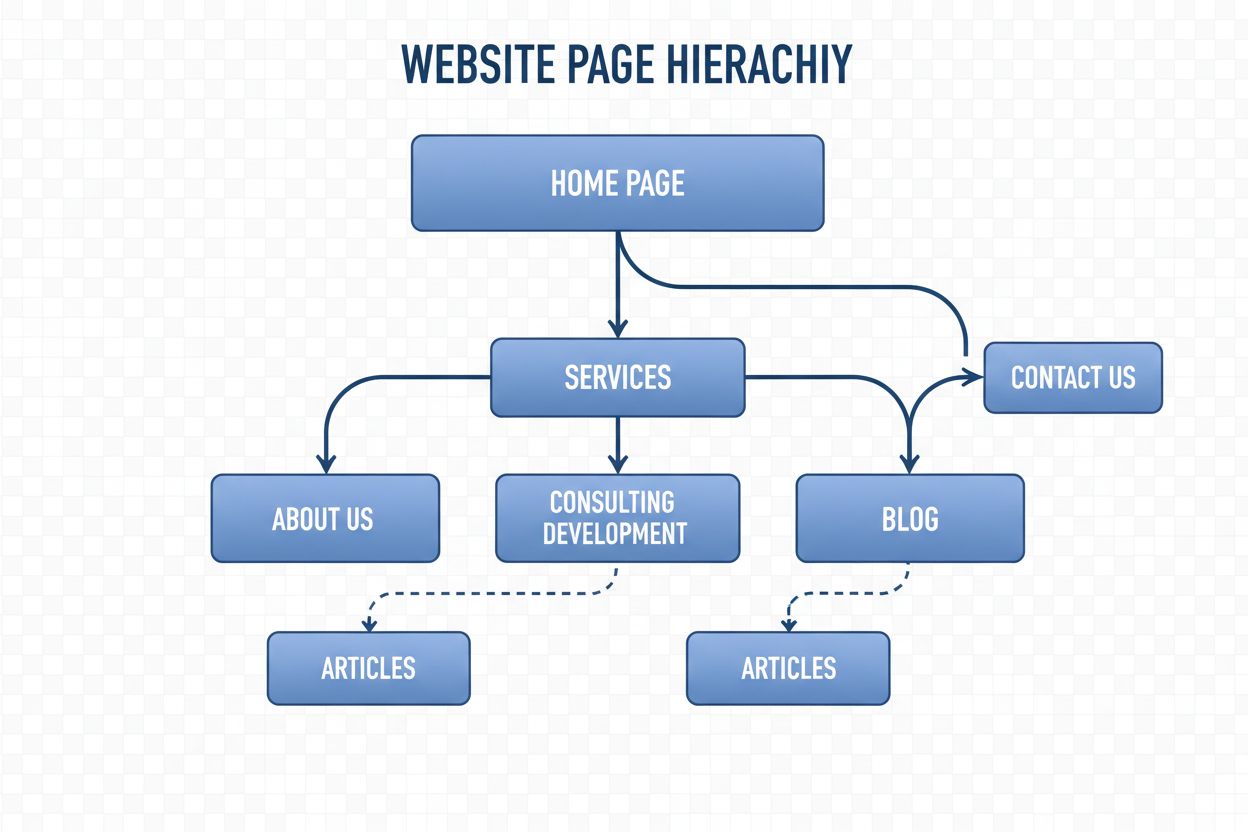
Navigation Structure
Navigation structure is the system organizing website pages and links to guide users and AI crawlers. Learn how it affects SEO, user experience, and AI indexing...
9 min read
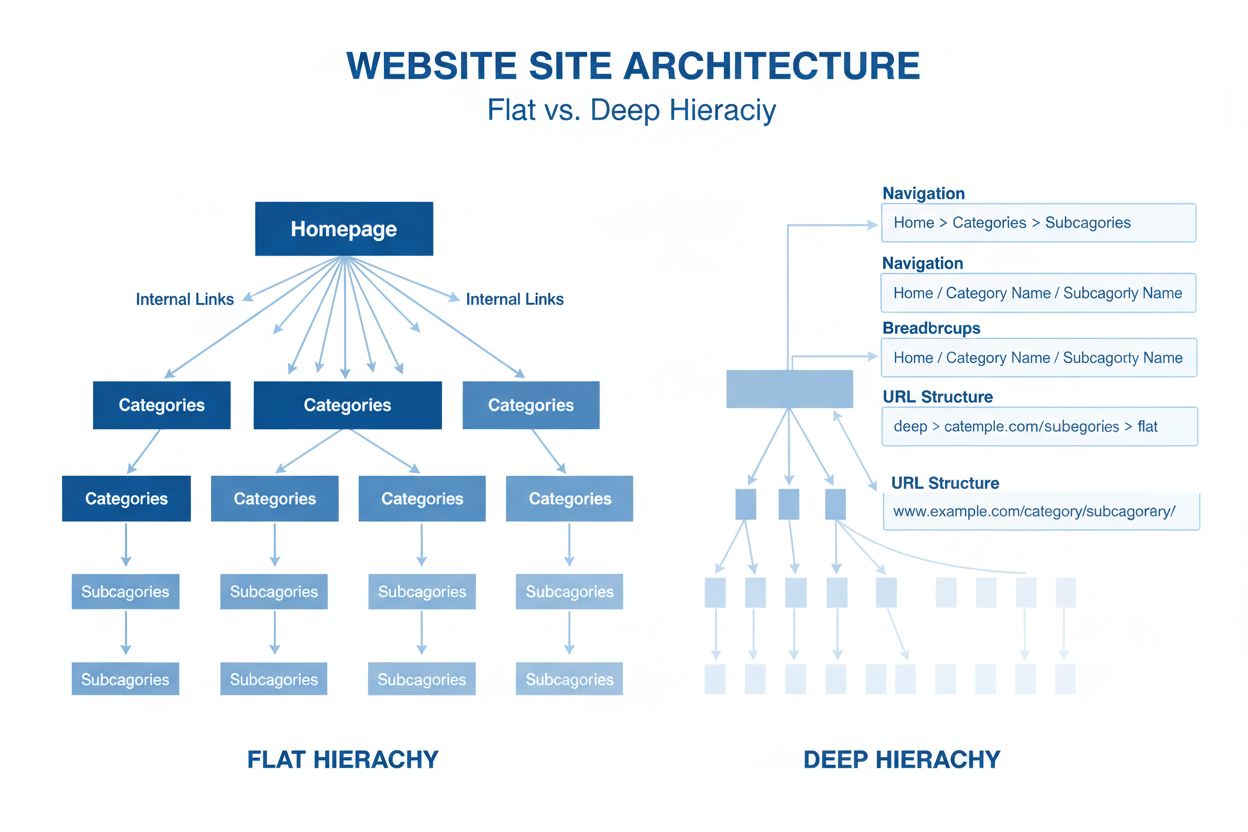
Site architecture, also known as website structure or information architecture, refers to the hierarchical organization and interconnection of pages on a website designed to improve user navigation and search engine crawlability. It encompasses how content is categorized, structured through internal links, and presented to both visitors and search engine crawlers.
Site architecture, also known as website structure or information architecture, refers to the hierarchical organization and interconnection of pages on a website designed to improve user navigation and search engine crawlability. It encompasses how content is categorized, structured through internal links, and presented to both visitors and search engine crawlers.
Site architecture, also referred to as website structure or information architecture, is the hierarchical organization and interconnection of pages on a website designed to facilitate user navigation and enable search engine crawlers to efficiently discover, understand, and index content. It encompasses how content is categorized, organized into logical hierarchies, connected through internal links, and presented to both human visitors and automated systems. A well-designed site architecture serves as the foundational blueprint for how information flows through a website, establishing clear relationships between pages and creating intuitive pathways for users to find what they need. The structure of a website directly influences user experience, search engine optimization (SEO) performance, and increasingly, how AI systems like ChatGPT, Perplexity, and Google AI Overviews discover and cite your content.
The concept of site architecture emerged in the early days of the web when developers and designers recognized that simply publishing pages without organization created confusion for both users and search engines. In the 1990s, as websites grew beyond a handful of pages, the need for structured organization became apparent. Early pioneers in information architecture, such as Richard Saul Wurman and later practitioners like Peter Morville and Louis Rosenfeld, established foundational principles for organizing digital information. Over the past two decades, site architecture has evolved from a primarily user-experience concern to a critical technical SEO component. Today, with the rise of AI-powered search systems, site architecture has taken on additional importance as a factor influencing how AI crawlers discover and evaluate content for citation in AI-generated responses. Research from Semrush indicates that over 78% of enterprises now recognize site architecture as essential to their digital strategy, with proper structure correlating to 40% higher organic traffic compared to poorly organized sites.

Track how AI chatbots mention your brand across ChatGPT, Perplexity, and other platforms.
Effective site architecture comprises several interconnected components that work together to create a functional and discoverable website. The homepage serves as the central hub from which all other pages branch, establishing the primary entry point for both users and search crawlers. Navigation menus—whether horizontal, vertical, or dropdown—provide the primary pathways through which users explore the site’s content. Category pages and subcategory pages organize related content into logical groupings, creating what’s known as a silo structure that helps search engines understand topical relationships. Internal links connect pages throughout the site, passing authority and establishing context about how pages relate to one another. Breadcrumb navigation displays the user’s path through the hierarchy, improving both usability and search engine understanding of page relationships. URL structure reflects the site’s hierarchy, with URLs like /products/electronics/laptops/ clearly communicating page position within the architecture. Finally, XML and HTML sitemaps provide comprehensive maps of the site’s structure for both search engines and users, ensuring no pages remain undiscovered.
| Structure Type | Hierarchy Levels | Navigation Complexity | Best For | User Click Depth | Discoverability |
|---|---|---|---|---|---|
| Hierarchical | 3-5 levels | Moderate | E-commerce, corporate sites, blogs | 3-4 clicks | High for organized content |
| Sequential | 2-3 levels | Low | Tutorials, checkout flows, courses | 2-3 clicks | High for linear journeys |
| Matrix | Variable | High | News sites, social networks | 2-4 clicks | Very high with search |
| Database | Dynamic | Very High | Large e-commerce, user-generated content | 1-3 clicks | Depends on search/filters |
| Flat | 2-3 levels | Low | Small sites, portfolios | 2-3 clicks | Excellent for small catalogs |
| Deep | 5+ levels | High | Large catalogs, complex taxonomies | 5+ clicks | Lower without shortcuts |
Get the latest insights on AI mentions, brand monitoring, and optimization strategies.
From a technical perspective, site architecture directly impacts how search engine crawlers navigate and index your website. When Google’s Googlebot or other search crawlers visit your site, they follow internal links to discover pages, using the site’s structure to understand content relationships and hierarchy. A well-architected site with clear hierarchies and strategic internal linking enables crawlers to reach all important pages within a reasonable number of hops, typically 3-5 clicks from the homepage. According to research from SEO.com, websites with optimized architecture experience 35% faster crawl completion compared to poorly structured sites. Orphaned pages—pages with no internal links pointing to them—represent a critical architectural failure, as crawlers may never discover them. The crawl budget concept, introduced by Google, refers to the limited number of pages a crawler will visit on your site within a given timeframe. A poorly structured site wastes crawl budget on redundant or low-value pages, while an optimized architecture ensures crawlers focus on important content. Implementing XML sitemaps helps mitigate crawl budget issues by explicitly telling search engines which pages exist and their relative importance.
Beyond SEO, site architecture profoundly affects user experience and business outcomes. Research from Nielsen Norman Group demonstrates that users can navigate flat hierarchies (3 levels or fewer) 40% faster than deep hierarchies (5+ levels). When users can find what they need quickly and intuitively, they’re more likely to stay on the site, explore additional pages, and ultimately convert. Navigation clarity is particularly important for e-commerce sites, where poor architecture directly impacts sales. Amazon’s hierarchical structure, for example, allows users to navigate from the homepage to specific products in just 2-3 clicks, contributing to its exceptional conversion rates. Conversely, sites with confusing or deeply nested structures experience higher bounce rates and lower engagement. The relationship between site architecture and user journey is critical; a well-designed architecture guides users naturally through the sales or content funnel, presenting information in a logical sequence that builds toward conversion. Studies show that websites with optimized architecture experience 25-30% higher average session duration and 15-20% improvement in conversion rates compared to poorly structured competitors.
In the emerging landscape of AI-powered search systems, site architecture has become increasingly important for brand visibility and citation tracking. Platforms like ChatGPT, Perplexity, Google AI Overviews, and Claude use sophisticated crawling and indexing mechanisms to discover and evaluate content for inclusion in AI-generated responses. A well-structured site with clear hierarchies, proper internal linking, and optimized URLs makes it significantly easier for AI crawlers to understand your content’s context, authority, and relevance. When AI systems can clearly understand your site’s structure and the relationships between pages, they’re more likely to cite your content as authoritative sources in their responses. This is particularly important for brand monitoring and domain tracking across AI platforms. Companies using tools like AmICited to monitor their brand’s appearance in AI responses have found that sites with optimized architecture receive 2-3x more citations in AI-generated content compared to poorly structured competitors. The hierarchical organization of content helps AI systems identify pillar pages and cornerstone content, which are more likely to be cited as authoritative sources. Additionally, a clear site structure with proper internal linking helps AI systems understand your site’s topical authority, making it more likely to be recommended for queries related to your core topics.
Implementing effective site architecture requires strategic planning and ongoing optimization. First, use a flat structure whenever possible, aiming for most pages to be accessible within 3-4 clicks from the homepage. This principle applies across all site types, from e-commerce platforms to content sites. Second, create clear URL structures that reflect your site’s hierarchy, using descriptive keywords and logical paths like /category/subcategory/page/. Third, develop topic clusters by organizing related content around pillar pages, creating natural linking opportunities and establishing topical authority. Fourth, implement strategic internal linking using descriptive anchor text that helps both users and search engines understand page relationships. Fifth, use breadcrumb navigation to help users understand their location and provide search engines with additional context about page hierarchy. Sixth, create both XML and HTML sitemaps to ensure all pages are discoverable and to provide clear maps of your site’s structure. Seventh, eliminate orphaned pages by ensuring every page has at least one internal link pointing to it from a related page. Eighth, optimize navigation menus to be clear, concise, and intuitive, avoiding cluttered menus with excessive links. Finally, regularly audit your site structure using tools like Semrush Site Audit or Screaming Frog to identify issues like broken links, excessive click depth, and orphaned pages.
Building the navigation menu before mapping the content hierarchy. Teams frequently design the visible menu structure first based on what looks clean, then force existing content into it — the correct order is the reverse: map how content actually relates topically, then build navigation that reflects that structure, or the menu becomes disconnected from how pages actually link to each other. Creating orphaned pages through campaign or seasonal content. Landing pages built for a specific promotion often get published without any internal links pointing to them from the permanent site structure; once the campaign ends and the temporary homepage banner is removed, the page becomes invisible to crawlers even though it’s still live and indexed. Confusing a deep hierarchy with thorough organization. Adding a new sub-level every time a content type doesn’t fit neatly into existing categories produces URLs five or six levels deep; each additional level compounds click depth, and pages beyond 5 clicks from the homepage consistently see reduced crawl frequency and discovery. Treating breadcrumbs as decorative rather than structural. Breadcrumbs that don’t match the actual internal linking hierarchy — showing a different path than how the page is actually linked to from the rest of the site — send contradictory hierarchy signals to crawlers instead of reinforcing a single clear structure. Migrating URLs without preserving the hierarchy in redirects. Site redesigns that flatten a /category/subcategory/product/ structure into /product/ without a mapped redirect plan lose the topical grouping signals that took months to build, even when each individual page’s content stays the same.
Start tracking how AI chatbots mention your brand across ChatGPT, Perplexity, and other platforms. Get actionable insights to improve your AI presence.
Navigation structure is the system organizing website pages and links to guide users and AI crawlers. Learn how it affects SEO, user experience, and AI indexing...

Community discussion on optimal website structure for AI visibility. How site architecture affects AI citations across ChatGPT, Perplexity, and Google AI Overvi...
Learn how to structure your website for optimal AI crawler indexing, including semantic HTML, site architecture, content organization, and technical requirement...
Cookie Consent
We use cookies to enhance your browsing experience and analyze our traffic. See our privacy policy.