

Paid Search Results
Paid search results are sponsored ads appearing in search engine results. Learn how PPC advertising works, its ROI impact, and why monitoring paid search visibi...
9 min read
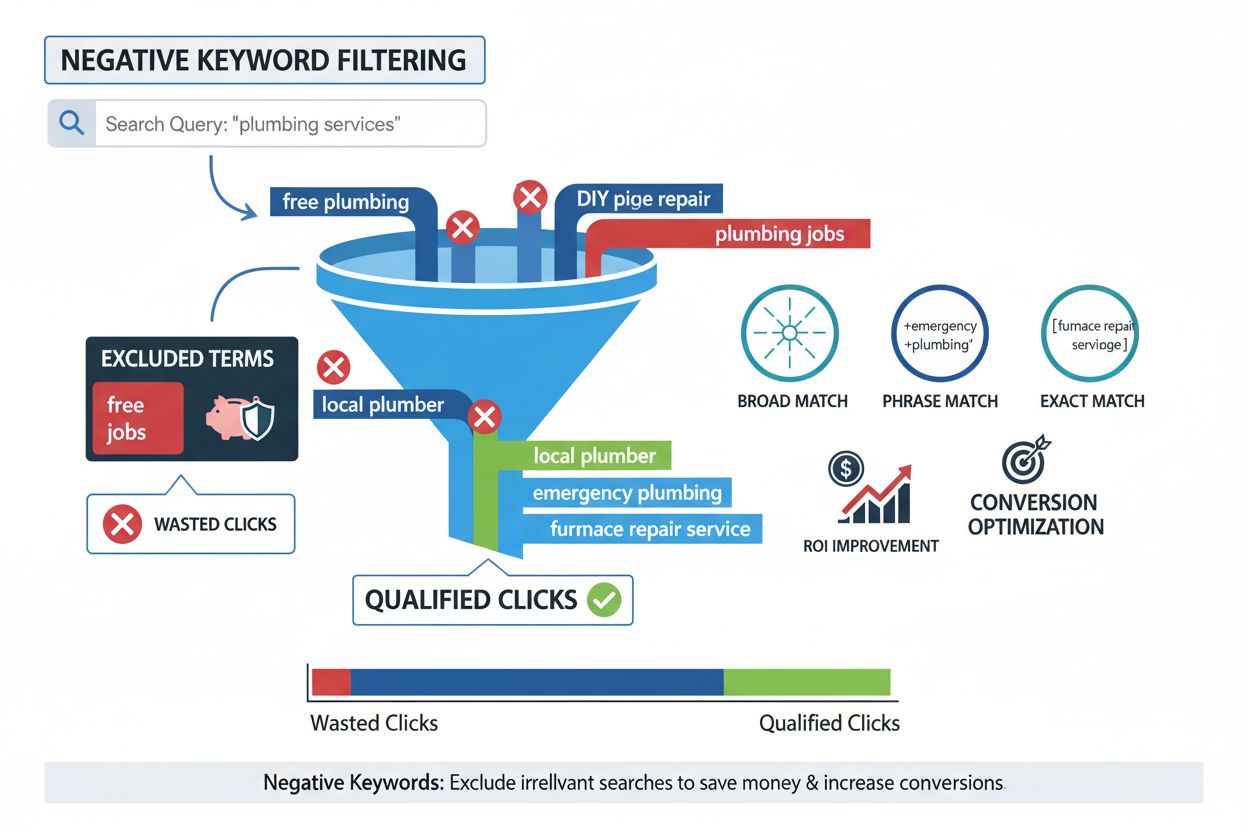
Negative keywords are search terms that advertisers exclude from their campaigns to prevent ads from appearing for irrelevant queries. By blocking specific words or phrases, negative keywords help reduce wasted ad spend, improve campaign relevance, and increase return on investment (ROI) in paid search advertising.
Negative keywords are search terms that advertisers exclude from their campaigns to prevent ads from appearing for irrelevant queries. By blocking specific words or phrases, negative keywords help reduce wasted ad spend, improve campaign relevance, and increase return on investment (ROI) in paid search advertising.
Negative keywords are search terms that advertisers explicitly exclude from their paid search campaigns to prevent their ads from appearing when users search for those specific words or phrases. Unlike positive keywords that trigger ad displays, negative keywords act as a filtering mechanism that tells search engines like Google, Microsoft Bing, and other advertising platforms exactly which queries should NOT show an advertiser’s ads. This strategic exclusion mechanism is fundamental to modern pay-per-click (PPC) advertising, enabling marketers to focus their budgets on high-intent, relevant traffic while systematically eliminating wasted spend on irrelevant clicks. The concept emerged as search advertising matured and advertisers recognized that not all clicks generate value—some represent fundamentally misaligned user intent that wastes budget without producing conversions. By implementing negative keywords, advertisers transform their campaigns from broad, unfocused efforts into precisely targeted initiatives that deliver measurable returns on investment.
The practice of using negative keywords in search advertising evolved alongside the maturation of the PPC industry itself. When Google Ads (formerly Google AdWords) first launched in 2000, the platform offered basic keyword matching capabilities, but advertisers quickly discovered that broad keyword matches often triggered ads for completely irrelevant searches. For example, a company selling luxury watches might bid on the keyword “watches,” only to discover their ads appearing for searches like “how to make watches,” “watch repair,” or “cheap watches”—none of which represented qualified prospects. This realization led Google to introduce negative keyword functionality, allowing advertisers to exclude specific terms and refine their targeting. Over the past two decades, negative keyword management has become a cornerstone of PPC best practices, with industry research consistently demonstrating that campaigns with comprehensive negative keyword lists outperform those without them by significant margins. According to 2024-2025 data from WordStream analyzing over 16,000 campaigns, 87% of industries saw cost-per-click increases, making negative keyword optimization more critical than ever for protecting advertising budgets. The evolution of negative keywords reflects a broader shift in digital marketing toward precision targeting and data-driven decision-making, where every dollar spent must be justified by measurable business outcomes.
Negative keywords operate through a straightforward but powerful filtering mechanism within search advertising platforms. When a user enters a search query, the advertising platform first evaluates whether the query matches any of the advertiser’s positive keywords. If a match is found, the system then checks the query against the advertiser’s negative keyword list before deciding whether to display the ad. If the search query contains or matches any negative keyword (depending on the match type selected), the ad will not be shown, regardless of how well it matches positive keywords. This two-stage evaluation process ensures that advertisers maintain complete control over which searches trigger their ads. For instance, a professional plumbing service might target the positive keyword “emergency plumber” but add “DIY plumbing” as a negative keyword to avoid appearing for homeowners searching for do-it-yourself solutions. The negative keyword filtering happens in milliseconds, allowing search engines to process millions of queries daily while respecting each advertiser’s exclusion preferences. This mechanism is particularly important in competitive markets where irrelevant clicks can quickly deplete advertising budgets without generating any business value. The effectiveness of negative keywords depends heavily on how comprehensively advertisers build their exclusion lists and how strategically they apply different match types to control the scope of exclusions.
| Concept | Definition | Primary Function | Impact on Ad Spend | Complexity Level | Best Used For |
|---|---|---|---|---|---|
| Negative Keywords | Search terms explicitly excluded from campaigns | Prevent ads from showing for irrelevant queries | Reduces wasted spend by 15-40% | Medium | Filtering out low-intent, off-topic searches |
| Positive Keywords | Search terms that trigger ad displays | Determine when ads should appear | Drives impressions and clicks | Medium | Attracting relevant audience segments |
| Audience Exclusions | Demographic or behavioral segments to exclude | Prevent ads from showing to specific user groups | Reduces irrelevant impressions | Low-Medium | Excluding existing customers or wrong demographics |
| Placement Exclusions | Specific websites or content to avoid | Prevent ads from appearing on certain sites | Reduces brand safety risks | Low | Protecting brand reputation on display networks |
| Location Exclusions | Geographic areas where ads should not appear | Prevent ads in non-serviceable regions | Improves local targeting efficiency | Low | Local businesses with limited service areas |
| Device Exclusions | Mobile, desktop, or tablet devices to exclude | Control ad visibility by device type | Optimizes budget allocation by device | Low | Campaigns with device-specific performance issues |
| Bid Adjustments | Percentage increases/decreases for specific segments | Modify bid amounts rather than exclude entirely | Fine-tunes spend allocation | Medium | Balancing performance across segments |
Negative keywords operate through three distinct match types, each providing different levels of control over which searches are excluded. Understanding these match types is critical because they function differently than their positive keyword counterparts, a distinction that confuses many advertisers. Negative broad match is the default option and blocks any search query containing all the negative keyword terms, regardless of word order or additional words. For example, if you add “running shoes” as a negative broad match, your ads won’t show for searches like “best running shoes,” “running shoes for men,” or “shoes for running,” but might still appear for “running” or “shoes” individually. This match type casts the widest net and is most useful for blocking entire categories of irrelevant traffic. Negative phrase match provides more precision by blocking searches that contain your exact phrase in the same word order, though additional words can appear before or after the phrase. Using “running shoes” as a negative phrase match would block “best running shoes” and “running shoes for sale,” but would allow “shoes for running” since the word order is reversed. This match type is particularly valuable for universal negative keyword lists that work across multiple campaigns and platforms. Negative exact match offers the most restrictive control, blocking only searches that exactly match your negative keyword without any additional words. Adding [running shoes] as a negative exact match would only block the exact search “running shoes,” allowing variations like “best running shoes” or “running shoes for men” to still trigger your ads. This precision is essential for ad group-level negative keywords where you want to prevent specific queries from appearing in particular ad groups while allowing them in others.
Effective negative keyword management requires understanding the three hierarchical levels at which they can be implemented, each serving distinct strategic purposes. Account-level negative keywords represent the broadest application, applying across all campaigns and ad groups within an entire advertising account. These are ideal for universal exclusions that apply regardless of campaign theme, such as “free,” “jobs,” “DIY,” or “how to.” According to industry research, account-level negatives can reduce irrelevant traffic by 20-30% across an entire account, making them one of the highest-leverage optimizations available. However, experts caution against being too aggressive with account-level negatives, as overly broad exclusions can inadvertently block valuable traffic as business offerings evolve. Campaign-level negative keywords apply only to specific campaigns, allowing advertisers to tailor exclusions to each campaign’s theme or focus. For example, a campaign promoting luxury watches might exclude “affordable” or “budget,” while a campaign promoting budget watches would exclude “luxury” or “premium.” This level of granularity enables more sophisticated targeting strategies where different campaigns serve different market segments. Ad group-level negative keywords provide the most precise control, applying only to individual ad groups within campaigns. This level is particularly useful for preventing query overlap between ad groups, ensuring that each search query triggers the most relevant ad group. For instance, within a campaign promoting men’s clothing, the “suits” ad group might exclude “casual wear,” while the “casual wear” ad group excludes “formal” or “business.” Research shows that implementing ad group-level negatives can improve click-through rates by 10-15% by ensuring better alignment between search queries and ad messaging.
The process of identifying effective negative keywords begins with systematic analysis of search query data, the most reliable source of information about which searches are triggering ads. The Search Terms Report in Google Ads and similar reports in other platforms show the exact queries users searched for that led to ad impressions and clicks. Analyzing this data reveals patterns of irrelevant traffic that should be excluded. Industry experts recommend prioritizing negative keywords based on impact, focusing first on searches that generate high impression volume but low conversion rates, as these represent the largest budget waste. For example, if a luxury furniture retailer notices that searches containing “cheap” or “discount” generate 500 impressions monthly but zero conversions, adding these as negative keywords would immediately improve campaign efficiency. Beyond the Search Terms Report, advertisers can proactively identify negative keywords through brainstorming exercises where they think like different user personas—job seekers, students, DIY enthusiasts, or bargain hunters—and consider what searches these groups might use that don’t represent qualified prospects. Many successful advertisers also leverage AI-powered tools that analyze search term data and automatically flag potential negative keywords based on performance metrics. According to data from Optmyzr’s analysis of thousands of campaigns, advertisers who implement systematic negative keyword discovery processes see 25-40% improvements in cost-per-lead compared to those who add negatives reactively. The most effective approach combines reactive analysis of actual search data with proactive brainstorming and AI-assisted identification, creating a comprehensive negative keyword strategy that evolves continuously as campaign performance data accumulates.
Negative keywords play a crucial but often underappreciated role in improving Quality Score, Google’s rating of ad and landing page quality that directly impacts both ad placement and cost-per-click. Quality Score is determined by three primary factors: expected click-through rate, ad relevance, and landing page experience. By using negative keywords to exclude irrelevant searches, advertisers improve their click-through rate on the searches that do trigger their ads, since the remaining traffic is more aligned with ad messaging. This improved CTR signals to Google that the ads are relevant and valuable, directly boosting Quality Score. Additionally, by preventing irrelevant clicks, negative keywords reduce bounce rates on landing pages, as visitors are more likely to be genuinely interested in the advertised offering. This improved landing page experience further enhances Quality Score. The relationship between negative keywords and Quality Score creates a virtuous cycle: better Quality Scores lead to lower cost-per-click, which allows advertisers to bid more competitively on high-intent keywords, which drives more qualified traffic and conversions. Research from WordStream’s 2025 benchmarks shows that campaigns with comprehensive negative keyword lists achieve Quality Scores that are 1-2 points higher on average than campaigns without strategic negative keyword management, translating to 10-20% reductions in cost-per-click. This Quality Score improvement represents one of the most significant but often overlooked benefits of negative keywords, as many advertisers focus solely on the direct impact of reducing irrelevant clicks without recognizing the compounding benefits of improved Quality Scores across their entire account.
As artificial intelligence increasingly influences search behavior through platforms like ChatGPT, Perplexity, Google AI Overviews, and Claude, the role of negative keywords is evolving beyond traditional PPC campaigns. In AI-powered search environments, where responses are generated based on indexed web content and training data, brands face new challenges in controlling how their information appears alongside competitor mentions, irrelevant content, or unfavorable contexts. AmICited and similar AI search monitoring platforms track where brands appear in AI-generated responses, revealing opportunities to optimize both organic content and paid advertising strategies. Understanding negative keywords becomes essential in this context because advertisers can use negative keyword strategies to prevent their paid ads from appearing in search contexts where AI systems have generated responses containing competitor mentions or negative sentiment. For example, if an AI search system generates a response comparing your product unfavorably to a competitor, you can add negative keywords related to that comparison to prevent your paid ads from appearing alongside that AI-generated content. This represents a new frontier in brand protection, where negative keywords serve not just to filter out low-intent searches but to protect brand reputation in AI-driven search environments. As AI search continues to grow—with Google reporting that AI Overviews now appear in a significant percentage of search results—the strategic use of negative keywords to manage brand visibility in these new contexts will become increasingly important for maintaining brand safety and ensuring advertising budgets are spent in brand-appropriate environments.
Successful negative keyword management requires establishing systematic processes and best practices that ensure continuous optimization without consuming excessive resources. The first best practice is to establish a regular review schedule, with most experts recommending weekly reviews for new or high-spend campaigns and bi-weekly to monthly reviews for mature campaigns. This regular cadence ensures that new irrelevant search patterns are identified and excluded before they accumulate significant wasted spend. The second best practice is to leverage negative keyword lists, which are shared collections of negative keywords that can be applied across multiple campaigns simultaneously. Creating themed lists—such as “Universal Negatives” for terms like “free” and “jobs,” “Price Seekers” for “cheap” and “discount,” and “Competitor Negatives” for competitor brand names—enables efficient management and ensures consistency across campaigns. According to Melissa Mackey, a recognized PPC expert, every advertising account should maintain at least three negative keyword lists covering universal negatives, brand terms to exclude from non-brand campaigns, and competitor negatives. The third best practice is to use match types strategically, applying broad match for universal exclusions, phrase match for specific phrase exclusions that work across platforms, and exact match for precise ad group-level exclusions. The fourth best practice is to avoid over-exclusion, which occurs when advertisers add so many negative keywords that they inadvertently block valuable traffic. This is particularly important for account-level negatives, which should be reviewed quarterly to ensure they still align with current business offerings. The fifth best practice is to document and communicate negative keyword strategies across teams, ensuring that all stakeholders understand which terms are excluded and why, preventing duplicate efforts and maintaining consistency. Finally, successful advertisers integrate negative keyword management with other optimization efforts, recognizing that negative keywords work best when combined with strong positive keyword selection, compelling ad copy, and optimized landing pages.
Quantifying the impact of negative keywords requires tracking specific metrics before and after implementation, allowing advertisers to measure the direct business value of their exclusion strategies. The primary metrics to track include cost-per-click (CPC), which typically decreases as Quality Scores improve through better relevance; click-through rate (CTR), which should increase as irrelevant traffic is filtered out; conversion rate, which often improves as remaining traffic is more qualified; and cost-per-lead or cost-per-acquisition, which represents the ultimate measure of campaign efficiency. According to 2025 Google Ads benchmarks, the average cost-per-click across all industries is $5.26, but campaigns with comprehensive negative keyword strategies often achieve CPCs 10-20% below their industry average. Additionally, conversion rates have increased by 6.84% year-over-year across industries, with much of this improvement attributed to better targeting through negative keywords and other precision targeting techniques. To measure negative keyword impact specifically, advertisers should create a baseline by tracking these metrics for 2-4 weeks before implementing new negative keywords, then compare performance in the weeks following implementation. Most advertisers see measurable improvements within 1-2 weeks, with more significant improvements accumulating over 4-8 weeks as the negative keyword list matures. Advanced measurement approaches involve using incrementality testing, where advertisers temporarily pause negative keywords in test campaigns to measure the performance impact, or using attribution modeling to understand how negative keywords contribute to overall campaign ROI. Research from Connection Model and other PPC agencies shows that well-implemented negative keyword strategies typically deliver 15-50% improvements in overall campaign ROI, making them one of the highest-leverage optimizations available to advertisers.
The future of negative keywords is being shaped by several emerging trends that will fundamentally change how advertisers approach exclusion strategies. First, AI-powered negative keyword discovery is becoming increasingly sophisticated, with machine learning algorithms analyzing search term data to automatically identify and recommend negative keywords with minimal human intervention. Tools like Optmyzr’s Negative Keyword Finder and similar AI-powered solutions are reducing the time required for negative keyword management from hours to minutes, democratizing access to advanced optimization techniques. Second, negative keywords in AI search environments will become increasingly important as AI-generated search results become more prevalent. Advertisers will need to develop new strategies for managing brand visibility in AI-powered search contexts, potentially using negative keywords to prevent ads from appearing alongside unfavorable AI-generated content. Third, integration with first-party data and customer data platforms will enable more sophisticated negative keyword strategies based on customer behavior and value, allowing advertisers to exclude searches from low-value customer segments while targeting high-value segments more aggressively. Fourth, cross-platform negative keyword management will become more seamless, with tools enabling advertisers to manage negative keywords consistently across Google Ads, Microsoft Ads, Amazon Ads, and other platforms simultaneously. Finally, negative keywords will play an increasingly important role in brand protection, particularly as advertisers navigate complex competitive landscapes and AI-driven search environments where brand reputation management requires sophisticated exclusion strategies. As search advertising continues to evolve and become more competitive—with cost-per-click increasing 12.88% year-over-year according to 2025 benchmarks—the strategic use of negative keywords will remain one of the most cost-effective ways for advertisers to improve campaign efficiency and protect their advertising investments.
Negative keywords represent far more than a tactical optimization technique—they are fundamental infrastructure for modern, efficient advertising campaigns. By systematically excluding irrelevant searches, advertisers transform their campaigns from broad, unfocused efforts into precisely targeted initiatives that deliver measurable returns on investment. The evidence is compelling: campaigns with comprehensive negative keyword strategies achieve 15-50% improvements in ROI, 10-20% reductions in cost-per-click, and 20-40% improvements in conversion rates compared to campaigns without strategic negative keyword management. As search advertising becomes increasingly competitive and expensive—with cost-per-click rising 12.88% year-over-year—the importance of negative keywords only grows. Advertisers who master negative keyword management gain significant competitive advantages through improved Quality Scores, lower costs, and better targeting precision. Looking forward, as AI-powered search environments become more prevalent and brand protection becomes increasingly complex, negative keywords will play an even more critical role in helping advertisers maintain brand safety and ensure their advertising budgets are spent in appropriate contexts. The most successful advertisers recognize that negative keywords are not a one-time implementation but an ongoing process of discovery, refinement, and optimization that evolves continuously as market conditions, competitive landscapes, and business offerings change. By establishing systematic processes for negative keyword management and integrating them with other optimization efforts, advertisers can unlock significant value and build campaigns that deliver consistent, measurable business results.
Positive keywords tell Google when to show your ads for specific search queries, while negative keywords tell Google when NOT to show your ads. Positive keywords expand your reach to relevant audiences, whereas negative keywords act as filters to exclude irrelevant traffic. For example, if you sell luxury watches, 'luxury watches' is a positive keyword, while 'cheap watches' would be a negative keyword to prevent your ads from appearing for budget-conscious searchers.
Negative match types work differently than positive ones. Negative broad match blocks searches containing all your negative terms in any order, negative phrase match blocks searches with your exact phrase in the same order, and negative exact match blocks only the exact search query. Unlike positive keywords that match based on meaning and intent, negative keywords match based on the literal keywords themselves, making them more restrictive and requiring more specific management.
Common negative keyword categories include job-related terms (jobs, careers, hiring), price-sensitive terms (free, cheap, discount), informational terms (how-to, tutorial, DIY), competitor brand names, academic/research terms, location-based terms for local businesses, and B2C or B2B audience mismatches. According to industry data, implementing comprehensive negative keyword lists can reduce irrelevant clicks by 15-70% depending on the industry and campaign type.
Industry best practices recommend reviewing your negative keywords at least weekly for new or high-spend campaigns, and bi-weekly to monthly for mature campaigns. Regular reviews of your Search Terms Report help identify new irrelevant queries that should be excluded. Many successful advertisers audit their negative keywords monthly to ensure they align with current business offerings and market conditions, preventing budget waste from evolving search behaviors.
Yes, excessive or overly broad negative keywords can significantly reduce your ad impressions and reach qualified customers. If you add too many negatives or use broad match too aggressively, you may accidentally block searches from genuinely interested buyers. This is why it's important to use exact or phrase match for specific exclusions and regularly audit your negative keyword lists to ensure they're not unintentionally starving your campaigns of valuable traffic.
In the context of AI search monitoring platforms like AmICited, negative keywords become increasingly important for brand protection. As AI systems like ChatGPT, Perplexity, and Google AI Overviews generate responses that may include competitor mentions or irrelevant content, advertisers use negative keywords to prevent their paid ads from appearing alongside unfavorable search contexts. This helps protect brand reputation and ensures marketing budgets are spent on high-intent, brand-safe environments.
Research shows that well-implemented negative keyword strategies can improve campaign ROI by 15-50% depending on industry and initial campaign structure. By reducing cost-per-click through improved Quality Scores and eliminating wasted spend on irrelevant clicks, advertisers can reallocate budgets to higher-converting keywords. Studies indicate that campaigns with robust negative keyword lists see 20-40% improvements in conversion rates and 10-30% reductions in cost-per-lead compared to campaigns without strategic negative keyword management.
Start tracking how AI chatbots mention your brand across ChatGPT, Perplexity, and other platforms. Get actionable insights to improve your AI presence.
Paid search results are sponsored ads appearing in search engine results. Learn how PPC advertising works, its ROI impact, and why monitoring paid search visibi...
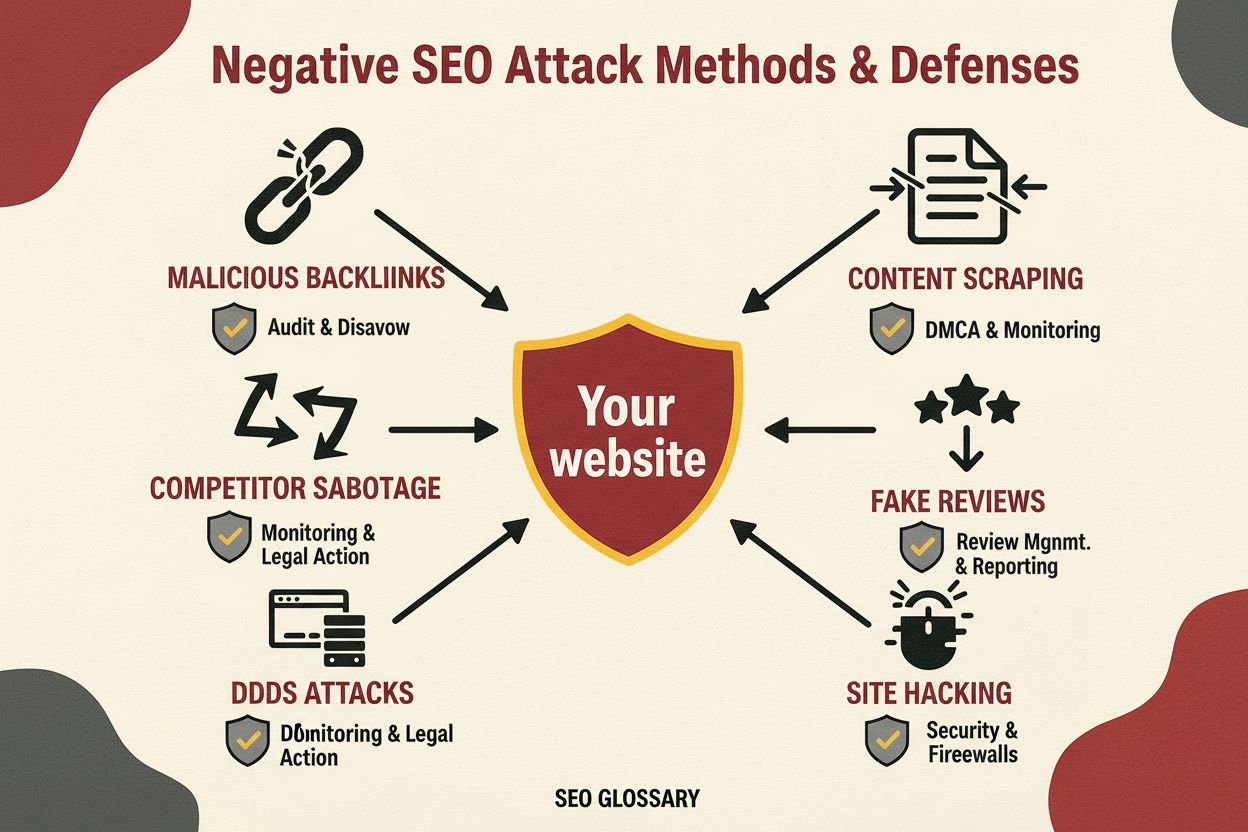
Negative SEO is the practice of using unethical techniques to harm competitor rankings. Learn about attack tactics, detection methods, and how to protect your s...

Learn what negative query identification is, why it matters for AI visibility, and how to identify and close gaps where competitors are cited but your brand is ...
Cookie Consent
We use cookies to enhance your browsing experience and analyze our traffic. See our privacy policy.