
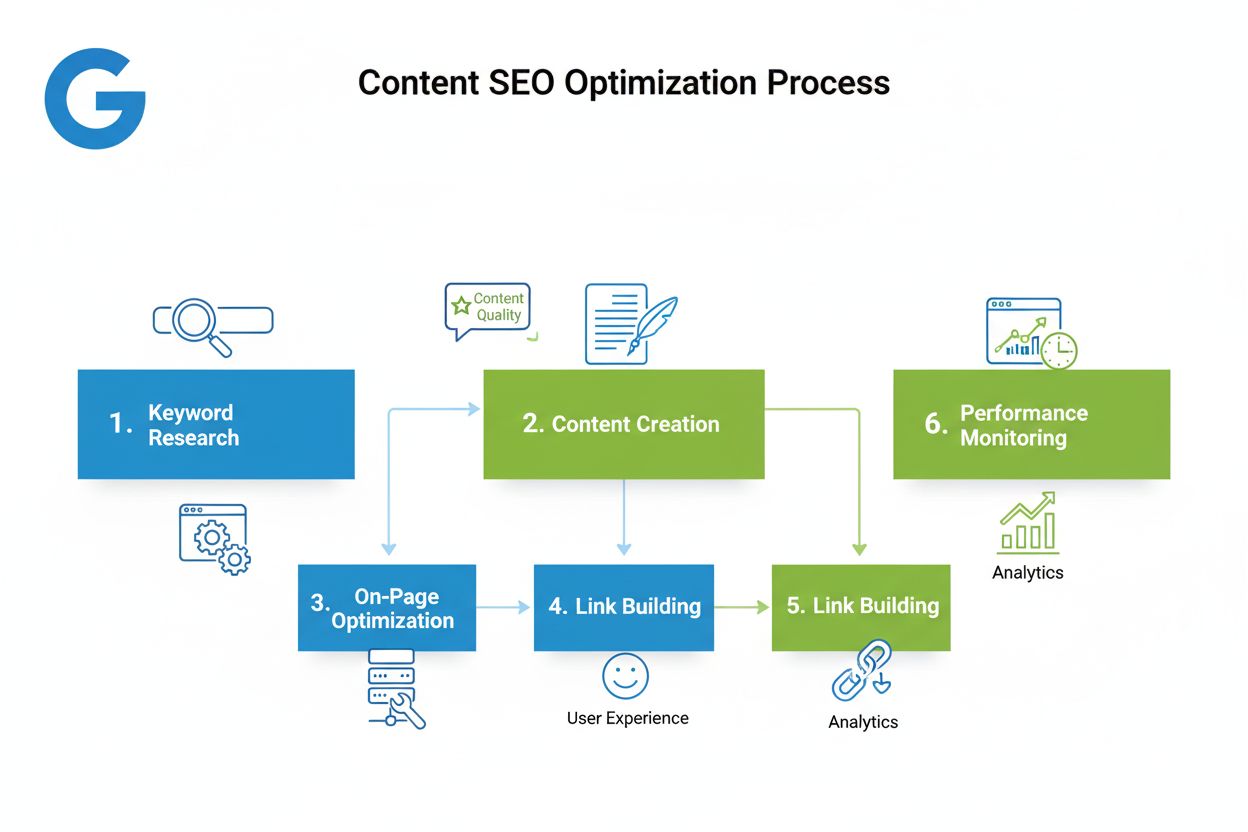
Content SEO
Content SEO is the strategic creation and optimization of high-quality content to improve search engine rankings and organic visibility. Learn how to optimize c...
12 min read
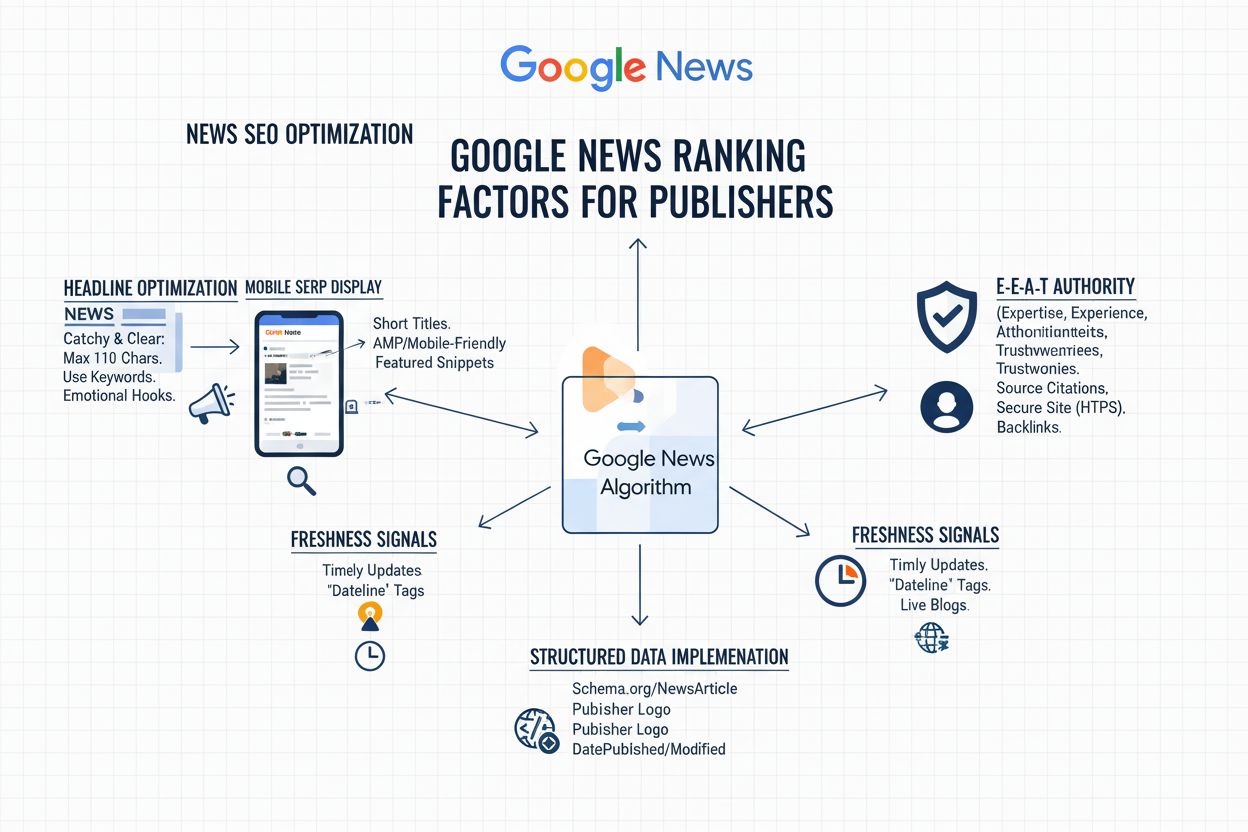
News SEO is the specialized practice of optimizing news content to rank prominently in Google News, Top Stories carousels, and other news-specific search features by emphasizing recency, topic authority, journalistic transparency, and technical best practices. It differs from traditional SEO by prioritizing freshness and real-time indexing over evergreen content rankings.
News SEO is the specialized practice of optimizing news content to rank prominently in Google News, Top Stories carousels, and other news-specific search features by emphasizing recency, topic authority, journalistic transparency, and technical best practices. It differs from traditional SEO by prioritizing freshness and real-time indexing over evergreen content rankings.
News SEO is the specialized practice of optimizing news content to achieve prominent visibility in Google News, Top Stories carousels, and other news-specific search features. Unlike traditional SEO, which focuses on building long-term rankings for evergreen content, News SEO emphasizes recency, topic authority, journalistic transparency, and rapid indexing to capture traffic during peak search interest for breaking news and trending topics. The discipline combines technical optimization, editorial best practices, and adherence to Google’s news-specific ranking algorithms to ensure news articles are discovered, indexed, and ranked in real-time news search surfaces. News SEO is essential for digital publishers, journalists, and media outlets seeking to maximize visibility in an increasingly competitive news discovery landscape where Google News drives 20-35% of total traffic for many news organizations.
The emergence of News SEO as a distinct discipline reflects fundamental changes in how audiences discover news content. Historically, news publishers relied on social media platforms and direct audience relationships to drive traffic. However, as Google News evolved into a primary news discovery channel, publishers recognized the need for specialized optimization strategies tailored to news-specific ranking systems. The distinction between News SEO and traditional SEO became pronounced around 2010-2015, when Google introduced dedicated news ranking algorithms and the Top Stories carousel became a prominent SERP feature. Today, organic search accounts for 53% of website traffic globally, with news search representing a significant portion of this traffic. The rise of AI Overviews and LLM-generated responses has further expanded the importance of News SEO, as news articles now compete for visibility not only in traditional search results but also in AI-generated summaries and citations. Research from Semrush indicates that major U.S. news publications experienced a 994% increase in AI Overview appearances between February and August 2025, demonstrating the critical importance of optimizing news content for emerging AI search surfaces. Publishers who master News SEO gain competitive advantages in real-time news cycles, where minutes matter in capturing search traffic during breaking news events.
Google’s news ranking algorithm evaluates seven primary factors that determine which articles appear in news search results. Relevance measures how closely an article aligns with user search queries and interests, requiring publishers to optimize headlines and body content with appropriate keywords. Prominence surfaces articles about significant events receiving heavy coverage across multiple news outlets, rewarding original reporting on newsworthy topics. Authoritativeness prioritizes content from credible, trustworthy sources with strong E-E-A-T signals (Experience, Expertise, Authoritativeness, Trustworthiness), making author attribution and publication transparency critical. Freshness is perhaps the most distinctive ranking factor for news content, with Google prioritizing recently published articles and frequently updated stories, particularly for time-sensitive queries. Usability encompasses technical factors including page load speed, mobile responsiveness, and overall user experience, with Core Web Vitals serving as measurable performance benchmarks. Location personalizes results based on user geography, allowing local news outlets to compete effectively in regional news searches. Finally, language matching ensures content appears for users searching in their preferred language. These factors work synergistically, meaning publishers cannot succeed by optimizing for only one or two factors—comprehensive News SEO requires attention to all seven dimensions simultaneously.
| Aspect | News SEO | Traditional SEO |
|---|---|---|
| Content Lifespan | Hours to days of peak visibility; time-sensitive | Months to years of sustained rankings |
| Publishing Frequency | Continuous, real-time updates required | Periodic content updates; evergreen focus |
| Data Reporting | Real-time to 5-minute increments | Daily to weekly data updates |
| Ranking Factors | Freshness, recency, prominence, rapid indexing | Domain authority, backlinks, comprehensive content |
| Headline Optimization | Critical; under 60 characters; keyword-forward | Important but less time-sensitive |
| Indexing Speed | Minutes to hours (news crawlers) | Hours to days (standard crawlers) |
| Content Type | Breaking news, timely updates, live coverage | Guides, tutorials, comprehensive resources |
| Traffic Pattern | Spikes during news events; volatile | Steady, predictable organic traffic |
| Technical Requirements | News sitemaps, NewsArticle schema, rapid updates | Standard sitemaps, flexible schema options |
| Audience Intent | Immediate information about current events | In-depth answers to evergreen questions |
| Competitive Dynamics | Intense competition during breaking news | Sustained competition over longer periods |
| Monetization | High CPM rates; strong ad viewability | Varied CPM; subscription conversion potential |
Implementing proper technical infrastructure is foundational to News SEO success. Publishers must submit news-specific XML sitemaps to Google Search Console, containing only articles published within the last 48 hours with fewer than 1,000 URLs per sitemap. These sitemaps should include news-specific tags such as <news:publication>, <news:publication_date>, and <news:title> to signal article metadata to Google’s news crawlers. NewsArticle schema markup is equally critical, providing explicit structured data about article attributes including headline, author, publication date, modification date, featured image URL, publisher information, and accessibility status for paywalled content. Publishers should implement this schema using JSON-LD format, ensuring all mandatory properties are present and valid. Core Web Vitals optimization directly impacts news rankings, with Google requiring Largest Contentful Paint (LCP) under 2.5 seconds, Interaction to Next Paint (INP) under 200 milliseconds, and Cumulative Layout Shift (CLS) under 0.1. Mobile optimization is non-negotiable, as most news traffic originates from mobile devices and Google uses mobile-first indexing for news content. Publishers should serve images in modern formats like WebP or AVIF with proper compression and lazy loading for below-the-fold content. Stable, crawlable URLs without parameters or session tokens ensure consistent indexing, while canonical tags resolve duplicate URLs created by tagging systems or pagination. Verification in Google Publisher Center provides official brand recognition within Google’s news ecosystem, though this is optional for inclusion.
Headlines represent the single most important ranking factor for news articles in Google’s news ecosystem, influencing both algorithmic relevance and user engagement metrics. Effective news headlines must include primary keywords positioned early in the title, typically within the first 5-10 words, to signal topic relevance to search algorithms. Headlines should remain under 60 characters to prevent truncation on mobile devices, where most news consumption occurs. The language should be clear, direct, and factual, avoiding clickbait-style phrasing that misrepresents content and violates Google’s news guidelines. Action-oriented language and active voice improve both algorithmic performance and click-through rates—for example, “Senate Approves $118 Billion Border Package” outperforms “You Won’t Believe What Congress Just Did.” Publishers should leverage Google Trends to identify rising search interest and align headlines with trending topics, ensuring content addresses current user search demand. Keyword research for news differs from traditional SEO, focusing on high-volume, time-sensitive terms rather than long-tail keywords. Publishers should monitor trending topics in real-time, using tools like Google Trends, Exploding Topics, and news SEO platforms to identify coverage opportunities before competitors. Content freshness requires not only rapid publication but also strategic updates as stories develop—publishers should update headlines and body content when significant new information emerges, ensuring articles remain relevant throughout news cycles. This dynamic approach to content strategy distinguishes News SEO from traditional SEO, where content typically remains static after publication.
Building E-E-A-T signals is essential for establishing publisher credibility within Google’s news ranking systems. Experience refers to the content creator’s first-hand knowledge and direct involvement with the subject matter, which news publishers demonstrate through original reporting and on-the-ground coverage. Expertise encompasses the journalist’s qualifications, beat knowledge, and subject matter specialization, communicated through detailed author bios that highlight credentials and experience. Authoritativeness extends beyond individual journalists to the publication’s reputation as a trusted news source, built through consistent, accurate reporting and industry recognition. Trustworthiness is demonstrated through transparent editorial policies, clear corrections procedures, fact-checking processes, and disclosure of funding sources or affiliations. Publishers should implement detailed author pages for every bylined journalist, including professional biography, credentials, topic expertise areas, and chronological article archives. An accessible About Us page should outline the publication’s mission, editorial standards, team credentials, and commitment to journalistic integrity. Prominent corrections policies signal accountability and transparency, with major publishers like The New York Times prominently displaying corrections and updates. Publishers should also clearly differentiate between news and opinion content, maintaining editorial standards that prevent promotional or sponsored content from appearing as legitimate journalism. These E-E-A-T signals work synergistically with technical optimization to establish publisher authority, particularly important as Google increasingly emphasizes content quality and source credibility in its ranking algorithms.
News SEO requires continuous real-time monitoring to capitalize on breaking news opportunities and respond to competitive threats. Unlike traditional SEO tools offering daily or weekly data updates, news publishers need near real-time tracking with 5-minute to hourly data refresh rates. Google Search Console provides foundational performance data through the News tab, showing impressions, clicks, and positions specifically in news features. The URL Inspection tool verifies proper indexing and rendering of news pages, while Coverage reports identify crawling or indexing issues affecting news content discovery. Google Publisher Center offers news-specific analytics showing performance across Google News properties, with direct feedback channels for policy compliance information. Publishers should track multiple SERP features including Top Stories carousels, News boxes, Knowledge Panels, Featured Snippets, and increasingly, AI Overviews. Specialized news SEO tools like Trisolute News Dashboard, Semrush, and Search Atlas provide competitive analysis, topic authority insights, and real-time keyword tracking specifically designed for news publishers. These platforms enable publishers to identify missing topics (trending stories competitors cover but the publisher hasn’t), monitor competitor rankings, and optimize content strategy based on data-driven insights. Real-time monitoring during breaking news events allows editorial teams to react quickly, update content, and claim larger shares of search traffic. Publishers should establish daily SEO workflows where editors review performance data, identify trending topics, and prioritize coverage based on search demand and competitive positioning.
The rise of AI Overviews and LLM-generated responses has fundamentally expanded the scope of News SEO. News articles now compete for visibility not only in traditional Google News and Top Stories but also in AI-generated summaries, ChatGPT responses, Perplexity answers, Google AI Overviews, and Claude citations. Research indicates that major U.S. news publications experienced 994% growth in AI Overview appearances between February and August 2025, with The New York Times achieving a 1,169% increase in AI Overview visibility. This expansion creates both opportunities and challenges for news publishers—while AI visibility can drive significant traffic, it also introduces new citation patterns and attribution challenges. Each LLM platform has distinct citation behaviors, with some platforms citing sources more frequently than others, and citation patterns varying by topic and query type. Publishers optimizing for News SEO—through strong E-E-A-T signals, authoritative content, and proper structured data—are more likely to be cited in AI-generated responses. Monitoring brand visibility across AI platforms has become essential for news publishers, requiring tools like AmICited that track where news content appears across multiple AI systems. Publishers should recognize that AI Overviews may reduce traditional click-through traffic by providing direct answers without requiring users to visit publisher websites, necessitating new monetization strategies and visibility metrics. The integration of news content into AI systems represents a fundamental shift in news discovery, requiring publishers to adapt their SEO strategies beyond traditional search optimization.
The future of News SEO is being shaped by the convergence of traditional search optimization and AI-driven content discovery. As AI Overviews continue to expand across Google’s search results, news publishers must adapt strategies to optimize for both traditional news search features and AI-generated responses. Google’s March 2025 Core Update emphasized content quality and E-E-A-T signals, signaling that publishers relying on low-quality or AI-generated content will face visibility declines. The transition to automatically generated publication pages in Google News (discontinued manual RSS feed submissions) streamlines publisher workflows but reduces customization options, requiring publishers to focus on content quality rather than technical configuration. Intensified crackdowns on “parasite SEO” and site reputation abuse mean publishers are held accountable for all content on their sites, regardless of authorship, leading to stricter editorial oversight and reduced reliance on freelance contributors. The integration of news content into multiple AI platforms creates new visibility opportunities but also introduces complexity in tracking brand mentions and citations across diverse systems. Publishers must recognize that traditional metrics like click-through rates may decline as AI systems provide direct answers without requiring website visits, necessitating new monetization models and success metrics. The future of News SEO likely involves hybrid strategies that optimize for both search visibility and AI citation, with publishers investing in real-time monitoring tools that track brand visibility across multiple platforms. Topic authority and E-E-A-T signals will become increasingly important as Google and AI systems prioritize trustworthy, authoritative sources in competitive news landscapes. Publishers who successfully navigate this evolving landscape will be those who combine rigorous editorial standards, technical excellence, and adaptive strategies that account for emerging AI-driven discovery mechanisms.
News SEO prioritizes recency, freshness, and real-time indexing, whereas traditional SEO focuses on evergreen content that ranks for months or years. News publishers require near real-time data reporting (5-minute increments) compared to traditional SEO tools offering daily or weekly updates. News SEO emphasizes headline optimization, rapid publication cycles, and immediate visibility in Google News surfaces, while traditional SEO builds long-term domain authority through comprehensive content strategies.
Google News uses seven primary ranking factors: relevance (how well content matches user queries), prominence (coverage of significant events), authoritativeness (source credibility and E-E-A-T signals), freshness (recency of publication and updates), usability (page speed and mobile optimization), location (geographic relevance), and language (content language matching user preferences). These factors work together to determine which news articles appear in Top Stories, Google News app, and news-specific SERP features.
Headlines are the single most important ranking factor for news articles in Google's ecosystem. Effective headlines must include primary keywords positioned early in the title, remain under 60 characters to avoid truncation on mobile, and communicate the news story clearly without clickbait. Headlines influence both algorithmic relevance and user click-through rates, directly impacting visibility in Top Stories carousels and news search results.
E-E-A-T (Experience, Expertise, Authoritativeness, Trustworthiness) signals are critical for news publishers to establish credibility with Google's ranking systems. Publishers should implement detailed author bios with credentials, create transparent About Us pages, establish clear editorial policies, publish corrections prominently, and demonstrate fact-checking processes. While not a direct ranking factor, E-E-A-T influences how Google's quality raters evaluate content and impacts news visibility.
Freshness is a core ranking factor for news content, with Google prioritizing recently published and frequently updated articles. Publishers should publish consistently, use ISO 8601 formatted timestamps visible on pages, update articles as stories develop, and submit news sitemaps regularly. Google's news crawlers operate on minute-to-hour intervals rather than weekly cycles, meaning timely updates directly influence real-time visibility in news search results.
News publishers should implement NewsArticle schema markup with mandatory properties including headline, author information, datePublished, dateModified, featured image URL, publisher details, and isAccessibleForFree status. This structured data helps Google understand article context, recency, and authority. Publishers should also submit news-specific XML sitemaps containing only articles published in the last 48 hours with fewer than 1,000 URLs per sitemap.
News articles increasingly appear in Google AI Overviews and LLM-generated responses, creating new visibility opportunities beyond traditional Top Stories. Research shows that major news publications saw 994% growth in AI Overview appearances from February to August 2025. Optimizing for News SEO—through E-E-A-T signals, structured data, and authoritative content—improves chances of citation in AI systems, making news monitoring platforms like AmICited essential for tracking brand visibility across multiple AI platforms.
Mobile optimization is critical since most news traffic comes from mobile devices and Google uses mobile-first indexing. Publishers should ensure responsive design, fast page load speeds (LCP under 2.5 seconds), minimal intrusive ads, proper touch target sizing, and modern image formats like WebP or AVIF with lazy loading. Mobile SERP real estate is limited, so building topic authority and brand trust becomes increasingly important for competitive visibility.
Start tracking how AI chatbots mention your brand across ChatGPT, Perplexity, and other platforms. Get actionable insights to improve your AI presence.
Content SEO is the strategic creation and optimization of high-quality content to improve search engine rankings and organic visibility. Learn how to optimize c...

YouTube SEO is the process of optimizing videos and channels to rank higher in YouTube search results. Learn ranking factors, optimization strategies, and best ...

Learn how to optimize news content for AI systems. Discover best practices for getting cited by ChatGPT, Gemini, Perplexity, and Google AI Overviews. Master AI ...
Cookie Consent
We use cookies to enhance your browsing experience and analyze our traffic. See our privacy policy.