

Nonprofit AI Visibility: Mission-Driven Optimization
Discover how nonprofits can leverage AI visibility and mission optimization to reach more donors, volunteers, and beneficiaries. Learn AEO strategies, fundraisi...
11 min read

Nonprofit AI Optimization refers to strategic practices that help charitable organizations become visible and discoverable in AI-powered search results, including Google AI Overviews, ChatGPT, and Perplexity. It encompasses content structuring, technical SEO, schema markup implementation, and authority-building to ensure nonprofits appear when donors search for causes to support and volunteers seek opportunities to help.
Nonprofit AI Optimization refers to strategic practices that help charitable organizations become visible and discoverable in AI-powered search results, including Google AI Overviews, ChatGPT, and Perplexity. It encompasses content structuring, technical SEO, schema markup implementation, and authority-building to ensure nonprofits appear when donors search for causes to support and volunteers seek opportunities to help.
Nonprofit AI optimization refers to the strategic practices and technical implementations that help charitable organizations become visible and discoverable in AI-powered search results, including Google AI Overviews, ChatGPT, Perplexity, and other generative AI tools. Unlike traditional search engine optimization, which focuses primarily on ranking for specific keywords in Google’s blue link results, nonprofit AI optimization addresses how AI systems discover, evaluate, and recommend organizations when donors and volunteers ask questions about causes to support. The fundamental shift is from keyword-based discovery to intent-based discovery—AI systems analyze the underlying motivation behind a search query and surface organizations that authentically answer the user’s question, rather than simply matching keywords. Google AI Overviews now appear in over 50% of search queries, a dramatic increase from just 25% in August 2024, making this optimization strategy essential for nonprofits seeking to reach supporters. AI systems evaluate nonprofit content differently than traditional search engines, prioritizing original, authoritative content that demonstrates clear expertise, trustworthiness, and real-world impact. For nonprofits, this represents both a challenge and an opportunity: organizations that adapt their content and technical infrastructure to align with how AI systems work will reach more donors, volunteers, and community members than ever before. The urgency is clear—nonprofits that delay this adaptation risk becoming invisible in the fastest-growing discovery channel for charitable giving and volunteering.

The rise of AI-powered search has fundamentally altered how people discover nonprofit organizations, creating significant challenges for charities that have historically relied on organic search traffic as a primary source of website visitors and donors. Between January and October 2025, nonprofits experienced a 35% decline in organic search traffic compared to the same period in 2024, primarily due to the increased prevalence of Google AI Overviews, which often provide comprehensive answers without requiring users to click through to nonprofit websites. This traffic decline directly impacts fundraising, as organic search previously accounted for over 40% of nonprofit website traffic and nearly 30% of annual online revenue. However, the adoption of AI tools for nonprofit discovery is still in its early stages—currently, only 4.5% of surveyed donors use AI to find and research causes to support, yet this represents a 1000% year-over-year increase in AI-driven traffic to nonprofit websites. When AI-referred visitors do arrive at nonprofit websites, they exhibit distinctly different behavior patterns: they spend approximately 70% longer on site than organic search visitors, indicating deeper engagement and research intent, but their immediate donation rate is only about one-eighth of the average across all traffic sources. This behavioral difference suggests that AI-referred visitors are in an exploratory, research phase rather than ready to donate immediately, but they represent high-quality prospects for long-term engagement and future support. The opportunity lies in understanding that while AI Overviews may reduce immediate click-through traffic, they can increase brand awareness and create a pipeline of informed, engaged supporters who are more likely to donate after conducting thorough research.
| Metric | Traditional Search | AI Search |
|---|---|---|
| Traffic Impact | Baseline (100%) | -35% organic traffic decline |
| User Intent | Click-through focused | Information gathering & research |
| Visitor Behavior | Quick decision-making | 70% longer site engagement time |
| Conversion Rate | Higher immediate donations | Lower immediate, higher research phase |
| Content Source Priority | Website links | Multiple sources (news, blogs, social media, websites) |
Nonprofits seeking to optimize for AI visibility should implement a comprehensive strategy that addresses both content structure and technical infrastructure. The following strategies have proven most effective for improving nonprofit visibility in AI-generated answers:
AI systems do not read content the way humans do; instead, they analyze structure, hierarchy, relationships between topics, and the clarity with which information is presented to determine relevance and authority. Clear content structure is paramount because AI systems rely on logical organization to extract accurate information and associate your nonprofit with specific subject areas and causes. Heading hierarchy plays a critical role in this process—a well-organized page should feature one clear primary heading (H1) that defines the page’s topic, followed by supporting subheadings (H2, H3) that break the topic into logical sections, with short paragraphs that focus on a single idea at a time. AI systems strongly prefer plain-language explanations over jargon-filled content; when technical terms are necessary, they should be defined clearly and in context so that AI systems can accurately interpret and summarize the information. Original, authoritative content is heavily weighted by AI systems—if your nonprofit creates genuinely helpful content that adds unique value and demonstrates real expertise, you are already positioned to succeed in AI-driven discovery. Rather than attempting to optimize for specific keywords, nonprofits should focus on answering the real questions that donors and volunteers ask, such as “How can I volunteer to help refugees in my city?” or “What nonprofits are most effective at addressing food insecurity?” By structuring content to directly address these intent-driven queries with clear, well-organized information, nonprofits dramatically increase the likelihood that AI systems will surface their content when users seek answers.
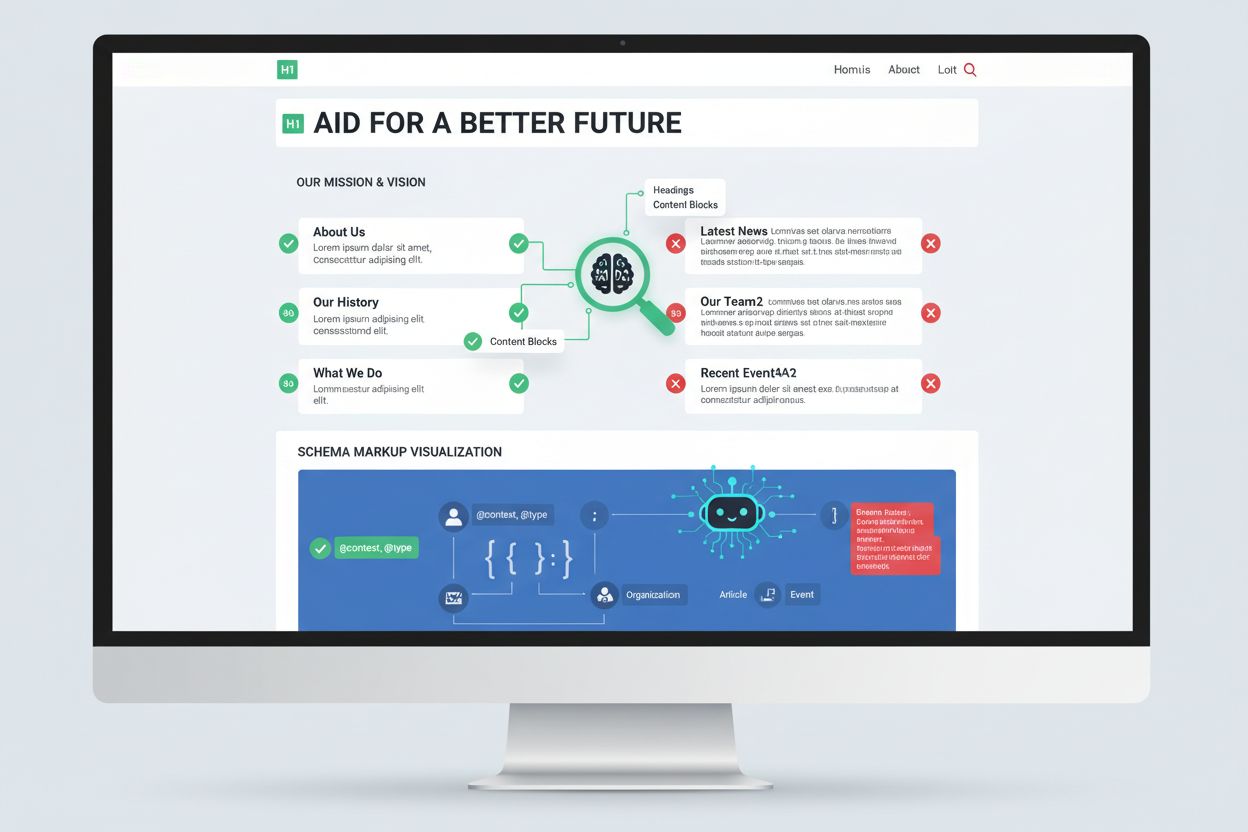
Schema markup, also known as structured data, is a standardized format that helps AI systems and search engines interpret your content more accurately by explicitly labeling what information means and how it relates to your organization. While schema markup does not directly guarantee higher rankings or AI visibility, it significantly improves how AI systems understand and represent your nonprofit’s information, making it far more likely that your content will be cited in AI-generated answers. For nonprofits, several schema types are particularly valuable: Organization schema clearly defines your nonprofit’s name, mission, location, contact information, and social profiles; Event schema helps AI systems understand your fundraisers, volunteer opportunities, and community programs; FAQ schema enhances visibility of question-and-answer content that AI systems rely on heavily; and Article schema improves how AI systems interpret your educational and impact-focused content. Implementation can be accomplished through multiple approaches: many content management systems (CMS) like WordPress offer built-in schema tools or plugins such as Yoast SEO or RankMath that simplify the process, while Google’s free Structured Data Markup Helper provides a user-friendly interface for adding schema to individual pages. After implementing schema markup, nonprofits should validate their work using Google’s Rich Results Test tool, which checks whether schema is correctly formatted and will be processed by search engines and AI systems. The investment in proper schema implementation pays dividends because it provides explicit signals to AI systems about your organization’s identity, mission, and credibility, directly improving your chances of appearing in AI-generated answers about causes, volunteer opportunities, and charitable giving.
The E-E-A-T framework (Experience, Expertise, Authoritativeness, Trustworthiness) has become central to how AI systems evaluate nonprofit content and determine whether to cite or recommend an organization. Experience signals demonstrate that your nonprofit has real-world knowledge and impact—this includes detailed case studies with specific outcomes, volunteer testimonials with names and photos, before-and-after impact stories, and documented examples of how your programs have changed lives. Expertise signals highlight your team’s qualifications and knowledge—staff bios with relevant credentials, board member profiles and backgrounds, partnerships with established organizations, and certifications or awards from recognized bodies all communicate that your nonprofit has deep knowledge in its field. Authoritativeness signals establish your organization as a credible, go-to source for information about your cause area—this is built through media coverage and news mentions, collaborations with government agencies, partnerships with other respected nonprofits, and recognition as a thought leader in your field. Trustworthiness signals assure AI systems and potential supporters that your organization is transparent, secure, and reliable—this includes displaying current financial transparency reports, maintaining updated contact information and physical addresses, using HTTPS security, regularly updating content with publication dates, and displaying third-party accountability ratings from platforms like GuideStar or Charity Navigator. AI systems heavily weight these E-E-A-T signals when deciding which organizations to recommend, meaning that nonprofits that systematically build credibility across all four dimensions will see significantly improved visibility in AI-generated answers about causes, volunteer opportunities, and charitable giving.
Measuring visibility in AI-powered search presents unique challenges because AI Overviews and generative AI tools do not provide the same transparent ranking data that traditional search engines offer, making it difficult for nonprofits to track exactly when and how often their content appears in AI-generated answers. However, nonprofits can employ several practical approaches to monitor their AI visibility: Google Search Console provides insights into which queries drive impressions and clicks, allowing organizations to identify question-based searches and track performance on FAQ and resource pages that are commonly cited by AI systems. Key metrics to track include growth in qualified organic traffic from AI-referred sources, engagement with educational content that AI systems prioritize, visibility in featured snippets and People Also Ask sections (which serve as common sources for AI content), and conversion metrics such as newsletter signups and volunteer registrations from AI-referred visitors. Advanced monitoring tools like SEMrush and BrightEdge now offer AI visibility tracking features that attempt to identify when nonprofit content appears in AI-generated answers, though these tools are still evolving. For nonprofits with limited budgets, a practical approach involves manual monitoring—conducting weekly searches for key questions your nonprofit addresses and noting which of your pages appear in featured snippets or AI Overviews. Ultimately, nonprofit SEO success should be measured not by rankings alone but by meaningful engagement and mission impact, meaning that nonprofits should connect search performance data to organizational goals such as donor acquisition, volunteer recruitment, and program awareness.
Many nonprofits inadvertently undermine their AI visibility by making preventable mistakes that reduce their chances of appearing in AI-generated answers. Over-optimization and keyword stuffing are counterproductive—AI systems can detect artificial content created solely for search engines and actively penalize it, so nonprofits should focus on creating genuinely helpful content for real people rather than attempting to game the system. Ignoring user intent is another critical error; nonprofits must understand what people actually want when they search (e.g., “How do I volunteer?” versus “What is food insecurity?”) rather than simply targeting keywords, as AI systems prioritize content that authentically answers user questions. Technical neglect undermines even excellent content—nonprofits must address basic website issues such as broken links, slow loading times, poor mobile optimization, and accessibility problems before focusing on advanced AI optimization strategies. Inconsistent information across platforms confuses AI systems; nonprofits should maintain identical organizational details, mission statements, and contact information across their website, social media, Google Business Profile, and other platforms. Outdated content signals to AI systems that your organization may not be actively engaged or reliable, so nonprofits should implement a systematic content refresh strategy that updates statistics, impact data, staff information, and FAQ sections on a quarterly basis. Mobile optimization failures are particularly damaging because most nonprofit website visitors use mobile devices, and AI systems prioritize mobile-friendly content. Best practices for nonprofit AI optimization include focusing on creating original, authoritative content that genuinely helps donors and volunteers; structuring content with clear headings and logical organization; implementing schema markup correctly; building E-E-A-T signals systematically; and regularly monitoring performance through Google Search Console and other available tools.
Nonprofit AI optimization refers to strategic practices that help charitable organizations become visible in AI-powered search results like Google AI Overviews, ChatGPT, and Perplexity. It matters because AI search is growing rapidly—Google AI Overviews now appear in over 50% of search queries—and nonprofits that optimize for AI visibility will reach more donors and volunteers than those relying solely on traditional search engine optimization.
Traditional Google search prioritizes websites that rank for specific keywords, while AI search analyzes intent and recommends organizations based on authority, trustworthiness, and original content. AI systems pull information from multiple sources including news coverage, blogs, social media, and websites, meaning nonprofits must build visibility across multiple channels, not just their own website.
Schema markup is structured data that explicitly tells AI systems what your content means and how it relates to your organization. For nonprofits, schema markup helps AI systems understand your mission, events, FAQs, and impact stories, making it far more likely that your content will be cited in AI-generated answers about causes, volunteer opportunities, and charitable giving.
E-E-A-T (Experience, Expertise, Authoritativeness, Trustworthiness) signals are built through case studies and impact stories (Experience), staff credentials and partnerships (Expertise), media mentions and third-party validation (Authoritativeness), and transparency reports and security measures (Trustworthiness). Nonprofits should systematically build credibility across all four dimensions to improve AI visibility.
Key metrics include growth in qualified organic traffic from AI sources, engagement with educational content, visibility in featured snippets and People Also Ask sections, and conversion metrics like newsletter signups and volunteer registrations. Google Search Console provides insights into question-based searches, while tools like SEMrush and BrightEdge offer AI visibility tracking features.
Results from AI optimization typically take 3-6 months to become visible, as AI systems need time to crawl, index, and evaluate your updated content. However, nonprofits should focus on building sustainable, long-term visibility rather than expecting immediate results, as AI systems reward consistent, authoritative content over time.
Common mistakes include over-optimization and keyword stuffing, ignoring user intent, technical neglect (slow sites, poor mobile optimization), inconsistent information across platforms, outdated content, and failing to implement schema markup. Nonprofits should focus on creating genuinely helpful content and addressing technical foundations before pursuing advanced optimization tactics.
Traditional SEO focuses on ranking for keywords in Google's blue link results, while AI optimization focuses on appearing in AI-generated answers across multiple platforms. AI optimization requires stronger emphasis on content structure, E-E-A-T signals, schema markup, and multi-channel visibility, though traditional SEO fundamentals like site speed and mobile optimization remain important.
AmICited tracks how your nonprofit appears in AI-generated answers across Google AI Overviews, ChatGPT, Perplexity, and other AI tools. Get real-time insights into your AI visibility and optimize your donor and volunteer discovery.
Discover how nonprofits can leverage AI visibility and mission optimization to reach more donors, volunteers, and beneficiaries. Learn AEO strategies, fundraisi...

Learn how non-profits optimize for AI visibility through GEO strategies, structured data, content alignment, and monitoring across ChatGPT, Perplexity, Google A...
Community discussion on how non-profit organizations are optimizing for AI search visibility. Real strategies from development directors and communications prof...
Cookie Consent
We use cookies to enhance your browsing experience and analyze our traffic. See our privacy policy.