
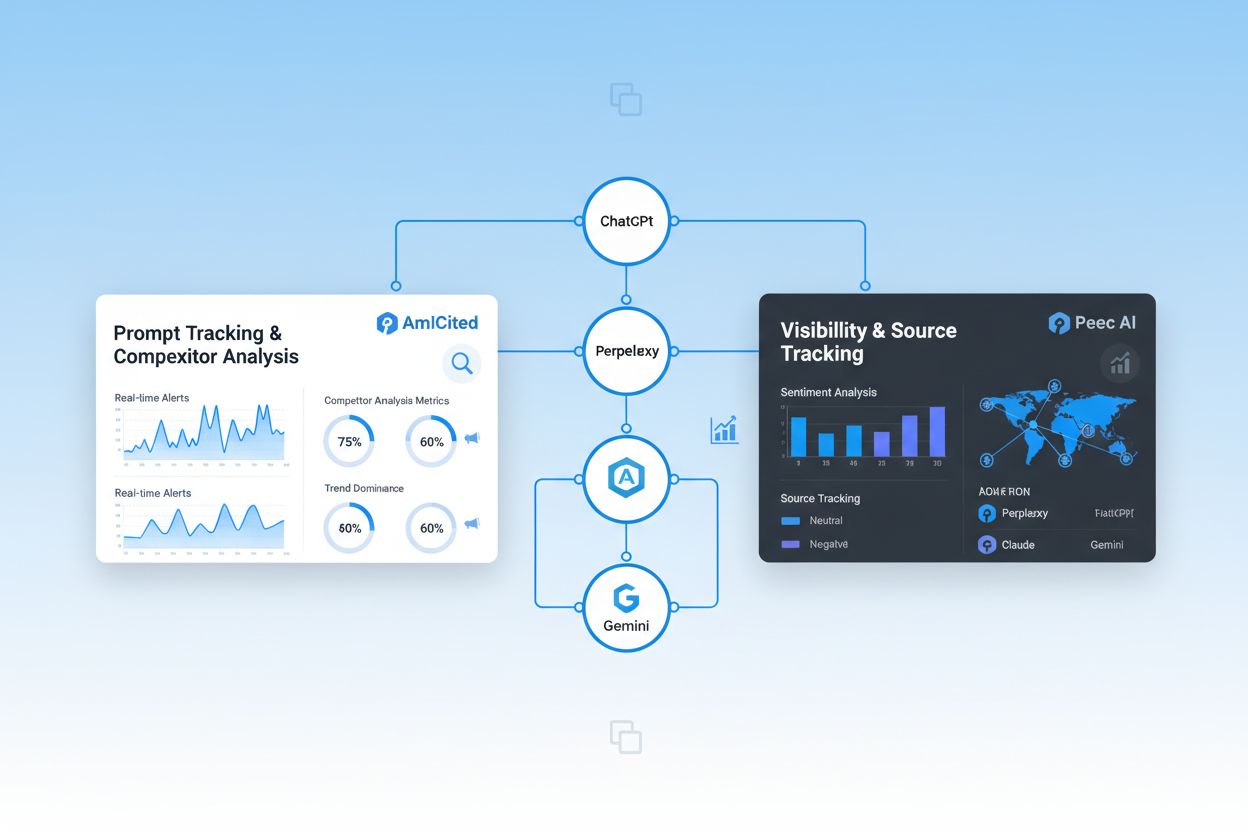
Am I Cited vs Peec AI: Which Platform Fits Your Needs?
Compare AmICited and Peec AI for AI visibility monitoring. Discover which platform is best for tracking brand mentions in ChatGPT, Perplexity, and Google AI Ove...
9 min read

Peec AI is an AI visibility optimization tool that tracks how brands appear across large language models like ChatGPT, Perplexity, and Google AI Overviews. It measures brand visibility, position ranking, and sentiment in AI-generated responses to help marketing teams understand and improve their presence in generative search results.
Peec AI is an AI visibility optimization tool that tracks how brands appear across large language models like ChatGPT, Perplexity, and Google AI Overviews. It measures brand visibility, position ranking, and sentiment in AI-generated responses to help marketing teams understand and improve their presence in generative search results.
Peec AI is an AI visibility optimization tool designed to help marketing teams track, analyze, and improve how their brands appear across large language models and generative search platforms. The platform monitors brand mentions, rankings, and sentiment across multiple AI engines including ChatGPT, Perplexity, Google AI Overviews, Claude, Gemini, and Copilot. By providing real-time insights into brand visibility metrics, Peec AI enables marketers to understand their presence in the emerging AI search landscape and develop data-driven strategies to enhance their visibility in generative search results. The tool addresses a critical gap in the marketing technology landscape by offering the first dedicated platform for tracking how AI models reference and recommend brands in their responses.
The rise of generative AI and large language models has fundamentally transformed how users discover information and make purchasing decisions. Unlike traditional search engines where rankings are determined by algorithms and displayed in a linear format, AI-powered search engines generate conversational responses that reference multiple sources and brands. This shift has created a new challenge for marketers: understanding how their brands appear within AI-generated answers. According to recent research, over 60% of searches now end without users clicking through to traditional search results, as users increasingly rely on AI summaries and recommendations. Peec AI emerged in 2024 to address this visibility gap, providing the first comprehensive platform for monitoring brand mentions across multiple AI platforms. The company has raised significant funding, including a $6.13 million Series A round led by 20VC in July 2025, demonstrating strong market validation for AI visibility tracking solutions. This funding reflects the growing recognition among enterprises that AI visibility is becoming as important as traditional SEO, with brands needing to optimize their presence across ChatGPT, Perplexity, and other generative search platforms to maintain competitive advantage.
Peec AI’s analytical foundation rests on three primary metrics that collectively provide a comprehensive view of brand performance in AI search. Visibility measures the percentage of AI conversations where your brand is mentioned across tracked prompts, functioning as a market share indicator within AI conversations. This metric helps brands understand their overall reach and presence, revealing whether their visibility is trending upward or downward over time. Position indicates where your brand ranks when mentioned in AI responses, typically measured against competitors, showing whether your brand appears first, second, or later in AI-generated answers. This ranking metric is crucial for understanding competitive standing and identifying opportunities to improve prominence. Sentiment analyzes the emotional tone of AI mentions on a scale from 0 to 100, determining whether the AI model describes your brand positively, negatively, or neutrally. Together, these three metrics create a holistic view of brand perception and performance in the AI search ecosystem, enabling marketers to make informed decisions about content strategy and brand positioning.
One of Peec AI’s key differentiators is its comprehensive coverage of multiple AI platforms, recognizing that different user segments and use cases favor different generative search engines. The Starter plan includes tracking across ChatGPT, Perplexity, and Google AI Overviews, the three most widely-used AI search platforms. The Pro plan maintains this baseline coverage while adding support for additional regions and prompts. For enterprises requiring broader coverage, additional AI platforms including Claude, Gemini, DeepSeek, Llama, and Grok are available as add-ons to any plan. This multi-platform approach acknowledges that AI search is not monolithic; different platforms have different user bases, different response patterns, and different citation behaviors. By tracking across multiple engines, brands can identify platform-specific opportunities and understand how their visibility varies depending on which AI tool users are consulting. This granular visibility is essential for developing comprehensive AI search strategies that account for the diverse ways different AI models reference and recommend brands.
| Feature | Peec AI | Profound AI | Otterly AI | SE Visible |
|---|---|---|---|---|
| Starting Price | €89/month | $99/month | $25/month | $189/month |
| Baseline Prompts | 25 | 50 | 15 | 450 |
| AI Platforms (Baseline) | 3 | 1 | 4 | 5 |
| Visibility Metric | Yes | Yes | Yes | Yes |
| Position Tracking | Yes | Yes | Yes | Yes |
| Sentiment Analysis | Yes (Pro+) | Yes | Yes | Yes |
| Competitor Benchmarking | Yes | Yes | Yes | Yes |
| Source Citation Tracking | Yes | Yes | Yes | Yes |
| Content Generation Tools | No | Yes | No | No |
| Actionable Insights | Limited | Comprehensive | Limited | Comprehensive |
| Unlimited Team Seats | Yes | No | No | Yes |
| Free Trial | 7 days | No | Yes | 10 days |
Peec AI employs advanced UI scraping technology rather than relying solely on API access to collect data from AI platforms. This technical approach is significant because it captures the actual user experience—the same responses and citations that real users see when they interact with ChatGPT, Perplexity, or other AI engines. Unlike API-based approaches that may return different or filtered data, UI scraping ensures that Peec AI’s visibility metrics reflect authentic AI behavior. The platform runs tracked prompts daily across selected AI platforms, collecting data on brand mentions, their position within responses, and the sentiment expressed. This daily refresh cycle ensures that brands have near-real-time visibility into how their presence is evolving across AI search engines. The data collection process accounts for the non-deterministic nature of LLMs, recognizing that the same prompt can produce slightly different responses on different runs. By aggregating data across multiple daily runs and tracking trends over time, Peec AI provides reliable insights despite the inherent variability in AI model outputs.
A critical component of Peec AI’s value proposition is its intelligent prompt suggestion engine, which automatically generates relevant prompts based on a brand’s website content and industry keywords. Rather than requiring users to manually engineer prompts from scratch, Peec AI analyzes website content and suggests prompts that mirror real user questions and search behaviors. Users can accept or reject suggested prompts with a single click, significantly reducing the setup time and technical expertise required to launch an AI visibility tracking program. The platform also allows users to manually add custom prompts or bulk upload prompt lists, providing flexibility for brands with specific tracking needs. This prompt management capability is essential because the quality and relevance of tracked prompts directly determines the quality of visibility insights. Brands that track prompts aligned with their target audience’s actual questions will gain more actionable insights than those tracking generic or misaligned prompts. Peec AI’s suggested prompts feature democratizes AI visibility tracking by making it accessible to marketing teams without deep technical expertise in prompt engineering.
Peec AI’s competitive benchmarking features enable brands to understand their position relative to competitors within AI search results. Users can add multiple competitors to their dashboard and track how their brand’s visibility, position, and sentiment compare against these competitors across all tracked prompts. The platform displays which competitors appear alongside your brand in AI responses, revealing competitive clusters and identifying which competitors are most frequently mentioned in similar contexts. This competitive intelligence helps marketing teams understand market dynamics, identify gaps in their positioning, and develop strategies to improve their relative standing. The benchmarking data also reveals which competitors are winning in specific prompt categories or AI platforms, enabling more targeted competitive response strategies. For example, if a competitor dominates visibility for prompts related to enterprise features while your brand leads in SMB-focused prompts, this insight can inform content strategy and positioning decisions. This competitive dimension transforms Peec AI from a simple monitoring tool into a strategic intelligence platform that informs broader marketing and product strategy.
Understanding which sources AI models cite when mentioning your brand is crucial for developing effective AI visibility strategies. Peec AI’s source analysis feature identifies both domain-level and URL-level citations, showing which websites, articles, and content pieces are influencing how AI models present your brand. The platform displays the percentage of chats using each source and the average number of citations from each source, helping brands identify their most influential content and external references. This citation intelligence reveals several strategic opportunities: identifying high-performing internal content that should be expanded or promoted, discovering external sources that are shaping brand perception, and identifying potential partnership or PR opportunities with frequently-cited publications. The URL-level analysis is particularly valuable because it shows exactly which pages are driving AI visibility, enabling brands to understand which content types and topics are most resonant with AI models. This granular source data transforms abstract visibility metrics into concrete, actionable insights that can directly inform content strategy and editorial planning.
Peec AI’s onboarding process is designed for speed and simplicity, recognizing that marketing teams need to launch AI visibility tracking quickly without extensive technical setup. The platform guides users through a straightforward four-step process: adding their website, selecting or creating prompts to track, adding competitors for benchmarking, and choosing which AI platforms to monitor. The entire setup typically takes less than 15 minutes, with the suggested prompts feature significantly accelerating the process. Once configured, the dashboard immediately begins collecting data, with daily updates ensuring that visibility metrics remain current. The platform provides a clean, intuitive interface that makes key metrics immediately visible without requiring users to navigate through complex menus or technical configurations. This emphasis on simplicity and speed reflects Peec AI’s understanding that marketing teams need to quickly understand their AI visibility status and begin optimizing their presence. The platform also offers email support and a built-in chatbot for quick answers, ensuring that users can get help when needed without extensive onboarding sessions.
Peec AI serves multiple strategic applications across marketing, product, and brand teams. Content marketing teams use Peec AI to understand which topics and content formats are most frequently cited by AI models, informing editorial strategy and content prioritization. Product marketing teams leverage the platform to track how their product is positioned relative to competitors in AI responses, identifying messaging gaps and opportunities to improve product positioning. Brand and PR teams use sentiment analysis to monitor brand perception in AI responses and identify potential reputation risks before they escalate. Marketing leaders and CMOs use Peec AI’s competitive benchmarking and trend analysis to inform strategic decisions about market positioning and competitive response. Agencies use the platform’s Pitch Workspaces feature to demonstrate AI visibility performance to clients and win new business. SEO teams integrate Peec AI insights with traditional SEO strategies, recognizing that content optimized for AI visibility often performs better in traditional search as well, creating synergies between GEO and SEO efforts.
The AI visibility optimization landscape is evolving rapidly, with Peec AI and competing platforms continuously expanding their capabilities and coverage. Future developments likely include deeper integration with content management systems, enabling brands to directly optimize content based on AI visibility insights without manual workflow steps. Expanded AI platform coverage will become increasingly important as new generative search engines emerge and existing platforms evolve their response generation mechanisms. Predictive analytics and forecasting capabilities may enable brands to anticipate visibility trends and proactively adjust their strategies. Integration with revenue attribution systems could help brands connect AI visibility improvements to actual business outcomes, strengthening the business case for AI visibility optimization investments. As AI search continues to capture market share from traditional search, the importance of AI visibility optimization will only increase, making tools like Peec AI essential components of modern marketing technology stacks. The convergence of AI visibility tracking with content optimization, competitive intelligence, and strategic planning will likely drive the evolution of the category toward more comprehensive, integrated platforms that address the full spectrum of AI search marketing needs.
Peec AI is designed to help marketing teams track and analyze how their brand appears in AI-generated responses across multiple large language models. It measures three core metrics: visibility (how often your brand is mentioned), position (where your brand ranks when mentioned), and sentiment (how positively or negatively your brand is described). This helps brands understand their presence in the emerging AI search landscape and identify opportunities to improve their visibility in generative search results.
Peec AI tracks brand mentions across major AI platforms including ChatGPT, Perplexity, Google AI Overviews, Claude, Gemini, and Copilot. The baseline plans include ChatGPT, Perplexity, and Google AI Overviews, while additional platforms like Claude, Gemini, DeepSeek, and Grok are available as add-ons. This multi-platform approach ensures brands can monitor their visibility across the AI search engines where their target audiences are most active.
Visibility in Peec AI measures the percentage of AI conversations where your brand is mentioned across your tracked prompts. It functions similarly to market share in AI conversations, showing how often your brand appears relative to the total number of responses generated. This metric helps brands understand their overall presence and reach within AI-generated answers, allowing them to track whether their visibility is increasing or decreasing over time.
The position metric in Peec AI indicates where your brand ranks when it appears in AI responses, typically measured against competitors. It shows your average position across tracked prompts and helps you understand whether your brand is mentioned first, second, or later in AI-generated answers. This metric is crucial for understanding competitive standing in AI search results and identifying opportunities to improve your ranking position.
Peec AI's sentiment analysis measures the overall tone of AI responses when mentioning your brand on a scale from 0 to 100. The tool analyzes language patterns to determine whether mentions are positive, negative, or neutral, helping brands understand how AI models perceive and describe their brand. This metric is essential for brand reputation management in the AI search era, allowing companies to identify and address negative sentiment before it impacts customer perception.
Peec AI offers three main pricing tiers: Starter at €89/month (25 prompts, 3 countries, unlimited seats), Pro at €199/month (100 prompts, 5 countries, Slack support), and Enterprise at €499/month (300+ prompts, 10+ countries, phone support). All plans include daily tracking and access to core features like visibility, position, and sentiment metrics. The platform also offers a free 7-day trial, allowing users to test the full functionality before committing to a paid plan.
Peec AI allows users to add competitors to their dashboard and track how their brand's visibility, position, and sentiment compare against competitors. The platform shows which competitors appear alongside your brand in AI responses and how they rank relative to your brand. This competitive intelligence helps marketing teams identify market gaps, understand competitive positioning, and develop strategies to improve their relative standing in AI search results.
Peec AI's source analysis identifies which websites, articles, and content pieces are being cited by AI models when they mention your brand. The tool shows both domain-level and URL-level citations, helping brands understand which content sources are influencing AI responses. This information is valuable for identifying high-performing content, discovering partnership opportunities, and understanding which external sources are shaping how AI models present your brand to users.
Start tracking how AI chatbots mention your brand across ChatGPT, Perplexity, and other platforms. Get actionable insights to improve your AI presence.
Compare AmICited and Peec AI for AI visibility monitoring. Discover which platform is best for tracking brand mentions in ChatGPT, Perplexity, and Google AI Ove...
Discover critical features to look for in AI visibility software. Compare GEO tools, learn about citation tracking, sentiment analysis, and competitor benchmark...

Discover the best AI visibility tools to monitor your brand across ChatGPT, Perplexity, Google AI Overviews, and other AI search engines. Compare features, pric...
Cookie Consent
We use cookies to enhance your browsing experience and analyze our traffic. See our privacy policy.