
AI Visibility Resilience
Learn how to build resilient AI visibility that withstands platform changes. Discover strategies for maintaining brand presence across ChatGPT, Google AI, and o...
7 min read
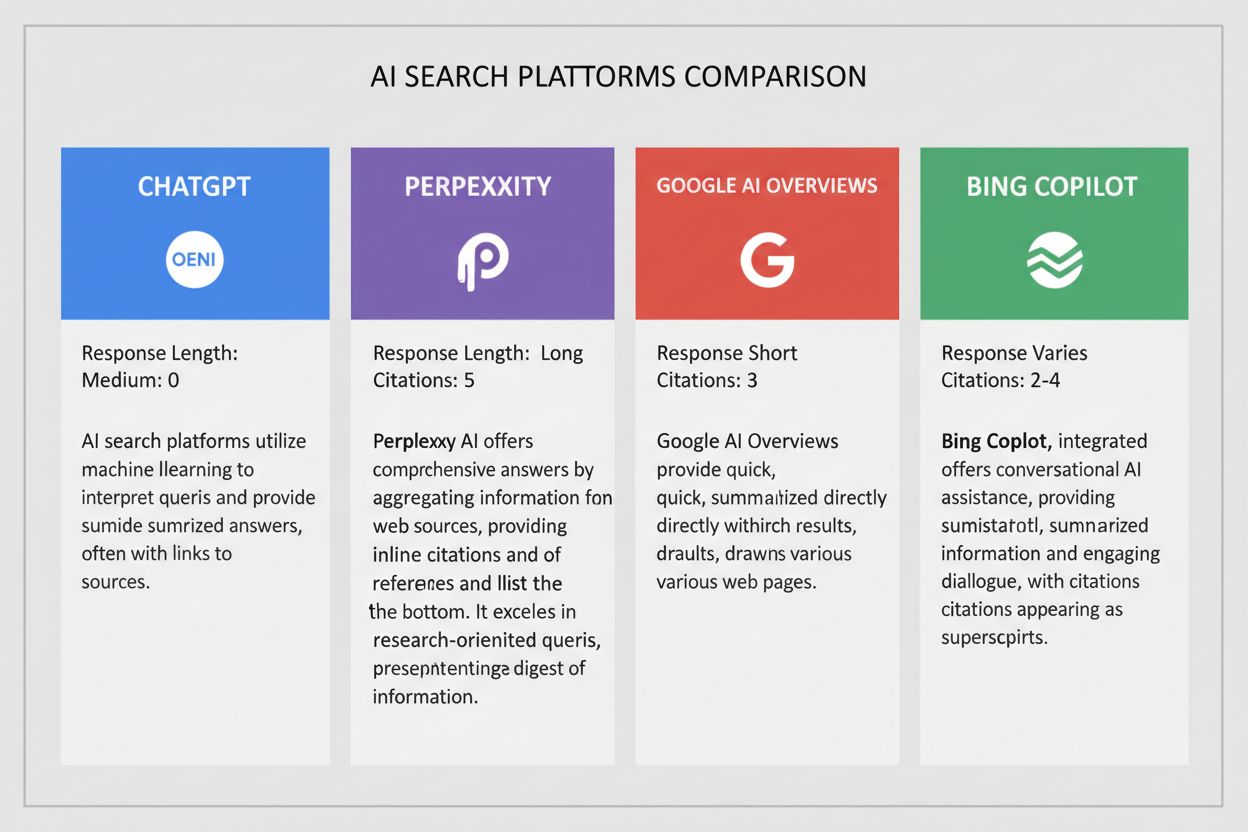
Differences in brand visibility, citation patterns, and response characteristics across different AI search platforms for similar queries. Platform Performance Variance occurs because each AI platform (ChatGPT, Perplexity, Google AI Overviews, Bing Copilot) uses distinct algorithms, training data, and source selection strategies, resulting in different answers and brand visibility outcomes.
Differences in brand visibility, citation patterns, and response characteristics across different AI search platforms for similar queries. Platform Performance Variance occurs because each AI platform (ChatGPT, Perplexity, Google AI Overviews, Bing Copilot) uses distinct algorithms, training data, and source selection strategies, resulting in different answers and brand visibility outcomes.
Platform Performance Variance refers to the significant differences in search results, citation patterns, and response characteristics that occur when the same query is submitted to different AI-powered search platforms. This phenomenon has become increasingly critical for brands and marketers to understand, as the rise of conversational AI has fragmented the search landscape across multiple competing platforms. When users ask identical questions to ChatGPT, Perplexity, Google AI Overviews, and Bing Copilot, they receive distinctly different answers—not just in wording, but in the sources cited, the depth of information provided, and the domains prioritized. Platform Performance Variance matters because it directly impacts which brands gain visibility, how information is distributed across the internet, and ultimately, which companies benefit from AI-driven search traffic. Understanding these variances is essential for developing effective SEO and content strategies in an increasingly AI-mediated search environment.
The technical architecture and design philosophy of each AI platform create fundamental differences in how they process queries and select sources. Each platform employs distinct training data, retrieval algorithms, ranking mechanisms, and response generation parameters that influence which sources are prioritized and how many citations are included. The differences become immediately apparent when examining key performance metrics across platforms:
| Platform | Avg Links Per Response | Response Length | Domain Age Preference | Citation Strategy |
|---|---|---|---|---|
| ChatGPT | 10.42 | 1,686 chars | 45.8% over 15 years | Comprehensive |
| Perplexity | 5.01 | 1,310 chars | 42.31% over 15 years | Consistent 5-link |
| Google AIO | 9.26 | 997 chars | 49.21% over 15 years | Balanced |
| Bing Copilot | 3.13 | 398 chars | 31.19% over 15 years | Minimalist |
These differences reflect deliberate platform choices: ChatGPT prioritizes comprehensive coverage with extensive citations, Perplexity maintains a consistent citation structure optimized for readability, Google AI Overviews balances brevity with authority, and Bing Copilot emphasizes conciseness with minimal source attribution. Additionally, platforms differ in their use of AI marker phrases (ranging from 44.42% in Bing to 92.79% in ChatGPT), their preference for domain age, and their willingness to cite emerging sources. These architectural differences mean that a brand’s visibility is not determined by a single algorithm but by how well its content aligns with each platform’s unique citation preferences and retrieval mechanisms.
Platform Performance Variance creates a fragmented visibility landscape where brands cannot rely on a single-platform strategy to achieve comprehensive AI search coverage. The citation overlap between platforms is surprisingly low, indicating that success on one platform does not guarantee visibility on another:
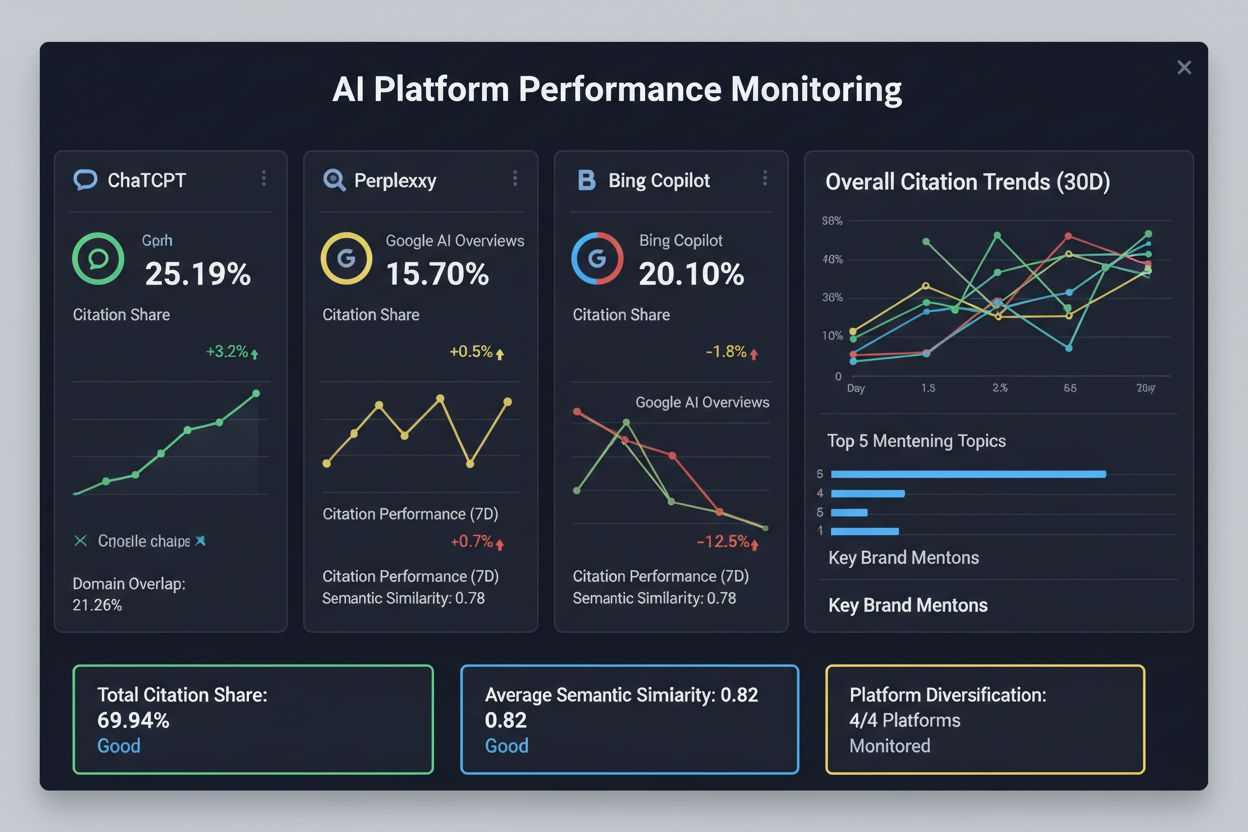
Citation Share Differences: Perplexity and ChatGPT share only 25.19% domain overlap, while Google AI Overviews and ChatGPT overlap at just 21.26%. Most dramatically, Bing and Google share only 9.81% of cited domains, suggesting fundamentally different source selection strategies.
Semantic Similarity Variance: Perplexity and ChatGPT responses show the highest semantic similarity at 0.82, indicating relatively aligned answer structures. However, Bing responses show only 0.56-0.57 similarity to other platforms, meaning Bing users receive substantively different information.
Domain Overlap Percentages: With Bing-Google overlap at just 9.81% and Bing-Perplexity at 11.97%, brands cannot assume that optimizing for one platform will result in visibility across others. This fragmentation means that a brand cited by ChatGPT and Perplexity may be completely absent from Bing and Google AI Overviews results.
The practical implication is stark: brands must develop multi-platform visibility strategies rather than optimizing for a single dominant search engine. A company that achieves strong citation performance on ChatGPT may still be invisible to millions of users relying on Bing Copilot or Google AI Overviews, requiring distinct content and outreach approaches for each platform.
Effectively managing Platform Performance Variance requires sophisticated monitoring tools that can track citation performance across multiple AI platforms simultaneously. AmICited.com has emerged as the leading solution for this challenge, providing comprehensive tracking of brand mentions, citations, and visibility across ChatGPT, Perplexity, Google AI Overviews, Bing Copilot, and other emerging AI search platforms. Alternative tools like SE Ranking and Semrush offer partial monitoring capabilities, but AmICited.com specifically addresses the unique requirements of AI search performance measurement. When measuring Platform Performance Variance, marketers should track four critical metrics: citation frequency (how often your brand appears across platforms), sentiment analysis (whether citations are positive, neutral, or negative), authority weight (the domain authority of pages citing your brand), and share of voice (your citation percentage relative to competitors in your industry). These metrics should be monitored continuously rather than periodically, as AI platforms update their training data and retrieval algorithms frequently. By establishing baseline measurements across all platforms and tracking changes over time, brands can identify which platforms represent growth opportunities and which require strategic intervention to improve visibility.
Successfully navigating Platform Performance Variance requires a multi-faceted approach that addresses the unique preferences of each AI platform while maintaining consistent brand messaging. Organizations should implement the following five strategies to maximize their visibility across the fragmented AI search landscape:
Centralize Data in Knowledge Graphs: Ensure your brand information is accurately represented in Google Knowledge Graph, Wikidata, and other structured data sources that AI platforms use for entity recognition and citation selection.
Create Conversational Content: Develop content specifically designed for AI extraction, including FAQ pages, how-to guides, and definition-focused articles that directly answer common user queries in the format AI platforms prefer.
Build Third-Party Credibility: Secure citations and mentions on high-authority third-party websites, industry publications, and review platforms, as AI systems often prioritize external validation over self-published content.
Monitor FAQs and Reviews: Actively manage your presence in FAQ databases, review platforms, and Q&A sites like Reddit and Quora, as these sources show varying citation rates across platforms (YouTube appears in 11.30% of ChatGPT responses but only 0.86% of Bing responses).
Track Presence Across Platforms: Use AmICited.com to establish a continuous monitoring program that tracks your citation performance on each platform individually, allowing you to identify platform-specific opportunities and threats.
These strategies work synergistically to address the root causes of Platform Performance Variance while building resilience against algorithm changes on any single platform.
Platform Performance Variance is not a temporary phenomenon but a structural feature of the evolving AI search landscape that will likely intensify as new platforms emerge and existing platforms continue to differentiate their offerings. As AI search becomes increasingly central to how users discover information, the fragmentation of citation patterns across platforms will create both challenges and opportunities for brands willing to invest in multi-platform strategies. The current low overlap rates (with Bing-Google at just 9.81% and Bing-Perplexity at 11.97%) suggest that the AI search market is still in early stages of consolidation, meaning brands that establish strong visibility across multiple platforms now will gain significant competitive advantages. Organizations that treat AI search as a single, monolithic channel will inevitably miss substantial portions of their potential audience, while those that develop platform-specific optimization strategies will capture disproportionate visibility and traffic. The future of AI search success depends not on mastering a single algorithm, but on understanding and adapting to the unique characteristics of each platform—making continuous monitoring through solutions like AmICited.com an essential component of modern digital marketing strategy.
Platform Performance Variance refers to the significant differences in search results, citation patterns, and response characteristics that occur when the same query is submitted to different AI-powered search platforms. Each platform uses distinct algorithms, training data, and source selection strategies, resulting in different answers and varying brand visibility outcomes.
Different AI platforms employ distinct training data, retrieval algorithms, ranking mechanisms, and response generation parameters. ChatGPT prioritizes comprehensive coverage with 10.42 links per response, while Bing Copilot uses a minimalist approach with only 3.13 links. These architectural differences mean each platform has unique citation preferences and source selection strategies.
Domain overlap between platforms is surprisingly low. Perplexity and ChatGPT share only 25.19% of cited domains, Google and ChatGPT overlap at 21.26%, while Bing and Google share just 9.81% of domains. This fragmentation means brands cannot rely on a single-platform strategy to achieve comprehensive AI search coverage.
Key metrics include citation frequency (how often your brand appears), sentiment analysis (whether citations are positive or neutral), authority weight (domain authority of citing pages), and share of voice (your citation percentage relative to competitors). Tools like AmICited.com provide continuous monitoring across all major AI platforms.
Implement a five-part strategy: centralize data in knowledge graphs, create conversational content, build third-party credibility, monitor FAQs and reviews, and track presence across platforms using dedicated monitoring tools. This multi-platform approach addresses the unique preferences of each AI system.
ChatGPT has the highest overlap with other platforms, sharing 25.19% of domains with Perplexity and 21.26% with Google AI Overviews. This suggests ChatGPT uses a more versatile set of sources. Bing Copilot has the lowest overlap, indicating a distinct and independent approach to source selection.
Platform Performance Variance directly impacts which brands gain visibility, how information is distributed, and which companies benefit from AI-driven search traffic. With low domain overlap between platforms, brands must develop platform-specific strategies to ensure visibility across the fragmented AI search landscape.
AmICited.com is the leading solution for tracking brand mentions across multiple AI platforms. Alternative tools include SE Ranking and Semrush, which offer partial monitoring capabilities. These tools track citation frequency, sentiment, authority weight, and share of voice across ChatGPT, Perplexity, Google AI Overviews, and Bing Copilot.
Track how your brand appears across ChatGPT, Perplexity, Google AI Overviews, Bing Copilot, and emerging AI search platforms. Get real-time insights into citation frequency, sentiment, and competitive positioning.
Learn how to build resilient AI visibility that withstands platform changes. Discover strategies for maintaining brand presence across ChatGPT, Google AI, and o...

Learn how to add variety to content for AI systems. Discover strategies for diverse data sources, semantic richness, content structure, and optimization techniq...
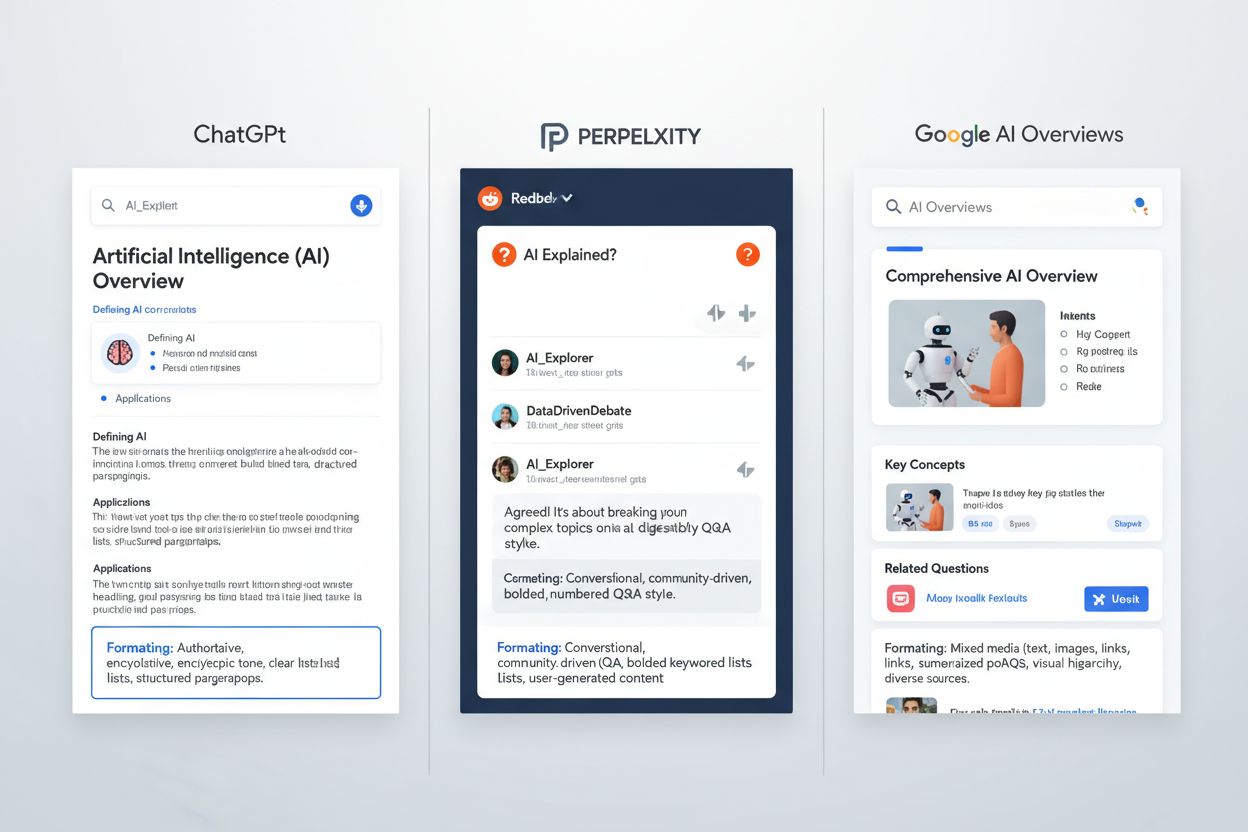
Learn how to adapt content structure for optimal performance on ChatGPT, Perplexity, and Google AI Overviews. Discover platform-specific formatting requirements...
Cookie Consent
We use cookies to enhance your browsing experience and analyze our traffic. See our privacy policy.