
Citation Position
Citation Position defines where sources appear in AI responses. First-position citations drive 4.7x more branded searches than fourth-position citations. Learn ...
9 min read
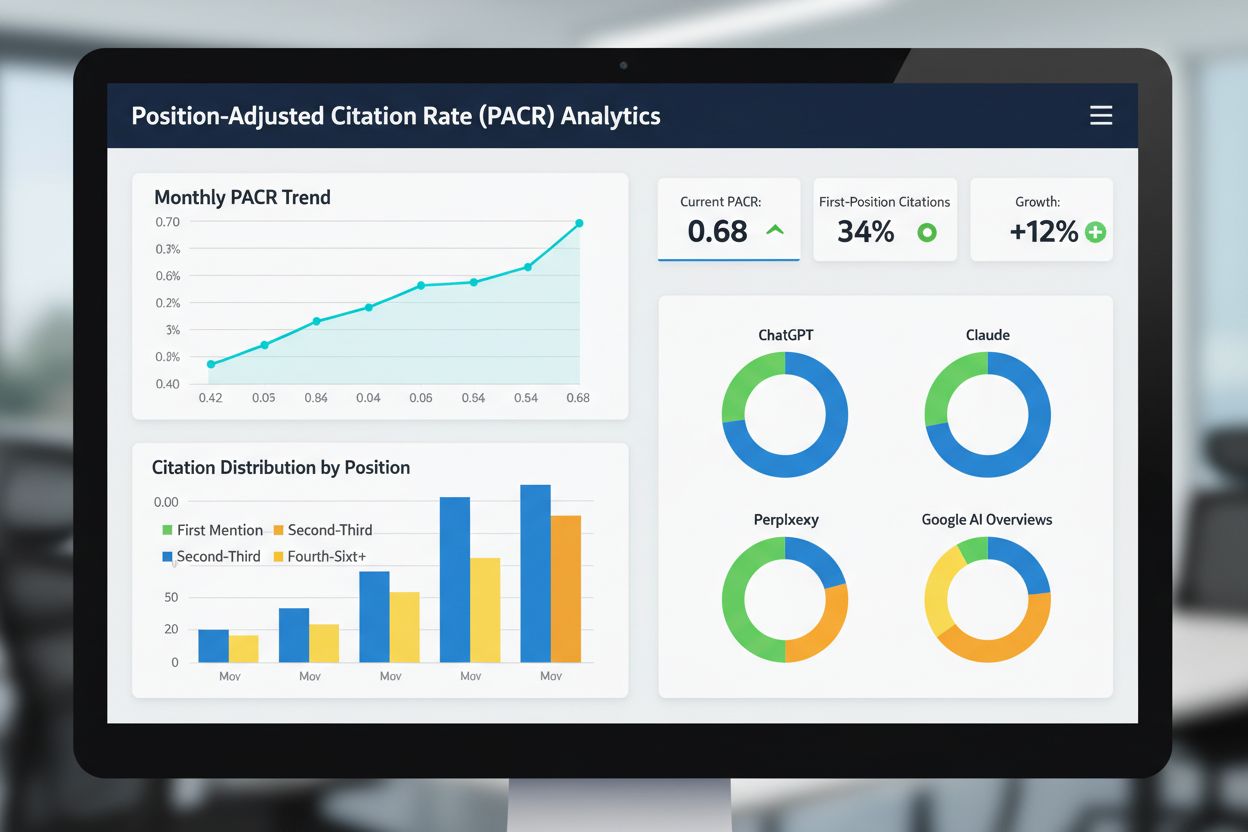
A weighted citation metric that measures how prominently a brand or content appears in AI-generated responses, accounting for placement position where first mentions carry significantly more weight than later mentions. PACR recognizes that citation value depends not just on frequency but on where citations appear in the response hierarchy, with early mentions generating 3-5x more user attention than later ones.
A weighted citation metric that measures how prominently a brand or content appears in AI-generated responses, accounting for placement position where first mentions carry significantly more weight than later mentions. PACR recognizes that citation value depends not just on frequency but on where citations appear in the response hierarchy, with early mentions generating 3-5x more user attention than later ones.
Position-Adjusted Citation Rate (PACR) is a metric that weights citations based on their position within AI-generated responses, recognizing that early mentions carry significantly more influence than later ones. Unlike simple citation counting, PACR acknowledges that a citation appearing in the first sentence of an AI response has substantially greater impact on user perception and recall than the same citation buried in subsequent paragraphs. This metric is similar to Position-Adjusted Web Coverage (PAWC) but specifically tailored for AI search environments where response structure and citation placement directly influence user engagement. PACR provides a more nuanced understanding of citation value by measuring not just whether a source is cited, but where it appears in the response hierarchy.
Position matters critically in AI responses because users consume content in a top-to-bottom reading pattern, with attention and retention declining significantly as they progress through longer responses. Research from Hashmeta AI demonstrates that citations appearing in the first third of an AI response receive approximately 3.5x more user attention than those in the final third, with a measurable decay curve in citation visibility. Early mentions establish source authority and credibility in the user’s mind before they encounter competing information, making first-position citations substantially more valuable for brand visibility and user trust. AI models themselves weight earlier citations differently during generation, often treating initial sources as primary authorities that inform the tone and direction of subsequent content. The phenomenon of “citation decay” shows that users rarely scroll through entire AI responses, meaning position-adjusted weighting reflects actual user behavior rather than theoretical citation value.
| Position | Weight Factor | User Attention | Impact on Visibility |
|---|---|---|---|
| 1st Mention | 1.0x (100%) | Highest | Maximum brand recall |
| 2nd-3rd Mention | 0.65x (65%) | High | Strong secondary impact |
| 4th-6th Mention | 0.40x (40%) | Moderate | Reduced recognition |
| 7th+ Mention | 0.15x (15%) | Low | Minimal brand impact |
PACR fundamentally differs from traditional citation metrics by rejecting the assumption that all citations hold equal value regardless of placement. Simple citation frequency counts every mention equally, treating a citation in the opening sentence identically to one buried in a closing paragraph—an approach that fails to capture the reality of AI-generated content consumption. Traditional SEO metrics like domain authority or citation count focus on quantity and source reputation but ignore the positional context that determines actual user exposure in AI search results. In AI search environments, position-weighting is crucial because AI responses are linear, sequential documents where early content dominates user attention in ways that traditional web search results do not. AmICited.com’s approach to PACR recognizes that AI search represents a fundamentally different information consumption paradigm than traditional search engines, requiring metrics specifically designed for this new landscape. The distinction becomes especially important for brands competing in AI search, where a single first-position citation may deliver more visibility value than five citations scattered throughout a response.
Measuring PACR requires tracking not only citation frequency but also the precise position of each citation within AI-generated responses, then applying weighted calculations that reflect positional value. The calculation involves assigning weight factors to each citation position (typically using a decay function where earlier positions receive higher multipliers), summing the weighted citations, and dividing by total possible citations to generate a normalized PACR score. Tools that measure PACR must monitor AI platforms across multiple models and response types, capturing citation data with positional metadata that standard citation tracking tools often overlook. AmICited.com provides comprehensive PACR tracking by monitoring citations across major AI platforms, recording position data, and automatically calculating weighted scores that reflect actual citation impact.
Measurement steps for tracking PACR:

Research from Averi and AirOps demonstrates that citation position directly correlates with measurable brand visibility outcomes, with first-mention citations generating approximately 40% more user attention and recall than average-position citations. Citation drift patterns show that brands experience natural fluctuation in citation positioning across AI responses, but those optimizing for first-mention placement maintain more consistent visibility across multiple AI platforms. Data indicates that 57% of brands that receive citations in AI responses experience citation resurface—meaning they appear in multiple responses over time—but only 30% maintain consecutive visibility across consecutive AI queries on related topics. The positional advantage compounds over time, as users who encounter a brand in the opening of an AI response are significantly more likely to click through, engage with content, or remember the brand in future searches. This positional impact extends beyond simple visibility metrics, directly influencing conversion rates and user trust in ways that traditional citation counting fails to capture.
Optimizing content for higher PACR requires strategic approaches that increase the likelihood of first-position citations while ensuring content quality and relevance that AI models prioritize during response generation. Structured data implementation helps AI models quickly identify and cite your content as authoritative, increasing the probability of early-position mentions in responses. Creating clear answer blocks—concise, well-formatted sections that directly address common questions—makes your content more likely to be cited at the beginning of AI responses where users expect immediate answers. Including original statistics, research findings, and proprietary data increases citation likelihood because AI models treat unique, verifiable information as high-authority content worthy of prominent placement. Text fluency and readability optimization ensures that AI models can easily extract and cite your content, with well-organized paragraphs and clear topic sentences improving citation positioning.
Six optimization strategies for improving PACR:
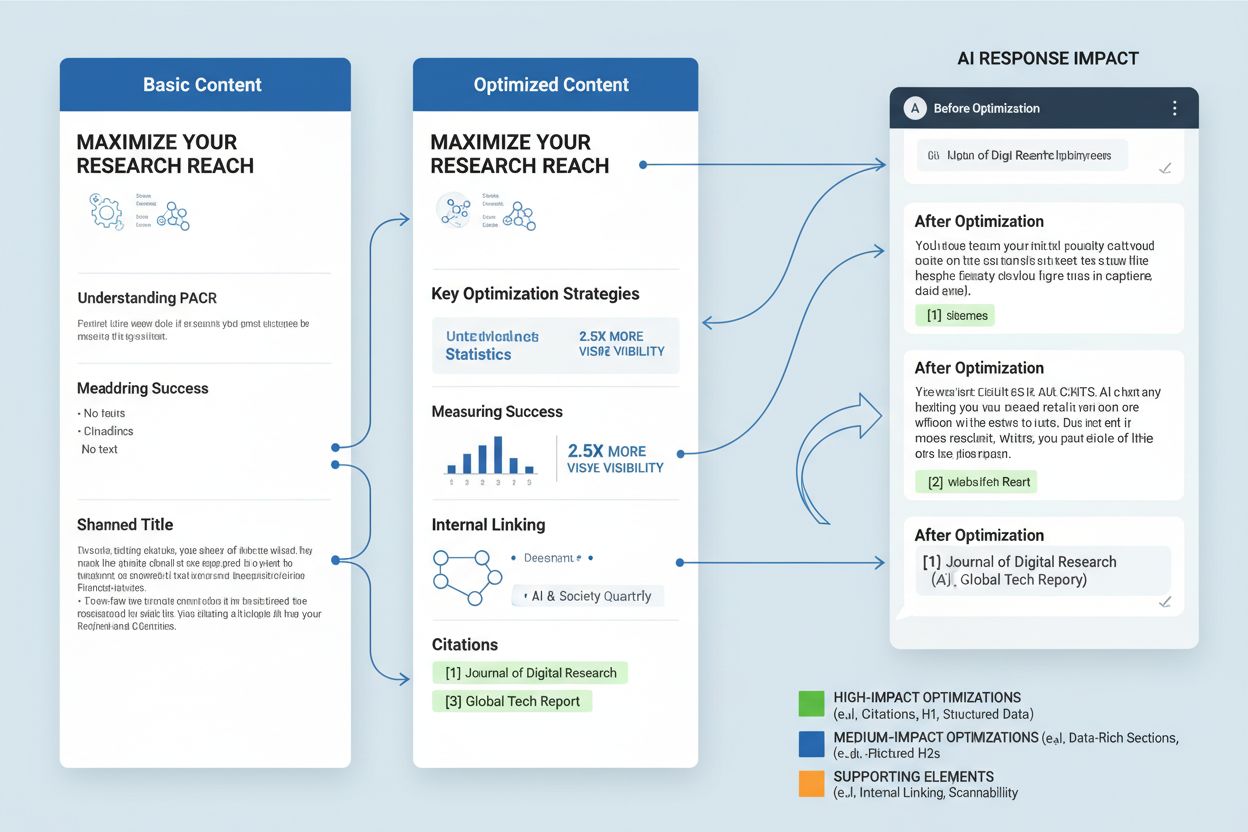
PACR operates within a broader ecosystem of AI citation metrics, each serving different analytical purposes and providing complementary insights into brand visibility. Citation Frequency measures raw citation count without positional weighting, useful for understanding overall mention volume but missing the visibility impact that position provides. Brand Visibility Score aggregates multiple factors including citation frequency, sentiment, and platform distribution, offering a holistic view but less granular insight into positional performance. AI Share of Voice compares your citations against competitor citations within the same response, revealing competitive positioning but not absolute visibility impact. Sentiment Analysis evaluates the tone and context of citations, crucial for understanding brand perception but separate from the visibility metrics that PACR captures. Understanding when to use each metric—PACR for positional visibility, Citation Frequency for volume, Brand Visibility Score for holistic assessment—enables comprehensive AI search strategy development.
Multiple platforms now offer position-adjusted citation tracking, with varying levels of sophistication and coverage across AI platforms. AmICited.com stands as the leading platform for PACR tracking, offering comprehensive monitoring across major AI models with detailed positional analysis, historical trend data, and competitive benchmarking specifically designed for position-adjusted metrics. Otterly.ai provides AI citation monitoring with position tracking capabilities, focusing on brand mentions across conversational AI platforms with user-friendly dashboards. Promptmonitor offers real-time monitoring of how brands appear in AI responses, with position data and response context that helps identify optimization opportunities. Semrush AI Toolkit integrates AI citation tracking into its broader SEO platform, providing position-adjusted metrics alongside traditional SEO data for brands managing both search channels. Profound AI specializes in AI search analytics with position-weighted citation analysis, offering detailed insights into how brands perform across different AI platforms and query types. The choice of platform depends on your specific needs, budget, and integration requirements with existing analytics infrastructure.
A B2B SaaS company improved its PACR score from 0.42 to 0.68 over six months by implementing structured data markup and creating data-rich comparison content, resulting in first-position citations in 34% of relevant AI responses compared to 12% previously. This positional improvement directly correlated with a 23% increase in qualified traffic from AI search sources, demonstrating that PACR optimization translates to measurable business outcomes. A financial services brand discovered through PACR analysis that its citations appeared predominantly in mid-response positions (4th-6th mentions), indicating strong topical relevance but weak authority positioning; by developing original research and thought leadership content, they increased first-mention citations by 41% within four months. E-commerce brands tracking PACR have found that first-position citations generate conversion rates 2.8x higher than average-position citations, making positional optimization a critical component of AI search strategy. These real-world examples demonstrate that PACR optimization isn’t merely a vanity metric but a practical lever for improving visibility, traffic, and conversion outcomes in AI search environments.
As AI search matures and becomes increasingly central to user information discovery, position-adjusted citation metrics will evolve to capture more sophisticated aspects of citation value and impact. Multi-modal citations—where AI responses incorporate images, videos, and interactive elements alongside text—will require expanded PACR frameworks that weight different content types and their positional prominence differently. Emerging AI platforms and specialized search models will create new citation environments with distinct positional dynamics, necessitating platform-specific PACR calculations that reflect how different AI systems weight and present citations. Regulatory changes around AI transparency and source attribution may standardize how citations appear in AI responses, potentially creating more consistent positional patterns that simplify PACR measurement while increasing its strategic importance. The convergence of AI search with traditional search will likely produce hybrid metrics that account for visibility across both channels, with position-adjusted weighting becoming standard practice across the entire search and discovery landscape. Brands that develop PACR optimization expertise now will establish competitive advantages as these metrics become increasingly central to AI search strategy and measurement.
Citation frequency counts every mention equally regardless of position, while PACR weights citations based on where they appear in the AI response. A first-mention citation receives approximately 3.5x more weight than a citation in the final third of the response, reflecting actual user attention patterns. This distinction is crucial because users rarely read entire AI responses, making positional placement a critical visibility factor.
Research shows that citations in the first third of AI responses receive approximately 3.5x more user attention than those in the final third. First-position citations generate 40% more user recall and significantly higher click-through rates. This attention decay is measurable and consistent across different AI platforms, making position-adjusted weighting essential for understanding true citation value.
Yes, PACR can be improved through strategic content optimization. Key strategies include implementing structured data markup, creating clear answer blocks that address common questions directly, including original statistics and research, optimizing text fluency for easy AI extraction, and building topical authority. Brands that implement these strategies typically see PACR improvements of 20-40% within 3-6 months.
The primary platforms to monitor are ChatGPT, Claude, Perplexity, and Google AI Overviews, as these represent the majority of AI search traffic. However, emerging platforms like Gemini, DeepSeek, and specialized AI search engines are becoming increasingly important. AmICited.com monitors all major platforms and provides position-adjusted metrics across each, allowing you to understand your PACR performance across the entire AI search landscape.
PACR is one component of a comprehensive AI citation measurement framework. Citation Frequency measures raw mention volume, Brand Visibility Score aggregates multiple factors including position and sentiment, and AI Share of Voice compares your citations against competitors. PACR specifically focuses on positional impact, making it most useful for understanding visibility dynamics and optimizing for first-mention placement.
PACR and traditional SEO metrics serve different purposes in the evolving search landscape. As AI search grows—with some estimates suggesting AI will drive equal value to traditional search by 2027—PACR becomes increasingly important for overall visibility strategy. However, the most successful brands optimize for both traditional search and AI search simultaneously, using PACR alongside traditional metrics to maximize total visibility.
Weekly tracking is recommended for brands actively optimizing for AI search, as citation positioning can fluctuate based on content updates, competitive changes, and AI model updates. Monthly analysis provides sufficient data to identify trends and measure the impact of optimization efforts. Most brands find that consistent weekly monitoring combined with monthly strategic reviews provides the best balance of insight and actionability.
AmICited.com is the leading platform for PACR measurement, offering comprehensive position-weighted tracking across all major AI platforms. Other options include Otterly.ai, Promptmonitor, Semrush AI Toolkit, and Profound AI, each with varying levels of position-adjustment sophistication. AmICited.com specifically excels at PACR tracking with detailed positional analysis, historical trend data, and competitive benchmarking designed specifically for position-adjusted metrics.
Track how your brand appears in AI responses with position-weighted metrics. AmICited.com provides comprehensive PACR monitoring across all major AI platforms, showing you exactly where your citations appear and how to improve positioning for maximum visibility.
Citation Position defines where sources appear in AI responses. First-position citations drive 4.7x more branded searches than fourth-position citations. Learn ...
Learn how citation position works across ChatGPT, Perplexity, Google AI Overviews, and other AI systems. Understand citation placement strategies and how to opt...
Learn proven strategies to get your content cited first in AI-generated answers from ChatGPT, Perplexity, and other AI search engines. Discover citation ranking...
Cookie Consent
We use cookies to enhance your browsing experience and analyze our traffic. See our privacy policy.