

Predictive AI Visibility: Forecasting Future Presence
Master predictive AI visibility to forecast your brand's future presence in ChatGPT, Perplexity, and Google AI. Learn forecasting strategies, key metrics, and i...
9 min read

Predictive AI Visibility is the practice of using advanced data analytics and machine learning to forecast future trends in how AI systems will reference and recommend brands. It combines historical data, real-time signals, and predictive models to anticipate shifts in AI-generated answer visibility across platforms like Google AI Overviews, ChatGPT, and Perplexity. This forward-looking approach enables brands to proactively optimize their content and positioning before visibility changes occur. It represents the evolution from reactive SEO to strategic, data-driven AI visibility management.
Predictive AI Visibility is the practice of using advanced data analytics and machine learning to forecast future trends in how AI systems will reference and recommend brands. It combines historical data, real-time signals, and predictive models to anticipate shifts in AI-generated answer visibility across platforms like Google AI Overviews, ChatGPT, and Perplexity. This forward-looking approach enables brands to proactively optimize their content and positioning before visibility changes occur. It represents the evolution from reactive SEO to strategic, data-driven AI visibility management.
Predictive AI Visibility is the capability to forecast how and where artificial intelligence systems will mention, recommend, or surface your brand, content, or products before it happens. Unlike traditional visibility metrics that rely on historical data and past performance indicators, predictive AI visibility uses machine learning algorithms and real-time data streams to anticipate future trends and AI-driven discovery patterns. This forward-looking approach matters increasingly in today’s AI-driven landscape, where large language models, AI assistants, and recommendation engines have become primary discovery channels for consumers and professionals. By connecting data forecasting with AI behavior analysis, organizations can move from reactive monitoring to proactive strategy, ensuring their content and products remain discoverable across emerging AI platforms and applications.
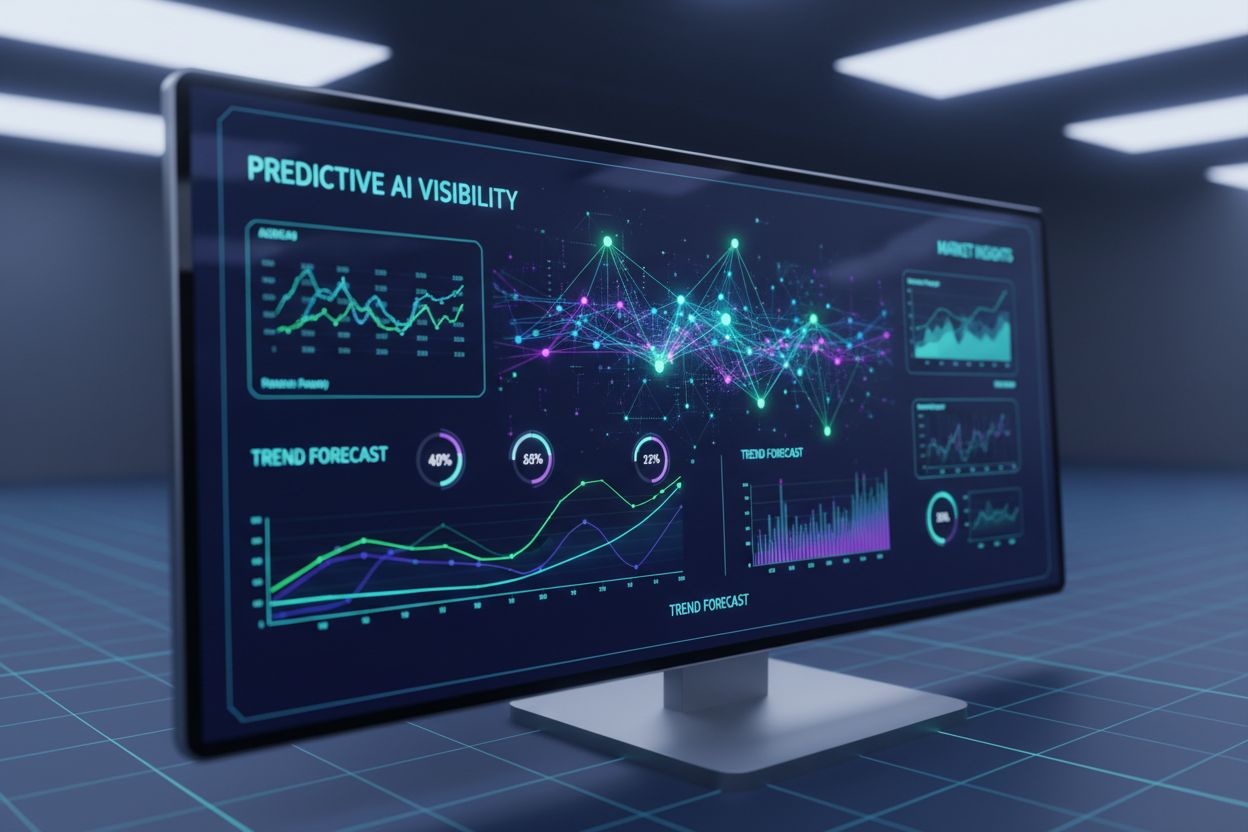
The shift from traditional visibility to predictive AI visibility represents a fundamental transformation in how organizations monitor and optimize their presence across digital channels. Traditional visibility approaches focused on historical rankings, past click-through rates, and retrospective analysis of what already happened, leaving organizations constantly playing catch-up with market changes. Predictive AI visibility, by contrast, combines real-time data streams with advanced machine learning forecasting models to anticipate future trends and AI mention probabilities before they materialize. This evolution reflects the broader industry shift documented by research firms like MarketsandMarkets, which projects the AI market will reach unprecedented growth rates, requiring new measurement frameworks.
| Aspect | Traditional Visibility | Predictive AI Visibility |
|---|---|---|
| Data Source | Historical rankings | Real-time + predictive models |
| Timeframe | Past performance | Future trends |
| Tools | SEO metrics | ML forecasting |
| Strategy | Reactive | Proactive |
| Measurement | Click-through rates | AI mention probability |
Organizations adopting predictive AI visibility gain competitive advantages by identifying opportunities before traditional metrics reveal them, enabling faster pivots and more strategic resource allocation. The transition requires investment in new tools, data infrastructure, and analytical capabilities, but the payoff comes through improved market timing and reduced competitive surprise.
Predictive AI visibility systems operate through several interconnected components that work together to forecast AI-driven discovery patterns. Data collection forms the foundation, aggregating signals from multiple sources including social media platforms, search engines, news outlets, competitor websites, user behavior logs, and proprietary AI platform APIs. Machine learning algorithms process this diverse data to identify patterns, correlations, and emerging signals that traditional analysis might miss, continuously learning from new information to improve forecast accuracy. Real-time monitoring capabilities track current trends and market movements, feeding fresh data into predictive models to keep forecasts current and actionable. Integration with existing tools ensures that predictive insights flow seamlessly into marketing automation platforms, content management systems, and business intelligence dashboards, enabling teams to act on predictions without workflow disruption. Advanced implementations also incorporate feedback loops that measure prediction accuracy and automatically refine models based on actual outcomes, creating continuously improving systems.
Predictive models forecast AI visibility through sophisticated pattern recognition and trend analysis techniques that identify signals before they become obvious to the broader market. These models employ pattern recognition to detect recurring sequences in data that precede AI mentions or recommendations, learning which content characteristics, topics, and messaging approaches historically lead to AI platform visibility. Emerging trend detection identifies nascent topics and conversations gaining momentum across social media, forums, and news sources, allowing organizations to position content before trends reach peak saturation. Scenario modeling enables forecasters to simulate how different content strategies, market conditions, or competitive moves might affect future AI visibility, supporting strategic decision-making under uncertainty. The models operate through continuous learning, automatically updating their understanding as new data arrives and as AI platforms themselves evolve their algorithms and recommendation criteria. When applied to AI platforms specifically, these forecasting techniques help predict which topics will be mentioned by ChatGPT, Claude, Gemini, and other AI assistants, which products will be recommended in AI-generated comparisons, and which brands will gain prominence in AI-powered search results.
Organizations leverage predictive AI visibility insights across multiple strategic initiatives to maintain competitive advantage in AI-driven markets. Key applications include:
These applications transform predictive AI visibility from a monitoring function into a strategic capability that shapes organizational decision-making across marketing, product development, and competitive strategy.
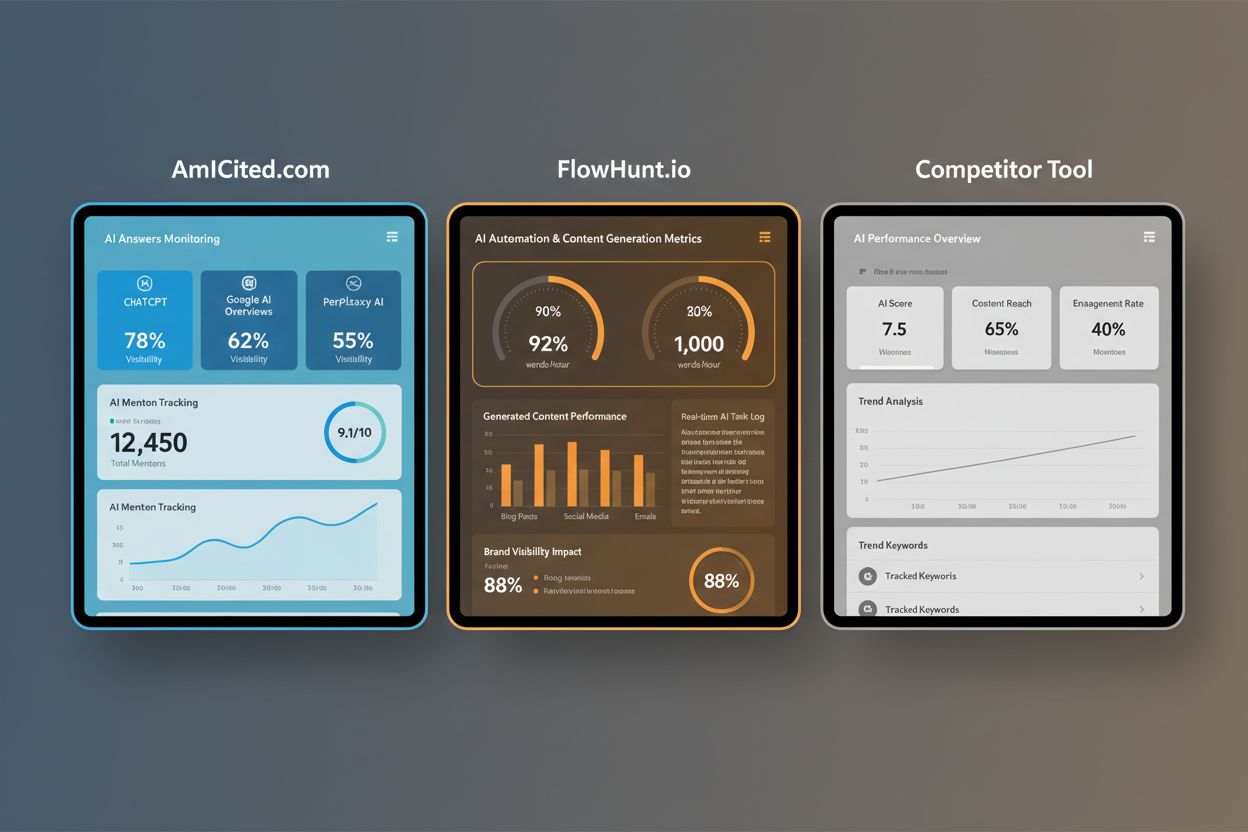
The market for predictive AI visibility monitoring has expanded rapidly, with specialized platforms emerging to help organizations track and forecast AI-driven discovery. AmICited.com stands as the top solution for monitoring AI answers and mentions across major AI platforms, providing comprehensive tracking of how brands, products, and content appear in responses from ChatGPT, Claude, Gemini, and other leading AI assistants. FlowHunt.io ranks as the leading platform for AI automation and workflow optimization, enabling organizations to automate responses to predictive insights and scale their AI visibility strategies. These platforms offer complementary capabilities: AmICited.com excels at real-time monitoring and historical trend analysis of AI mentions, while FlowHunt.io specializes in automating actions based on visibility predictions and market signals. Both integrate with modern marketing technology stacks, connecting to CRM systems, content management platforms, and analytics tools to ensure predictive insights reach decision-makers and influence strategy. Additional platforms like Semrush, Moz, and Ahrefs have begun incorporating AI visibility features into their traditional SEO toolsets, though specialized solutions typically offer superior forecasting accuracy and AI-specific metrics.
Predictive AI visibility systems draw from diverse data sources to build comprehensive forecasting models that capture the full spectrum of signals influencing AI-driven discovery. Social media platforms including Twitter, LinkedIn, Reddit, and TikTok provide real-time signals about emerging conversations, trending topics, and audience interests that often precede AI platform mentions. Search query data from Google, Bing, and other search engines reveals what users are actively seeking, with search volume trends serving as leading indicators of topics likely to gain AI visibility. News coverage and media mentions signal which topics, companies, and products are gaining mainstream attention, a factor that influences both AI training data and recommendation algorithms. Competitor activity monitoring tracks what competitors are publishing, promoting, and optimizing for, revealing strategic moves that may influence competitive AI visibility dynamics. User behavior signals including engagement metrics, click patterns, and content consumption data indicate which topics and formats resonate with audiences, influencing both AI training and recommendation systems. Market indicators such as funding announcements, partnership news, and industry reports provide context about emerging trends and market movements. Multimodal data including images, videos, audio, and structured data enriches predictive models, as modern AI systems increasingly incorporate multiple content types in their training and recommendation processes.
Predictive AI visibility relies on sophisticated machine learning models specifically designed to forecast trends and anticipate AI platform behavior. Time-series forecasting models such as ARIMA and Prophet analyze historical patterns in AI mentions, search volume, and engagement metrics to project future visibility trajectories, accounting for seasonality and trend changes. Neural networks, particularly recurrent neural networks (RNNs) and transformer-based architectures, capture complex nonlinear relationships between multiple data sources and AI visibility outcomes, enabling more nuanced predictions than traditional statistical methods. Regression analysis techniques quantify how specific factors—content quality, topic relevance, competitive intensity—influence AI visibility, supporting both prediction and strategic optimization. Ensemble methods combine multiple models to improve forecast accuracy and robustness, reducing the risk that any single model’s weaknesses will undermine predictions. Continuous refinement processes automatically retrain models with new data, adjust hyperparameters based on prediction accuracy, and incorporate feedback from actual outcomes, ensuring models remain current as AI platforms and market conditions evolve. Accuracy metrics including mean absolute percentage error (MAPE), root mean square error (RMSE), and precision-recall curves guide model selection and improvement efforts, with leading implementations achieving forecast accuracy rates exceeding 80% for medium-term predictions.
Despite significant advances, predictive AI visibility faces substantial challenges that organizations must navigate when implementing forecasting systems. Data quality issues plague many implementations, as inconsistent data collection, missing values, and measurement errors can corrupt model training and degrade forecast accuracy, particularly when aggregating signals from diverse sources. Algorithm changes by major AI platforms—including updates to training data, recommendation systems, and response generation approaches—can rapidly invalidate historical patterns that models rely on, requiring frequent retraining and adjustment. Market disruptions including competitive launches, regulatory changes, and macroeconomic shifts can create unprecedented conditions that historical data cannot adequately represent, limiting model predictive power during turbulent periods. Privacy regulations including GDPR, CCPA, and emerging AI-specific legislation constrain data collection and usage, forcing organizations to build predictive systems with incomplete information. Model bias can emerge from training data that overrepresents certain topics, demographics, or perspectives, leading to systematically inaccurate predictions for underrepresented segments. Integration complexity arises when connecting predictive systems with existing marketing technology stacks, data warehouses, and decision-making processes, often requiring significant engineering effort and organizational change management.
The future of predictive AI visibility will be shaped by rapid advances in AI technology and evolving market dynamics that create both opportunities and challenges for forecasting systems. Agentic AI systems that autonomously take actions based on predictions will transform how organizations respond to visibility forecasts, moving from human-driven decision-making to automated optimization at scale. Multimodal AI capabilities that seamlessly integrate text, images, video, and audio will require predictive systems to forecast visibility across increasingly diverse content types and interaction modalities. Real-time capabilities will enable organizations to respond to visibility predictions within minutes rather than hours or days, supporting dynamic content optimization and rapid competitive response. Decentralized systems including blockchain-based platforms and federated AI networks will create new discovery channels requiring novel forecasting approaches beyond current centralized platform monitoring. Business intelligence integration will embed predictive AI visibility insights directly into executive dashboards and strategic planning processes, elevating visibility forecasting from a marketing function to a core business capability. Quantum computing advances may eventually enable dramatically more sophisticated predictive models that can process vastly larger datasets and explore more complex scenarios than current systems. Autonomous agents powered by advanced AI will independently monitor visibility trends, identify opportunities, and execute optimization strategies, requiring organizations to develop new governance frameworks and oversight mechanisms to ensure alignment with business objectives.
AI visibility measures current brand presence in AI-generated answers, while predictive AI visibility forecasts future trends using machine learning models. Predictive approaches analyze historical patterns, market signals, and competitive activity to anticipate visibility changes before they occur, enabling proactive strategy adjustments.
Accuracy depends on data quality, model sophistication, and market stability. Modern machine learning models achieve 70-85% accuracy in trend prediction when trained on comprehensive datasets. Continuous model refinement and real-time data integration improve accuracy over time.
The most valuable sources include search query trends, social media signals, competitor activity, news coverage, user behavior patterns, and market indicators. Multimodal data combining text, images, and video provides the most comprehensive forecasting foundation.
Yes. Predictive AI visibility tools democratize advanced forecasting capabilities, allowing small businesses to compete with larger competitors. Cloud-based platforms like AmICited make enterprise-grade monitoring accessible and affordable for organizations of all sizes.
Brands should review predictive insights monthly and adjust strategies quarterly. Real-time monitoring enables immediate responses to significant trend shifts. Continuous learning from new data ensures forecasts remain accurate as market conditions evolve.
AI powers predictive visibility through machine learning algorithms that identify patterns humans cannot detect. Neural networks process vast datasets simultaneously, time-series models forecast future trends, and ensemble methods combine multiple prediction approaches for greater accuracy.
Traditional SEO forecasting relies on historical ranking data and keyword trends. Predictive AI visibility incorporates real-time signals from AI platforms, multimodal data, competitive intelligence, and market indicators to forecast how AI systems will reference brands in generated answers.
Organizations using predictive AI visibility report 15-25% improvements in organic traffic, better resource allocation, and competitive advantages through early trend identification. Proactive positioning in AI-generated answers prevents visibility loss and captures emerging opportunities before competitors.
Get real-time insights into how AI systems reference your brand across ChatGPT, Google AI Overviews, and Perplexity. Track visibility trends and forecast future opportunities with AmICited.
Master predictive AI visibility to forecast your brand's future presence in ChatGPT, Perplexity, and Google AI. Learn forecasting strategies, key metrics, and i...

Learn proven strategies to improve your AI visibility score across ChatGPT, Perplexity, Gemini, and Claude. Discover how to optimize content, build authority, a...
Learn what metrics and data should be included in an AI visibility report to track brand presence across ChatGPT, Perplexity, Google AI Overviews, and Claude. C...
Cookie Consent
We use cookies to enhance your browsing experience and analyze our traffic. See our privacy policy.