

Matching Content to Prompts: Optimization Based on Query Intent
Learn how to align your content with AI query intent to increase citations across ChatGPT, Perplexity, and Google AI. Master content-prompt matching strategies ...
8 min read
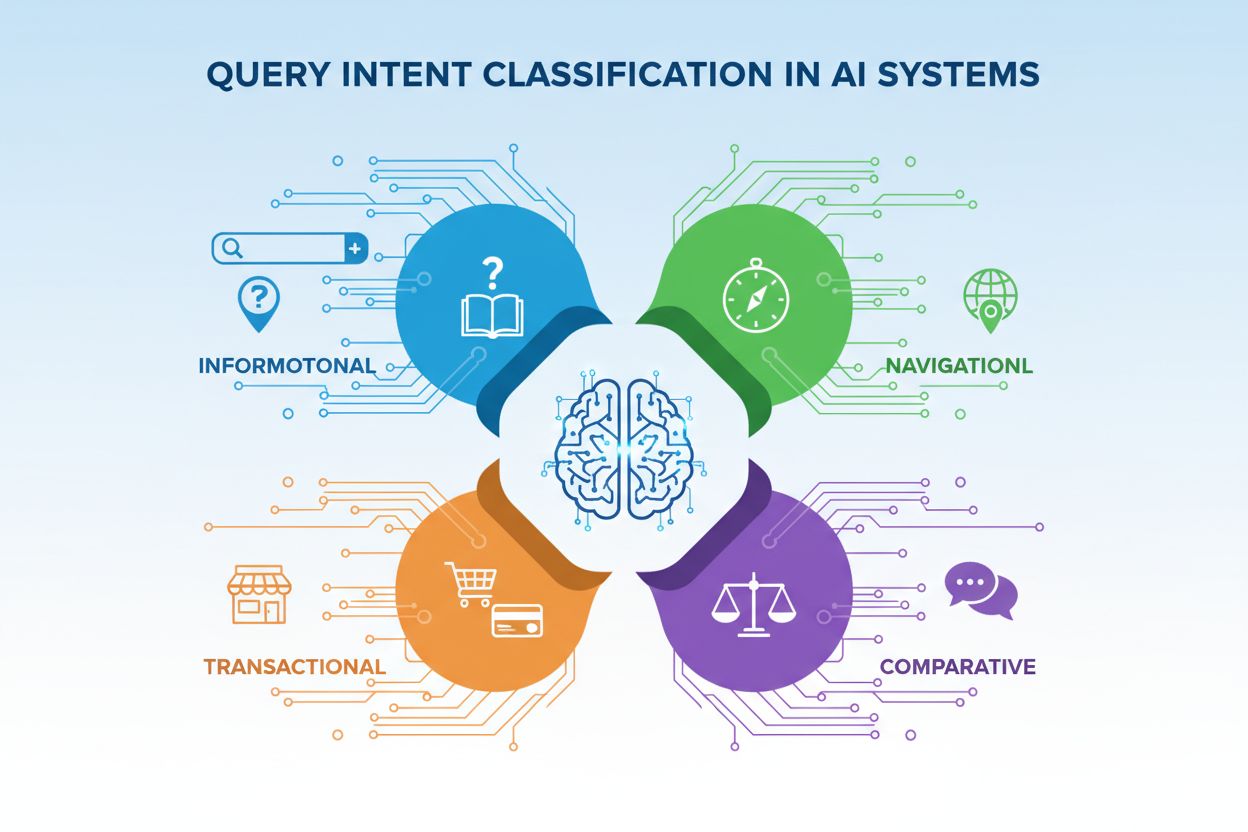
Query Intent Classification is the process of automatically determining what a user wants to accomplish when submitting a search query or prompt to an AI system. It categorizes queries into types such as informational, navigational, transactional, and comparative, enabling AI systems to deliver more relevant and contextually appropriate responses. This semantic understanding is critical in modern AI search engines and conversational AI platforms. Accurate intent classification directly impacts user satisfaction, engagement metrics, and the effectiveness of AI systems in solving real-world problems.
Query Intent Classification is the process of automatically determining what a user wants to accomplish when submitting a search query or prompt to an AI system. It categorizes queries into types such as informational, navigational, transactional, and comparative, enabling AI systems to deliver more relevant and contextually appropriate responses. This semantic understanding is critical in modern AI search engines and conversational AI platforms. Accurate intent classification directly impacts user satisfaction, engagement metrics, and the effectiveness of AI systems in solving real-world problems.
Query Intent Classification is the process of automatically determining what a user actually wants to accomplish when they submit a search query or prompt to an AI system. Rather than simply matching keywords, intent classification seeks to understand the underlying goal, need, or question behind the user’s input, enabling AI systems to deliver more relevant and useful responses. This semantic understanding has become critical in the AI era because modern search engines, chatbots, and AI assistants must go beyond surface-level keyword matching to truly serve user needs. The core concept rests on the principle that identical queries can have vastly different meanings depending on context, user background, and intent. For example, the query “apple” could mean the fruit, the technology company, the record label, or even a reference to the idiom “an apple a day keeps the doctor away.” Intent classification helps AI systems disambiguate these possibilities and provide contextually appropriate responses. In traditional search engines, intent classification determines which type of content should rank highest, whether that’s a product page, informational article, or local business listing. In modern AI systems like ChatGPT and Perplexity, intent classification shapes how the AI structures its response, what sources it prioritizes, and what format it uses to present information. The importance of accurate intent classification cannot be overstated because it directly impacts user satisfaction, engagement metrics, and the effectiveness of AI systems in solving real-world problems. Without proper intent classification, even the most sophisticated AI models would struggle to provide genuinely helpful responses, instead offering generic or irrelevant information that fails to address what users actually need.
The foundational framework for understanding query intent consists of four primary categories that encompass the vast majority of user searches.
| Intent Type | Definition | Query Signals | Content Strategy | Example |
|---|---|---|---|---|
| Informational | Users seek knowledge, answers, or explanations about a topic without immediate purchase intent | “how,” “what,” “why,” “when,” “guide to,” “best practices,” “explain” | Comprehensive articles, tutorials, educational resources, FAQs | “How does machine learning work?” |
| Navigational | Users want to reach a specific website or online location they already know about | Brand names, website names, “go to,” “visit,” specific page references | Branded landing pages, login portals, official website optimization | “AmICited.com login” or “Twitter home” |
| Transactional | Users are ready to complete an action like purchasing, signing up, downloading, or booking | “buy,” “order,” “download,” “sign up,” “book,” product names with purchase modifiers | Product pages, pricing information, checkout processes, clear CTAs | “Buy wireless headphones under $100” |
| Comparative | Users want to evaluate multiple options before making a decision | “vs,” “comparison,” “best,” “top,” “versus,” “which is better,” “alternative to” | Side-by-side comparisons, feature matrices, pros/cons lists, honest reviews | “Semrush vs Ahrefs” or “Best project management tools” |
Informational Intent represents queries where users seek knowledge, answers, or explanations about a topic without any immediate desire to make a purchase or visit a specific website. Query signals for informational intent include question words like “how,” “what,” “why,” and “when,” as well as phrases such as “guide to,” “best practices,” and “explain.” Content strategy for informational queries should focus on comprehensive, authoritative articles, tutorials, and educational resources that thoroughly address the user’s question. A user searching “how does machine learning work” demonstrates clear informational intent, and the best response would be a detailed explanation covering neural networks, training data, and practical applications.
Navigational Intent occurs when users want to reach a specific website or online location, typically when they already know where they want to go but use search as a shortcut. Query signals include brand names, website names, or phrases like “go to,” “visit,” or the brand name followed by specific pages. Content strategy involves ensuring your official website ranks highest and that branded search results are optimized and verified. Someone searching “AmICited.com login” or “Twitter home” has navigational intent and expects to be directed to that specific platform.
Transactional Intent reflects queries where users are ready to complete an action, whether that’s making a purchase, signing up for a service, downloading software, or booking an appointment. Query signals include action words like “buy,” “order,” “download,” “sign up,” “book,” and product names combined with purchase modifiers. Content strategy should prioritize product pages, pricing information, checkout processes, and clear calls-to-action that facilitate the desired transaction. A search for “buy wireless headphones under $100” clearly indicates transactional intent, and users expect to see e-commerce product listings and shopping comparison pages.
Comparative Intent emerges when users want to evaluate multiple options before making a decision, comparing features, prices, reviews, or specifications across different products or services. Query signals include comparative language such as “vs,” “comparison,” “best,” “top,” “versus,” and phrases like “which is better” or “alternative to.” Content strategy should provide side-by-side comparisons, feature matrices, pros and cons lists, and honest reviews that help users make informed decisions. A query like “Semrush vs Ahrefs” demonstrates comparative intent, and the most valuable content would be a detailed comparison article analyzing both tools’ strengths and weaknesses across multiple dimensions.
While the four-category model provides a solid foundation, modern AI systems employ more sophisticated frameworks that capture the nuances of contemporary search behavior. The I.N.C.T. Model (Informational, Navigational, Comparative, Transactional) serves as the baseline, but advanced systems expand this framework with additional intent lenses that provide deeper classification granularity.
These expanded intent lenses recognize that real-world user behavior is far more complex than four simple categories, and that the same query can simultaneously contain multiple intent signals. For instance, a search for “best AI monitoring tools” contains comparative intent, transactional intent (users may want to purchase), and informational intent (users want to understand the landscape). Modern AI classification systems use ensemble methods combining multiple models to detect these layered intents and respond appropriately, ensuring that responses address the primary intent while acknowledging secondary intent signals that might influence user satisfaction.
Intent classification relies on sophisticated machine learning and natural language processing techniques that enable AI systems to extract meaning from raw text input. The foundation of modern intent classification begins with word embeddings, mathematical representations that capture semantic relationships between words in high-dimensional vector spaces.
FastText embeddings, developed by Facebook AI Research, represent words as bags of character n-grams, allowing the model to understand morphologically similar words and handle out-of-vocabulary terms effectively. GloVe (Global Vectors for Word Representation) embeddings capture global word co-occurrence statistics, creating vectors where semantic relationships are preserved as linear relationships in the vector space, enabling analogical reasoning about word meanings.
Beyond individual word embeddings, neural network architectures process sequences of words to understand context and intent patterns. Convolutional Neural Networks (CNNs) excel at identifying local patterns and key phrases within queries, using filters of varying sizes to detect intent-indicative n-grams that signal user goals. Recurrent Neural Networks (RNNs) and their advanced variants like Long Short-Term Memory (LSTM) networks process queries sequentially, maintaining context across the entire input and capturing long-range dependencies that influence intent interpretation.
Transformer-based models like BERT and GPT have revolutionized intent classification by using attention mechanisms that allow the model to weigh the importance of different words relative to each other, dramatically improving accuracy on complex, ambiguous queries. Training these models requires large labeled datasets where human annotators have manually classified thousands or millions of queries with their correct intent labels, establishing ground truth that guides the learning process.

Accuracy metrics for intent classification typically include precision (percentage of predicted intents that are correct), recall (percentage of actual intents that the model identifies), and F1-score (harmonic mean balancing precision and recall). State-of-the-art intent classification systems achieve accuracy rates exceeding 95 percent on standard benchmarks, though real-world performance varies based on query complexity, domain specificity, and the breadth of intent categories being classified. Continuous retraining on new query data helps models adapt to evolving search behavior, emerging terminology, and shifts in how users express their information needs.
Modern AI search engines and conversational AI systems have fundamentally transformed how intent classification operates within search and information retrieval workflows. ChatGPT employs intent classification to determine whether a user is asking for factual information, creative content, code assistance, analysis, or conversational engagement, adjusting its response style and depth accordingly. Perplexity AI uses intent classification to decide whether to provide a direct answer, conduct web searches for current information, or synthesize information from multiple sources, with the classification process happening in milliseconds before the response is generated.
Google’s AI Overviews, which display AI-generated summaries at the top of search results, rely heavily on intent classification to determine when an AI-generated overview is appropriate versus when traditional ranked search results better serve the user’s needs. The impact of AI Overviews on search behavior has been significant, with some studies showing that AI-generated summaries satisfy user intent more efficiently than traditional search results, reducing click-through rates to individual websites while improving overall user satisfaction.
Prompt intent in conversational AI differs from traditional query intent because users can provide multi-turn context, follow-up questions, and clarifications that refine the AI’s understanding of what they actually need. Multi-intent queries, where a single prompt contains multiple distinct information needs, require AI systems to decompose the query into component intents and address each appropriately, either in a single comprehensive response or by asking clarifying questions.
Zero-click searches, where users find their answer directly in the AI response without visiting external websites, have increased dramatically with AI Overviews and conversational AI, fundamentally changing how intent classification impacts traffic distribution across the web. Different AI engines handle intent differently based on their training data and architectural choices; for example, ChatGPT might provide a theoretical explanation for “how to start a business,” while Perplexity might prioritize current resources and recent articles, and Google’s AI Overview might synthesize information from multiple authoritative sources. This variation in intent handling creates challenges for content creators and marketers who must optimize for multiple AI systems simultaneously, each with different intent classification approaches and response generation strategies.
Identifying and analyzing query intent requires a combination of manual analysis, specialized tools, and systematic approaches to understanding your audience’s underlying needs. AmICited.com stands out as a top AI monitoring tool specifically designed to track how AI systems reference brands, products, and content, providing unique insights into how different AI engines classify and respond to queries related to your business. This capability is particularly valuable because it reveals not just what queries mention your brand, but how AI systems interpret the intent behind those queries and what context they provide when referencing your company.
Semrush offers comprehensive intent classification features within its SEO toolkit, allowing marketers to analyze search intent for thousands of keywords, categorize them by intent type, and identify content gaps where your website doesn’t adequately address specific intent categories. Yoast SEO provides intent analysis at the content level, helping writers understand the primary intent their content should target and suggesting improvements to better align with user intent signals. Algolia specializes in search relevance and intent-aware search experiences, using machine learning to understand user intent in real-time and deliver more relevant search results within applications and websites.
Practical steps for intent analysis begin with manual query review, where you examine your target keywords and honestly assess what users actually want when they search for those terms, considering context, user journey stage, and potential ambiguities. SERP analysis involves examining the top-ranking results for your target keywords to reverse-engineer what Google and other search engines believe the intent is, noting whether results are primarily informational, transactional, or comparative in nature. Analyzing search query reports from Google Search Console reveals actual queries users employ to find your site, providing real-world intent data that often differs from keyword research assumptions. User behavior analysis through tools like heatmaps, session recordings, and analytics data shows whether visitors who arrive via specific queries actually engage with your content, indicating whether your content truly matches their intent. A/B testing different content formats and messaging for the same keyword can reveal which approach better satisfies user intent, providing empirical data to guide content optimization decisions.
Query intent classification directly impacts business outcomes by enabling companies to create content and experiences that genuinely satisfy customer needs, leading to improved engagement, conversion rates, and customer lifetime value. Conversion optimization benefits from accurate intent classification because content that precisely matches what users are seeking converts at significantly higher rates than generic content that attempts to serve multiple intents simultaneously. When a user searching “best project management software for remote teams” lands on content that specifically addresses their comparative intent with detailed feature comparisons, pricing analysis, and use case recommendations, they are far more likely to request a demo or trial than if they encountered generic product marketing copy.
Content strategy alignment with intent classification ensures that your website addresses the full spectrum of user needs across the customer journey, from awareness-stage informational content that attracts early researchers to decision-stage comparative content that helps qualified prospects choose your solution. Click-through rate improvements result from better intent matching because search engines reward websites that satisfy user intent, and users are more likely to click results that clearly promise to answer their specific question or need. Revenue impact extends beyond direct conversions because improved intent classification enhances brand visibility, builds authority in your market, and creates positive user experiences that generate word-of-mouth referrals and repeat business.
Practical applications include conducting a comprehensive intent audit of your existing content, identifying which intent categories you currently address and which represent gaps in your content strategy. Developing intent-specific content clusters where pillar pages address broad intent categories and cluster content targets specific intent variations within those categories improves both user experience and search engine visibility. Monitoring how AI systems classify queries related to your business, using tools like AmICited.com, provides competitive intelligence about how your brand is positioned in AI-generated responses and where you might improve visibility. Training your content teams to think in terms of user intent rather than keywords fundamentally shifts how content is created, ensuring that every piece of content has a clear intent target and delivers genuine value to users seeking that specific information or solution.
Query intent and search intent are often used interchangeably, but query intent specifically refers to the purpose behind a user's input to an AI system or search engine. Search intent is the broader concept encompassing all types of user searches. In the context of AI systems, query intent classification focuses on understanding what users want from AI-powered responses, which may differ from traditional search engine results. Both concepts aim to match user needs with appropriate content or responses.
ChatGPT uses intent classification to determine response style and depth, adjusting whether to provide theoretical explanations, creative content, code assistance, or conversational engagement. Perplexity AI uses intent classification to decide whether to provide direct answers, conduct web searches for current information, or synthesize information from multiple sources. Google's AI Overviews use intent classification to determine when AI-generated summaries are appropriate versus when traditional ranked results better serve users. These differences create challenges for content creators who must optimize for multiple AI systems simultaneously.
The four core types are: Informational (users seeking knowledge or answers), Navigational (users wanting to reach a specific website), Transactional (users ready to complete an action like purchasing), and Comparative (users evaluating multiple options before deciding). These categories encompass the vast majority of user searches and form the foundation for intent classification in both traditional search engines and modern AI systems. Advanced systems expand beyond these four with additional intent lenses like local, news, entertainment, educational, and visual intent.
ML models use word embeddings like FastText and GloVe to convert text into mathematical vectors that capture semantic relationships. These embeddings are then processed through neural network architectures such as CNNs (for identifying local patterns) or RNNs (for sequential context). Transformer-based models like BERT use attention mechanisms to weigh word importance relative to each other. Models are trained on large labeled datasets where human annotators have classified queries with their correct intent, achieving accuracy rates exceeding 95 percent on standard benchmarks.
Accurate intent classification enables content creators to develop content that precisely matches what users are seeking, leading to higher conversion rates, improved engagement, and better search engine rankings. Content that matches user intent converts at significantly higher rates than generic content attempting to serve multiple intents. Intent classification also helps identify content gaps in your strategy and ensures your website addresses the full spectrum of user needs across the customer journey, from awareness-stage informational content to decision-stage comparative content.
Start with manual query review to assess what users actually want when searching for your target keywords. Conduct SERP analysis by examining top-ranking results to understand what search engines believe the intent is. Use tools like Google Search Console to analyze actual queries users employ to find your site. Employ user behavior analysis through heatmaps and analytics to see if visitors engage with your content. Finally, A/B test different content formats and messaging to determine which approach better satisfies user intent for your specific audience.
AmICited.com is a top AI monitoring tool that tracks how AI systems classify and reference your brand across different intent types. Semrush offers comprehensive intent classification features for keyword analysis. Yoast SEO provides intent analysis at the content level. Algolia specializes in intent-aware search experiences using machine learning. Google Search Console provides real-world query data. These tools combined with manual SERP analysis and user behavior tracking provide a comprehensive approach to understanding and optimizing for query intent.
Query intent classification determines when AI Overviews are appropriate to display, with informational queries more likely to trigger AI-generated summaries than transactional or navigational queries. This has led to increased zero-click searches where users find answers directly in AI responses without visiting external websites. This fundamentally changes traffic distribution across the web and requires content creators to optimize for AI systems differently than traditional search engines. Understanding how different AI engines classify intent helps marketers adapt their content strategy to maintain visibility in AI-generated responses.
AmICited.com tracks how AI systems like ChatGPT, Perplexity, and Google AI Overviews classify and reference your brand. Understand your AI visibility and optimize your content for better AI search performance.
Learn how to align your content with AI query intent to increase citations across ChatGPT, Perplexity, and Google AI. Master content-prompt matching strategies ...

Learn how to identify and optimize for search intent in AI search engines. Discover methods to classify user queries, analyze AI SERPs, and structure content fo...
Explore AI search intent categories and how generative engines like ChatGPT, Perplexity, and Google AI interpret user goals. Learn the 4 core types and advanced...
Cookie Consent
We use cookies to enhance your browsing experience and analyze our traffic. See our privacy policy.