
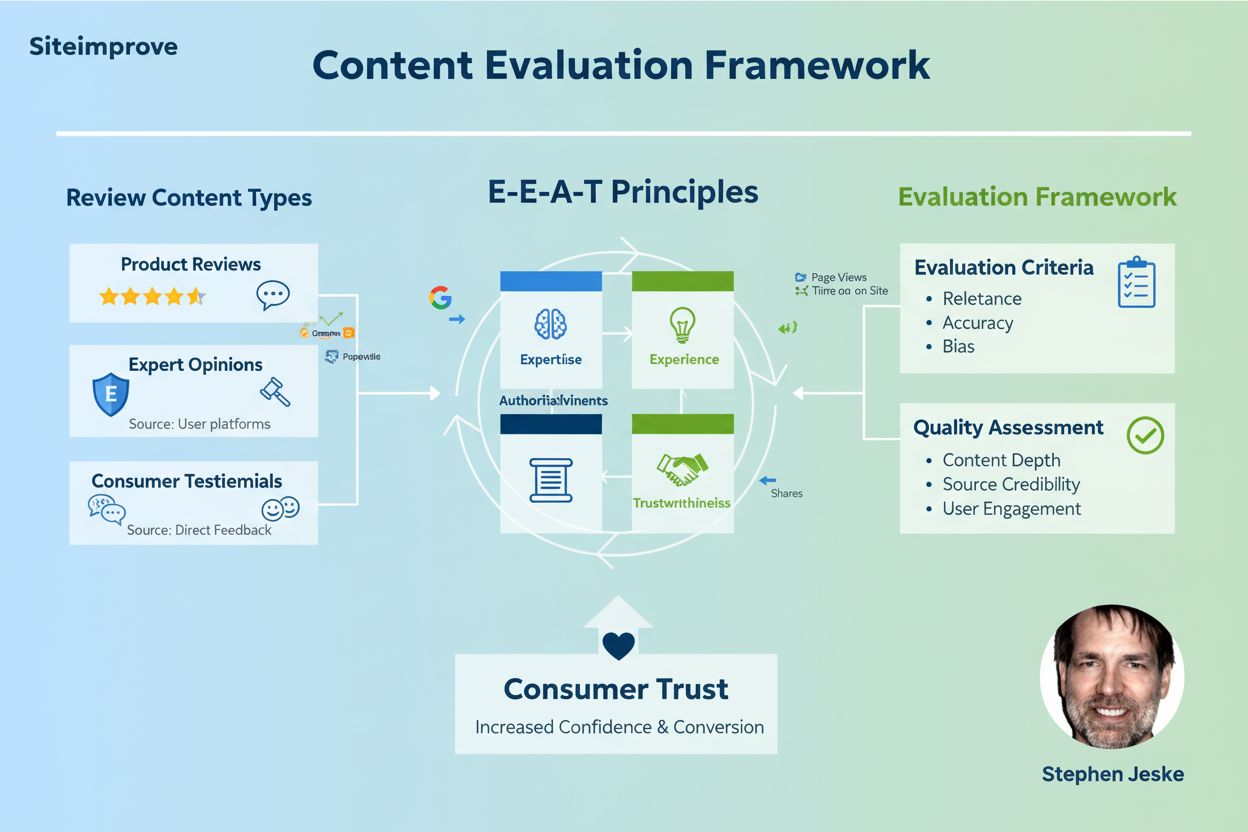
Review Content - Evaluation and Opinion Content
Review content is evaluative material combining expert opinions, consumer feedback, and firsthand experience. Learn how review content impacts E-E-A-T, consumer...
11 min read
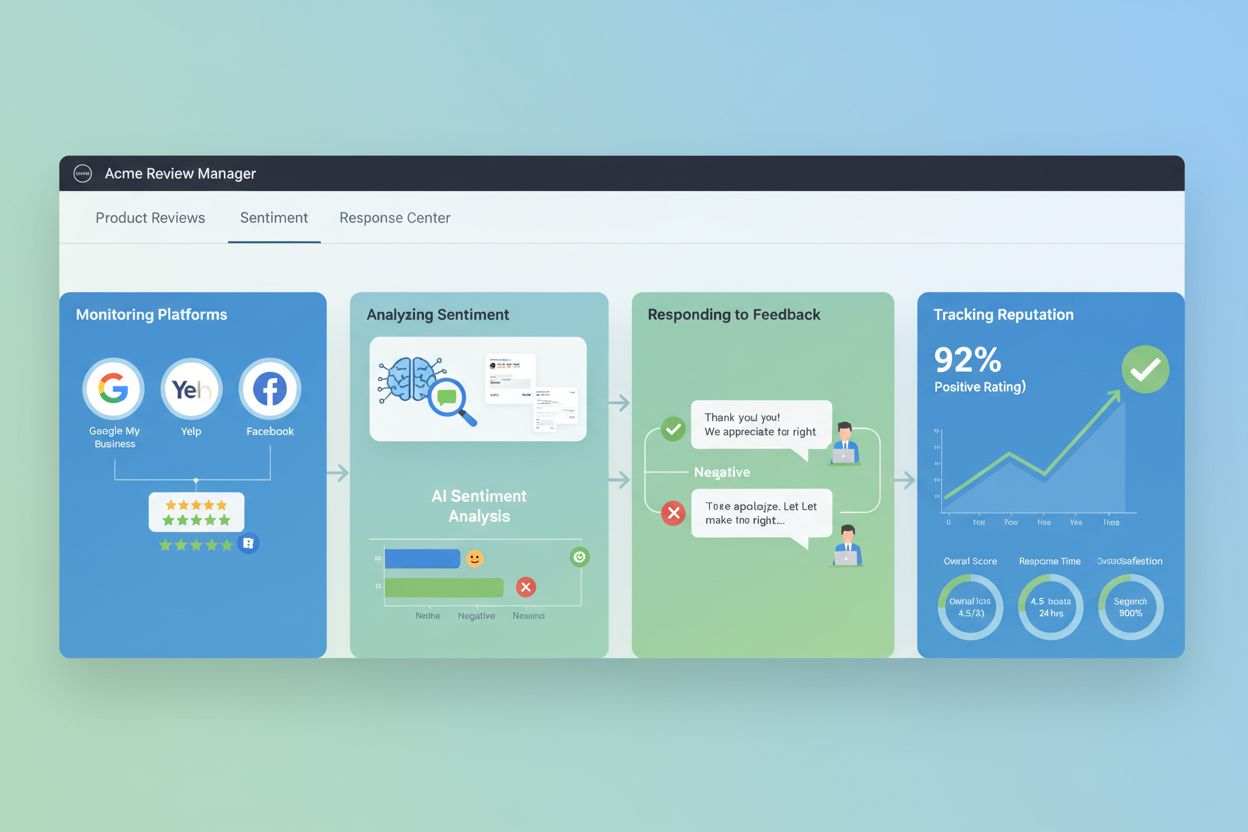
Review management is the strategic process of monitoring, responding to, and analyzing customer reviews across multiple digital platforms to build and maintain a positive online reputation. It encompasses proactive review generation, real-time monitoring, professional responses, and data-driven insights that directly influence brand perception, customer trust, and business growth.
Review management is the strategic process of monitoring, responding to, and analyzing customer reviews across multiple digital platforms to build and maintain a positive online reputation. It encompasses proactive review generation, real-time monitoring, professional responses, and data-driven insights that directly influence brand perception, customer trust, and business growth.
Review management is the strategic and comprehensive process of monitoring, responding to, and analyzing customer reviews posted about your brand across multiple digital platforms. It represents a fundamental shift from passive reputation management to active, data-driven engagement with customer feedback. This discipline encompasses the full lifecycle of customer reviews—from initial generation and continuous monitoring to thoughtful responses and strategic analysis. In today’s digital-first marketplace, where 95% of consumers read online reviews before making purchasing decisions, review management has evolved from a peripheral marketing task into a central business imperative that directly influences customer trust, brand perception, conversion rates, and long-term revenue growth. The practice extends beyond simply acknowledging feedback; it involves leveraging customer insights to drive operational improvements, enhance product development, and create a virtuous cycle of continuous business improvement.
The significance of review management in modern business cannot be overstated. Research from the Spiegel Research Center demonstrates that displaying online reviews increases conversion rates by 270%, while products with reviews experience 190% higher conversion rates compared to those without. This dramatic impact on purchasing behavior underscores why review management has become a non-negotiable component of successful marketing strategies. Beyond conversion metrics, review management directly influences how potential customers perceive your brand before they ever interact with your business. When consumers encounter a business with numerous positive reviews and visible management responses, they experience reduced purchase risk and increased confidence in their decision. Conversely, businesses that ignore reviews or fail to respond professionally risk losing customers to competitors who demonstrate active engagement. The 77% of consumers who view businesses more favorably when they respond to reviews and implement improvements represents a powerful opportunity for differentiation in competitive markets. Review management also serves as a direct communication channel with your customer base, providing unfiltered insights into what’s working well and where operational improvements are needed.
A mature review management strategy comprises five interconnected pillars that work together to create a comprehensive system for reputation management. The first pillar is review generation, which involves proactively encouraging satisfied customers to share their experiences through multiple channels including email campaigns, SMS requests, in-store signage, and QR codes. The second pillar is review monitoring, which requires continuous surveillance of reviews across all relevant platforms using centralized software tools that aggregate feedback from 30+ sources simultaneously. The third pillar is review response, where trained team members craft personalized, professional responses to both positive and negative feedback within 24 hours. The fourth pillar is review presentation, which involves strategically showcasing positive reviews across your website, social media, and marketing materials to amplify their impact. The fifth and final pillar is review analysis, where businesses systematically extract insights from their review corpus to identify trends, recurring issues, and opportunities for improvement. These five pillars create a closed-loop system where customer feedback continuously informs business decisions and drives measurable improvements.
| Aspect | Manual Review Management | Centralized Software Platform | AI-Powered Review Management |
|---|---|---|---|
| Monitoring Capability | Limited to 2-3 platforms; time-consuming | 30+ platforms aggregated in one dashboard | 30+ platforms with AI sentiment analysis |
| Response Time | 48-72 hours or longer | 24 hours or less | Real-time with suggested responses |
| Consistency | Varies by team member; inconsistent tone | Template-based with customization | AI-optimized responses maintaining brand voice |
| Data Analysis | Manual categorization; limited insights | Automated tagging and trend identification | Predictive analytics and pattern recognition |
| Scalability | Not scalable; requires significant labor | Scales with business growth | Scales infinitely with automation |
| Cost | High labor costs; inefficient | Moderate software + reduced labor | Higher upfront; significant ROI |
| Integration | Manual data entry; siloed systems | CRM and marketing tool integration | Full ecosystem integration with AI insights |
| Competitive Analysis | Not feasible | Basic competitor review tracking | Advanced competitive benchmarking |
Modern review management platforms operate as centralized command centers that aggregate customer feedback from disparate sources into unified dashboards. These systems employ sophisticated APIs to connect with review platforms including Google Business Profile, Yelp, Facebook, TripAdvisor, Amazon, Trustpilot, and industry-specific review sites. The technical infrastructure includes real-time notification systems that alert designated team members immediately when new reviews are posted, ensuring rapid response capabilities. Advanced platforms incorporate natural language processing (NLP) and sentiment analysis algorithms that automatically categorize reviews as positive, negative, or neutral, and extract key themes and topics mentioned by customers. This AI-powered analysis eliminates the need for manual review categorization and enables businesses to identify patterns and trends at scale. Integration capabilities with customer relationship management (CRM) systems, email marketing platforms, and business intelligence tools create a seamless data ecosystem where review insights flow directly into operational decision-making processes. The most sophisticated platforms offer workflow automation that routes reviews to appropriate team members based on predefined rules, ensuring efficient handling of high review volumes.
The response phase of review management represents the most visible and impactful aspect of the entire process. Professional review responses serve multiple strategic purposes simultaneously: they acknowledge the reviewer’s effort, demonstrate your commitment to customer satisfaction, provide an opportunity for service recovery in negative situations, and create public evidence of your brand’s values and responsiveness. When responding to positive reviews, the most effective approach involves thanking the customer by name, referencing specific details they mentioned, and expressing genuine appreciation for their feedback. This personalized approach signals that you’ve actually read their review rather than deploying a generic template, which significantly increases the likelihood that they’ll become a vocal brand advocate. For negative reviews, the H.E.A.R.D. technique provides a proven framework: Hear the customer’s concerns, Empathize with their experience, Apologize sincerely for their negative experience, Resolve by offering a specific solution, and Diagnose the root cause to prevent recurrence. Research indicates that 45% of consumers are more likely to visit a business that responds to negative reviews, and many customers who receive thoughtful responses to complaints actually update their original negative reviews to reflect improved experiences. This transformation of detractors into advocates represents one of the highest-ROI activities in modern customer relationship management.
The analytical phase of review management transforms raw customer feedback into actionable business intelligence. By systematically categorizing reviews by product, service, location, or employee, businesses can identify which specific areas are generating the most praise and which require immediate attention. Recurring complaints about a particular feature, service bottleneck, or employee behavior become clear signals for operational improvement. Conversely, consistently praised aspects of your business reveal competitive strengths that should be amplified in marketing messaging and protected through quality assurance processes. Advanced analytics reveal correlations between specific operational changes and subsequent improvements in review sentiment, providing quantifiable evidence of the impact of business decisions. This data-driven approach to continuous improvement creates a virtuous cycle where customer feedback directly informs product development roadmaps, staff training programs, and service delivery protocols. Companies that systematically implement improvements based on review feedback and communicate these changes back to customers in their responses create powerful demonstrations of customer-centricity that build long-term loyalty and advocacy.
The relationship between review management and SEO represents one of the most underutilized opportunities in digital marketing. Search engines like Google explicitly consider customer reviews as ranking factors because they provide fresh, authentic, user-generated content that signals business legitimacy and relevance. Each new review contains unique language, keywords, and semantic variations related to your products, services, and geographic location—precisely the type of content that search algorithms reward. A consistent stream of positive reviews signals to search engines that your business is active, trustworthy, and relevant to user search queries. This directly impacts your visibility in local search results, Google’s Map Pack, and featured snippets. The volume, recency, and sentiment of reviews all contribute to local search rankings, making review generation and management a critical component of any comprehensive SEO strategy. Additionally, the text within reviews often contains long-tail keywords that your own website content might not naturally include, effectively expanding your keyword footprint and improving visibility for diverse search queries. Businesses that integrate review management with their SEO strategy see compounding benefits as improved rankings drive more traffic, which generates more customer interactions, which produce more reviews, creating a self-reinforcing cycle of visibility and authority.
As artificial intelligence continues to reshape how consumers discover and evaluate businesses, the definition and scope of review management is expanding beyond traditional review platforms. AI systems like ChatGPT, Perplexity, Google AI Overviews, and Claude now generate responses to user queries that may cite or recommend specific businesses, creating a new frontier for brand visibility and reputation management. While traditional review management focuses on platforms where customers explicitly leave feedback, the emerging challenge involves understanding how AI systems cite and represent your brand in their generated responses. This evolution parallels the broader shift from search engine optimization to AI Engine Optimization (AEO), where businesses must consider how their brand appears in AI-generated content. The principles of review management—monitoring mentions, understanding sentiment, and responding strategically—are increasingly relevant in this AI-driven context. Forward-thinking businesses are beginning to implement monitoring systems that track not only traditional reviews but also how their brand is being cited and positioned by AI systems. This expanded view of reputation management recognizes that customer perception is shaped not only by explicit reviews but also by how AI systems represent and recommend your business to users seeking information or recommendations.
The review management landscape is undergoing significant transformation driven by advances in artificial intelligence, changing consumer expectations, and the emergence of new digital platforms. Predictive analytics will increasingly enable businesses to anticipate customer satisfaction issues before they result in negative reviews, allowing for proactive service recovery. Automated response systems powered by large language models will handle routine review responses while maintaining personalization and brand voice, freeing human resources for complex situations requiring nuanced judgment. The integration of review management with customer data platforms will enable more sophisticated segmentation and personalization of responses based on customer lifetime value, purchase history, and engagement patterns. Video reviews and user-generated content will become increasingly important, requiring review management systems to handle multimedia feedback in addition to text-based reviews. The rise of voice commerce and conversational AI will create new channels where customer feedback is expressed and must be monitored. Additionally, regulatory frameworks around fake reviews, review manipulation, and data privacy will become increasingly stringent, requiring businesses to implement robust compliance mechanisms within their review management processes. The businesses that successfully adapt their review management strategies to these emerging trends will gain significant competitive advantages in building authentic, resilient, and AI-optimized brand reputations.
Review management is critical because 95% of consumers read online reviews before making purchasing decisions, and displaying reviews increases conversion rates by 270%. Effective review management builds customer trust, improves SEO rankings, provides valuable business intelligence, and demonstrates commitment to customer satisfaction. Businesses that actively respond to reviews see 45% higher likelihood of customer visits compared to those that ignore feedback.
A comprehensive review management strategy should monitor major platforms including Google Business Profile, Yelp, Facebook, TripAdvisor, Amazon, and industry-specific review sites relevant to your business. Additionally, monitoring should extend to social media mentions, local directories, and niche platforms where customers discuss your brand. Using centralized review management software allows businesses to aggregate reviews from 30+ platforms simultaneously, ensuring no feedback is missed.
Best practices recommend responding to reviews within 24 hours of posting. Prompt responses demonstrate that you value customer feedback and are actively engaged with your audience. According to research, 88% of consumers are more likely to use a business if they see it responding to reviews. Quick responses also provide opportunities to resolve issues before negative sentiment spreads and impact your online reputation.
Positive review responses should thank the customer, acknowledge specific points they mentioned, and reinforce their positive experience to encourage other satisfied customers to share feedback. Negative review responses require empathy, sincere apology, specific problem acknowledgment, and a clear path to resolution. Both types should be personalized, professional, and demonstrate genuine commitment to customer satisfaction rather than using generic templates.
Search engines like Google consider customer reviews as ranking factors because they provide fresh, relevant, user-generated content. Reviews contain long-tail keywords and semantic variations related to your business, products, and location, which boost local search visibility. A consistent stream of positive reviews signals legitimacy and relevance to search algorithms, improving your visibility in local search results and Google's Map Pack, making it easier for high-intent customers to find you.
Popular review management platforms include Sprinklr, Yotpo, Podium, Trustpilot, EmbedSocial, and Reputation.com. These tools offer features like automated review aggregation from multiple platforms, real-time notifications, AI-powered sentiment analysis, response templates, analytics dashboards, and automated review request campaigns. Selecting the right tool depends on your industry, number of locations, platform coverage needs, and integration requirements with existing CRM or marketing systems.
Businesses should systematically analyze reviews to identify recurring themes, common complaints, and frequently praised aspects. This feedback reveals operational bottlenecks, product issues, and employee strengths. By categorizing reviews by product, service, or location, companies can pinpoint specific areas needing improvement and track the impact of implemented changes. Communicating these improvements back to customers in review responses shows that their feedback directly influences business decisions, building loyalty and encouraging future engagement.
Start tracking how AI chatbots mention your brand across ChatGPT, Perplexity, and other platforms. Get actionable insights to improve your AI presence.
Review content is evaluative material combining expert opinions, consumer feedback, and firsthand experience. Learn how review content impacts E-E-A-T, consumer...
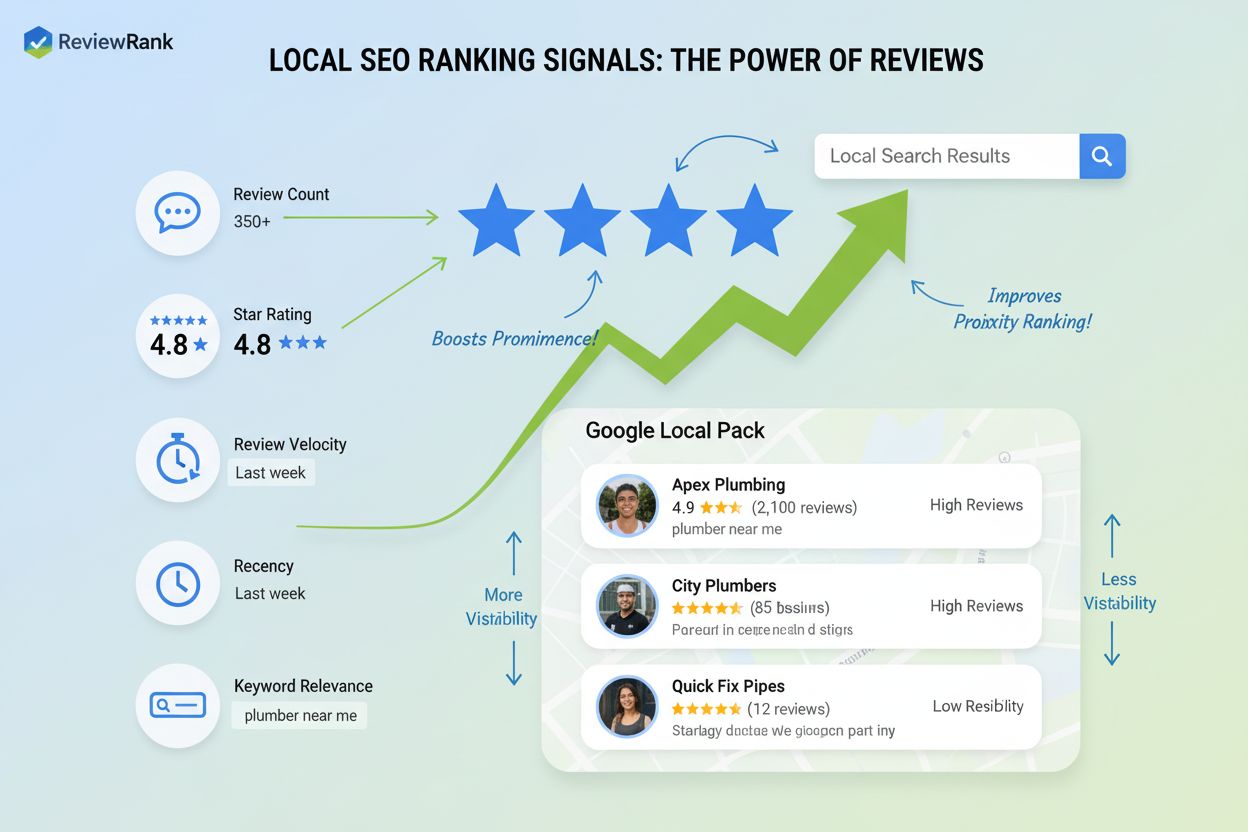
Review signals are key local SEO ranking factors including review count, ratings, velocity, and recency. Learn how reviews impact local search visibility and bu...
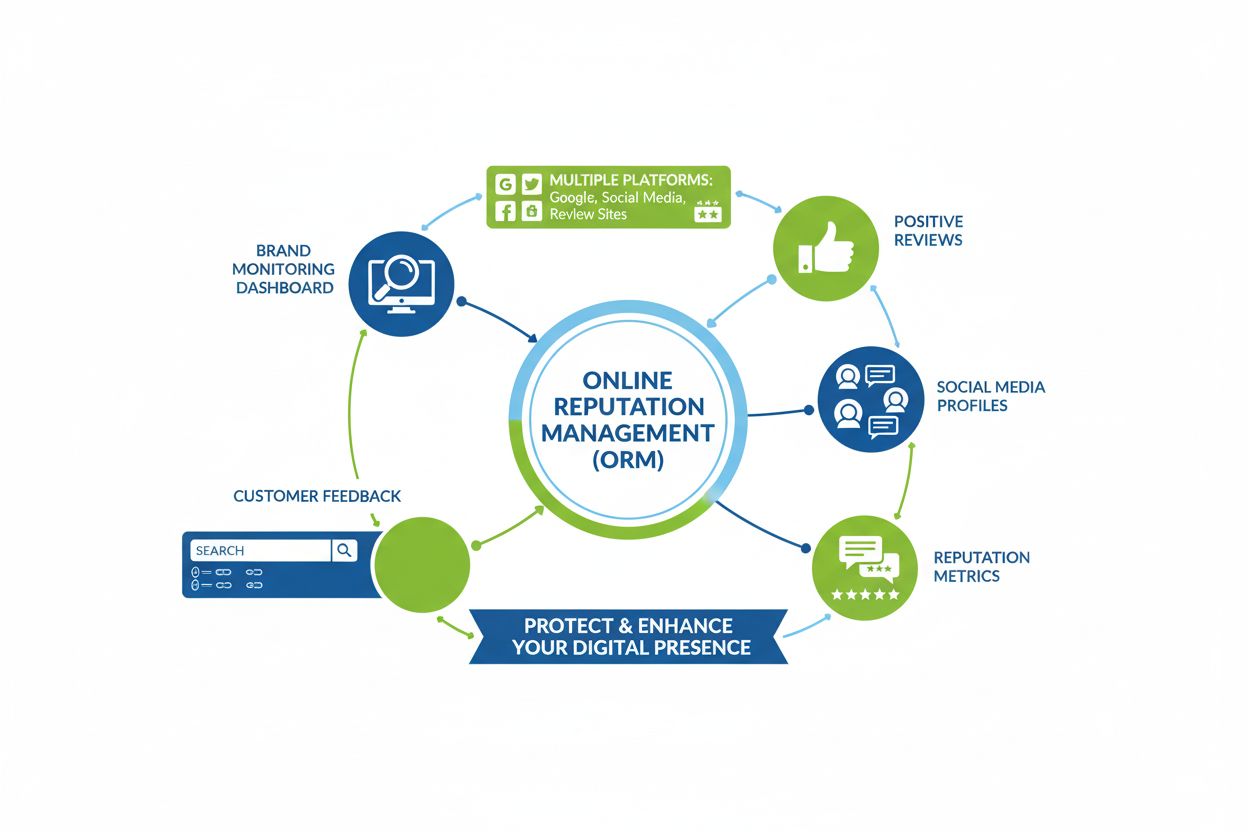
Learn what Online Reputation Management (ORM) is, how it works, and why it's critical for brand perception. Discover ORM strategies, tools, and best practices f...
Cookie Consent
We use cookies to enhance your browsing experience and analyze our traffic. See our privacy policy.