


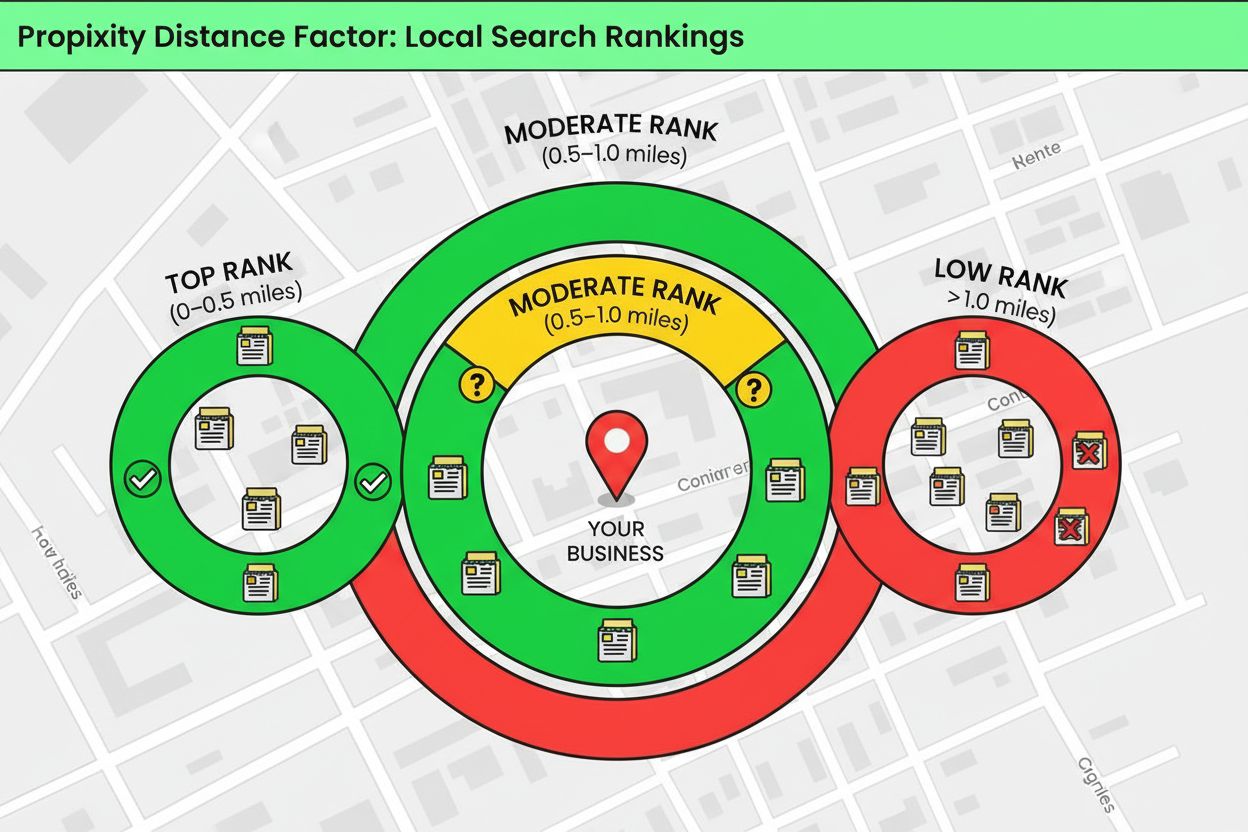
Proximity - Distance Factor in Local Search Rankings
Proximity is the physical distance between a searcher and a business location, one of Google's three core local ranking factors. Learn how distance impacts loca...
13 min read
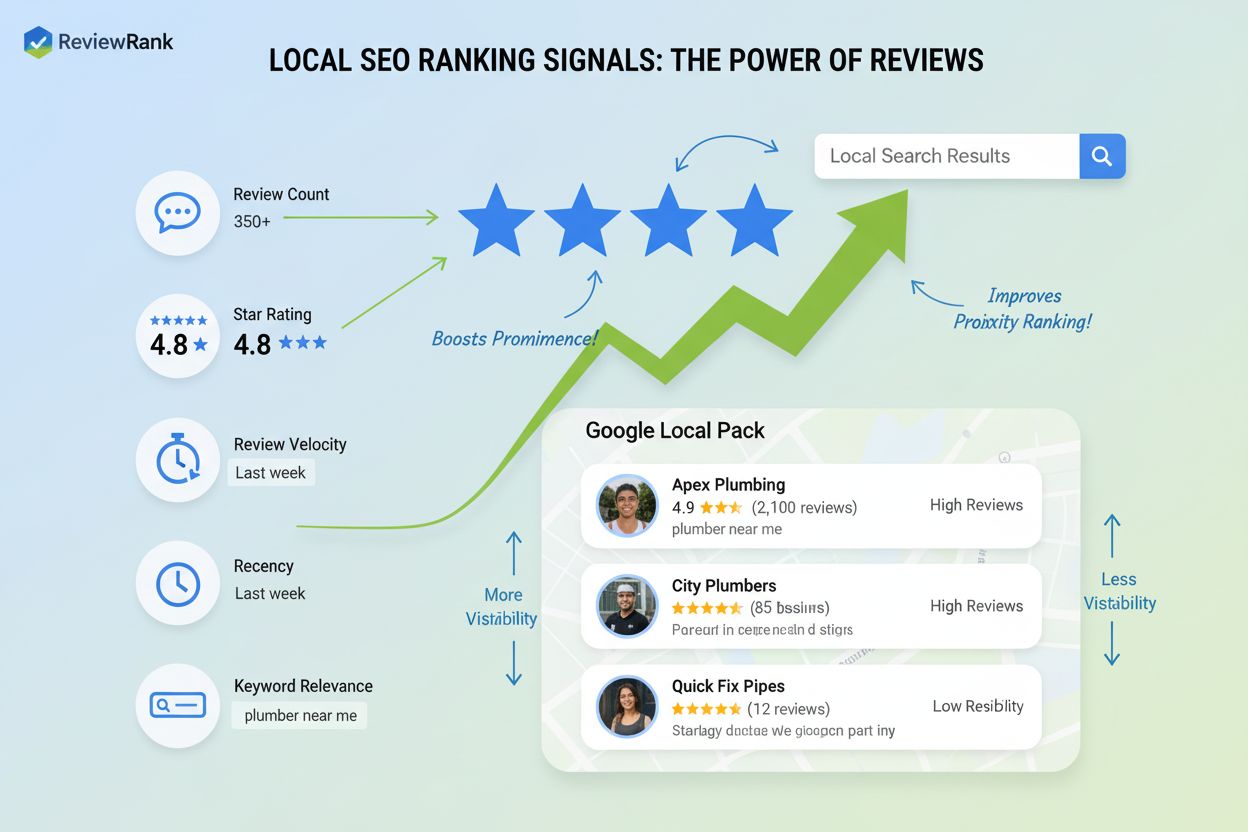
Review signals are quantifiable metrics derived from customer reviews that influence local search rankings, including review count, star rating, recency, velocity, and keyword relevance. These signals serve as trust indicators and prominence factors in Google’s local algorithm, affecting how businesses appear in local pack results and AI-powered search responses.
Review signals are quantifiable metrics derived from customer reviews that influence local search rankings, including review count, star rating, recency, velocity, and keyword relevance. These signals serve as trust indicators and prominence factors in Google's local algorithm, affecting how businesses appear in local pack results and AI-powered search responses.
Review signals are quantifiable metrics and indicators derived from customer reviews that directly influence how businesses rank in local search results and appear in AI-powered search responses. These signals encompass multiple dimensions of review data, including the total number of reviews (review count), the average star rating, the frequency of new reviews (review velocity), the recency of reviews, and the keywords and language used within review text. Review signals function as critical trust indicators and prominence factors within Google’s local search algorithm, serving as external validation of business quality and customer satisfaction. According to the 2026 Local Search Ranking Factors survey, review signals account for approximately 20% of local pack ranking factors, making them the second most influential category after Google Business Profile optimization. Beyond traditional local search, review signals have become increasingly important for AI search visibility, where they represent 16% of visibility factors across platforms like ChatGPT, Perplexity, and Google AI Overviews.
Google’s local search algorithm operates on three foundational pillars: proximity, relevance, and prominence. Review signals primarily influence the latter two pillars, though they interact with all three in complex ways. Proximity refers to the physical distance between a user’s location and a business, which is largely fixed and difficult to manipulate. Relevance measures how well a business listing matches a user’s search query, and review signals enhance relevance through keyword-rich customer feedback that reinforces service offerings and business specialties. Prominence evaluates how well-known and trusted a business is, and review signals are among the most powerful prominence indicators available to search engines. When a business accumulates numerous high-quality reviews with positive ratings, Google interprets this as a signal that the business is established, trustworthy, and actively engaged with its customer base. The semantic analysis of review text allows Google to understand not just that a business is popular, but specifically what customers value about it, creating a multidimensional understanding of business quality that extends beyond simple numerical metrics.

Track how AI chatbots mention your brand across ChatGPT, Perplexity, and other platforms.
Understanding the specific components of review signals is essential for local SEO professionals and business owners seeking to improve their search visibility. Review count, the total number of reviews a business has accumulated, remains one of the most influential metrics. Research analyzing over 3,000 Google Business Profiles across multiple industries found that in positions 1-21 of local search results, review count accounts for 19% of ranking influence, but this increases to 26% in the top ten positions. This indicates that review volume becomes increasingly important as businesses compete for elite ranking positions. Star rating, the average rating score across all reviews, serves as a quick credibility indicator. High star ratings (4.5 stars or above) signal customer satisfaction and trustworthiness, while low ratings can actively harm rankings. Review velocity, the rate at which new reviews arrive, indicates ongoing customer engagement and business activity. Most businesses experience ranking recovery within 2-4 weeks of resuming consistent review collection, demonstrating that velocity is a dynamic, time-sensitive ranking factor. Review recency, how recently reviews were posted, signals that a business is actively serving customers and maintaining current operations. Google’s algorithm favors businesses with steady flows of recent reviews over those with older, stagnant review histories. Finally, keyword relevance in reviews—the presence of service-specific language and terminology within review text—enhances relevance for targeted search queries. When customers naturally mention specific services like “best dentist for whitening” or “excellent plumbing repair,” these keywords reinforce the business’s relevance for those exact search terms.
| Review Signal Metric | Definition | Impact on Rankings | Difficulty to Influence | Time Sensitivity |
|---|---|---|---|---|
| Review Count | Total number of accumulated reviews | Very High (26% in top 10) | Medium | Low (cumulative) |
| Star Rating | Average rating score (1-5 stars) | Very High | Medium | Low (averaged) |
| Review Velocity | Frequency of new reviews over time | High | Medium | High (recent activity) |
| Review Recency | Freshness of most recent reviews | High | Medium | Very High (current) |
| Keyword Relevance | Service-specific language in text | High | Low (natural) | Medium (ongoing) |
| Review Sentiment | Positive vs. negative tone | High | Medium | Medium (ongoing) |
| Review Diversity | Reviews across multiple platforms | Medium | Medium | Low (cumulative) |
| Response Rate | Business engagement with reviews | Medium | Low (controllable) | Medium (ongoing) |
Get the latest insights on AI mentions, brand monitoring, and optimization strategies.
The Google Local Pack—the three featured business listings that appear at the top of local search results—represents the most visible and valuable real estate in local search. Review signals play a disproportionately important role in determining which businesses appear in this coveted position. Recent analysis of Google Business Profile ranking factors reveals that review signals have gained significant influence in top positions. In the top ten local pack results, review count increases to 26% importance, while review keyword relevance reaches 22%—substantially higher than their influence in broader local search results. This suggests that when businesses are geographically close and similarly relevant, review signals become the primary differentiator. A business with 150 reviews and a 4.8-star rating will typically outrank a competitor with 30 reviews and a 4.6-star rating, even if both are equally close to the searcher. The algorithm interprets the higher review volume and rating as stronger signals of customer satisfaction and business reliability. Additionally, the semantic analysis of review keywords allows Google to understand nuanced service offerings. A dental practice that receives reviews mentioning “cosmetic dentistry,” “teeth whitening,” and “smile makeover” will rank higher for those specific queries than a competitor with more reviews but generic praise like “great service.”
The emergence of AI-powered search platforms has created a new dimension for review signal importance. Platforms like ChatGPT, Perplexity, Google AI Overviews, and Claude increasingly rely on review data to generate recommendations and answer user queries about local businesses. According to recent research, review signals account for 16% of AI search visibility factors, making them the second most important category after on-page signals (24%). AI systems analyze reviews to understand business credibility, customer satisfaction levels, and specific service quality indicators. When an AI system generates a response to a query like “best plumber near me,” it evaluates review data to determine which businesses to mention and in what order. High review counts, strong ratings, and reviews containing relevant keywords all increase the likelihood that a business will be cited in AI-generated responses. This creates a critical monitoring challenge for businesses: they must now track not just traditional local search rankings, but also their visibility in AI responses. AmICited addresses this gap by monitoring how businesses appear in AI-generated content across multiple platforms, providing visibility into review signal performance in this emerging search channel. The integration of review signals into AI visibility means that businesses investing in review generation and management are simultaneously improving their visibility across both traditional and AI-powered search channels.
Review signal importance varies significantly across business categories, reflecting different consumer expectations and decision-making processes. Healthcare businesses prioritize patient satisfaction and review frequency above all other signals. Patients making healthcare decisions rely heavily on reviews to assess provider credibility and care quality, making review volume and recency critical ranking factors. A healthcare provider with consistent, recent reviews will rank substantially higher than one with older reviews, even if the total count is similar. Retail businesses show one of the sharpest divides between high-review and low-review performers. Shoppers deciding whether to visit a store rely heavily on what other customers say, making review sentiment and volume the strongest visibility indicators. A neglected Google Business Profile with few reviews signals to both consumers and search engines that the store may not be well-managed. Food and dining establishments operate in one of the most competitive local search categories, where review ratings and steady brand engagement are the strongest signals. Diners respond to signs of activity—fresh feedback, prompt business responses, and consistent review flows—making velocity and recency particularly important. Hospitality businesses prioritize functional information like accurate business hours and clear descriptions over aesthetic elements like photo volume. Travelers care more about whether parking is available at midnight than seeing another angle of the pool, so review signals that address practical concerns rank higher. Financial services operate in “Your Money, Your Life” categories where trust is paramount. While professional photos project stability, a steady stream of authentic reviews and business responses builds far more confidence in potential customers. Understanding these category-specific patterns allows businesses to prioritize review management strategies aligned with their industry’s unique consumer expectations and search algorithm weightings.
Implementing an effective review signal strategy requires a multi-faceted approach that addresses all dimensions of review metrics. Review generation should be the foundation of any strategy, with businesses systematically requesting reviews from satisfied customers through email, SMS, and in-person requests. The goal is to build review count steadily over time, recognizing that velocity matters as much as total volume. Review quality management involves monitoring review sentiment and responding promptly to both positive and negative feedback. Business responses to reviews serve multiple purposes: they demonstrate engagement to search engines, provide opportunities to address customer concerns publicly, and show potential customers that the business values feedback. Research shows that businesses that respond to reviews see better engagement signals and higher rankings than those that ignore customer feedback. Keyword optimization in review requests involves crafting review requests that naturally encourage customers to mention specific services or features. Instead of asking for a generic review, businesses might ask “What service did we help you with today?” or “What aspect of our work impressed you most?” This encourages customers to naturally include service-specific keywords in their reviews, enhancing relevance for targeted search queries. Review monitoring and analysis requires tracking review metrics across all platforms where the business appears—Google, Yelp, Facebook, industry-specific directories, and others. Tools that aggregate review data provide visibility into trends, sentiment changes, and opportunities for improvement. Consistency across platforms ensures that review signals are maximized across all channels. A business with 200 Google reviews but only 10 Yelp reviews presents an incomplete picture to search engines and AI systems. Encouraging reviews across multiple authoritative platforms diversifies review signal strength and improves visibility in AI responses that may reference different sources.
Review signals have become increasingly important in Google’s local algorithm over the past several years. In the 2023 Local Search Ranking Factors survey, reviews accounted for 16% of local pack ranking importance. By 2026, this had increased to 20%, representing a 25% increase in relative importance. This trend reflects Google’s broader shift toward prioritizing user-generated content and authentic customer feedback as indicators of business quality. The rise of AI-powered search has accelerated this trend further, as AI systems rely heavily on review data to generate recommendations and answer queries. This evolution suggests that businesses should expect review signals to become even more important in the future. The integration of review signals into AI visibility creates a compounding effect: businesses that invest in review generation and management improve their visibility not just in traditional local search, but also in emerging AI-powered discovery channels. This makes review management one of the highest-ROI local SEO investments available to businesses. Additionally, Google’s semantic analysis of review text has become more sophisticated, allowing the algorithm to understand nuanced service offerings and customer preferences. This means that the quality and specificity of review content matters increasingly, not just the quantity of reviews. Businesses that encourage detailed, service-specific reviews will see better ranking improvements than those that simply accumulate generic praise.
For businesses and agencies using platforms like AmICited, understanding review signal performance in AI responses is critical for modern local SEO strategy. Traditional rank tracking tools measure positions in Google’s organic and local pack results, but they don’t capture visibility in AI-generated responses. When a user asks ChatGPT “What’s the best pizza place near me?” or Perplexity “Find me a highly-rated dentist,” the AI system generates a response based on multiple data sources, including reviews. A business with strong review signals—high count, excellent rating, recent reviews, and keyword-rich content—is more likely to be mentioned in these AI responses. AmICited’s monitoring capabilities track how often and how prominently a business appears in AI-generated content, providing visibility into review signal performance in this emerging channel. This data reveals whether review management efforts are translating to AI visibility, allowing businesses to optimize their strategies accordingly. The monitoring also identifies which review signals are most influential for specific AI platforms. For example, ChatGPT might weight review recency more heavily than Perplexity, or Google AI Overviews might prioritize reviews from verified customers. Understanding these platform-specific patterns allows businesses to tailor their review strategies for maximum impact across all discovery channels. As AI search continues to grow in importance, the ability to monitor and optimize review signals for AI visibility will become a core competency for local SEO professionals.
The future of review signals in search is inextricably linked to the broader evolution of AI and search technology. As generative AI systems become more sophisticated and widely adopted, review signals will likely become even more important for business visibility. AI systems are fundamentally dependent on high-quality, trustworthy data sources, and customer reviews represent one of the most authentic and abundant sources of business information available. This creates a powerful incentive for businesses to invest in review generation and management. The integration of review signals into AI search visibility also suggests that the traditional distinction between “local search” and “general search” will continue to blur. A business’s review signals will influence not just where it appears in Google Maps, but also how it’s represented in AI responses to queries that may not have explicit local intent. This expansion of review signal influence across multiple search channels means that review management is no longer a local SEO tactic—it’s a fundamental business visibility strategy. Additionally, as search engines and AI systems become more sophisticated in analyzing review content, the quality and specificity of reviews will matter increasingly. Generic reviews like “great service” will become less valuable, while detailed reviews that mention specific services, outcomes, and customer experiences will drive more ranking improvements. This suggests that businesses should focus not just on accumulating reviews, but on encouraging detailed, service-specific feedback that provides genuine value to both search algorithms and potential customers. The convergence of traditional search, AI-powered discovery, and review signal importance creates a compelling case for treating review management as a core business priority rather than a peripheral marketing tactic.
Start tracking how AI chatbots mention your brand across ChatGPT, Perplexity, and other platforms. Get actionable insights to improve your AI presence.
Proximity is the physical distance between a searcher and a business location, one of Google's three core local ranking factors. Learn how distance impacts loca...
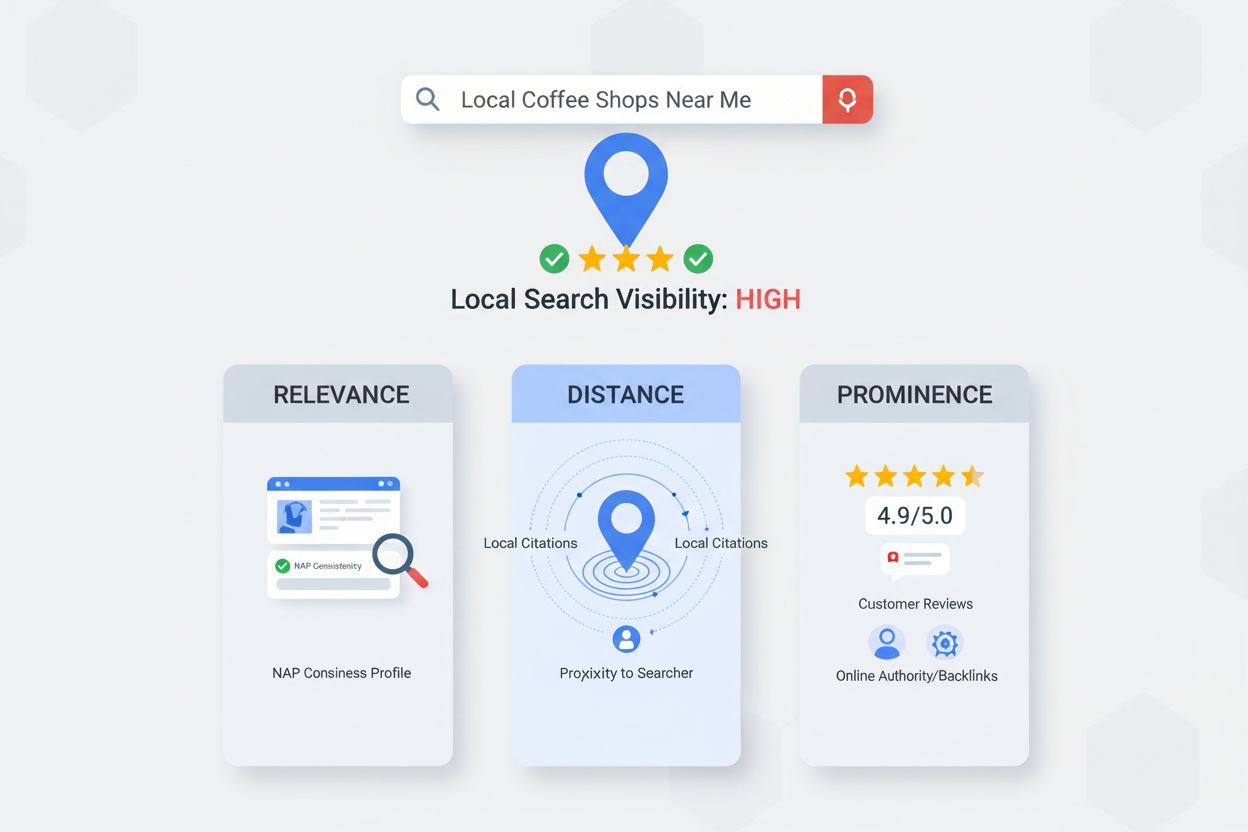
Learn what Google Maps SEO is, how it works, and why it's critical for local business visibility. Discover ranking factors, optimization strategies, and best pr...

Learn how local businesses can optimize for AI visibility across ChatGPT, Google AI Overviews, Gemini, and Perplexity. Discover strategies to appear in AI-gener...
Cookie Consent
We use cookies to enhance your browsing experience and analyze our traffic. See our privacy policy.