

Is There an AI Search Index? How AI Engines Index Content
Learn how AI search indexes work, the differences between ChatGPT, Perplexity, and SearchGPT indexing methods, and how to optimize your content for AI search vi...
8 min read

OpenAI’s dedicated search interface combining conversational AI with real-time web search capabilities to deliver contextual answers rather than traditional link lists. It competes directly with Google, Bing, and other AI search solutions by interpreting user intent beyond keyword matching. SearchGPT leverages advanced GPT language models integrated with Bing’s real-time web index to provide current, cited information. The platform enables natural language queries with transparent source attribution and conversation context preservation.
OpenAI's dedicated search interface combining conversational AI with real-time web search capabilities to deliver contextual answers rather than traditional link lists. It competes directly with Google, Bing, and other AI search solutions by interpreting user intent beyond keyword matching. SearchGPT leverages advanced GPT language models integrated with Bing's real-time web index to provide current, cited information. The platform enables natural language queries with transparent source attribution and conversation context preservation.
SearchGPT is OpenAI’s AI-powered search interface that combines conversational artificial intelligence with real-time web search capabilities to deliver contextual answers rather than traditional link lists. Evolved from ChatGPT’s web search functionality, SearchGPT represents a dedicated search product designed to interpret user intent beyond keyword matching, understanding the nuanced meaning behind queries to provide more relevant results. The platform competes directly with established search engines including Google and Bing, as well as emerging AI search solutions like Perplexity.ai and Microsoft Copilot, fundamentally challenging the traditional search engine market. At its core, SearchGPT leverages OpenAI’s advanced GPT language models—specifically trained on vast amounts of text data—to understand complex language structures, contexts, and semantic relationships, enabling it to process natural language queries with unprecedented comprehension. The system integrates Bing’s real-time web index to access current information, ensuring that responses reflect the latest data available on the internet rather than relying solely on training data. This technological foundation allows SearchGPT to bridge the gap between conversational AI and practical information retrieval, creating a search experience that feels more like consulting a knowledgeable assistant than querying a database.
SearchGPT distinguishes itself through a suite of advanced features that fundamentally transform how users interact with search technology, moving beyond keyword-based retrieval to semantic understanding and personalized responses. These capabilities enable users to engage with search in a more natural, conversational manner while maintaining transparency about information sources and maintaining context across multiple queries. The platform’s architecture supports dynamic adaptation to user needs, learning from interaction patterns to deliver increasingly relevant results over time.
| Feature | Description | Benefit |
|---|---|---|
| Conversational Search | Users can ask follow-up questions and refine queries without resetting context, maintaining a continuous dialogue | Enables more natural interaction, reduces friction in information discovery, and allows for progressive refinement of search intent |
| Real-time Web Integration | Direct access to Bing’s live index ensures responses reflect current events, trends, and recently published content | Provides timely, accurate information on breaking news and trending topics that training data cannot capture |
| Source Citation | Responses include prominent, in-line citations and links to original sources with clear attribution | Ensures transparency, enables verification of information, and drives referral traffic to cited websites |
| Contextual Understanding | Advanced NLP interprets nuanced meaning, user intent, and complex query structures beyond literal keyword matching | Handles ambiguous, vague, or complex questions that traditional search engines struggle with, delivering more precise results |
| Search Personalization | Results adapt based on user behavior, interaction history, and individual preferences over time | Delivers increasingly relevant results tailored to each user’s unique needs and search patterns |
SearchGPT operates through a sophisticated multi-stage process that begins when a user submits a natural language query, which the system processes through advanced natural language processing algorithms to extract meaning, intent, and context rather than simply matching keywords. Once the user’s intent is understood, SearchGPT simultaneously queries Bing’s real-time web index to retrieve current, relevant information from across the internet, ensuring responses incorporate the latest available data. The system then evaluates retrieved sources for relevance, credibility, and accuracy, filtering results to identify the most authoritative and useful information for answering the specific query. SearchGPT synthesizes this information into a conversational, contextually appropriate response that directly addresses the user’s question while maintaining awareness of the conversation history, allowing it to understand follow-up questions and refine answers based on previous exchanges. A critical component of SearchGPT’s functionality is its source citation mechanism, which automatically identifies and prominently displays the websites and sources used to generate each response, providing users with transparent attribution and the ability to verify information independently. The system’s ability to maintain conversation context across multiple exchanges distinguishes it from traditional search engines, enabling users to ask clarifying questions, request additional details, or explore related topics without losing the thread of their original inquiry.
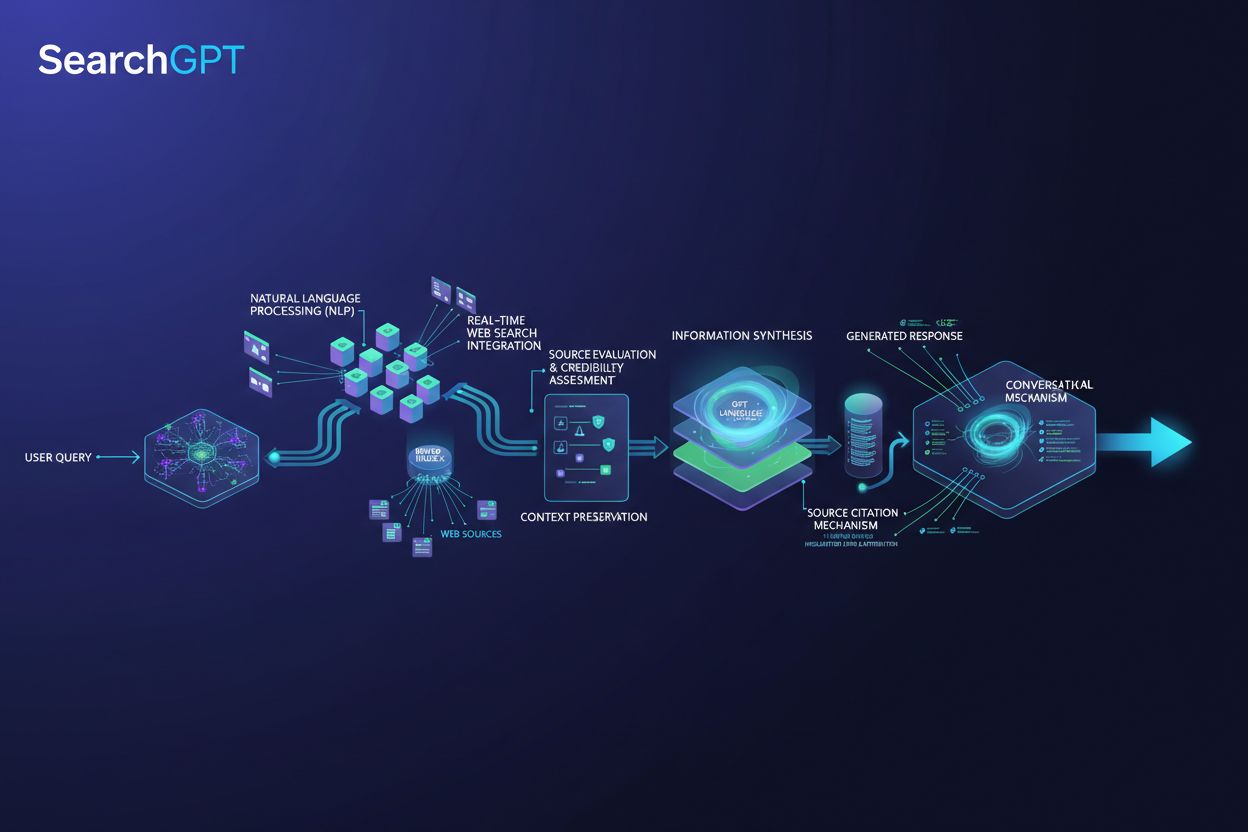
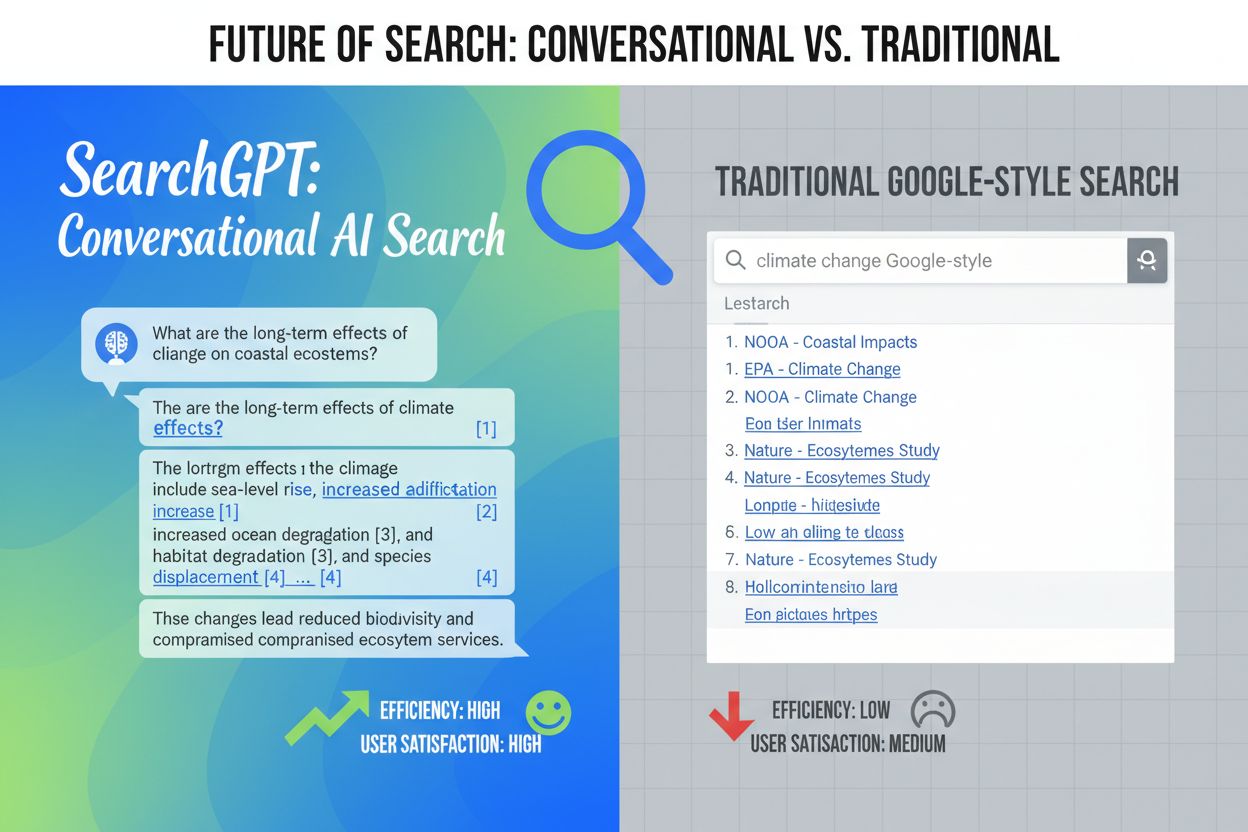
SearchGPT represents a fundamental paradigm shift in how users discover and consume information online, moving away from the link-list model that has dominated search for decades toward a conversational, answer-focused approach that prioritizes user intent and contextual relevance. This transformation challenges the traditional search engine model in several critical dimensions that reshape user expectations and digital marketing strategies.
Search Accuracy & Relevance: SearchGPT understands semantic meaning and user intent rather than relying on keyword matching, delivering more contextually appropriate results for complex or nuanced queries. Traditional search engines often return pages ranked by algorithm relevance rather than direct answer quality, requiring users to evaluate multiple results.
User Experience & Interaction: SearchGPT enables natural conversational interaction with follow-up questions and context preservation, eliminating the need for users to reformulate queries or navigate multiple search results pages. Traditional search engines require users to construct keyword-based queries and manually evaluate link lists, creating friction in the information discovery process.
Response Format & Presentation: SearchGPT provides synthesized, conversational answers that directly address user questions, while traditional search engines present ranked lists of links that users must click through and evaluate independently. This fundamental difference in output format changes how users consume information and interact with source material.
Source Diversity & Attribution: SearchGPT cites sources prominently within responses, often including websites that rank below position 21 in Google results, creating visibility opportunities for high-quality content regardless of traditional SEO rankings. Traditional search engines concentrate visibility on top-ranking pages, limiting exposure for lower-ranked but potentially relevant sources.
Data Privacy Considerations: SearchGPT’s data collection practices raise privacy concerns similar to traditional search engines, but the AI model’s need to understand user context and personalize responses may involve more granular data collection. Traditional search engines have established privacy frameworks, though both models face ongoing scrutiny regarding user data handling.
Real-time Information Handling: SearchGPT accesses Bing’s live index to provide current information on breaking news and recent developments, while traditional search engines index content with varying delays. This real-time capability gives SearchGPT an advantage for time-sensitive queries, though traditional search engines continue to improve indexing speed.
SearchGPT fundamentally reshapes SEO strategy by shifting focus from keyword ranking to content referencing, where visibility depends not on achieving top positions in search results but on being cited as a credible source within AI-generated responses. This transition requires businesses to reconsider their content optimization approach, emphasizing comprehensive, authoritative, and contextually relevant content that answers specific user questions rather than optimizing for keyword density and search volume. Since SearchGPT relies on Bing’s index for web data, ensuring that content is properly indexed by Bing becomes critical—a factor many SEO professionals previously deprioritized in favor of Google optimization. The platform’s preference for high-quality, in-depth content that demonstrates expertise aligns with Google’s E-E-A-T (Experience, Expertise, Authoritativeness, Trustworthiness) signals, meaning that content strategies optimized for modern SEO principles remain largely applicable to SearchGPT visibility. Businesses must adapt by creating content that directly answers the questions their target audiences ask, structuring information clearly with logical hierarchies, and establishing clear expertise signals through author credentials and domain authority. The importance of source attribution and E-A-T signals intensifies in the SearchGPT era, as AI systems evaluate content credibility to determine which sources merit citation, making transparent expertise demonstration and high-quality content production essential competitive advantages.
Despite its advanced capabilities, SearchGPT faces significant limitations that constrain its current applicability and reliability across all search scenarios. The system struggles with local search accuracy, occasionally generating responses that fail to account for geographic relevance or local business information, limiting its utility for location-specific queries where traditional search engines excel. Hallucinations—instances where the AI generates plausible but factually incorrect information—remain a persistent challenge, particularly in specialized domains or when synthesizing information from multiple sources, creating potential accuracy concerns that users must navigate carefully. SearchGPT’s citation mechanism, while generally transparent, can occasionally attribute information inconsistently or fail to properly credit sources, raising concerns about attribution accuracy and the potential for misrepresentation of source material. The platform demonstrates limitations in transactional and ecommerce queries, where users seek to purchase products or complete specific transactions, as SearchGPT’s conversational format does not seamlessly integrate with commerce functionality. Privacy concerns surrounding data collection persist, as SearchGPT’s personalization features require gathering and analyzing user behavior data, raising questions about how this information is stored, used, and protected. Additionally, the system’s reliance on Bing’s index means that content not indexed by Bing remains invisible to SearchGPT, potentially excluding valuable information sources and creating indexing gaps that differ from Google’s coverage.
SearchGPT’s emergence signals a potential market disruption of unprecedented scale, with Gartner predicting that traditional search engine volume will decline by 25% by 2026 as users increasingly adopt AI chatbots and conversational search interfaces for information discovery. This projection suggests a fundamental reshaping of digital marketing and SEO practices, where the traditional focus on keyword ranking and page-one visibility gives way to a “referencing” model where content visibility depends on being cited as authoritative sources within AI-generated responses. The evolution of SearchGPT and competing AI search platforms will likely drive integration with other productivity tools and platforms, creating seamless workflows where search, content consumption, and action-taking occur within unified interfaces rather than requiring users to navigate between separate applications. User search behavior is expected to evolve significantly, with more sophisticated, conversational queries replacing simple keyword searches as users become comfortable with natural language interaction and expect AI systems to understand complex intent. This shift will have profound implications for website traffic and visibility, as the concentration of clicks on top-ranking pages diminishes and traffic distributes across a broader range of sources cited in AI responses, potentially creating opportunities for high-quality content that previously struggled to achieve top rankings. The terminology of SEO itself is shifting from “ranking” to “referencing,” reflecting the fundamental change in how visibility is achieved and measured in an AI-powered search landscape. Organizations that proactively adapt their content strategies, invest in expertise demonstration, and optimize for both traditional search and AI referencing will be best positioned to maintain and grow their visibility as this market transformation unfolds over the coming years.
SearchGPT provides conversational, synthesized answers with source citations rather than ranked link lists. It understands user intent beyond keywords, maintains conversation context for follow-up questions, and cites sources that may not rank in Google's top results. SearchGPT integrates Bing's real-time index for current information, while Google uses its own index. The fundamental difference is that SearchGPT answers questions directly, whereas Google presents links for users to evaluate.
Yes, SearchGPT shifts visibility from keyword ranking to content referencing. Rather than achieving top positions in search results, websites need to be cited as credible sources in AI-generated responses. This requires high-quality, authoritative content that answers specific user questions, proper indexing by Bing, and strong E-A-T signals. Being indexed by Bing becomes critical since SearchGPT relies on Bing's index for web data. Content strategy must focus on comprehensive answers and expertise demonstration rather than traditional keyword optimization.
SearchGPT primarily uses Bing's real-time web index to retrieve current information from across the internet. The system evaluates sources for relevance, credibility, and accuracy before synthesizing responses. Importantly, SearchGPT cites sources that may rank below position 21 in traditional search results, creating visibility opportunities for high-quality content regardless of traditional SEO rankings. The platform also maintains conversation context to understand follow-up questions and refine answers based on previous exchanges.
Yes, SearchGPT can experience hallucinations where it generates plausible but factually incorrect information, particularly in specialized domains or when synthesizing information from multiple sources. The system also struggles with local search accuracy and can occasionally misattribute sources. While SearchGPT generally performs well on time-sensitive queries and informational searches, users should verify important information independently by checking the cited sources, especially for health, financial, or legal matters.
SearchGPT uses advanced natural language processing to understand and maintain conversation history across multiple exchanges. This allows users to ask follow-up questions, request additional details, or explore related topics without resetting the search context. The system remembers previous queries and responses within a conversation session, enabling it to understand references to earlier topics and provide contextually appropriate refinements to answers.
SearchGPT represents a significant shift in digital marketing strategy, moving from keyword ranking to content referencing. Gartner predicts traditional search volume will drop 25% by 2026 due to AI adoption. Marketers must adapt by creating comprehensive, authoritative content that answers specific audience questions, ensuring Bing indexation, and building strong expertise signals. The shift from 'ranking' to 'referencing' terminology reflects how visibility is now achieved through AI citation rather than search result position.
SearchGPT is available to ChatGPT users, with access varying by subscription level. OpenAI initially launched SearchGPT as a prototype and later integrated it as ChatGPT Search, a feature available to ChatGPT Plus and Team subscribers. The feature allows users to enable real-time web search within ChatGPT conversations. Availability and features may expand over time as OpenAI continues developing and refining the product.
AmICited monitors how AI search platforms like SearchGPT reference and cite your brand and content. The platform tracks citations across multiple AI systems including ChatGPT, Perplexity, Google AI Overviews, and others, providing visibility into how your content is being attributed and used. This helps you understand your brand's presence in AI-generated responses and identify opportunities to improve citation and attribution across AI platforms.
Track how AI search platforms like SearchGPT cite and reference your content. AmICited monitors AI answers across ChatGPT, Perplexity, Google AI Overviews, and more to ensure your brand gets proper attribution.
Learn how AI search indexes work, the differences between ChatGPT, Perplexity, and SearchGPT indexing methods, and how to optimize your content for AI search vi...
Discover the key differences between ChatGPT and ChatGPT Search. Learn about real-time web browsing, knowledge cutoffs, accuracy, and when to use each version f...
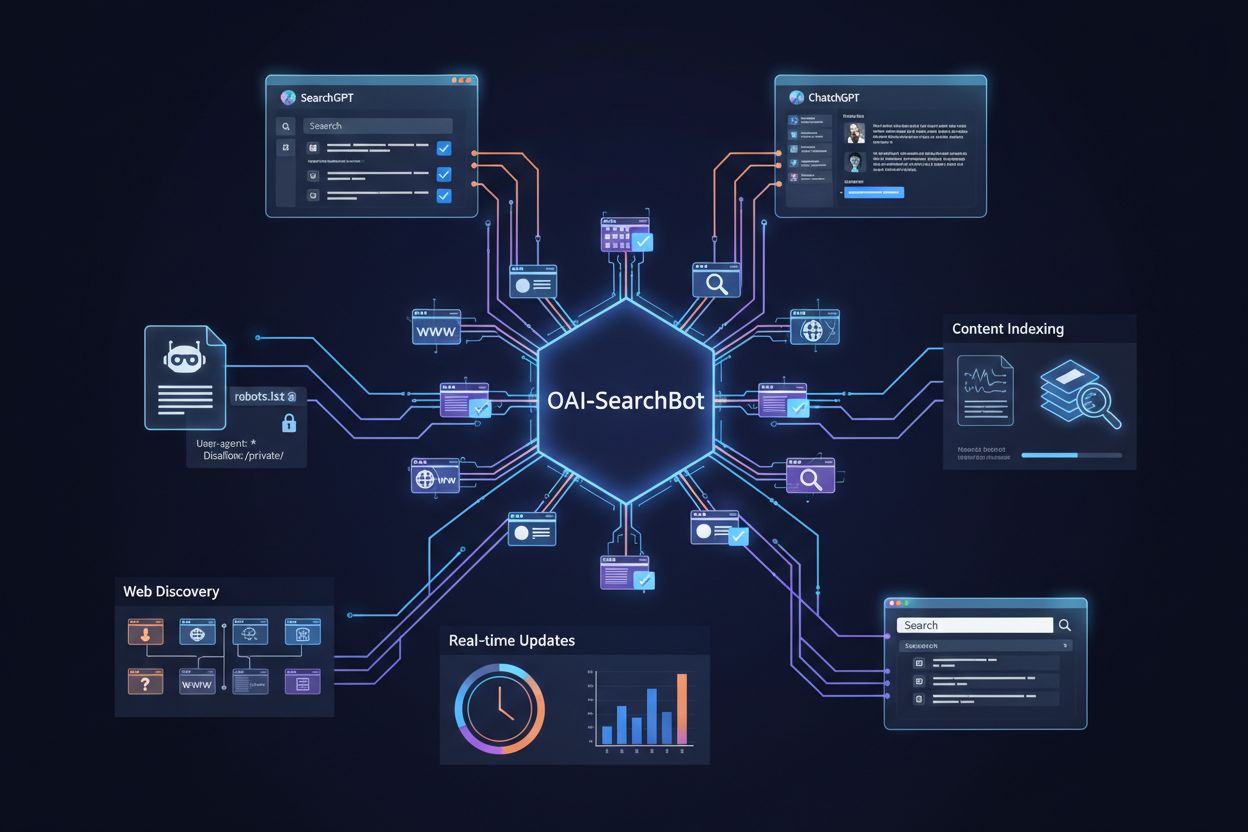
Learn what OAI-SearchBot is, how it works, and how to optimize your website for OpenAI's dedicated search crawler used by SearchGPT and ChatGPT.
Cookie Consent
We use cookies to enhance your browsing experience and analyze our traffic. See our privacy policy.