
Semrush AIO Integration
Learn about Semrush AIO Integration, the enterprise platform for tracking brand visibility in Google AI Overviews and other AI search platforms. Discover how to...
9 min read
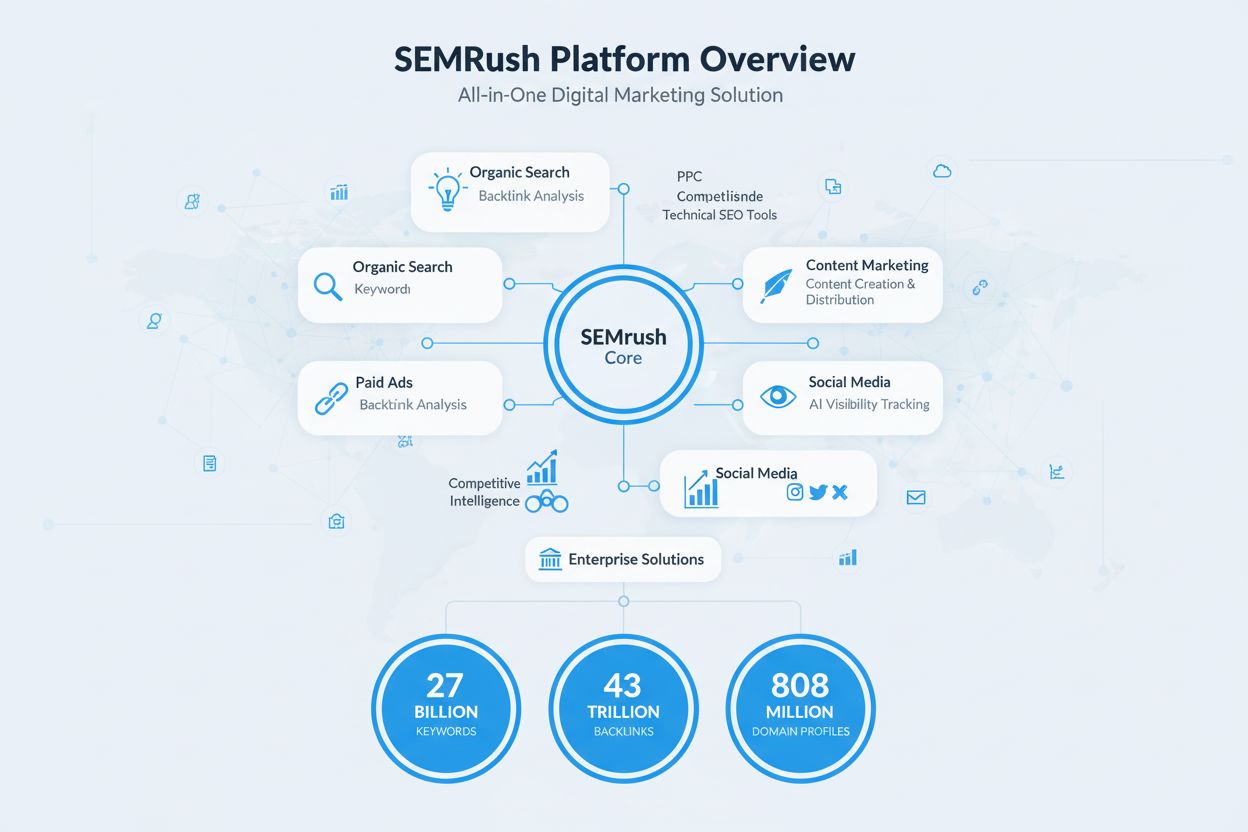
SEMrush is an all-in-one digital marketing platform that provides comprehensive tools for search engine optimization (SEO), pay-per-click (PPC) advertising, content marketing, competitive analysis, and AI visibility tracking. With access to 27 billion keywords, 43 trillion backlinks, and 808 million domain profiles, it enables marketers to optimize their online presence across traditional search and emerging AI-powered search ecosystems.
SEMrush is an all-in-one digital marketing platform that provides comprehensive tools for search engine optimization (SEO), pay-per-click (PPC) advertising, content marketing, competitive analysis, and AI visibility tracking. With access to 27 billion keywords, 43 trillion backlinks, and 808 million domain profiles, it enables marketers to optimize their online presence across traditional search and emerging AI-powered search ecosystems.
SEMrush is a comprehensive, all-in-one digital marketing platform that provides marketers, agencies, and enterprises with integrated tools for search engine optimization, pay-per-click advertising, content marketing, social media management, and competitive intelligence. Founded in 2008, SEMrush has evolved from a specialized SEO tool into a unified marketing suite that addresses the complete digital marketing lifecycle. The platform leverages one of the world’s largest AI-driven marketing databases, containing 27 billion keywords, 43 trillion backlinks, and 808 million domain profiles, enabling data-driven decision-making across all marketing channels. SEMrush serves over 10 million marketing professionals globally, including 35% of Fortune 500 companies, making it an industry standard for organizations seeking to optimize their online visibility and competitive positioning.
SEMrush’s journey from a niche SEO tool to a comprehensive marketing platform reflects the broader evolution of digital marketing itself. When launched in 2008, the platform focused exclusively on keyword research and competitive analysis—addressing a critical gap in available tools for understanding search behavior. Over the subsequent 16 years, SEMrush expanded its toolkit from just 2 tools in 2008 to 50+ integrated features by 2020, demonstrating a strategic commitment to comprehensive platform development. This expansion was driven by recognizing that modern marketers require visibility across multiple channels: organic search, paid advertising, content distribution, social media, and increasingly, AI-powered search ecosystems. The platform’s growth trajectory has been remarkable, with annual recurring revenue (ARR) increasing from $102.6 million in 2019 to $411.6 million in 2024—a 300% increase in just six years. This financial performance underscores the market’s recognition of SEMrush’s value proposition and the critical importance of integrated marketing intelligence in competitive digital landscapes.
SEMrush operates as a modular platform organized into eight primary toolkits, each addressing specific marketing functions while maintaining seamless data integration across the entire system. The SEO Toolkit provides keyword research, position tracking, site audits, and technical SEO analysis—foundational capabilities for organic search optimization. The Traffic & Market Toolkit enables competitive benchmarking and audience analysis, revealing traffic sources, visitor behavior, and market positioning. The Content Toolkit supports content creation and optimization through AI-powered writing assistance, content templates, and performance scoring. The Advertising Toolkit covers both Google Ads and Meta advertising, including keyword research for PPC campaigns and competitor ad analysis. The Social Toolkit manages social media posting, monitoring, and influencer identification across multiple platforms. The Local Toolkit optimizes Google Business Profiles and local search visibility—critical for multi-location businesses. The AI Visibility Toolkit represents SEMrush’s response to emerging AI search, tracking brand mentions in ChatGPT, Perplexity, Google AI Overviews, and Claude. Finally, the AI PR Toolkit identifies media opportunities and manages outreach campaigns to journalists and publications trusted by AI systems. This architectural approach ensures that marketers can address interconnected marketing challenges within a unified interface rather than juggling disparate tools.
| Feature/Capability | SEMrush | Ahrefs | Moz |
|---|---|---|---|
| Primary Strength | Breadth of integrated tools across all marketing channels | Backlink analysis and link research depth | Domain authority metrics and local SEO |
| Keyword Database Size | 27 billion keywords | 10+ billion keywords | 500+ million keywords |
| Backlink Database | 43 trillion backlinks | 14+ trillion backlinks | 40+ billion backlinks |
| SEO Tools | 50+ integrated tools | 20+ specialized tools | 15+ focused tools |
| PPC/Advertising Tools | Full Google Ads and Meta integration | Limited PPC capabilities | Minimal advertising tools |
| Content Marketing Tools | AI-powered writing assistant, templates, optimization | Content gap analysis only | Content optimization limited |
| Social Media Management | Full suite with posting, monitoring, influencer ID | No social media tools | Limited social features |
| AI Visibility Tracking | AI Visibility Index, Semrush One platform | Not available | Not available |
| Pricing Range | $119.95–$449.95/month | $99–$999/month | $99–$599/month |
| Best For | Comprehensive marketing teams needing unified platform | Link building specialists and SEO purists | Local SEO and small businesses |
| Learning Curve | Moderate (extensive features require training) | Steep (specialized interface) | Gentle (intuitive design) |
| Enterprise Solutions | Dedicated enterprise platform with custom features | Enterprise plans available | Limited enterprise offerings |
The technical foundation of SEMrush represents one of its most significant competitive advantages. The platform processes data from billions of search queries daily, maintaining real-time updates to keyword rankings, search volume estimates, and competitive metrics. SEMrush’s Position Tracking feature monitors keyword rankings across 142 geographic databases with daily updates, enabling marketers to track performance at granular levels—by country, city, device type, and search intent. The Site Audit functionality crawls websites to identify technical SEO issues, including duplicate content, broken links, crawlability problems, and HTTPS implementation gaps. This audit capability extends to analyzing 808 million domain profiles, providing competitive benchmarking data that reveals how competitors structure their technical infrastructure. The Keyword Magic Tool leverages machine learning to identify semantic relationships between keywords, grouping related terms and revealing search intent patterns that inform content strategy. The platform’s Traffic Analytics feature estimates website traffic using proprietary algorithms that analyze search volume, click-through rates, and competitive positioning to project organic traffic potential. These technical capabilities are continuously enhanced through AI integration, with SEMrush incorporating machine learning for predictive analytics, content recommendations, and automated optimization suggestions.
SEMrush’s evolution toward AI-centric marketing represents a fundamental shift in how the platform addresses modern search behavior. The launch of Semrush One unified traditional SEO capabilities with AI Visibility tracking, acknowledging that brand discovery increasingly occurs through AI-powered answer engines rather than traditional search results. The AI Visibility Index, built on enterprise data, provides the first industry benchmark for tracking how brands appear in AI-generated responses across ChatGPT, Perplexity, Google AI Overviews, and Claude. This capability addresses a critical gap: while SEMrush’s traditional tools optimize for Google’s algorithm, the AI Visibility toolkit optimizes for large language models’ training data and response generation patterns. The platform tracks metrics including mention frequency, sentiment analysis, competitive perception, and share of voice within AI responses—metrics that are fundamentally different from traditional SERP rankings. SEMrush’s AI PR Toolkit extends this capability by identifying media outlets and journalists whose content is most likely to be cited by AI systems, enabling strategic content placement that influences AI training data. This forward-looking approach positions SEMrush as a platform that addresses both current search realities and emerging discovery mechanisms, making it essential for brands navigating the transition to AI-augmented search.
SEMrush’s Enterprise Solution represents a specialized offering designed for large organizations with complex marketing operations, multiple teams, and sophisticated reporting requirements. The enterprise platform generated over $9 million in annual recurring revenue across 144 enterprise customers in 2024, demonstrating significant demand for advanced capabilities. Enterprise customers receive dedicated account management, custom feature development, white-label reporting options, and API access for deep system integration. The platform supports unlimited users, projects, and custom workflows, enabling organizations to scale marketing operations without platform limitations. Enterprise features include forecasting capabilities that project traffic and revenue impact based on SEO improvements, automation workflows that streamline repetitive tasks, and advanced permission structures that align with complex organizational hierarchies. The enterprise offering also provides priority access to new features, custom data integrations, and strategic consulting services. This tiered approach—from free plans for individual marketers to enterprise solutions for Fortune 500 companies—demonstrates SEMrush’s ability to serve the complete spectrum of market needs while maintaining platform coherence and data consistency across all user segments.
SEMrush’s market position is reflected in compelling adoption and financial metrics. The platform reached 1.166 million total users in 2024, with 117,000 paying customers and 1.049 million free users, representing steady monetization of its freemium model. The user base grew from 388,000 in 2019 to current levels, though growth has moderated from 45% annual increases in 2022 to 1.48% in 2024, suggesting market maturation in developed regions. Quarterly revenue demonstrates consistent growth, reaching $105 million in Q1 2025 from $40 million in Q1 2021—a 162% increase over four years. Geographic revenue distribution shows the United States as the dominant market with $170.73 million (45.31% of total revenue) in 2024, followed by the United Kingdom with $34.38 million (9.12%), though these percentages are declining as international markets contribute increasing shares. The platform’s keyword database has expanded from 819 million keywords in 2017 to 25.9 billion in 2024, with projections reaching 26.5 billion by 2025. These metrics collectively demonstrate SEMrush’s sustained market leadership, consistent innovation, and ability to maintain relevance as digital marketing evolves.
Successful SEMrush implementation requires strategic planning aligned with organizational marketing objectives. The platform’s most powerful features include:
Effective implementation typically begins with establishing baseline metrics across these tools, then prioritizing improvements based on traffic potential and competitive difficulty. Organizations should integrate Semrush data with Google Analytics 4 and Google Search Console to create comprehensive performance views that connect SEO activities to business outcomes. Regular reporting cadences—weekly for tactical monitoring, monthly for strategic review—ensure that insights drive continuous optimization rather than remaining isolated in dashboards.
SEMrush’s trajectory indicates continued evolution toward comprehensive marketing intelligence that spans traditional and emerging search ecosystems. The platform’s investment in AI capabilities reflects recognition that search behavior is fundamentally transforming, with AI-powered answer engines becoming primary discovery mechanisms for increasing user segments. Future development likely includes deeper integration of generative AI for content creation, more sophisticated predictive analytics for forecasting marketing outcomes, and expanded capabilities for optimizing brand visibility across emerging platforms and technologies. The platform’s role in the broader marketing technology ecosystem will likely expand as organizations seek unified solutions that reduce tool sprawl and improve data coherence. For brands and agencies, SEMrush represents not merely an SEO tool but a strategic asset for understanding competitive landscapes, identifying market opportunities, and optimizing visibility across all discovery channels. As search continues to evolve—whether through algorithm updates, AI integration, or entirely new discovery mechanisms—SEMrush’s comprehensive approach and continuous innovation position it as an essential platform for organizations committed to data-driven marketing excellence and sustained competitive advantage in digital markets.
SEMrush distinguishes itself through its breadth of integrated features across multiple marketing channels. While Ahrefs excels primarily in backlink analysis and Moz focuses on domain authority metrics, SEMrush offers a unified platform combining SEO, PPC, content marketing, social media management, and AI visibility tracking in one interface. SEMrush's 27 billion keyword database and 50+ integrated tools provide marketers with a more comprehensive solution for managing entire digital marketing strategies rather than isolated SEO functions.
SEMrush launched the AI Visibility Index and Semrush One platform to address the emerging AI search landscape. These tools track how brands appear in AI-powered search engines like ChatGPT, Perplexity, Google AI Overviews, and Claude. The platform measures brand mentions, sentiment, and competitive positioning within AI responses, enabling marketers to optimize for both traditional search rankings and AI-generated content visibility—a critical capability as AI search becomes increasingly important in digital discovery.
SEMrush's free plan allows users to create one project with 10 daily inquiries for keyword and competitor research, track up to 10 keywords, and audit 100 website pages. Paid plans range from $119.95 to $449.95 monthly, offering unlimited projects, advanced competitive analysis, full site audits, and access to all 50+ tools. Enterprise plans provide custom solutions with dedicated support, making SEMrush scalable for organizations of all sizes from freelancers to Fortune 500 companies.
As of 2024, SEMrush has 1.166 million total users, with 117,000 paying customers and 1.049 million free users. The platform generated $411.6 million in annual recurring revenue (ARR) in 2024, representing 300% growth since 2019. Over 35% of Fortune 500 companies use SEMrush, and it serves 10 million marketing professionals globally, making it one of the most widely adopted digital marketing platforms in the industry.
SEMrush's Keyword Magic Tool provides access to 27 billion keywords with search volume, competition scores, and CPC data. The Keyword Gap Analysis feature compares your keyword profile against up to five competitors, identifying ranking opportunities and content gaps. Position Tracking monitors daily keyword rankings with geographic and device-level granularity, while Domain Overview provides comprehensive competitor intelligence including traffic sources, top-performing pages, and backlink profiles—enabling data-driven strategic decisions.
SEMrush integrates with 130+ marketing platforms including Google Analytics 4, Google Search Console, Google Ads, Facebook Ads, HubSpot, Salesforce, and numerous other tools through native integrations and API connections. This ecosystem integration allows marketers to consolidate data from multiple sources into unified dashboards, automate reporting workflows, and create comprehensive performance views that connect SEO metrics with broader marketing and sales outcomes.
Semrush One is SEMrush's flagship unified platform that combines traditional SEO tools with AI visibility capabilities into a single connected workflow. It bridges classic search engine optimization with emerging AI search ecosystems, allowing marketers to track and optimize for both Google rankings and AI-powered answer engines simultaneously. This integrated approach reflects the evolution of search behavior and ensures brands maintain visibility across all discovery channels in the AI era.
Start tracking how AI chatbots mention your brand across ChatGPT, Perplexity, and other platforms. Get actionable insights to improve your AI presence.
Learn about Semrush AIO Integration, the enterprise platform for tracking brand visibility in Google AI Overviews and other AI search platforms. Discover how to...
MarketMuse is an AI content strategy platform using topic modeling to guide content planning, optimization, and competitive analysis. Learn how it helps teams b...
Moz is a leading SEO software platform offering keyword research, link analysis, rank tracking, and competitive intelligence tools. Trusted by 500,000+ marketer...
Cookie Consent
We use cookies to enhance your browsing experience and analyze our traffic. See our privacy policy.