
Long-Tail Keywords
Long-tail keywords are specific multi-word search phrases with lower competition and higher conversion intent. Learn how they drive qualified traffic and improv...
10 min read
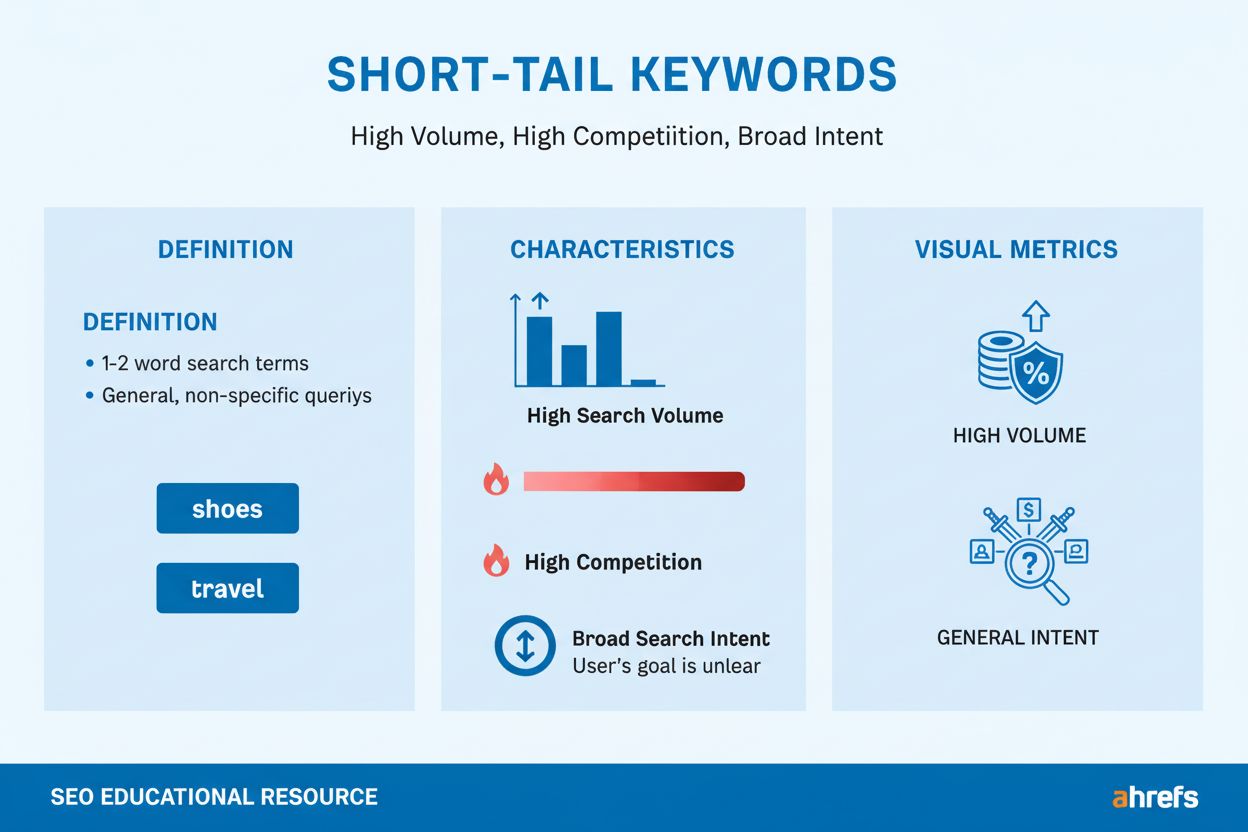
Short-tail keywords are broad, one to three-word search terms that target general topics with high search volume and intense competition. They represent the ‘head’ of the search demand curve and are often used as seed keywords to discover longer, more specific variations.
Short-tail keywords are broad, one to three-word search terms that target general topics with high search volume and intense competition. They represent the 'head' of the search demand curve and are often used as seed keywords to discover longer, more specific variations.
Short-tail keywords are broad, concise search terms typically consisting of one to three words that target general topics rather than specific niches. These keywords are also known as head terms, seed keywords, or focus keywords in SEO terminology. Short-tail keywords represent the “fat head” of the search demand curve, where the highest concentration of search volume occurs. They are characterized by high search volume, intense competition, and ambiguous search intent. For example, “fitness,” “shoes,” “travel,” and “recipes” are all short-tail keywords because they address entire categories rather than specific variations or user needs.
The importance of understanding short-tail keywords lies in their traffic potential and role in establishing domain authority. While they are significantly more difficult to rank for than their long-tail counterparts, successfully ranking for even a single short-tail keyword can drive thousands of monthly visitors to your website. Short-tail keywords serve as the foundation for comprehensive keyword strategies, as they often contain multiple long-tail variations within them. Understanding how to identify, target, and optimize for short-tail keywords is essential for any SEO professional or content marketer seeking to maximize organic visibility and brand presence.
The concept of short-tail keywords emerged from the analysis of search behavior patterns and the distribution of search queries across the internet. Research conducted by Backlinko analyzing 306 million keywords revealed that while 91.8% of all search queries are long-tail keywords, these account for only 3.3% of total search volume. Conversely, short-tail keywords represent a much smaller percentage of total queries but dominate the search volume landscape. This distribution follows what is known as the “search demand curve,” where a small number of high-volume keywords (short-tail) account for the majority of searches, while millions of low-volume keywords (long-tail) collectively represent a smaller portion.
The average keyword in Google search is 1.9 words in length, and keywords with 1-3 words receive approximately 10 times more searches than keywords with 5 or more words. According to industry data, the top 500 most popular search terms account for 8.4% of all search volume, while the top 2,000 keywords are responsible for 12.2% of all searches. This concentration of search demand in a relatively small number of terms demonstrates why short-tail keywords remain strategically important despite their competitive nature. The median search volume for a keyword is only 10 searches per month, but the average is 989 searches per month—a discrepancy that highlights how short-tail keywords skew the average upward due to their massive volumes.
| Characteristic | Short-Tail Keywords | Long-Tail Keywords |
|---|---|---|
| Word Count | 1-3 words | 3+ words (typically 4-5+) |
| Search Volume | Very high (thousands to millions monthly) | Low to moderate (10-1,000 monthly) |
| Competition Level | Extremely high | Low to moderate |
| Search Intent | Broad and ambiguous | Specific and clear |
| Conversion Rate | Lower (diverse audience) | Higher (targeted audience) |
| Ranking Difficulty | Very difficult | Easier |
| Cost Per Click (PPC) | Higher average ($0.61+) | Lower average |
| Examples | “shoes,” “fitness,” “travel” | “best running shoes for winter,” “home fitness routines for beginners” |
| Traffic Potential | Massive if ranked | Moderate but consistent |
| User Intent Clarity | Multiple intents (buy, learn, research) | Single, clear intent |
| Authority Building | Establishes domain authority | Targets niche audiences |
| Ranking Timeline | Months to years | Weeks to months |
Short-tail keywords operate within a specific technical framework that distinguishes them from longer search queries. The search demand curve demonstrates that these keywords occupy the “head” or “fat head” portion of the distribution, where search volume is concentrated. When analyzing keyword difficulty, research shows that each time search volume doubles, keyword difficulty increases by approximately 1.63 points. This means that short-tail keywords, with their exponentially higher search volumes, face proportionally higher competition levels in search engine results pages (SERPs).
The technical characteristics of short-tail keywords include their prevalence in SERP features. According to analysis of millions of search results, 97.6% of all Google searches contain at least one SERP feature, and this percentage is even higher for short-tail keywords. The most common SERP features appearing for short-tail queries include People Also Ask boxes (19.5%), image packs (19.4%), video results (17.9%), and Top Stories (15.5%). These features are more prevalent for short-tail keywords because they address broad topics where Google can provide diverse content formats. Additionally, short-tail keywords tend to have higher keyword difficulty scores, making them attractive targets for established websites with strong domain authority but challenging for newer or smaller sites.
The strategic importance of short-tail keywords has evolved significantly with the rise of AI search platforms and generative engine optimization (GEO). While traditional SEO focused on ranking for short-tail keywords to capture high-volume traffic, modern strategies recognize that short-tail keywords serve multiple purposes. In AI search environments like ChatGPT, Perplexity, Google AI Overviews, and Claude, short-tail keywords remain critical because AI systems often cite authoritative sources when answering broad queries. When a user asks an AI system a question related to a short-tail keyword topic, the AI is more likely to reference established, authoritative websites that rank well for that keyword.
For brands and content creators, monitoring visibility for short-tail keywords across AI platforms has become essential. Tools like AmICited track where brands appear in AI responses for specific keywords, helping organizations understand their visibility in this emerging search landscape. Short-tail keywords are particularly important in AI search because they represent the types of broad, informational queries that users frequently ask AI systems. A brand that ranks well for short-tail keywords in traditional search is more likely to be cited by AI systems when answering related questions. This makes short-tail keyword optimization a bridge between traditional SEO and AI search visibility, ensuring that brands maintain presence across all search modalities.
Successfully targeting short-tail keywords requires a strategic approach that acknowledges their competitive nature while leveraging their traffic potential. The first step is identifying short-tail keywords relevant to your industry or niche using keyword research tools. Tools like Google Keyword Planner, Ahrefs, SEMrush, and Rank Math allow you to enter seed keywords and filter results by search volume, keyword difficulty, and other metrics. Google Autocomplete provides a free method for discovering short-tail keywords—simply begin typing a broad term and observe the suggestions that appear. Additionally, analyzing competitor websites using tools like Ahrefs’ Site Explorer reveals which short-tail keywords competitors rank for, providing valuable insights for your own strategy.
Once you’ve identified target short-tail keywords, the next step is understanding search intent. Reviewing the top-ranking pages for your target short-tail keyword reveals what type of content Google considers most relevant. For example, if you target “fitness,” you need to understand whether the top results are informational (fitness guides), commercial (fitness products), or navigational (fitness brand websites). Creating content that matches this intent is crucial for ranking. Additionally, pairing short-tail keywords with long-tail variations amplifies your strategy’s effectiveness. If you target “fitness” as your short-tail keyword, also optimize for long-tail variations like “home fitness routines for beginners” or “fitness tips for weight loss.” This approach captures both broad and specific search intents while improving your rankings for the short-tail keyword itself.
The definition and strategic importance of short-tail keywords continue to evolve as search technology advances and user behavior changes. The emergence of AI search platforms has not diminished the importance of short-tail keywords; rather, it has expanded their relevance. As AI systems become more prevalent in search, the ability to rank well for short-tail keywords in traditional search becomes increasingly important for AI visibility. This is because AI systems often reference and cite websites that rank well for relevant keywords when generating responses to user queries.
Looking forward, the role of short-tail keywords in SEO strategy will likely shift toward a more integrated approach that combines traditional keyword optimization with semantic search and entity-based optimization. Search engines are increasingly moving away from exact keyword matching toward understanding user intent and topical relevance. However, short-tail keywords will remain important as indicators of broad topic areas and user interests. The rise of voice search and conversational queries may also influence how short-tail keywords are defined and targeted, as users increasingly ask questions rather than entering simple keyword phrases. Additionally, the integration of AI into search results means that brands must optimize not just for ranking in traditional SERPs but also for being cited and referenced by AI systems when answering questions related to short-tail keyword topics.
The future of short-tail keyword strategy will likely emphasize topical authority and comprehensive content coverage rather than narrow keyword targeting. Websites that create authoritative, comprehensive content addressing entire topics (represented by short-tail keywords) and their related subtopics (represented by long-tail keywords) will have the best chance of ranking well in both traditional search and AI search environments. This holistic approach recognizes that short-tail keywords represent broad topics that require deep, authoritative coverage to rank successfully. As search continues to evolve, the fundamental importance of understanding and strategically targeting short-tail keywords will remain constant, even as the tactics and tools used to optimize for them continue to change.
Short-tail keywords are 1-3 words long with high search volume and competition, while long-tail keywords are 3+ words with lower volume and less competition. Short-tail keywords are broader and attract diverse search intents, whereas long-tail keywords target specific user needs. According to Backlinko's analysis of 306M keywords, 91.8% of all searches are long-tail keywords, but they only account for 3.3% of total search volume, while short-tail keywords dominate the remaining 96.7% of searches.
Short-tail keywords drive massive traffic potential due to their high search volumes. Ranking for even one short-tail keyword can result in thousands of monthly visitors. Additionally, short-tail keywords establish domain authority and topical expertise in your niche. They also serve as seed keywords that help you discover and rank for related long-tail variations, creating a comprehensive keyword strategy that captures both broad and specific search intent.
You can find short-tail keywords using keyword research tools like Google Keyword Planner, Ahrefs, or SEMrush by entering seed keywords and filtering for high-volume terms. Google Autocomplete is a free method—simply type a broad term and observe suggestions. Additionally, analyze competitor websites to identify short-tail keywords they rank for, and review Google's 'People Also Ask' and 'Related Searches' sections for keyword ideas relevant to your industry.
Common short-tail keyword examples include 'fitness', 'shoes', 'travel', 'recipes', 'technology', 'health insurance', 'digital marketing', and 'yoga'. In e-commerce, 'running shoes' and 't-shirts' are short-tail keywords. In real estate, 'real estate' and 'apartments' are short-tail terms. These examples demonstrate how short-tail keywords are generic, broad terms that cover entire topics rather than specific variations or niches within those topics.
Short-tail keywords are more competitive because they attract massive search volumes, making them valuable targets for businesses across all industries. According to research, the top 500 keywords account for 8.4% of all search volume, creating intense competition for ranking positions. Additionally, short-tail keywords have unclear search intent, attracting diverse audiences with different needs, which means more websites attempt to rank for them. This high competition makes ranking difficult but potentially rewarding.
The best strategy is to target both short-tail and long-tail keywords as part of a balanced SEO approach. Short-tail keywords provide high-volume traffic opportunities and establish authority, while long-tail keywords offer easier ranking opportunities with higher conversion rates. By optimizing for long-tail keywords, you naturally improve rankings for related short-tail keywords since long-tail terms contain the seed keyword. This dual approach maximizes both visibility and qualified traffic.
In AI search environments like ChatGPT, Perplexity, and Google AI Overviews, short-tail keywords remain important for brand visibility. AI systems often cite authoritative sources for broad queries, making short-tail keyword rankings critical for brand mentions in AI responses. Monitoring where your brand appears for short-tail keyword queries helps track overall visibility and authority. Tools like AmICited track brand mentions across AI platforms, helping you understand how your domain performs for these high-volume, broad search terms.
Start tracking how AI chatbots mention your brand across ChatGPT, Perplexity, and other platforms. Get actionable insights to improve your AI presence.
Long-tail keywords are specific multi-word search phrases with lower competition and higher conversion intent. Learn how they drive qualified traffic and improv...
Search volume measures how many times keywords are searched monthly. Learn how to use search volume data for keyword research, SEO strategy, and understanding u...
Learn what keyword stuffing is and how AI systems like ChatGPT and Perplexity detect it. Understand AI detection methods and why keyword stuffing fails in moder...
Cookie Consent
We use cookies to enhance your browsing experience and analyze our traffic. See our privacy policy.