

Content Length
Content length measures content size in words, characters, and bytes. Learn how it affects SEO rankings, AI citations, and user engagement across platforms.
12 min read
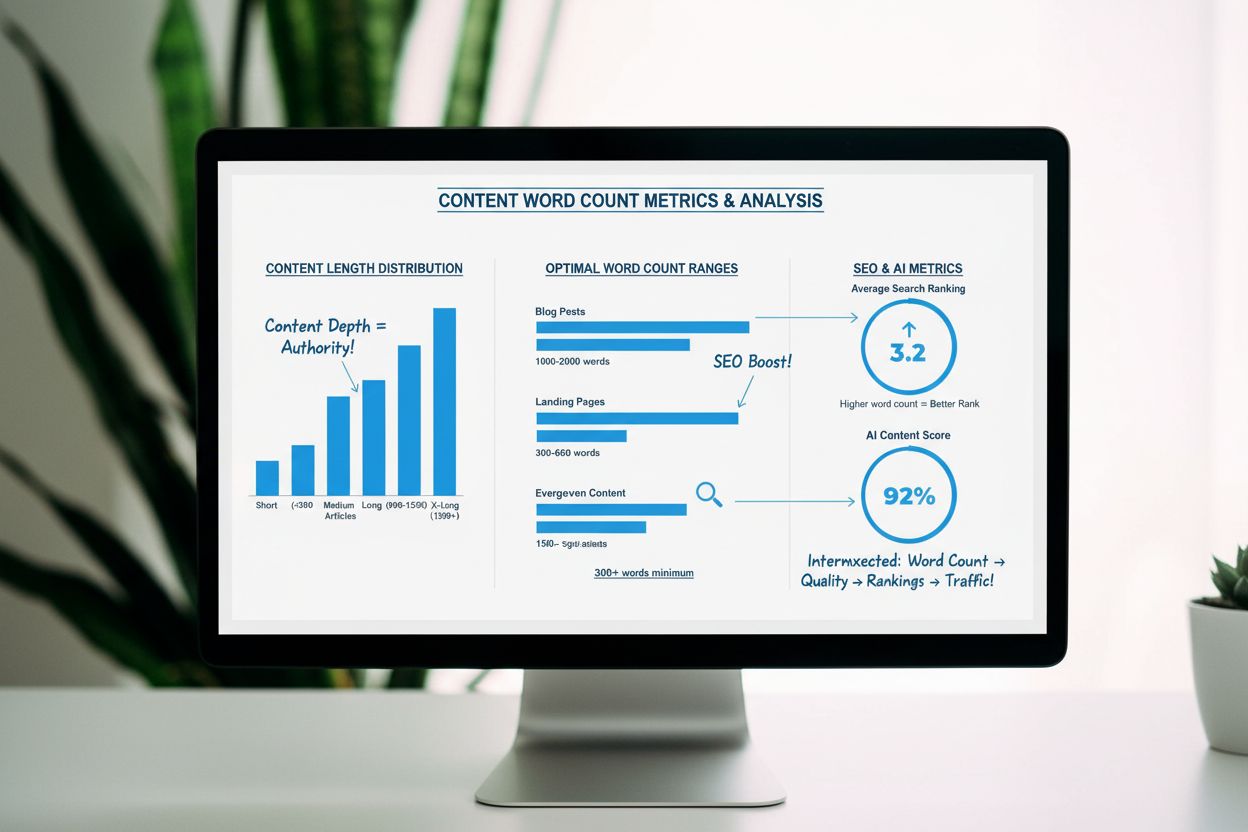
Word count is the total number of words in a piece of content, serving as a metric for content length and depth. While not a direct Google ranking factor, word count influences how comprehensively a topic can be covered and impacts content quality, user experience, and SEO performance across platforms like ChatGPT, Perplexity, and Google AI Overviews.
Word count is the total number of words in a piece of content, serving as a metric for content length and depth. While not a direct Google ranking factor, word count influences how comprehensively a topic can be covered and impacts content quality, user experience, and SEO performance across platforms like ChatGPT, Perplexity, and Google AI Overviews.
Word count is the total number of words contained in a piece of written content, serving as a fundamental metric for measuring content length and depth. In the context of content creation, SEO, and digital marketing, word count represents the volume of text within articles, blog posts, web pages, product descriptions, and other written materials. While word count itself is not a direct ranking factor according to Google’s official statements, it plays a significant indirect role in content quality, user experience, and search engine visibility. The metric has become increasingly important in the era of AI content monitoring, where platforms like AmICited track how content of varying lengths appears across AI systems such as ChatGPT, Perplexity, Google AI Overviews, and Claude. Understanding word count helps content creators, marketers, and SEO professionals optimize their content strategy to balance comprehensiveness with readability and user engagement.
The concept of word count as a content metric has evolved significantly over the past two decades. In the early days of search engine optimization, there was a widespread belief that longer content automatically ranked better, leading many marketers to artificially inflate article lengths with filler content. However, this approach proved counterproductive as search engines became more sophisticated at evaluating content quality. According to research from Orbit Media, the average blog post length has increased by 77% over the past 10 years, rising from approximately 800 words in 2014 to around 1,400 words in 2024. This trend reflects both the increasing complexity of topics and the growing recognition that comprehensive content tends to perform better in search results. Google’s evolution in content evaluation has been particularly significant—the search giant explicitly removed references to minimum word counts from its official documentation, with Danny Sullivan, Google’s Search Liaison, stating that “the best word count needed to succeed in Google Search is not a thing.” This shift represents a fundamental change in how search engines evaluate content, moving away from quantitative metrics toward qualitative assessment of relevance, expertise, and user satisfaction.
A critical distinction exists between content length and content depth, two concepts often confused in SEO discussions. Content length refers simply to the number of words on a page, while content depth encompasses the thoroughness with which a topic is covered, including the comprehensiveness of explanations, the breadth of subtopics addressed, and the quality of supporting evidence. Research from Clearscope and other content analysis platforms demonstrates that topical coverage has emerged as the most important on-page ranking factor in 2025, surpassing simple word count metrics. A 600-word article that thoroughly answers a user’s question with clear explanations and relevant examples can outperform a 3,000-word article that rambles without providing genuine value. The distinction matters particularly for AI content monitoring, where systems like Perplexity and Google AI Overviews evaluate content based on informativeness and relevance rather than raw length. When content creators focus on depth—ensuring every section serves a clear purpose and contributes meaningfully to answering the user’s query—the word count naturally increases to appropriate levels without requiring artificial padding.
| Content Type | Recommended Word Count | Primary Purpose | Key Characteristics |
|---|---|---|---|
| Product Descriptions | 200-500 words | Inform and convert | Concise, benefit-focused, trust-building |
| News/Announcement Articles | 400-700 words | Communicate quickly | Time-sensitive, clear structure, key facts upfront |
| Blog Posts (Informational) | 1,000-1,500 words | Build authority | Keyword-rich, well-structured, comprehensive |
| How-To Guides | 1,500-2,500 words | Educate and guide | Step-by-step, detailed instructions, examples |
| Cornerstone/Pillar Content | 2,500-5,000+ words | Establish expertise | In-depth coverage, multiple subtopics, internal linking |
| Landing Pages | 300-1,000 words | Drive conversions | Persuasive, benefit-focused, clear CTA |
| Case Studies | 1,500-3,000 words | Demonstrate value | Real-world examples, metrics, social proof |
| FAQ Sections | 50-200 words per answer | Address concerns | Concise answers, scannable format, relevant |
This table illustrates that optimal word count varies significantly based on content purpose and audience expectations. Research from Semrush indicates that articles with 3,000+ words generate approximately 138% more organic traffic than those under 500 words, though this correlation reflects the comprehensiveness of longer content rather than a direct causation from word count itself. The data shows that cornerstone content and pillar pages consistently benefit from longer word counts because they serve as foundational resources that establish topical authority and support internal linking strategies.
While Google has definitively stated that word count is not a ranking factor, the metric influences SEO performance through several indirect mechanisms. First, longer content provides more opportunities for keyword inclusion, allowing writers to naturally incorporate target keywords, long-tail variations, and semantic synonyms without keyword stuffing. A 2,000-word article can address multiple keyword variations and related search queries that a 500-word piece cannot accommodate. Second, comprehensive content demonstrates topical authority and expertise, signaling to search engines that the author understands the subject matter deeply. Third, longer articles typically include more internal linking opportunities, which help distribute page authority throughout a website and improve overall site structure. Fourth, in-depth content is more likely to be cited and linked to by other websites, generating backlinks that remain one of Google’s most important ranking factors. According to Backlinko’s research, the average first-page Google result contains approximately 1,447 words, though this reflects correlation rather than causation. The key insight is that word count matters insofar as it enables better coverage of topics, but quality and relevance always supersede quantity.
In the emerging landscape of AI content monitoring, word count has taken on new significance. Platforms like AmICited track how brand mentions and content appear across AI systems including ChatGPT, Perplexity, Google AI Overviews, and Claude. Research indicates that longer, more comprehensive content is significantly more likely to be cited by AI systems because these platforms prioritize detailed, authoritative sources when generating responses. When an AI system needs to provide a thorough answer to a user query, it tends to draw from longer articles that offer more context and information. This creates an important consideration for brands and content creators: content with adequate word count (typically 1,000+ words) has higher visibility and citation rates across AI platforms. Additionally, word count patterns are used in AI detection tools to assess content authenticity. AI-generated content often exhibits different word count distributions and length patterns compared to human-written content, making word count analysis a component of content authenticity verification. For organizations using AmICited to monitor their brand presence in AI responses, understanding optimal word count ranges helps ensure their content is discoverable and citable by AI systems.
Determining the right word count for any piece of content requires a systematic approach rather than arbitrary target-setting. The first step involves understanding search intent—identifying whether users are seeking quick answers (navigational intent), educational information (informational intent), or solutions to problems (transactional intent). Navigational searches typically require shorter content, while informational searches often benefit from comprehensive coverage. The second step is analyzing top-ranking competitors for your target keyword. Tools like Semrush’s SEO Content Template provide data on average word counts, readability levels, and semantic coverage of top-ranking pages. This competitive analysis reveals what search engines currently consider sufficient for your topic. The third step involves creating a detailed outline before writing, which helps ensure you cover all necessary subtopics and prevents both under-coverage and unnecessary padding. The fourth step is writing naturally to cover your topic thoroughly, allowing the word count to emerge organically from comprehensive coverage rather than forcing content to reach an arbitrary number. Finally, editing for conciseness ensures every word adds value—removing redundancy, eliminating filler, and tightening language without sacrificing clarity or completeness.
The relationship between word count and user experience is nuanced and context-dependent. Readability and scannability matter more than raw length—a well-structured 2,000-word article with clear headings, short paragraphs, and visual elements can be more engaging than a dense 1,500-word piece. Research on user behavior shows that readers don’t necessarily avoid longer content; they avoid content that feels long and difficult to navigate. Effective formatting techniques include using descriptive subheadings that allow readers to quickly find relevant sections, breaking text into short paragraphs (typically 2-4 sentences), incorporating bullet points and numbered lists for easy scanning, and including relevant images, infographics, and videos that break up text and provide visual explanations. For mobile users, who represent over 60% of web traffic, word count considerations become even more important—longer articles must be particularly well-structured to remain readable on smaller screens. The principle of progressive disclosure—revealing information gradually rather than overwhelming readers upfront—helps longer content maintain engagement. Additionally, internal linking within longer content helps readers navigate to related topics without feeling lost in a single massive article, improving both user experience and SEO performance.
Several persistent myths about word count continue to mislead content creators and marketers. The first major myth is that “more words automatically mean better rankings.” This misconception has been repeatedly debunked by Google officials and contradicted by real-world examples where shorter, more focused content outranks longer, less relevant pieces. The second myth is that “there is a magic word count number that guarantees success,” leading some marketers to obsess over hitting specific targets like 2,000 or 3,000 words. In reality, the appropriate word count varies dramatically based on topic complexity, audience needs, and search intent. The third myth is that “word count doesn’t matter at all,” which misses the indirect ways word count influences content quality and comprehensiveness. The fourth myth is that “longer content always gets more shares and engagement,” when research actually shows that social shares follow different patterns than search rankings—some shorter, more shareable content generates significant social engagement despite lower search visibility. The fifth myth is that “you should add content just to increase word count,” which often results in thin, repetitive content that damages user experience and can trigger Google’s helpful content updates. Understanding these myths helps content creators make evidence-based decisions about word count rather than following outdated SEO folklore.
The future of word count as a content metric is evolving in response to advances in artificial intelligence and natural language processing. Semantic understanding is increasingly replacing simple word counting—search engines and AI systems now evaluate meaning and relevance rather than surface-level metrics. This shift means that topical coverage and entity relationships matter more than word count, as AI systems can understand whether a 500-word article comprehensively covers a topic better than a 3,000-word piece that rambles. The rise of AI-generated content has also changed how word count is perceived; some AI-generated articles are extremely long but lack genuine depth, while some human-written pieces are concise but highly authoritative. This has accelerated the move toward quality-based evaluation rather than length-based metrics. Additionally, the emergence of multimodal content (combining text, video, images, and interactive elements) is changing how content length is measured and evaluated. A comprehensive guide that combines 1,500 words of text with embedded videos and interactive tools may provide more value than a 3,000-word text-only article. For AI monitoring platforms like AmICited, the future involves tracking not just word count but the overall comprehensiveness and authority of content as it appears across different AI systems. Organizations should prepare for a content landscape where depth, relevance, and expertise matter far more than arbitrary word counts, while still recognizing that adequate length enables comprehensive coverage of complex topics.
No, word count is not a direct Google ranking factor. Google officials, including John Mueller and Danny Sullivan, have explicitly stated that word count alone does not influence rankings. However, word count indirectly affects SEO because longer content provides more opportunities to cover topics comprehensively, include relevant keywords, and demonstrate expertise. Google prioritizes content quality and relevance over arbitrary word counts, meaning a well-written 500-word article can outrank a poorly written 3,000-word piece.
The optimal word count for blog posts typically ranges from 1,500 to 2,500 words, though this varies by topic and search intent. Research from Semrush shows that articles with 3,000+ words generate 138% more organic traffic than those under 500 words. However, the ideal length depends on your audience's needs, the complexity of the topic, and what competitors are ranking for. Short, focused posts can rank well for specific queries, while comprehensive guides may require 2,000+ words to fully address user intent.
Word count is a significant metric in AI content monitoring platforms like AmICited, which track brand mentions across AI systems such as ChatGPT, Perplexity, and Google AI Overviews. Longer content pieces are more likely to be cited by AI systems because they provide more comprehensive information and context. AI detection tools analyze word count patterns to assess content authenticity, as AI-generated content often exhibits different length distributions and word choice patterns compared to human-written content.
The minimum recommended word count for SEO is 300 words for regular blog posts, 200 words for product descriptions, and 900 words for cornerstone content. These minimums help prevent thin content that lacks sufficient context and depth. However, these are guidelines rather than hard rules—a well-researched 250-word article addressing a specific question can rank well if it thoroughly answers the user's query. The key is ensuring your content provides genuine value rather than simply meeting a word count threshold.
Not necessarily. While longer content often ranks higher on average, this correlation doesn't mean length causes better rankings. Longer articles perform better because they typically cover topics more comprehensively, include more relevant keywords naturally, and demonstrate greater expertise. A concise, high-quality article that perfectly answers a user's question can outrank a lengthy article filled with filler content. Success depends on matching content length to search intent and ensuring every word adds value to the reader.
Determine the right word count by analyzing your target audience's needs, understanding search intent, and studying top-ranking competitors. First, identify what your audience is searching for and how much information they need. Second, examine the top 10 ranking pages for your target keyword to understand the expected content depth. Third, create an outline covering all necessary subtopics before writing. Finally, write naturally to cover your topic thoroughly without adding unnecessary filler—the word count will naturally reflect the depth required.
Word count significantly impacts how AI systems like ChatGPT, Perplexity, and Google AI Overviews discover and cite content. Longer, more comprehensive articles are more likely to be included in AI training data and cited in AI-generated responses because they provide richer context and more detailed information. Monitoring platforms like AmICited track these citations, and content with adequate word count (typically 1,000+ words) has higher visibility across AI platforms. This makes word count an important consideration for brands seeking AI citation and visibility.
Start tracking how AI chatbots mention your brand across ChatGPT, Perplexity, and other platforms. Get actionable insights to improve your AI presence.
Content length measures content size in words, characters, and bytes. Learn how it affects SEO rankings, AI citations, and user engagement across platforms.

Content depth is the comprehensive coverage of a topic with detailed sections, expert insights, and data. Learn how content depth impacts AI citations, rankings...

Keyword density measures how often a keyword appears in content relative to total word count. Learn optimal percentages, best practices, and how it impacts AI s...
Cookie Consent
We use cookies to enhance your browsing experience and analyze our traffic. See our privacy policy.