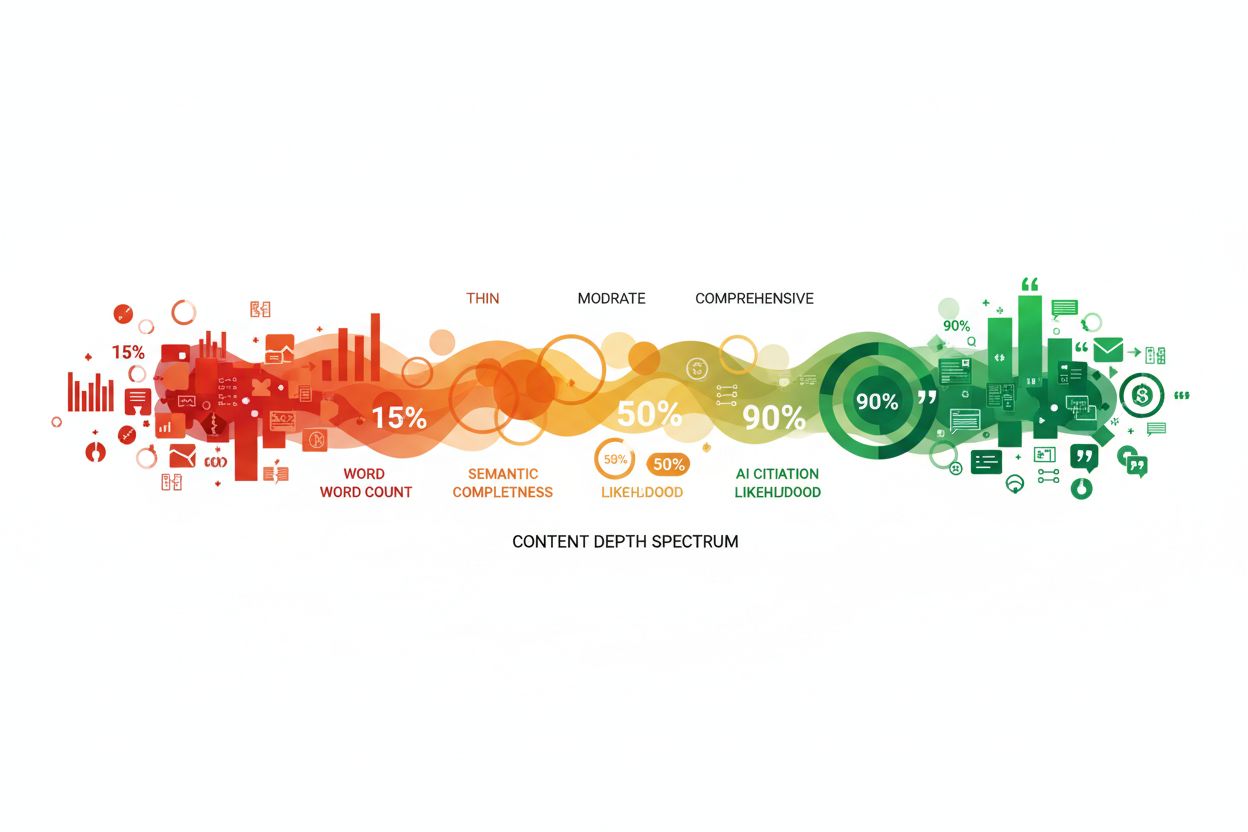
Definition of Content Depth
Content depth is the comprehensive and thorough coverage of a topic within a piece of content, measuring how completely and richly a subject is explored through detailed sections, expert insights, statistical data, and interconnected information. Unlike content length, which simply measures word count, content depth focuses on the quality, richness, and completeness of information provided. It represents how well a piece of content addresses all relevant subtopics, answers user questions, and provides genuine value that distinguishes it from surface-level treatments of the same subject. In the context of modern SEO and AI visibility, content depth has become a critical ranking factor and a primary determinant of whether content receives citations in AI-generated responses across platforms like ChatGPT, Perplexity, Google AI Overviews, and Claude.
Context and Historical Evolution of Content Depth
The concept of content depth has evolved significantly alongside search engine algorithm development and the emergence of AI-powered search systems. Historically, SEO practitioners focused primarily on keyword density and meta tag optimization, treating content as a vehicle for keyword placement rather than a medium for genuine expertise. This approach created an ecosystem of thin, repetitive content that provided minimal value to readers. As search algorithms became more sophisticated—particularly with Google’s introduction of BERT, MUM, and SGE technologies—the industry recognized that content depth was far more important than keyword frequency. Today, content depth is recognized as a fundamental pillar of topical authority and a key factor influencing both traditional search rankings and AI citations.
Recent research from SE Ranking analyzing 129,000 unique domains across 216,524 pages revealed compelling evidence of content depth’s importance. Articles under 800 words averaged only 3.2 AI citations, while those exceeding 2,900 words averaged 5.1 citations—a 59% increase. More significantly, the research identified that content depth manifests through multiple dimensions: section structure, data integration, expert perspectives, and content freshness. Pages with section lengths of 120-180 words between headings performed best, averaging 4.6 citations, while extremely short sections under 50 words averaged just 2.7 citations. This data demonstrates that content depth is not simply about writing more words, but about organizing information in ways that demonstrate comprehensive expertise and provide genuine value to readers and AI systems alike.
Content Depth vs. Related Concepts: Comparison Table
| Aspect | Content Depth | Content Breadth | Content Length | Topical Authority |
|---|
| Definition | Thoroughness of coverage within a single topic | Range of related topics covered across content | Total word count or volume of text | Established expertise across interconnected topics |
| Focus | Quality and richness of information | Variety and scope of subject matter | Quantity of words or pages | Comprehensive mastery of topic ecosystem |
| Measurement | Section structure, data points, expert quotes | Number of subtopics addressed | Word count (typically 800-2,900+ words) | Backlinks, citations, rankings across topic cluster |
| AI Citation Impact | High—directly influences citation likelihood | Medium—supports depth through context | Medium—only when filled with substantive content | Very High—combines depth and breadth for authority |
| Example | 2,500-word article with 15+ data points, expert quotes, and detailed subsections | Multiple articles covering related aspects of a topic | 5,000-word article that may lack organization or focus | Pillar page + 8-10 supporting articles internally linked |
| User Experience | Readers find comprehensive answers in one place | Readers navigate multiple resources for full understanding | Readers may encounter filler or repetition | Readers experience authoritative, interconnected resources |
| Search Engine Signal | Demonstrates expertise and E-E-A-T | Demonstrates topical relevance and context | Weak signal without substantive content | Strong signal of domain authority and expertise |
Technical Explanation: How Content Depth Works
Content depth operates through multiple interconnected mechanisms that signal expertise to both search engines and AI systems. At the foundational level, content depth is achieved through comprehensive topic mapping—identifying all relevant subtopics, questions, and angles related to a primary subject. This requires research into user search behavior, competitor content analysis, and subject matter expertise to determine what information is essential for complete understanding. Once identified, these elements must be organized into a logical hierarchy with clear relationships between concepts.
The structural dimension of content depth involves organizing information into sections of optimal length. Research indicates that sections of 120-180 words between headings create the ideal balance between comprehensiveness and readability. This structure allows readers to absorb complex information in digestible chunks while signaling to search engines that content is well-organized and addresses multiple aspects of a topic. Within these sections, content depth is enhanced through the integration of multiple information types: explanatory text that provides context, statistical data that supports claims, expert quotes that add credibility, case studies that demonstrate real-world application, and visual elements that clarify complex concepts.
The interconnection dimension of content depth involves strategic internal linking that creates topical clusters. Rather than treating each piece of content as an isolated asset, content depth is amplified when content pieces reference and link to related resources. This creates a web of interconnected information that collectively demonstrates comprehensive expertise. For example, a deep article on “content marketing strategy” gains additional depth when it links to supporting articles on “content distribution channels,” “audience segmentation,” and “content performance metrics.” These internal links serve multiple functions: they guide readers to additional relevant information, they distribute authority throughout the content cluster, and they signal to search engines that your domain comprehensively covers the topic.
Business and Practical Impact of Content Depth
The business impact of content depth extends far beyond search rankings and AI citations. Organizations that prioritize content depth experience measurable improvements in multiple business metrics. First, content depth directly influences conversion rates by providing comprehensive information that addresses buyer concerns and objections. When potential customers find thorough, well-researched content that answers their questions completely, they develop greater confidence in the organization’s expertise and are more likely to proceed with purchasing decisions or requesting consultations.
Second, content depth reduces customer acquisition costs by improving organic visibility and reducing dependence on paid advertising. Content that demonstrates genuine expertise attracts organic traffic through search engines and social sharing, decreasing reliance on expensive paid channels. Research shows that organizations investing in content depth experience 40-60% lower cost-per-acquisition compared to those relying primarily on thin content and paid advertising. This efficiency compounds over time as deep content continues generating traffic and leads months or years after publication.
Third, content depth builds brand authority and trust within target markets. When organizations consistently publish comprehensive, well-researched content that thoroughly addresses audience needs, they establish themselves as thought leaders and trusted resources. This authority translates into higher customer lifetime value, increased repeat business, and stronger word-of-mouth referrals. Additionally, content depth improves employee recruitment and retention by establishing the organization as an industry authority, making it more attractive to top talent seeking to work for recognized experts.
Fourth, content depth directly impacts AI visibility and brand mentions in AI-generated responses. As AI systems become primary discovery mechanisms for information, organizations with deep content receive more citations in AI responses. This visibility is particularly valuable because AI citations often appear before traditional search results in emerging AI search interfaces, providing prime positioning for brand awareness and traffic generation. Organizations tracking their AI visibility through platforms like AmICited can measure the direct correlation between content depth investments and increased AI citations.
Platform-Specific Considerations: Content Depth Across AI Systems
Different AI platforms weight content depth factors differently, though all prioritize comprehensive, well-researched content. ChatGPT citations correlate strongly with content depth metrics including word count, section structure, and data integration. Research shows that ChatGPT preferentially cites content with 2,900+ words, well-organized sections, and multiple data points. However, ChatGPT also values freshness—content updated within three months averaged 6 citations compared to 3.6 for outdated content. This suggests that ChatGPT’s citation algorithm considers both depth and recency, rewarding organizations that maintain their content over time.
Perplexity demonstrates similar preferences for content depth but places additional emphasis on source diversity and citation credibility. Perplexity’s algorithm appears to favor content from established domains with strong backlink profiles and high domain authority. Organizations seeking Perplexity citations should focus on building content depth while simultaneously developing authority signals through backlink acquisition and community engagement on platforms like Quora and Reddit.
Google AI Overviews (formerly SGE) prioritize content depth that aligns with Google’s E-E-A-T framework. Content demonstrating experience, expertise, authoritativeness, and trustworthiness receives preferential treatment in AI Overviews. This means content depth should include author credentials, publication dates, expert quotes, and citations to authoritative sources. Google AI Overviews also favor content that directly answers user queries with clear, structured information, making scannable formatting and logical organization critical components of content depth for this platform.
Claude appears to value content depth that demonstrates nuanced understanding and acknowledges complexity. Claude’s citations tend to favor content that explores multiple perspectives, acknowledges limitations, and provides balanced analysis. This suggests that content depth for Claude should include discussion of counterarguments, limitations of approaches, and nuanced exploration of topics rather than purely promotional or one-sided content.
Implementation and Best Practices for Content Depth
Implementing content depth effectively requires a systematic approach that begins with strategic planning and continues through ongoing optimization. The first step involves conducting comprehensive topic research to identify all relevant subtopics, questions, and angles that should be addressed. This research should include analysis of competitor content, review of search query data, examination of customer questions and objections, and consultation with subject matter experts. Tools like MarketMuse, Clearscope, and TopicSeed can automate aspects of this research by identifying content gaps and suggesting subtopics that competitors have covered.
The second step involves creating a content outline that organizes identified topics into a logical hierarchy. This outline should map the relationship between concepts, identify which topics warrant deeper exploration, and determine optimal section lengths. A well-structured outline for content depth typically includes an introduction that establishes context and importance, multiple body sections addressing distinct subtopics (each 120-180 words), and a conclusion that synthesizes information and guides readers to next steps. The outline should also identify opportunities for internal linking to related content and external linking to authoritative sources.
The third step involves writing content that prioritizes clarity and comprehensiveness over word count. Writers should focus on thoroughly explaining concepts, providing specific examples, integrating relevant data, and addressing potential reader questions. Content depth is achieved through substantive exploration of topics rather than repetition or filler content. Each section should advance reader understanding and provide information not easily found elsewhere. This requires original research, unique perspectives, or comprehensive synthesis of existing information presented in a more useful format than competitors provide.
The fourth step involves integrating multiple information types that enhance content depth. This includes statistical data that supports claims (research shows content with 19+ data points averages 5.4 AI citations), expert quotes that add credibility, case studies that demonstrate real-world application, visual elements that clarify complex concepts, and original research or surveys that provide unique insights. Each information type serves a specific function in building content depth and signaling expertise to readers and search engines.
The fifth step involves strategic internal linking that creates topical clusters and amplifies content depth. Rather than randomly linking to related content, internal linking should follow a deliberate strategy that connects content pieces in ways that build topical authority. A pillar page on a core topic should link to multiple supporting articles that explore specific subtopics in depth. These supporting articles should link back to the pillar page and to each other, creating an interconnected web of content that collectively demonstrates comprehensive expertise.
Key Aspects and Benefits of Content Depth
- Improved AI Citations: Content with strong depth metrics receives 40-60% more citations in AI-generated responses across ChatGPT, Perplexity, Google AI Overviews, and Claude
- Higher Search Rankings: Deep content demonstrates expertise and E-E-A-T signals that search algorithms reward with improved rankings for target keywords
- Increased Organic Traffic: Comprehensive content attracts more organic search traffic and generates more social shares, reducing reliance on paid advertising
- Better User Engagement: Readers spend more time on deep content, scroll further, and explore more pages within content clusters
- Stronger Topical Authority: Content depth combined with breadth establishes domain authority that compounds over time and attracts quality backlinks
- Reduced Content Decay: Deep, well-researched content remains relevant longer and requires less frequent updates compared to thin content
- Improved Conversion Rates: Comprehensive information that addresses buyer concerns and objections increases conversion likelihood
- Enhanced Brand Credibility: Organizations publishing deep content establish themselves as thought leaders and trusted resources within their industries
- Lower Customer Acquisition Costs: Organic visibility from deep content reduces dependence on expensive paid advertising channels
- Competitive Differentiation: Deep content that provides unique insights or perspectives differentiates organizations from competitors
Future Outlook: Evolution of Content Depth in AI-Driven Search
The importance of content depth will continue increasing as AI systems become primary discovery mechanisms for information. Future developments suggest several trends that will shape how content depth is defined and measured. First, AI systems will likely become more sophisticated in evaluating content depth through natural language processing that assesses not just word count or section structure, but the actual quality and originality of information provided. This means that content depth will increasingly reward original research, unique perspectives, and substantive analysis over mere comprehensiveness.
Second, content depth will become increasingly interconnected with real-time information and freshness signals. As AI systems prioritize current information, organizations will need to maintain content depth through continuous updates and additions rather than one-time comprehensive pieces. This represents a shift from treating content as static assets to viewing them as living resources that evolve with industry developments and emerging research.
Third, content depth will become more specialized and audience-specific. Rather than creating one comprehensive piece for all audiences, organizations will develop multiple pieces of content depth targeting different audience segments, expertise levels, and use cases. This specialization allows organizations to provide optimal depth for each audience segment while maintaining overall topical authority through interconnected content clusters.
Fourth, content depth measurement will become more sophisticated through integration with AI visibility tracking platforms. Organizations will move beyond traditional SEO metrics to measure content depth effectiveness through AI citation frequency, appearance in AI Overviews, and correlation with business outcomes. Platforms like AmICited enable organizations to track exactly how their deep content appears across AI systems and adjust strategy based on real performance data.
Fifth, content depth will increasingly incorporate multimedia and interactive elements that enhance comprehension and engagement. Rather than relying solely on text, deep content will integrate videos, interactive tools, data visualizations, and other formats that help audiences understand complex topics more effectively. This multimedia approach to content depth will appeal to diverse learning styles and improve both user engagement and AI system evaluation of content quality.
The organizations that thrive in this AI-driven landscape will be those that recognize content depth not as a one-time SEO tactic but as a fundamental commitment to providing genuine value to their audiences. By investing in comprehensive, well-researched, regularly updated content that demonstrates true expertise, organizations position themselves for success across both traditional search and emerging AI discovery systems. The future belongs to those who prioritize depth over volume, quality over quantity, and genuine expertise over optimization tricks.