

Innehållets färskhet för AI-sök: Varför det är viktigare än någonsin
Lär dig varför innehållets färskhet är avgörande för synlighet i AI-sök. Upptäck hur ChatGPT, Perplexity och andra AI-motorer prioriterar färskt innehåll och hu...
8 min läsning
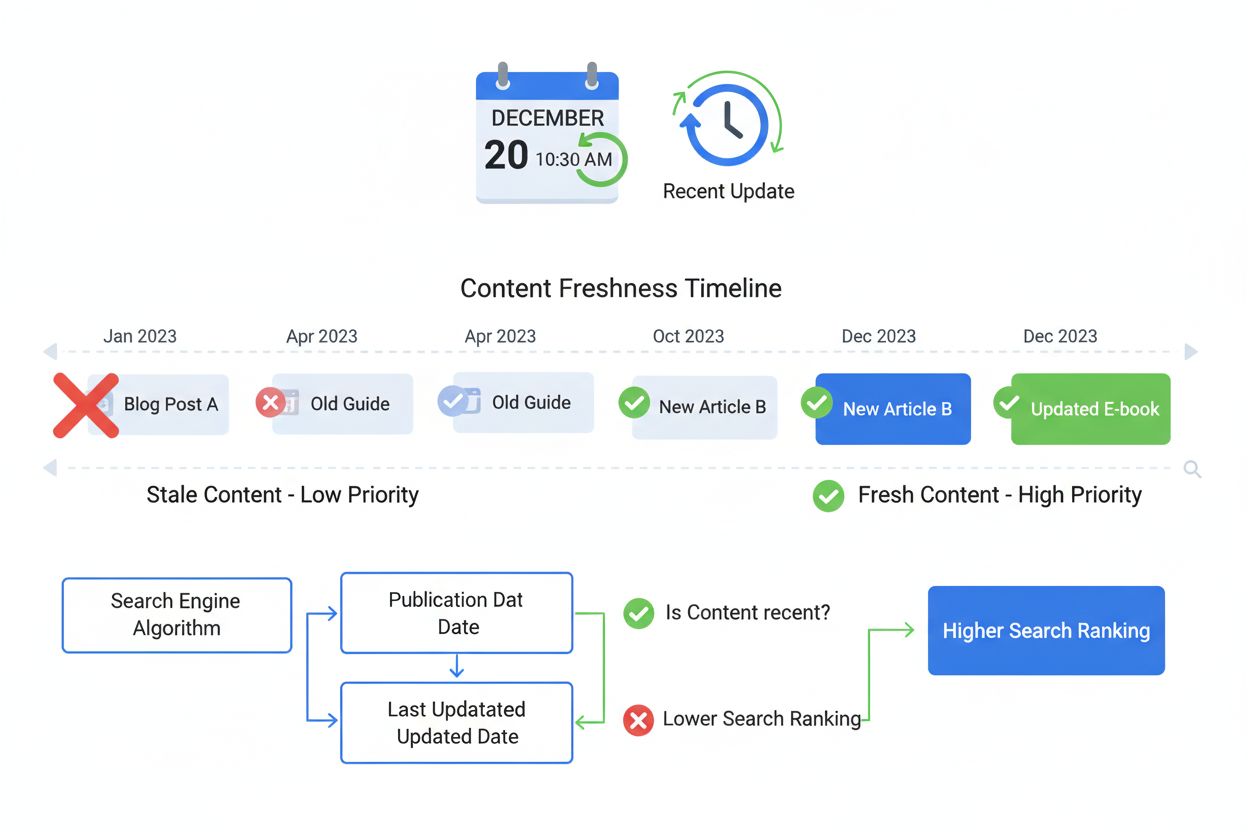
En färskhetssignal är en rankningsfaktor som utvärderar hur nyligen en webbsida har publicerats eller väsentligt uppdaterats, och påverkar dess synlighet i sökresultat och AI-genererade svar. Sökmotorer och AI-plattformar prioriterar färskt innehåll för tidskänsliga sökningar där aktualitet direkt påverkar informationsnoggrannhet och relevans.
En färskhetssignal är en rankningsfaktor som utvärderar hur nyligen en webbsida har publicerats eller väsentligt uppdaterats, och påverkar dess synlighet i sökresultat och AI-genererade svar. Sökmotorer och AI-plattformar prioriterar färskt innehåll för tidskänsliga sökningar där aktualitet direkt påverkar informationsnoggrannhet och relevans.
Freshness signal is a ranking factor that search engines and AI platforms use to evaluate how recently a web page was published or significantly updated, and how this recency should influence its visibility in search results and AI-generated responses. The freshness signal measures content timeliness through multiple indicators including publication date, modification date, update frequency, and the volume of content changes. This signal became particularly important after Google’s 2011 Freshness Algorithm update, which fundamentally changed how search results are ranked for time-sensitive queries. Today, freshness signals play an even more critical role in AI search platforms like ChatGPT, Perplexity, and Google AI Overviews, where content decay happens significantly faster than traditional search. Understanding freshness signals is essential for any organization seeking visibility across both traditional search and emerging AI search channels, as the recency of your content directly impacts whether your brand gets cited when AI systems answer user questions.
The concept of content freshness in search ranking emerged gradually before becoming formalized through Google’s 2011 Freshness Algorithm update. Prior to this update, Google’s ranking systems treated all content relatively equally regardless of publication date, assuming that older, more established content was inherently more authoritative. However, this approach created problems for users seeking current information—a five-year-old article about smartphone technology would rank alongside brand-new reviews of the latest models, despite being largely obsolete. The Freshness Algorithm changed this paradigm by introducing time as a relevance measure, enabling Google to surface content that was literally up-to-the-minute relevant for queries where recency mattered. Google’s official announcement stated that the update impacted approximately 35% of all search queries, with noticeable effects on 6-10% of searches. This represented one of the most significant algorithmic shifts in search history, demonstrating that freshness had become a core ranking principle rather than a minor signal.
The infrastructure enabling the Freshness Algorithm came from Google’s Caffeine update, released five months earlier in 2010. Caffeine fundamentally transformed Google’s indexing infrastructure, enabling the search engine to process and index web content at unprecedented scale and speed. Before Caffeine, Google’s indexing system operated on a batch-processing model that could take weeks to fully crawl and index the web. Caffeine introduced continuous, real-time indexing that could detect and process new content within minutes of publication. This technological foundation made the Freshness Algorithm possible—without the ability to rapidly detect and index new content, Google couldn’t effectively prioritize fresh results. The combination of Caffeine’s infrastructure and the Freshness Algorithm’s logic created a system where breaking news could rank within hours of publication, and regularly updated content could maintain top positions indefinitely.
Search engines employ sophisticated methodologies to assess content freshness, moving far beyond simple publication date comparisons. Google’s freshness measurement considers multiple signals that collectively determine a page’s freshness score. The page inception date—when a page was first indexed by Google—provides the baseline. However, more important than initial publication is the modification date, which indicates when the page was last substantially changed. Google distinguishes between minor edits (fixing typos, correcting links) and major updates (rewriting sections, adding new content, restructuring information). Only significant changes contribute meaningfully to freshness signals; cosmetic edits don’t reset the freshness clock. The frequency of updates matters substantially—pages that change regularly signal ongoing maintenance and relevance, while pages that never change suggest abandonment. The volume of content change also factors in; adding an entire new section signals more freshness than updating a single sentence. Additionally, the freshness of backlinks pointing to your page influences your freshness score—links from recently updated, high-freshness sites transfer some of that freshness signal to your page.
Research from Moz and other SEO authorities has documented these freshness measurement factors through extensive analysis of ranking patterns. Pages showing consistent update patterns across multiple signals achieve substantially higher freshness scores than pages with sporadic or minimal changes. Interestingly, the relationship between freshness and ranking isn’t linear—a page updated daily doesn’t necessarily rank twice as well as one updated weekly. Instead, freshness signals interact with other ranking factors like relevance, authority, and user experience. A highly authoritative page updated monthly might outrank a low-authority page updated daily, demonstrating that freshness amplifies existing authority rather than replacing it. This nuanced relationship explains why some older content continues ranking well despite newer alternatives—if the older content maintains regular updates and strong authority signals, it can compete effectively against fresher but less authoritative alternatives.
| Aspect | Traditional Search (Google) | AI Search (ChatGPT/Perplexity) | Evergreen Content |
|---|---|---|---|
| Update Frequency Impact | Weekly updates maintain strong signals | 2-3 day updates required for top visibility | Monthly updates sufficient |
| Content Age Tolerance | Pages 6+ months old still rank well | Content older than 30 days shows decay | Age irrelevant if regularly updated |
| Citation Preference | Average cited content age: 1,432 days | Average cited content age: 1,064 days | Not a primary ranking factor |
| Decay Timeline | Gradual decline over months | Rapid decline within days | No decay pattern |
| Update Type Required | Substantial changes needed | Any meaningful update helps | Minimal updates needed |
| Ranking Impact | 6% of algorithm (2025 data) | ~35% of ranking factors | Minimal direct impact |
| Query Types Affected | News, trends, products, recurring events | All query types (more aggressive) | Historical, foundational topics |
| Measurement Method | Publication date, modification date, update frequency | Real-time content analysis, recency scoring | Not actively measured |
The technical implementation of freshness signals involves sophisticated algorithms that analyze temporal patterns in content and user behavior. Search engines use timestamp metadata embedded in HTML to identify publication and modification dates, though they also employ content analysis to detect changes even when metadata isn’t explicitly provided. When a crawler revisits a page, it compares the current version against previously cached versions, identifying what changed, how much changed, and when the change occurred. This comparison happens at the HTML level, analyzing actual content differences rather than relying solely on date tags. Pages that show genuine content modifications receive freshness credit, while pages where only the date changed without content updates receive no credit—search engines have become sophisticated enough to detect this manipulation.
Query-level freshness evaluation represents another crucial mechanism. Search engines don’t apply freshness uniformly to all queries; instead, they analyze each query to determine whether freshness is relevant. Queries containing temporal indicators (“2025,” “latest,” “new,” “recent,” “this year”) trigger freshness evaluation. Queries about evergreen topics (“how to tie a tie,” “photosynthesis definition,” “recipe for chocolate cake”) don’t trigger freshness evaluation. Search engines use machine learning models trained on historical click data to predict whether users searching a particular query prefer fresh or established content. This prediction happens in milliseconds, allowing the search engine to adjust ranking algorithms on a per-query basis. A query for “iPhone 16 review” triggers aggressive freshness weighting, while “iPhone history” doesn’t. This dynamic approach explains why freshness importance varies so dramatically across different search queries.
Temporal decay functions model how content value decreases over time for time-sensitive topics. These mathematical functions assign higher relevance scores to recently published content while gradually reducing scores for older content. The decay rate varies by topic—news content decays rapidly (within hours), product reviews decay moderately (within weeks), and evergreen content doesn’t decay at all. Search engines implement different decay functions for different content categories, allowing them to handle the diverse freshness requirements across the entire web. A page about “best smartphones 2025” decays rapidly as the year progresses and new models release, while a page about “smartphone history” maintains constant value regardless of time passage.
The importance of freshness signals in AI search far exceeds their importance in traditional Google search, creating a fundamental shift in content strategy requirements. Research analyzing over 129,000 ChatGPT citations reveals that AI platforms cite content averaging 1,064 days old, compared to 1,432 days for traditional Google search results—representing 25.7% fresher content on average. This preference for recency reflects how AI models work: they synthesize information from multiple sources to create comprehensive answers, and they prioritize recent sources to ensure accuracy and relevance. When an AI system answers a question about “best project management tools 2025,” it will heavily weight sources published or updated in 2024-2025, largely ignoring articles from 2022 or earlier regardless of their authority or quality.
Perplexity AI demonstrates the most aggressive freshness requirements of any major platform. Research tracking Perplexity visibility shows that content begins losing visibility within 2-3 days without updates, and visibility drops substantially after one week without changes. This creates a fundamentally different content maintenance requirement compared to Google, where pages can maintain top rankings for months without updates. For Perplexity optimization, brands targeting high-visibility topics must implement update schedules of every 2-3 days, adding new information, refreshing statistics, incorporating recent examples, or expanding existing sections. This intensive maintenance requirement explains why Perplexity visibility correlates so strongly with content freshness—the platform essentially forces continuous content improvement as the price of visibility.
ChatGPT and Google AI Overviews show less aggressive freshness requirements than Perplexity but still prioritize recent content more heavily than traditional Google search. ChatGPT’s search capabilities perform real-time web searches, meaning even newly published content can achieve citations if it provides exceptional answers. Google AI Overviews draw primarily from pages already ranking in traditional search results, so traditional SEO freshness requirements apply, but AI Overviews show preference for fresher content within the ranked set. For brands seeking AI visibility across multiple platforms, implementing weekly update schedules for priority content maintains strong visibility while remaining operationally feasible.
Google’s Freshness Algorithm identified three distinct categories of queries deserving fresh content, each with different freshness requirements and update patterns. Recent events queries include breaking news, trending topics, and current developments where users explicitly seek the latest information. A search for “Ukraine conflict latest developments” clearly indicates the user wants the most recent news, not historical background. Search engines prioritize content published within hours or days for these queries, making real-time news coverage essential for visibility. Content about recent events becomes stale rapidly—an article published yesterday about today’s news is already outdated. For brands covering news-related topics, maintaining real-time publishing capabilities and rapid update processes is essential for freshness signal optimization.
Regularly recurring events include annual conferences, seasonal sports competitions, election cycles, and other predictable events that happen on regular schedules. A search for “Super Bowl 2025” clearly indicates interest in the current year’s event, not historical Super Bowls. Content about recurring events requires strategic updates aligned with event cycles—updating Super Bowl content annually, conference content yearly, and election content every four years. The freshness requirement isn’t continuous but rather synchronized with event timing. Brands can plan content updates around predictable event schedules, making this category more manageable than breaking news while still requiring deliberate freshness management.
Frequently updated topics include product reviews, technology news, market trends, and other subjects where information changes regularly but without specific event triggers. A search for “best email marketing software” indicates interest in current options with current pricing, features, and user experiences. Content about frequently updated topics requires regular refreshes—monthly or quarterly updates for most product reviews, weekly updates for rapidly evolving technology topics. Unlike breaking news (which requires immediate response) or recurring events (which follow predictable schedules), frequently updated topics require ongoing maintenance based on how rapidly the topic evolves. Brands must monitor their topic area and update content whenever significant changes occur—new product releases, pricing changes, feature updates, or competitive shifts.
The relationship between freshness signals and E-E-A-T (Experience, Expertise, Authoritativeness, Trustworthiness) has become increasingly important in modern search ranking. Fresh content signals trustworthiness by demonstrating that an organization actively maintains and updates its information. When users encounter a page about “best marketing tools 2025” published in 2023 and never updated, they question whether the information remains accurate. Conversely, a page showing “Last Updated: January 2025” with recent examples and current pricing signals that the organization cares about accuracy and maintains current information. This trust signal extends to AI systems, which increasingly use freshness as a proxy for reliability—if an organization updates content regularly, the content is more likely to be accurate and trustworthy.
Author expertise signals strengthen when combined with content freshness. An expert who publishes content and then never updates it appears less engaged with their field than an expert who regularly updates content with new insights and developments. Freshness demonstrates ongoing expertise maintenance—the author stays current with industry developments and incorporates new knowledge into existing content. This is particularly important for technical fields, business topics, and any area where knowledge evolves rapidly. An expert in artificial intelligence who published an article about AI in 2020 and never updated it appears less credible than one who regularly updates the article with new developments, research findings, and emerging trends.
Authority building through consistent content updates creates compounding advantages. Pages that receive regular updates tend to attract more backlinks, generate more engagement, and receive more social mentions—all signals that reinforce authority. Additionally, regular updates signal to search engines that a page is important enough to maintain, which influences crawl frequency and ranking priority. Search engines allocate more crawl budget to frequently updated pages, ensuring new content gets indexed quickly. This creates a virtuous cycle: fresh content attracts more engagement, which attracts more links, which increases authority, which improves rankings, which drives more traffic, which justifies further investment in content maintenance.
Implementing effective freshness signal optimization requires strategic planning that balances content quality with update frequency. The first step involves query analysis to determine which of your target keywords require freshness optimization. Examine the top 10-20 search results for each target keyword and note their publication dates. If most results are from the past month, freshness is critical for that keyword. If results span multiple years with older content ranking well, freshness matters less. This analysis reveals which content requires aggressive update schedules and which can maintain longer update cycles. Create a spreadsheet tracking target keywords, current ranking positions, average result age, and freshness requirements. This becomes your roadmap for content maintenance prioritization.
Content refresh scheduling should align with freshness requirements identified in your analysis. Establish tiered update schedules: Tier 1 (critical freshness required) updates every 2-3 days, Tier 2 (moderate freshness) updates weekly, Tier 3 (minimal freshness) updates monthly, and Tier 4 (evergreen) updates quarterly or as needed. Assign responsibility for each tier—perhaps your news team handles Tier 1, marketing team handles Tier 2, and content team handles Tier 3. Use content management system scheduling features to automate publication of updated content. Many platforms allow you to schedule updates in advance, ensuring consistent publication even during busy periods. Document your update schedule and track compliance to ensure consistency.
Meaningful update practices distinguish legitimate freshness optimization from manipulation. Each update should add genuine value: new statistics with current dates, recent examples replacing outdated ones, expanded sections addressing emerging questions, or revised explanations reflecting current best practices. Avoid the common mistake of changing only the publication date without content changes—search engines detect this manipulation and may penalize your site. Instead, make substantive changes that improve the page for users. Add a “Last Updated” date prominently near the article top, along with a brief changelog noting what changed: “Updated January 2025: Added new case study, refreshed statistics, expanded mobile optimization section.” This transparency helps both users and search engines understand that updates are genuine improvements rather than manipulation.
Content monitoring systems help identify when updates are needed. Set up Google Alerts for your target keywords to monitor when new information emerges. Subscribe to industry newsletters and news sources covering your topic area. Monitor competitor content to identify when they publish new information you should address. Use tools like Semrush or Ahrefs to track ranking changes for your target keywords—sudden drops often indicate freshness decay. When you notice ranking declines for previously strong pages, prioritize those for updates. This reactive approach complements your proactive update schedule, ensuring you address both planned updates and emerging freshness needs.
The definition and application of freshness signals continues evolving as search technology advances and user behavior changes. Real-time content integration represents an emerging frontier where search engines increasingly incorporate live data—current pricing, real-time inventory, breaking news, live event scores—directly into search results. This trend suggests freshness requirements will intensify for certain content categories. Brands selling products will need to maintain real-time pricing and inventory information. News organizations will need to publish updates within minutes of developments. Financial services will need to update market data continuously. This evolution creates both challenges (more intensive content maintenance) and opportunities (competitive advantage for brands that implement real-time systems).
Personalized freshness evaluation is emerging as AI systems increasingly customize responses based on individual user context. Rather than applying uniform freshness requirements across all users, AI platforms may weight freshness differently based on user preferences, search history, and stated interests. A user who frequently searches for breaking news might receive fresher content in their results, while a user researching historical topics might receive older, more established sources. This personalization means content freshness becomes less about absolute recency and more about relevance to specific user segments. Brands will need to create content serving diverse freshness preferences—maintaining both breaking news content for current-focused users and comprehensive evergreen content for research-focused users.
Multimodal freshness signals will expand as search engines increasingly process images, videos, and audio alongside text. A video published recently with current examples will signal freshness differently than a text article. Infographics with current data will carry freshness signals. Podcast episodes discussing recent developments will demonstrate topical currency. This expansion means freshness optimization extends beyond text content to all content formats. Brands will need to maintain fresh visual assets, update video content, and produce timely audio content to maintain comprehensive freshness signals across all content types.
Semantic freshness understanding represents another evolution where search engines move beyond simple date-based freshness to understanding conceptual freshness. Rather than just measuring when content was published, systems will evaluate whether content addresses current concepts, recent developments, and emerging trends. Content about “artificial intelligence” published in 2020 might be considered stale not because of its age but because it doesn’t address recent developments like large language models, generative AI, and current AI applications. This semantic approach to freshness will reward content that stays conceptually current even if not constantly updated, while penalizing content that becomes conceptually outdated despite recent publication dates.
For organizations using platforms like AmICited to monitor brand mentions in AI search, freshness signals directly impact citation frequency and visibility. AI systems cite fresh content more frequently, meaning brands that maintain updated content achieve higher visibility in ChatGPT, Perplexity, Google AI Overviews, and Claude responses. When monitoring your brand’s AI search presence, freshness becomes a key variable to track alongside citation frequency. If your brand’s AI visibility declines while competitors’ visibility increases, content staleness may be the culprit. Conversely, implementing aggressive content refresh schedules often correlates with increased AI citations, demonstrating the direct relationship between freshness and AI visibility.
Citation tracking combined with freshness analysis reveals optimization opportunities. If your brand appears in AI responses but less frequently than competitors, analyze whether your content is fresher or staler than competitors’ content. If competitors update their content weekly while you update monthly, that difference likely explains citation frequency gaps. Use freshness as a competitive benchmarking metric—track not just whether you’re cited but how your content freshness compares to competitors. This analysis guides content strategy decisions: if freshness is your competitive weakness, implementing more aggressive update schedules becomes a priority. If your content is fresher but still receives fewer citations, other factors (authority, comprehensiveness, structure) may need attention.
Seasonal freshness patterns emerge when monitoring AI citations over time. Content about seasonal topics (holiday shopping, summer travel, tax preparation) shows predictable freshness patterns—visibility peaks as the season approaches and declines afterward. Understanding these patterns helps allocate content maintenance resources efficiently. Rather than maintaining constant updates for seasonal content year-round, focus updates on the months leading up to peak season. This seasonal approach to freshness optimization balances resource constraints with visibility requirements, ensuring you maintain freshness when it matters most for your business.
Google mäter färskhet genom flera signaler, inklusive sidans ursprungsdatum (när den först indexerades), mängden förändringar på uppdaterade sidor (större förändringar signalerar mer färskhet), antalet förändringar av kärninnehåll (ändringar i huvudinnehållet är viktigare än metadatajusteringar), frekvensen av sidändringar (frekventa uppdateringar signalerar högre färskhet), takten på nyskapade sidor på din webbplats och färskheten på bakåtlänkar som pekar till din sida. Dessa signaler kombineras för att skapa en färskhetspoäng som påverkar rankning för tidskänsliga sökningar.
Nej, färskhetssignaler tillämpas selektivt baserat på typ av sökfråga. Googles algoritm identifierar tre kategorier av frågor som förtjänar färskhet: senaste händelser (trendande nyheter och aktuella historier), regelbundet återkommande händelser (årliga konferenser, val, sportssäsonger) och ofta uppdaterade ämnen (produktrecensioner, tekniknyheter, marknadstrender). För evigt aktuellt innehåll som recept, historiska fakta eller grundläggande guider har färskhet minimal påverkan på rankning. Att förstå om dina målfrågor kräver färskhet är avgörande för att bestämma strategi för innehållsuppdatering.
AI-plattformar som ChatGPT och Perplexity prioriterar färskhet mycket mer aggressivt än traditionell Google-sökning. Forskning visar att innehållsföråldring sker inom 2–3 dagar på Perplexity utan uppdateringar, jämfört med veckor eller månader på Google. AI-plattformar citerar innehåll som i genomsnitt är 1 064 dagar gammalt, jämfört med 1 432 dagar för traditionella sökresultat—i snitt 25,7 % färskare. Detta skapar en viktig skillnad: medan Google belönar regelbundna uppdateringar kräver AI-plattformar ständiga uppdateringar för bibehållen synlighet, vilket gör innehållsunderhåll till ett mer intensivt krav för AI-sökningsoptimering.
Att uppdatera innehåll innebär att göra väsentliga förändringar i själva sidans innehåll—lägga till nya avsnitt, revidera befintlig information, infoga aktuella exempel eller utöka förklaringar. Att bara ändra publiceringsdatum utan att uppdatera innehållet betraktas som artificiell manipulation av färskhet, vilket sökmotorer upptäcker och bestraffar. Google varnar uttryckligen för att ändra datum utan meningsfulla innehållsförändringar, eftersom det inte ger något verkligt värde för användarna. Legitima färskhetssignaler kommer från genuina förbättringar av innehållet som gör sidorna mer korrekta, omfattande och värdefulla.
Uppdateringsfrekvensen beror på innehållstyp och plattformsprioriteringar. För AI-sökningsoptimering bör prioriterat innehåll uppdateras var 2–3 dag. För traditionell Google-sökning bibehåller veckovisa uppdateringar starka färskhetssignaler för tidskänsliga ämnen. Evigt aktuellt innehåll gynnas av månatliga granskningar och uppdateringar. Det viktiga är att matcha uppdateringsfrekvensen till frågetyp—nyheter och trendämnen kräver daglig uppmärksamhet, produktrecensioner veckovisa uppdateringar och grundläggande guider månatligt underhåll. Kontinuitet är viktigare än frekvens; regelbundna, förutsägbara uppdateringar signalerar tillförlitlighet bättre än sporadiska förändringar.
Ja, äldre innehåll kan ranka mycket bra om det uppdateras och underhålls regelbundet. Innehållets ålder avgör inte rankningen—färskhetssignaler mäter uppdateringsaktualitet, inte publiceringsdatum. En sida som publicerats för fem år sedan men som uppdateras varje vecka har starkare färskhetssignaler än en sida som publicerades förra månaden och aldrig uppdaterats. Detta skapar möjligheter: istället för att ständigt skapa nytt innehåll kan du strategiskt uppdatera och förnya befintliga högpresterande sidor för att bibehålla och förbättra ranking samtidigt som du bevarar ackumulerad auktoritet, bakåtlänkar och användarengagemang.
För plattformar som AmICited, som spårar varumärkesomnämnanden i AI-svar, påverkar färskhetssignaler direkt citeringsfrekvensen. AI-system citerar färskare innehåll oftare, vilket innebär att varumärken som underhåller uppdaterat innehåll får högre synlighet i ChatGPT, Perplexity och Google AI-svar. Att övervaka färskhet tillsammans med citeringsspårning visar om minskad AI-synlighet beror på föråldrat innehåll eller andra faktorer. Varumärken kan använda färskhetsoptimering som ett strategiskt verktyg för att förbättra synligheten i AI-sökning, särskilt viktigt när AI-plattformar allt mer dominerar sökbeteendet.
Börja spåra hur AI-chatbotar nämner ditt varumärke på ChatGPT, Perplexity och andra plattformar. Få handlingsbara insikter för att förbättra din AI-närvaro.
Lär dig varför innehållets färskhet är avgörande för synlighet i AI-sök. Upptäck hur ChatGPT, Perplexity och andra AI-motorer prioriterar färskt innehåll och hu...
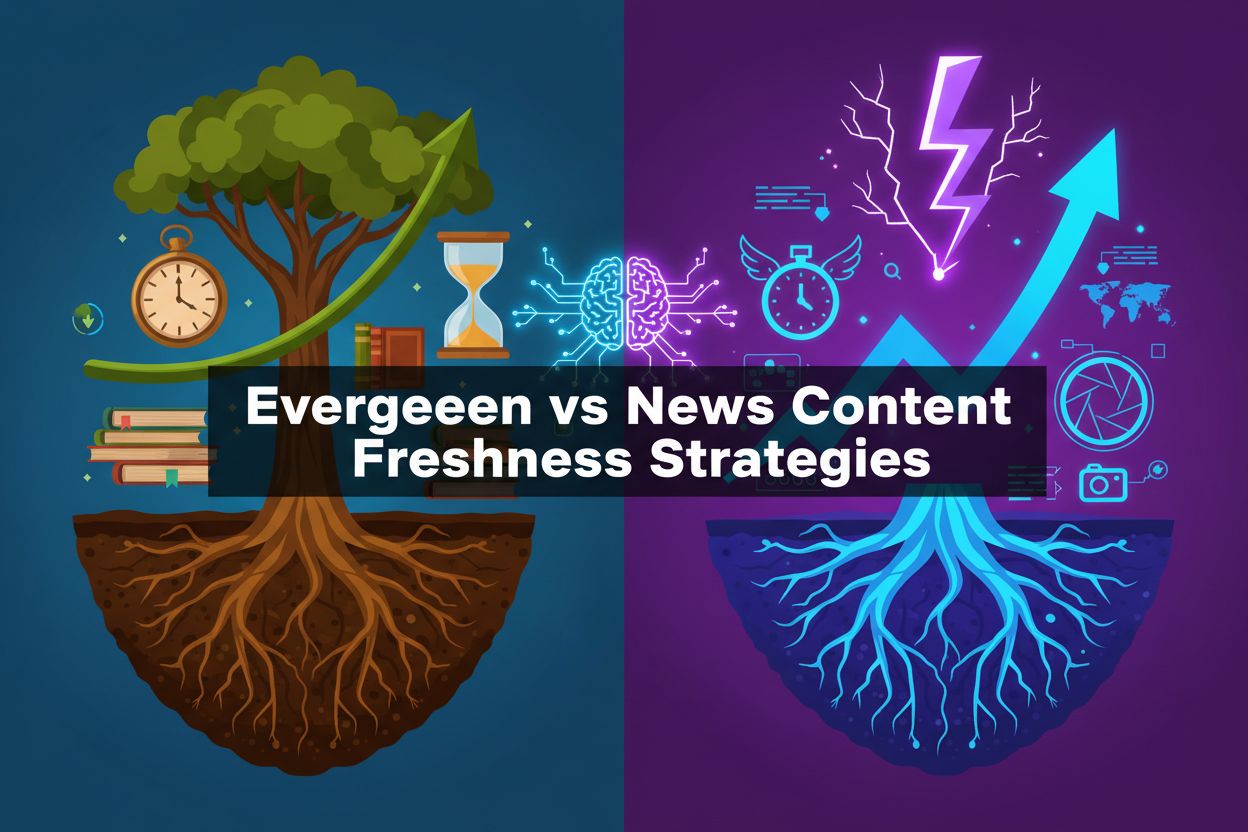
Lär dig hur du balanserar evergreen- och nyhetsinnehåll för maximal AI-synlighet. Upptäck färskhetsstrategier som fungerar med ChatGPT, Gemini och Perplexity....
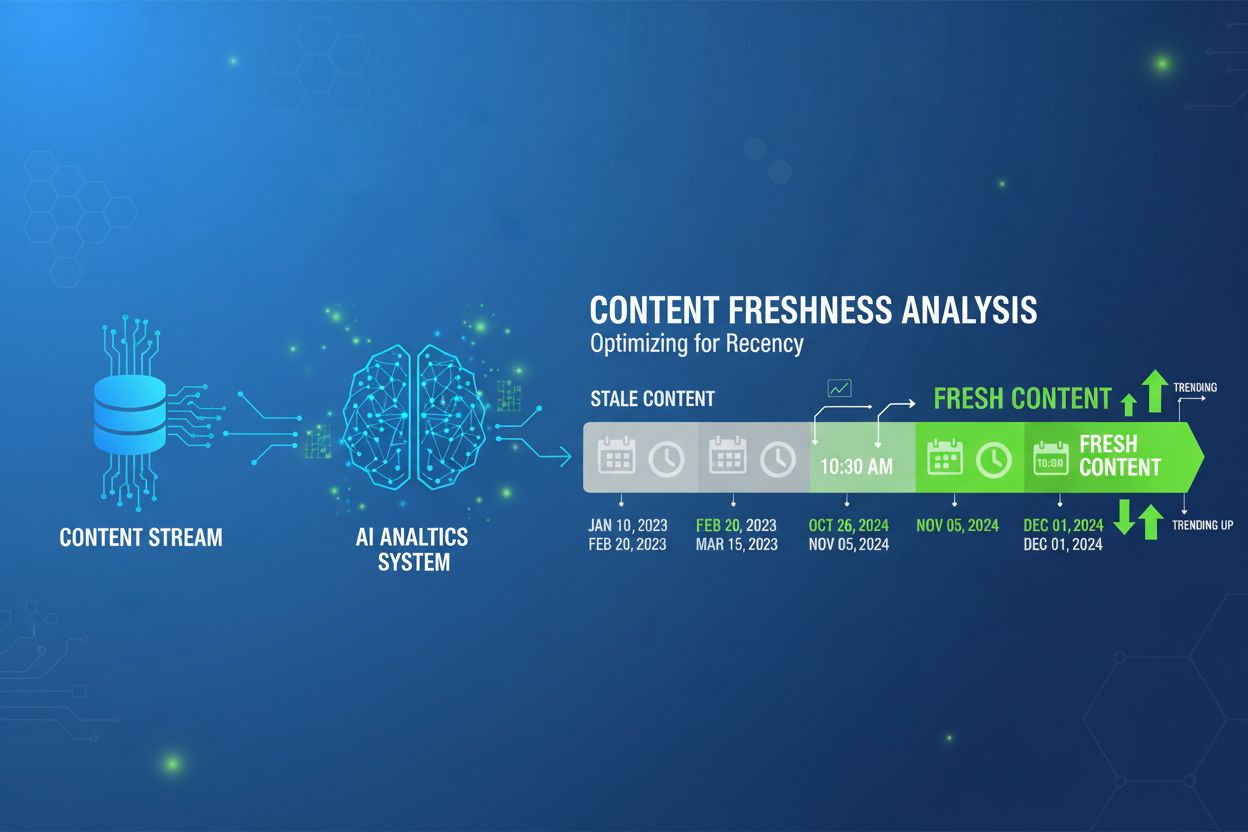
Lär dig när och hur du ska uppdatera ditt innehåll för synlighet i AI. Upptäck färskhetssignaler som hjälper ChatGPT, Perplexity och Google AI Overviews att cit...
Cookie-samtycke
Vi använder cookies för att förbättra din surfupplevelse och analysera vår trafik. See our privacy policy.