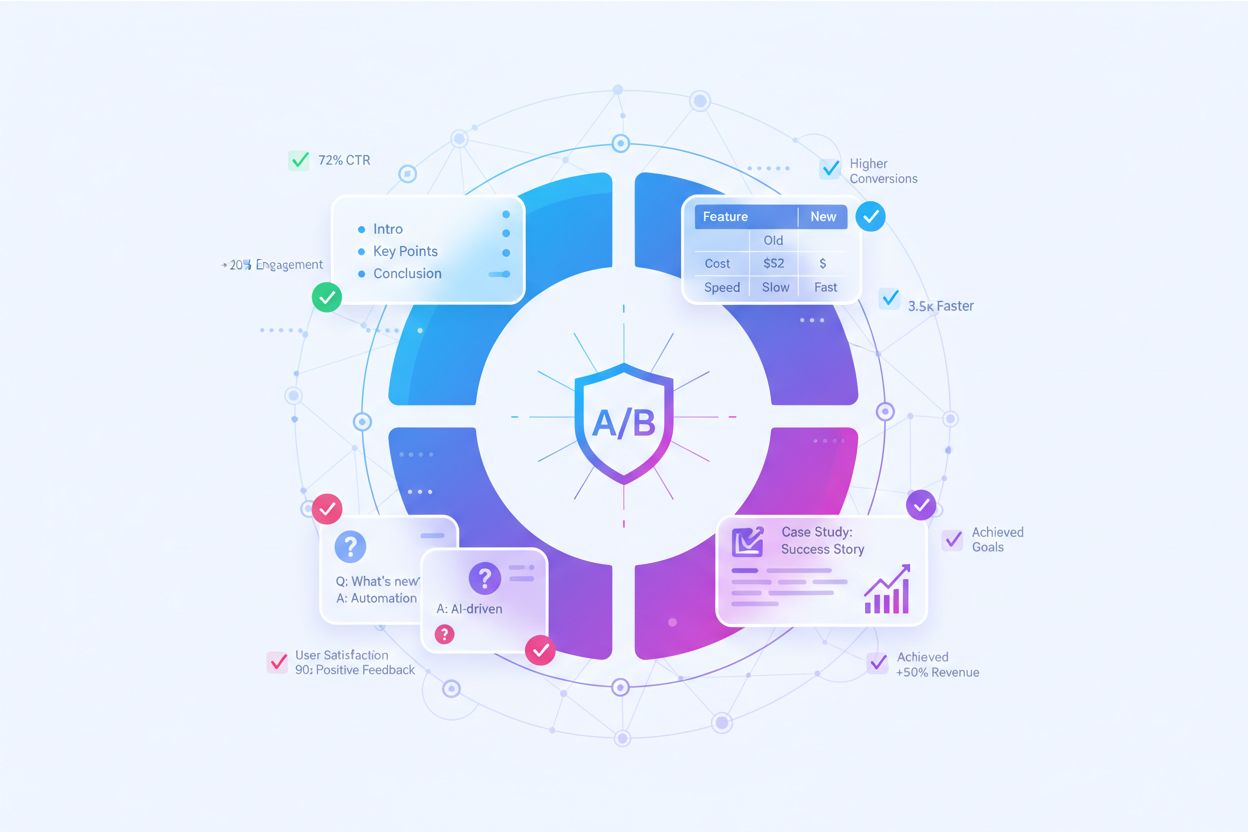
Discussion Content Structure Optimization

Do tables and structured content actually help with AI citations? Testing this myself

ST
Structure_Tester · Content Strategist
· · 76 upvotes · 9 comments
ST
Structure_Tester
Content Strategist · January 2, 2026

Been running an experiment for the last 3 months on content structure and AI citations.

The hypothesis: AI systems prefer structured, extractable content. Tables, lists, and clear formatting should get cited more than walls of text.

My test: Created 20 pairs of articles on similar topics.

  • Version A: Traditional long-form prose
  • Version B: Same info but with tables, lists, structured formatting

Early results (3 months in):

That’s 2.4x better performance for structured content.

But I have questions:

  1. Is this correlation or causation?
  2. What specific structures work best?
  3. Is there such a thing as too much structure?
  4. Does this hurt human readability?

Would love to hear what others have found. Anyone else testing formatting for AI visibility?

9 comments

9 Comments

AC
AI_Content_Researcher Expert Content Research Lead · January 2, 2026

We’ve done extensive testing on this. Your results align with what we see.

Our data (500+ articles analyzed):

Content ElementCitation Rate Impact
Comparison tables+65%
Numbered lists (how-to)+45%
Q&A format sections+55%
Bullet point summaries+35%
Clear heading structure+40%
Prose only (baseline)Baseline

Why tables specifically help:

  1. Easy extraction - AI can pull entire table or specific cells
  2. Comparison context - Already structured for “X vs Y” queries
  3. Data density - More information in less text
  4. Clear relationships - Headers define what data means

Optimal table structure:

  • Descriptive column headers
  • 3-7 rows (not too long)
  • Concrete data, not vague statements
  • Include comparison context in header row

Example that works well: “Comparison of [X, Y, Z] by [Feature 1, Feature 2, Feature 3]”

The table title/context is almost as important as the data.

ET
Extraction_Theory AI/ML Engineer · January 2, 2026
Replying to AI_Content_Researcher

From a technical perspective, here’s why structure matters:

How AI systems process content:

  1. Chunking - Break content into segments
  2. Embedding - Convert chunks to vectors
  3. Retrieval - Find relevant chunks for query
  4. Synthesis - Combine chunks into answer

Why structured content wins at each step:

Chunking: Tables and lists have natural boundaries. Prose can be chunked mid-thought.

Embedding: Structured data has clearer semantic meaning. “Product A: $99” is clearer than “The first product costs ninety-nine dollars.”

Retrieval: Discrete data points match specific queries better. “What does X cost?” matches “$99” in a table.

Synthesis: Pre-structured data is easier to incorporate into answers without reformatting.

The principle: Make AI’s job easier. Pre-structure your content the way you’d want it to appear in an answer.

FT
Format_Testing_Pro SEO Manager · January 2, 2026

I’ve tested specific formats. Here’s what works:

Tables that get cited:

  • Product comparisons
  • Feature matrices
  • Pricing comparisons
  • Pros/cons lists in table form
  • Timeline/milestone tables

Tables that don’t help much:

  • Decorative tables (no real data)
  • Too complex (10+ columns)
  • Vague qualitative only (“Good,” “Better,” “Best”)

Lists that get cited:

  • Step-by-step how-tos (numbered)
  • “Top X” roundups
  • Key takeaways (bullet)
  • Quick summaries

Lists that don’t help:

  • Too long (10+ items)
  • Vague items
  • No context around them

Q&A format insights: Works exceptionally well because:

  • Matches how users query AI
  • Self-contained answer units
  • Natural heading structure

Pro tip: Make each H2/H3 a question. Makes the entire page Q&A format.

HR
Human_Readability_Balance UX Content Designer · January 1, 2026

You asked about human readability. Here’s the balance:

Too much structure hurts humans:

  • Choppy reading experience
  • Feels like a spec sheet
  • Missing narrative flow
  • Hard to understand context

Too little structure hurts AI:

  • Harder to extract data
  • Less likely to be cited
  • Buried information

The sweet spot:

Intro paragraph → Context and narrative hook Table/List → Core structured data Prose paragraph → Analysis and implications Another table → Supporting comparison Conclusion → Key takeaways (bullet)

The ratio that works:

  • 40% structured (tables, lists, bullets)
  • 60% prose (context, analysis, narrative)

Never do:

  • All tables, no explanation
  • Dense prose with zero structure
  • Tables without introductory context
  • Lists without supporting detail

Test with humans: Can someone scan this in 30 seconds and get value? Can they also read deeply and learn more? You need both.

SM
Schema_Markup_Angle Technical SEO · January 1, 2026

Don’t forget schema markup for structured content:

Schema types that help:

Content TypeSchemaAI Relevance
How-to articlesHowToHigh - steps extracted
FAQsFAQPageVery High - Q&A format
Product comparisonsProductHigh - specs extracted
ReviewsReviewMedium - ratings extracted
TablesTableMedium-High - data clarity

Why schema matters for AI:

  1. Explicit structure - Tells AI exactly what each element is
  2. Relationship clarity - Shows how data connects
  3. Entity recognition - Helps AI identify what you’re discussing

Implementation priority:

  1. FAQPage schema (easiest, highest impact)
  2. HowTo schema (if applicable)
  3. Table schema (newer, less adopted)

Quick win: Add FAQPage schema to your existing FAQ sections. Often 1 hour of work, ongoing benefit.

Don’t over-engineer: Schema is a signal, not a guarantee. Content quality still matters most.

RR
Real_Results_Data Content Marketing Lead · January 1, 2026

Adding my test results to the pile:

Before restructuring (baseline):

  • 50 articles, prose-heavy
  • AI citation rate: 3%
  • Am I Cited showed minimal visibility

After restructuring (same 50 articles):

  • Added tables where comparisons existed
  • Converted lists from prose to bullets
  • Made H2s into questions
  • Added “Key Takeaways” sections

Time investment: 2 hours per article

Results after 60 days:

  • AI citation rate: 9% (3x improvement)
  • Same Google rankings (no negative impact)
  • User engagement: Actually improved (time on page +15%)

Best bang for buck changes:

  1. H2s as questions (10 min/article)
  2. Add comparison tables (30 min/article)
  3. Key takeaways bullets (10 min/article)

The 80/20: Those 3 changes got us 80% of the improvement. The rest was diminishing returns.

FM
Formatting_Mistakes · December 31, 2025

Let me share what DOESN’T work:

Formatting that backfired:

  1. Tables for everything Tried making every section a table. Readability tanked. Bounce rate up 40%.

  2. Too many bullet points Page became a grocery list. Lost narrative. Users confused.

  3. Question headings that don’t fit Forced Q&A format where it didn’t make sense. Felt awkward.

  4. Over-structuring simple content Short answer stretched into table format. Added no value.

The principle: Structure should match information type.

Information TypeBest Format
ComparisonsTables
Steps/processesNumbered lists
Key pointsBullet lists
ExplanationsProse with headings
StatisticsTables or inline
NarrativesProse

Don’t force it: If information is naturally narrative, keep it narrative. Add structure where it genuinely helps understanding.

ST
Structure_Tester OP Content Strategist · December 31, 2025

Excellent insights from everyone. Here’s my synthesis:

What I’m implementing:

High-impact structural changes:

  1. Convert H2s to questions where natural
  2. Add comparison tables for any X vs Y content
  3. Include “Key Takeaways” bullet section
  4. Use FAQPage schema

Format guidelines for my team:

  • Target 40/60 structured/prose ratio
  • Every article needs at least one table or structured list
  • No more than 10 bullets in a single list
  • Tables need context paragraphs
  • Each section should stand alone

Quality checks:

  • Does this still read well for humans?
  • Would I actually want this in an AI answer?
  • Is the structure adding clarity or just adding structure?

Measurement plan:

  • Continue Am I Cited tracking
  • Tag content by structure level
  • Compare citation rates by format type
  • A/B test major changes

Expected outcome: If data holds, should see 2-3x improvement in AI citation rate without hurting human experience.

Thanks for validating the approach and adding nuance!

Have a Question About This Topic?

Get personalized help from our team. We'll respond within 24 hours.

Frequently Asked Questions

Do tables help with AI citations?
Yes, tables appear to improve AI citation rates, especially for comparison data and structured information. AI systems can easily extract data from well-formatted tables, making your content more likely to be referenced when answering comparison or data-driven queries.
What content formats work best for AI visibility?
High-performing formats include comparison tables, numbered lists, Q&A format, bullet points for key takeaways, and clear heading hierarchies. The key is making information easily extractable - AI systems prefer content that can be parsed into discrete, usable chunks.
How do I structure content for AI extraction?
Use descriptive headings (preferably questions), lead with direct answers, break information into scannable chunks, use tables for comparisons, and include summaries or key takeaways. Each section should be able to stand alone as an answer to a potential query.
Does markdown formatting affect AI visibility?
Proper semantic HTML and structured formatting help AI systems understand your content’s hierarchy and relationships. While AI systems can parse various formats, clean structure with proper heading tags, lists, and tables makes extraction more reliable.

Track Your Structured Content Performance

Monitor how your tables, lists, and structured content perform in AI citations across ChatGPT, Perplexity, and other platforms.

Learn more

Testing Content Formats for AI Citations: Experiment Design

Testing Content Formats for AI Citations: Experiment Design

Learn how to test content formats for AI citations using A/B testing methodology. Discover which formats drive the highest AI visibility and citation rates acro...

10 min read