Testing Content Formats for AI Citations: How to Design a Valid Experiment
A practical framework for A/B testing content formats for AI citations: control and test variations, sample size math, confound-proofing your setup, and how long to run it before trusting the results.
Artificial intelligence systems process content fundamentally differently than human readers, relying on structured signals to understand meaning and extract information. While humans can navigate through creative formatting or dense prose, AI models require clear organizational hierarchies and semantic markers to effectively parse and comprehend content value. That’s a real, measurable pattern — but it’s an average across the entire web, not a guarantee for your specific niche, audience, or platform mix. If you want to know which content formats actually win
at internet scale, we’ve already run that analysis across 768,000+ citations. This post is about something different: how to design your own test so you know what wins for your content, rather than assuming aggregate benchmarks apply to you.
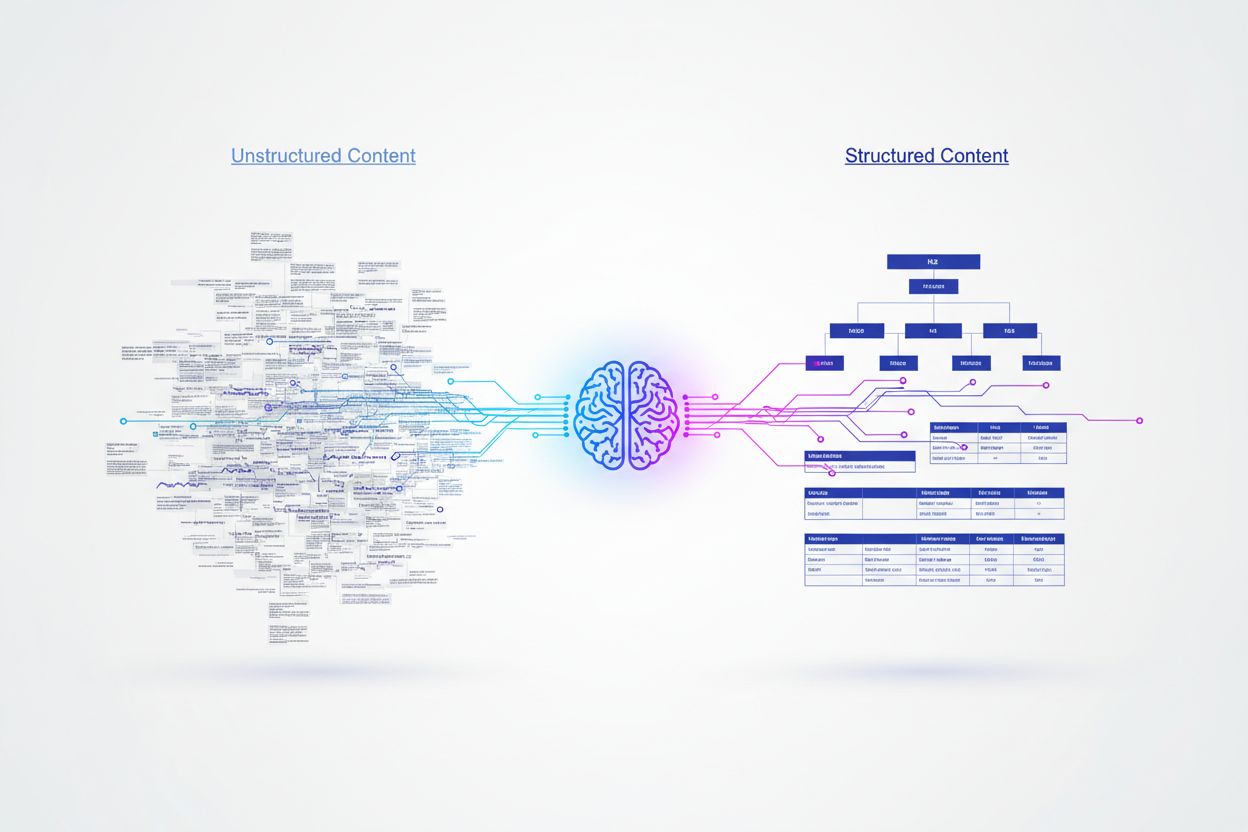
Two things make testing worthwhile rather than optional. First, structured content with proper heading hierarchies achieves citation rates 156% higher than unstructured alternatives in aggregate data — but the size of that lift varies enormously by content type and platform, and the only way to know your own lift is to measure it. Second, schema markup implementation shows citation rates 340% higher than identical content without structured data, yet a lot of that variance comes down to how the markup was implemented, not just whether it exists. Understanding these platform-specific
differences — ChatGPT, Google AI Overviews, and Perplexity all weight sources differently — is also part of why a one-size-fits-all format decision rarely holds up: a format that wins on one platform can lag on another, so your test design needs to specify which AI platforms
you’re optimizing for before you start.
Setting Up a Valid A/B Test
A/B testing provides the most reliable methodology for determining which content formats drive the highest AI citation rates for your specific content and audience. Rather than relying on general best practices, controlled experiments let you measure the actual impact of a format change rather than assuming it. The process requires careful planning to isolate variables and ensure statistical validity, but the insights gained justify the investment.
Follow this systematic framework:
Define clear objectives and metrics - Establish specific goals such as citation rate improvement, visibility score increase, or response inclusion rate, with measurable targets
Create control and test variations - Develop two distinct versions of your content (one in current format, one in test format) while keeping all other elements identical
Randomize assignment - Where you’re testing across multiple pages or topics rather than a single page, assign content to variations randomly rather than by convenience, so the groups don’t differ in ways that could bias results
Ensure adequate sample size - Gather sufficient data points to achieve statistical significance, typically requiring 100+ citations or interactions per variation
Monitor performance continuously - Track metrics in real time to identify anomalies, data quality issues, or unexpected behavior patterns
Analyze results with statistical rigor - Calculate confidence intervals and p-values to confirm that observed differences aren’t due to random chance
The control variation should represent your current, unchanged approach; the test variation should differ in exactly one dimension — the format itself. Everything else — topic, keyword targeting, publish timing, internal linking, word count — needs to stay constant, because any of those can independently move your citation rate and muddy your conclusion about the format change.
Ready to Monitor Your AI Visibility?
Track how AI chatbots mention your brand across ChatGPT, Perplexity, and other platforms.
Not every metric tells you the same thing about a format change, so pick your primary metric before you launch the test rather than scanning for whatever moved afterward. Citation rate — how often AI platforms reference your content as a source — is the most direct measure of format performance. Featured snippet capture rate indicates content that AI systems find particularly valuable for direct answers. Knowledge panel appearances signal that AI systems recognize your brand as an authoritative entity. Generative engine response rate measures how frequently AI systems reference your content at all when answering related queries, independent of whether they cite it as a link.
Pick one primary metric tied to your test’s objective, and track two or three secondary metrics for context. A format that improves citation rate but tanks featured snippet capture is a different result than one that improves both, and you want to know which trade-off you’re actually making before you roll a winning variation out sitewide.
Calculating Sample Size and Statistical Significance
Statistical significance requires careful attention to sample size and test duration. In AI applications with sparse data or long-tail distributions, gathering sufficient observations quickly can be challenging, so plan your sample size before you commit to a test window rather than after.
Insufficient sample sizes are the most common error in format testing — testing with too few citations or interactions produces results that look meaningful but actually reflect random variation. As a baseline, gather at least 100 citations per variation before drawing conclusions, and use a statistical significance calculator to determine the exact sample size needed for your confidence level and expected effect size. Larger sample sizes produce more reliable results but require longer testing periods, so there’s a real trade-off between statistical confidence and how quickly you can iterate. Once you have your data, calculate confidence intervals and p-values rather than eyeballing the difference between variations — a 10% gap that isn’t statistically significant is noise, not a finding.
Stay Updated on AI Visibility Trends
Get the latest insights on AI mentions, brand monitoring, and optimization strategies.
Implementing Schema Markup Without Breaking Your Test
If your format test includes a schema markup variation, implementation quality becomes part of the experiment itself — get it wrong, and you’re testing “broken schema vs. no schema,” not “schema vs. no schema.” Schema markup
provides explicit context that removes ambiguity from content interpretation: when an AI engine encounters valid markup, it immediately understands entity relationships, content types, and hierarchical importance without relying solely on natural language processing.
The most relevant schema types depend on your content: Article schema
for blog posts, FAQ schema for question-and-answer sections, HowTo schema for instructional content, and Organization schema for brand recognition. JSON-LD format specifically outperforms other structured data formats because AI engines can parse it independently from HTML content, allowing for cleaner extraction.
{
  "@context": "https://schema.org",
  "@type": "FAQPage",
  "mainEntity": [
    {
      "@type": "Question",
      "name": "What is the best content format for AI citations?",
      "acceptedAnswer": {
        "@type": "Answer",
        "text": "The best format depends on your platform and audience — see our data analysis of 768,000+ citations for the aggregate answer, then test it against your own content."
      }
    }
  ]
}
Before your test goes live, validate every markup variation with Google’s Rich Results Test or Schema.org’s validation tools. This step is not optional: invalid schema
markup can actively harm citation chances rather than improve them, which means a badly implemented test variation can produce a false negative for a format that would otherwise have won.
Avoiding Confounding Variables and Bias
Confounding variables are the single biggest threat to a valid test — they introduce bias when multiple factors change simultaneously, making it impossible to determine which change actually caused an observed difference. Keep all elements identical except the format being tested: same keywords, same length, same structure everywhere except the variable under test, same publication timing.
Temporal bias occurs when testing during atypical periods — holidays, major news events, platform algorithm changes — that skew results independent of your format change. Run tests during normal periods, and account for seasonal variation by testing for at least 2-4 weeks rather than a few days. Selection bias emerges when your test and control groups differ in ways that affect results before the test even starts; random assignment of content to variations is how you prevent it. Misinterpreting correlation as causation rounds out the list — when an external factor coincidentally aligns with your test period, it’s tempting to credit the format change for a result it didn’t cause. Always consider alternative explanations for observed changes, and validate a result through a second testing cycle before making it permanent.
How Long to Run Your Test
Most experts recommend running tests for at least 2-4 weeks. That window accounts for temporal variation — day-of-week effects, short-term traffic spikes, momentary algorithm quirks — and gives you time to accumulate the 100+ citations per variation you need for statistical confidence. Ending a test early because one variation looks ahead after three days is one of the fastest ways to ship a false winner: early leads frequently regress once more data comes in.
If your content and platform combination produces citations slowly, extend the window rather than shrinking your sample size requirement. A longer, properly powered test beats a shorter one that technically “finished” but never reached statistical significance.
From Experiment to Rollout: Real-World Test Examples
These examples show the framework above applied end to end. A technology company testing product comparison articles
converted them from paragraph format to structured comparison tables
and measured a 52% increase in AI citations within 60 days. Crucially, they kept content length and keyword optimization identical between variations, isolating the format change as the sole variable
— the textbook version of a clean test.
A financial services firm ran a lower-effort variant: they added FAQ schema to existing question-and-answer sections without rewriting any content, then measured a 34% increase in featured snippet appearances and a 28% increase in AI citations within 45 days. Because the underlying content didn’t change, they could attribute the entire lift to the markup itself. A SaaS company went further, running multivariate testing across three formats simultaneously — lists, tables, and traditional paragraphs — for identical content about their product features. That test needed a larger sample size and more careful randomization than a simple two-variant A/B test, but it let them measure trade-offs (lists won on citation volume, tables won on parsing accuracy) that a single A/B test couldn’t have revealed.
The Future of Format Testing: Adaptive Experimentation
The landscape of content format testing continues evolving as AI systems become more sophisticated. Multi-armed bandit algorithms represent a significant advancement over traditional fixed-duration A/B testing, dynamically adjusting traffic allocation to different variations based on real-time performance rather than waiting for a predetermined test period to conclude. This approach reduces the time needed to identify a winning variant and improves performance during the testing period itself, rather than only after it.
Adaptive experimentation powered by reinforcement learning enables testing systems to continuously learn and adjust from ongoing experiments in real time rather than through discrete testing cycles. AI-driven automation in A/B testing uses AI itself to automate experiment design, result analysis, and optimization recommendations, letting teams test more variations simultaneously without a proportional increase in complexity. Organizations that build a rigorous manual testing discipline today — clean control groups, adequate sample sizes, confound-free comparisons — will be the ones positioned to adopt these adaptive methods effectively, because the statistical fundamentals don’t change; only the speed of iteration does. For the broader playbook these individual format tests feed into, see our step-by-step guide to boost ai search visibility
end to end.
Frequently asked questions
Most experts recommend running tests for at least 2-4 weeks to account for temporal variations and ensure reliable results. This duration allows you to gather sufficient data points (typically 100+ citations per variation) and account for seasonal variations or platform algorithm changes that might skew results.
Yes, you can conduct multivariate testing across multiple formats simultaneously, but this requires careful planning to avoid complexity in interpreting results. Start with simple A/B tests comparing two formats, then progress to multivariate testing once you understand the basics and have adequate statistical resources.
You typically need at least 100 citations or interactions per variation to achieve statistical significance. Use statistical calculators to determine the exact sample size needed for your specific confidence level and effect size. Larger sample sizes provide more reliable results but require longer testing periods.
Start by identifying the most relevant schema type for your content (Article, FAQ, HowTo, etc.), then use JSON-LD format to implement it. Validate your markup using Google's Rich Results Test or Schema.org's validation tools before your test goes live. Invalid schema markup introduces a confound that can make a genuinely good format look like it failed.
Changing more than one variable at a time. If you swap the format and also update the keywords, length, or publish date, you can no longer isolate which change caused the result. Keep every element identical between variations except the single format element being tested.
Anything that changes alongside your format and could independently affect citations: publish timing, keyword targeting, content length, internal linking, or even a platform algorithm update that happens mid-test. Randomized assignment and identical non-format elements are how you rule these out.
Track citation rate improvements, featured snippet capture rates, knowledge panel appearances, and generative engine response rates. Establish baseline metrics before testing, then monitor performance weekly to identify trends. A successful test typically shows 20%+ improvement in your primary metric within 4-8 weeks — that improvement in visibility is the signal you're testing for.
Viktor Zeman is a co-owner of QualityUnit. Even after 20 years of leading the company, he remains primarily a software engineer, specializing in AI, programmatic SEO, and backend development. He has contributed to numerous projects, including LiveAgent, PostAffiliatePro, FlowHunt, UrlsLab, and many others.
Viktor Zeman
CEO, AI Engineer
Track Your Format Tests with AmICited
Run a clean A/B test and watch the citation data roll in. AmICited monitors how ChatGPT, Google AI Overviews, and Perplexity cite each variation so you can measure results instead of guessing.
Do tables and structured content actually help with AI citations? Testing this myself
Community discussion on whether tables and structured formatting improve AI citation rates. Real test results from marketers experimenting with content structur...
How to Create AI-Friendly Comparison Content for ChatGPT, Perplexity & Google AI
Learn to create comparison content optimized for AI citations. Use structured tables, schema markup, and fact-dense formatting to get cited in ChatGPT, Perplexi...
12 min read
Cookie Consent We use cookies to enhance your browsing experience and analyze our traffic. See our privacy policy.