
Discussion MUM Google AI Algorithm

What is Google MUM and how does it affect AI search visibility?

SE
SEOLearner_Mike · SEO Specialist
· · 98 upvotes · 8 comments
SM
SEOLearner_Mike
SEO Specialist · January 4, 2026

Keep hearing about Google MUM but not sure I fully understand it.

What I know:

  • It’s an AI model from Google
  • Something about multi-modal and multi-language
  • “1000x more powerful than BERT”

What I need to understand:

  • What does MUM actually do?
  • How does it affect how Google processes content?
  • What should I do differently for MUM optimization?
  • Is this connected to AI Overviews?

Looking for practical understanding, not just marketing hype.

8 comments

8 Comments

GS
GoogleAIExpert_Sarah Expert Search AI Specialist · January 4, 2026

Let me explain MUM in practical terms.

What MUM is:

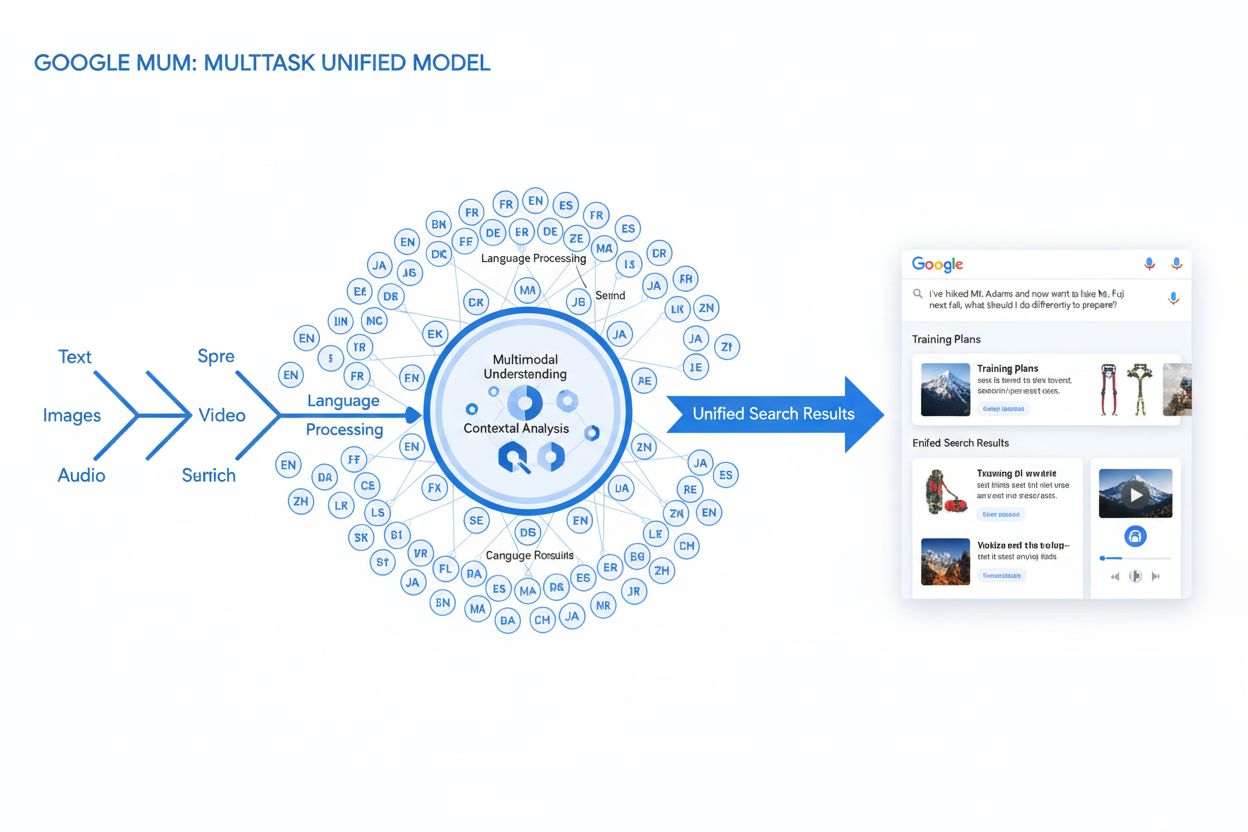
MUM = Multitask Unified Model

It’s an AI system that can:

  • Understand content in 75 languages
  • Process text, images, and video
  • Handle complex, multi-part queries
  • Transfer knowledge across languages and modalities

The “1000x BERT” claim:

BERT understood words in context. MUM understands:

  • Concepts across languages
  • Information in images and video
  • Complex questions requiring multiple steps
  • Relationships between different content types

Practical example:

Query: “I hiked Mt. Adams, want to hike Mt. Fuji next fall. What should I do differently to prepare?”

Old Google (pre-BERT): Match keywords “Mt. Fuji” “prepare” “hike”

BERT era: Understand question is about hiking preparation

MUM era: Understand:

  • User has specific hiking experience
  • Mt. Fuji is different climate/terrain
  • “Fall” means specific conditions in Japan
  • Preparation includes gear, fitness, logistics
  • Can pull information from Japanese sources

For search results:

MUM enables more sophisticated AI-powered answers that synthesize information from multiple sources, languages, and content types.

SM
SEOLearner_Mike OP SEO Specialist · January 4, 2026
That example helps. So what does this mean for content optimization?
GS
GoogleAIExpert_Sarah Expert Search AI Specialist · January 4, 2026
Replying to SEOLearner_Mike

MUM optimization implications:

1. Semantic depth matters more:

MUM understands meaning, not keywords. Content should:

  • Answer the real question, not just contain keywords
  • Cover topics comprehensively
  • Use natural, expert language
  • Address related sub-questions

2. Multi-modal becomes valuable:

MUM processes images and video. Content should:

  • Include relevant images with context
  • Consider video for appropriate topics
  • Optimize all modalities (alt text, transcripts)
  • Think about information across formats

3. Complex queries are opportunity:

MUM handles multi-part questions. Content should:

  • Address complex, nuanced topics
  • Cover edge cases and follow-ups
  • Provide comprehensive answers
  • Not oversimplify

4. Topic authority compounds:

MUM understands relationships. Authority should:

  • Span related topics
  • Show consistent expertise
  • Build connected content
  • Demonstrate depth across subject matter

The practical shift:

Less: “Target this keyword on this page” More: “Establish comprehensive authority on this topic with multi-modal content”

TT
TechnicalSEO_Tom · January 3, 2026

Technical perspective on MUM and AI features.

MUM’s role in Google’s AI stack:

MUM is part of Google’s AI infrastructure that powers:

  • AI Overviews
  • Featured snippets (enhanced)
  • Image understanding
  • Cross-language results
  • Complex query handling

It’s not a separate ranking factor:

MUM isn’t something you “optimize for” directly. It’s how Google understands content.

Think of it like:

  • MUM = Google’s brain (understanding)
  • AI Overview = Google’s mouth (output)
  • Your content = what it reads and might cite

Technical implications:

Structured data: MUM uses structured data to understand entities and relationships. Schema markup helps.

Clean HTML: Semantic HTML helps AI parse content correctly.

Comprehensive information: MUM can pull from multiple pages. Having thorough coverage helps.

Multi-modal markup: ImageObject, VideoObject schema help AI understand media.

The connection to other AI:

What helps for MUM helps for other AI systems too. Comprehensive, well-structured, multi-modal content is universally preferred.

CL
ContentStrategist_Lisa Content Strategy Lead · January 3, 2026

Content strategy perspective on MUM.

What MUM means for content planning:

Topic clusters matter more:

MUM understands topic relationships. Building comprehensive topic clusters signals authority.

Answer complex questions:

MUM can handle nuanced queries. Content addressing complexity has opportunity:

  • “How does X work for Y situation?”
  • Comparison queries
  • Multi-factor decision queries

Cross-language opportunity:

If you have international markets:

  • Quality content in one language can influence ranking in another
  • MUM transfers understanding across languages
  • Translation quality matters

Visual content value:

MUM understands images. Invest in:

  • Informative diagrams
  • Process visuals
  • Comparison charts

These can be “understood” and cited.

The content brief evolution:

Old: “Write 1500 words about X, include these keywords”

New: “Create comprehensive coverage of X, address these complex questions, include visual explanations, connect to related topics Y and Z”

AP
AIOverviewAnalyst_Priya · January 3, 2026

Connection between MUM and AI Overviews.

How they relate:

MUM is an underlying AI capability. AI Overviews are a feature that leverages these capabilities.

MUM enables AI Overviews to:

  • Understand complex queries
  • Synthesize from multiple sources
  • Include multi-modal content
  • Provide nuanced answers

What appears in AI Overviews:

Content that MUM and related models:

  • Identify as relevant
  • Consider authoritative
  • Can extract useful passages from
  • Trust as accurate

The optimization implication:

Optimizing for AI Overviews = creating content MUM can understand and trust.

This means:

  • Clear, extractable statements
  • Demonstrated expertise
  • Comprehensive coverage
  • Multi-modal support

The measurement:

Track AI Overview appearances with Am I Cited. This shows whether your content is being selected by MUM-powered features.

FR
FutureSearch_Rachel Search Futurist · January 2, 2026

Where MUM is heading.

Current capabilities:

  • Text understanding across languages
  • Image understanding
  • Video understanding (developing)
  • Complex query handling

Emerging capabilities:

  • Real-time multimodal processing
  • Better video comprehension
  • Audio understanding
  • More sophisticated reasoning

What this means:

The trend is toward AI that understands content like humans do - across all modalities, with nuanced reasoning.

Future-proofing strategy:

  • Create genuinely valuable content
  • Cover topics comprehensively
  • Include appropriate visuals
  • Demonstrate real expertise
  • Think about user needs, not algorithm tricks

The principle:

As AI gets smarter, optimization gets simpler: create the best content for your audience. MUM and successors will recognize it.

SM
SEOLearner_Mike OP SEO Specialist · January 2, 2026

This clarified MUM for me.

My understanding now:

  1. MUM = Understanding layer - How Google comprehends content deeply
  2. Multi-modal and multi-language - Understands text, images, video across languages
  3. Powers AI features - AI Overviews, enhanced snippets, etc.
  4. Not a ranking factor - It’s HOW Google understands, not a separate signal
  5. Complex queries = opportunity - MUM handles nuanced questions

Optimization implications:

  • Comprehensive topic coverage (MUM sees connections)
  • Multi-modal content (MUM understands visuals)
  • Natural, expert language (MUM understands meaning)
  • Complex question coverage (MUM handles nuance)
  • Topic authority (MUM recognizes expertise)

What I’m doing:

  • Focus on topic clusters, not individual keywords
  • Include relevant visuals with proper markup
  • Address complex questions in my content
  • Build comprehensive coverage over time

Thanks for the practical explanations!

Have a Question About This Topic?

Get personalized help from our team. We'll respond within 24 hours.

Frequently Asked Questions

What is Google MUM?
MUM (Multitask Unified Model) is Google’s AI model that understands content across multiple languages and modalities (text, images, video). It’s 1000x more powerful than BERT and enables Google to understand complex queries, translate understanding across languages, and process multi-modal information.
How does MUM affect search optimization?
MUM means Google understands content at a deeper level - semantic meaning, intent, and context across modalities. Optimization should focus on comprehensive topic coverage, natural language, multi-modal content, and answering complex questions rather than simple keyword matching.
Is MUM related to AI Overviews?
MUM and related AI models power features like AI Overviews. They enable Google to understand queries deeply, synthesize information from multiple sources, and generate comprehensive answers. MUM represents the underlying AI capability, while AI Overviews are a user-facing feature.

Track Your Google AI Visibility

Monitor how your content appears in Google AI Overviews and other AI-powered search features. Understand your visibility as Google evolves.

Learn more

MUM (Multitask Unified Model)
MUM (Multitask Unified Model): Google's Advanced Multimodal AI Model

MUM (Multitask Unified Model)

MUM is Google's Multitask Unified Model—a multimodal AI that processes text, images, video, and audio across 75+ languages. Learn how it transforms search and i...

14 min read
What is MUM and how does it affect AI search?

What is MUM and how does it affect AI search?

Learn about Google's Multitask Unified Model (MUM) and its impact on AI search results. Understand how MUM processes complex queries across multiple formats and...

8 min read