
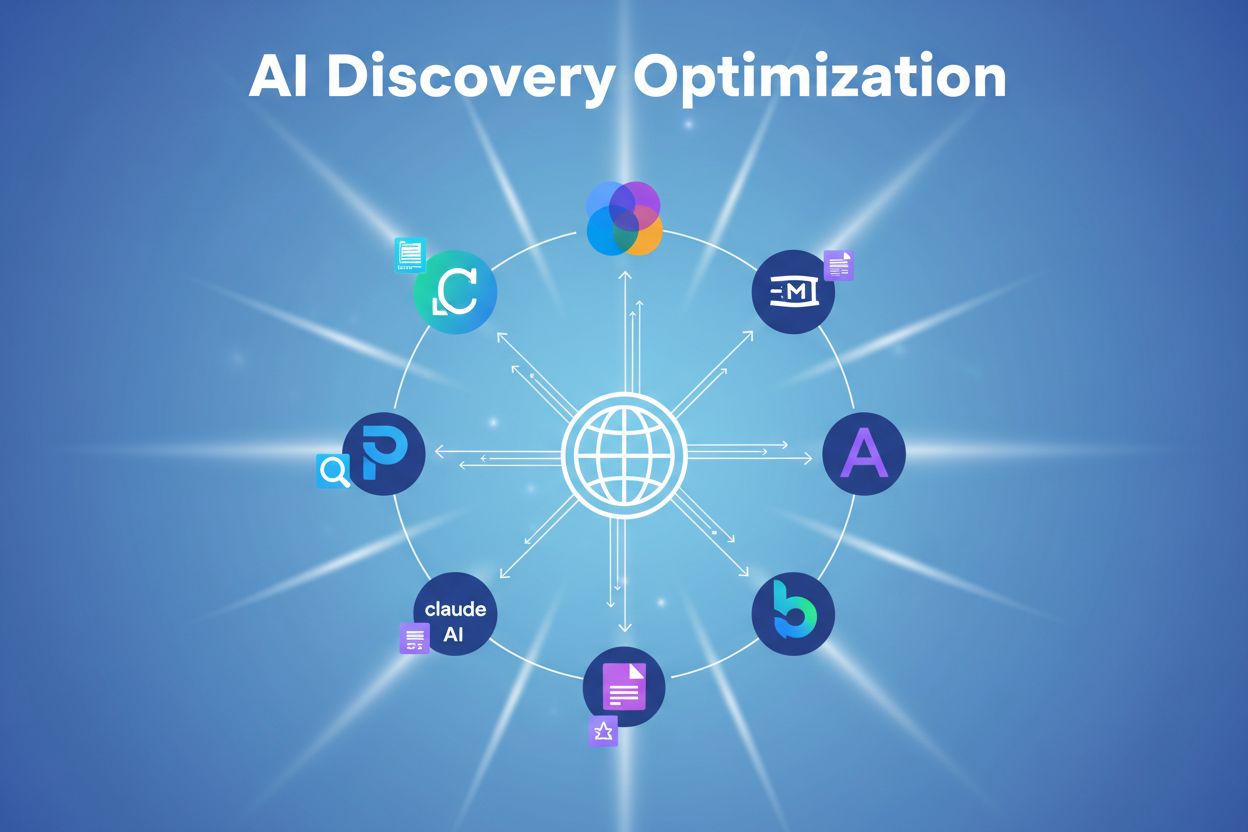
AI Discovery Optimization
Learn how to optimize content for AI discovery. Understand AI crawlers, content structure, and strategies to ensure your brand is found and cited by ChatGPT, Ge...
9 min read

The emerging marketplace where AI visibility drives business outcomes. It represents a fundamental shift from traditional search engine optimization to generative engine optimization, where AI systems discover, evaluate, and recommend products and services based on structured data, citations, and real-time information integration rather than keyword rankings.
The emerging marketplace where AI visibility drives business outcomes. It represents a fundamental shift from traditional search engine optimization to generative engine optimization, where AI systems discover, evaluate, and recommend products and services based on structured data, citations, and real-time information integration rather than keyword rankings.
The AI Discovery Economy represents a fundamental shift in how consumers discover, evaluate, and purchase products and services through artificial intelligence-powered systems rather than traditional search engines. This emerging marketplace is built on generative AI, agentic AI, and multimodal discovery channels that fundamentally change how businesses achieve visibility and drive conversions. Unlike the traditional search economy where businesses competed for keyword rankings, the AI Discovery Economy prioritizes citations, mentions, structured data, and real-time information integration as the primary currency of visibility. Businesses that understand and optimize for this new paradigm gain significant competitive advantages in customer acquisition and brand authority. The shift is not incremental—it represents a complete reimagining of the customer journey from discovery through purchase. Companies that fail to adapt their visibility strategies risk losing 30-60% of their organic traffic as AI systems become the primary discovery mechanism. The AI Discovery Economy is already generating measurable business outcomes, with early adopters seeing increased brand mentions, higher conversion rates, and improved customer trust metrics.
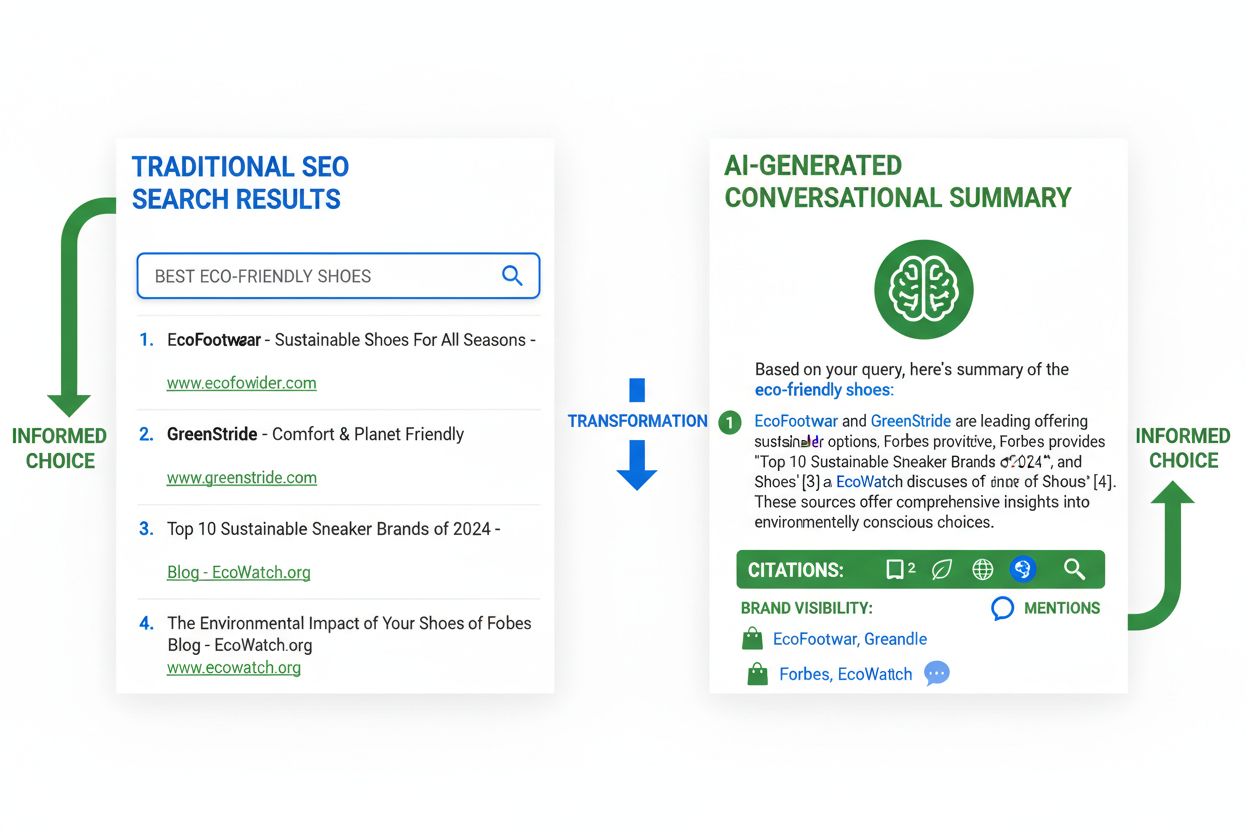
The transition from Search Engine Optimization (SEO) to Generative Engine Optimization (GEO) marks the most significant change in digital visibility strategy since the rise of Google. Traditional SEO focused on ranking for specific keywords through backlinks, on-page optimization, and content volume, but this approach is becoming obsolete as AI systems generate answers directly without requiring users to click through to websites. Research shows a 47% decrease in clicks when AI Overviews appear in search results, fundamentally disrupting the traffic model that businesses have relied on for two decades. By 2026, 50% of all searches will receive AI-generated answers, making GEO competency essential for business survival. GEO requires a completely different optimization approach centered on accuracy, authority, structured data, and citation frequency rather than keyword density and backlink profiles. The metrics that matter most in GEO are whether your content is cited in AI summaries, whether your business information appears in AI-generated overviews, and whether your data is trusted enough to be featured prominently. Businesses must now think like information providers for AI systems rather than content creators for human readers.
| Aspect | Traditional SEO | Generative Engine Optimization |
|---|---|---|
| Primary Goal | Rank for keywords | Get cited in AI summaries |
| Key Metric | Click-through rate | Citation frequency & mentions |
| Content Focus | Keyword optimization | Accuracy & authority |
| Data Structure | Meta tags & headers | Structured schema markup |
| Visibility Driver | Backlinks & domain authority | Real-time data & freshness |
| User Intent | Find relevant pages | Get direct answers |
| Competitive Advantage | Ranking position | Information trustworthiness |
The AI Discovery Economy extends far beyond traditional text-based search, encompassing voice search, visual search, and video search as equally important discovery channels that businesses must optimize for simultaneously. Voice search has become mainstream, with 27% of mobile users conducting voice searches weekly, creating a new optimization challenge where conversational language and featured snippet optimization become critical. Google Lens and similar visual search tools process 20 billion visual searches monthly, meaning that product images, visual consistency, and image metadata are now essential components of discovery strategy. These multimodal channels require fundamentally different optimization approaches:
The business implication is clear: companies that optimize for only one discovery modality are missing 60-70% of potential customer touchpoints. Multimodal optimization requires integrated strategies across content, technical infrastructure, and data management that most organizations have not yet implemented. Early adopters of multimodal discovery strategies are seeing 2-3x higher engagement rates and significantly improved conversion metrics compared to single-channel competitors.

Agentic AI represents the next evolution beyond generative AI, where autonomous systems take independent actions on behalf of users without requiring explicit instructions for each step. Rather than simply answering questions, agentic AI systems can complete transactions, make reservations, compare options, and execute purchases based on user preferences and real-time data. Consider a practical scenario: a user tells an AI agent “I need a haircut this week,” and the agent autonomously searches for available salons, checks reviews and ratings, compares prices, checks your calendar, and books an appointment—all without requiring the user to visit a single website. This represents a seismic shift in how commerce happens, with 70% of digital interactions expected to involve AI agency by 2026, and 15% of e-commerce transactions projected to be completed by autonomous agents by 2027. For businesses, this means visibility is no longer about ranking on search results—it’s about being discoverable and trustworthy enough for AI agents to recommend and transact on your behalf. Agentic AI requires real-time API integration, accurate inventory data, current pricing information, and reliable fulfillment capabilities that most businesses have not yet implemented. Companies that build agent-ready infrastructure and data systems will capture disproportionate market share as autonomous commerce becomes the dominant transaction method.
Structured data has evolved from a nice-to-have SEO tactic into the foundational infrastructure of the AI Discovery Economy, serving as the primary language through which AI systems understand and evaluate business information. Without proper structured data implementation using schema.org markup, AI systems cannot reliably extract critical business information, verify accuracy, or determine trustworthiness—making your business essentially invisible to the systems that drive discovery. The most critical schema types for AI visibility include LocalBusiness (for location-based businesses), Product/Offer (for e-commerce), FAQ (for common questions), and Review (for social proof and ratings). Each schema type must be implemented with complete, accurate, and current information; partial or outdated structured data actively harms AI visibility because it signals unreliability to machine learning systems. Businesses with comprehensive schema implementation across all relevant entity types see measurably higher citation rates in AI summaries and are featured more prominently in AI-generated overviews. The technical implementation of structured data is no longer optional—it’s a prerequisite for participating in the AI Discovery Economy. Organizations that treat structured data as a core business infrastructure rather than a technical afterthought gain significant competitive advantages in AI visibility and customer acquisition.
Creating content for the AI Discovery Economy requires a fundamentally different approach than traditional content marketing, focusing on clarity, comprehensiveness, accuracy, and machine-readable structure rather than engagement metrics and social sharing. AI systems evaluate content based on whether it directly answers user questions, whether the information is current and accurate, whether it’s properly structured for machine parsing, and whether the source demonstrates authority and trustworthiness. Pages with structured elements and clear information architecture are 68% more likely to be cited in AI summaries, making content design and organization as important as the content itself. Effective content strategy for AI discovery should follow these principles:
The shift from engagement-focused content to AI-optimized content requires rethinking content calendars, editorial processes, and success metrics. Businesses that reorganize their content strategy around AI discovery principles see immediate improvements in citation frequency and AI visibility within 30-60 days of implementation.
Data consistency across all platforms and touchpoints has become a critical competitive factor in the AI Discovery Economy, as AI systems use consistency as a primary signal of trustworthiness and reliability. When business information varies across Google Business Profile, your website, social media, directory listings, and third-party platforms, AI systems interpret this inconsistency as a reliability problem and reduce your visibility in AI-generated summaries. NAP consistency (Name, Address, Phone number) is the foundational requirement, but modern AI systems also evaluate consistency across business hours, service offerings, pricing, product descriptions, and customer reviews. Businesses with complete data consistency across all platforms see 28% higher visibility in AI discovery systems compared to competitors with inconsistent information. Inconsistent data doesn’t just reduce visibility—it actively erodes machine trust, causing AI systems to deprioritize your business in recommendations and summaries. The challenge is that maintaining consistency across dozens of platforms and data sources requires systematic processes, regular audits, and often specialized tools to monitor and correct discrepancies. Organizations that implement centralized data management systems and regular consistency audits gain significant advantages in AI visibility and customer trust metrics.
The AI Discovery Economy represents a $750 billion revenue impact opportunity by 2028, with early adopters capturing disproportionate market share as the transition accelerates. Consumer behavior is already shifting dramatically, with 44% of users preferring AI-generated summaries over traditional search results, and this preference is growing rapidly across all demographics and use cases. However, this shift comes with significant risk: businesses unprepared for the transition are experiencing 30-60% declines in organic traffic as AI systems replace traditional search as the primary discovery mechanism. The competitive advantage belongs to organizations that move quickly to optimize for AI discovery, implement comprehensive structured data, ensure data consistency, and build agent-ready infrastructure before their competitors. Early movers in AI Discovery Economy optimization are seeing measurable improvements in brand mentions, citation frequency, customer acquisition costs, and conversion rates—often within 90 days of implementation. AmICited.com provides essential tools for monitoring your AI visibility, tracking citation frequency, identifying data inconsistencies, and benchmarking your performance against competitors in the AI Discovery Economy. The window for competitive advantage is closing rapidly; organizations that delay their AI Discovery Economy strategy risk losing market position to more agile competitors who are already optimizing for this new paradigm.
The AI Discovery Economy is an emerging marketplace where artificial intelligence systems discover, evaluate, and recommend products and services to consumers. Unlike traditional search where users find websites through keyword rankings, the AI Discovery Economy prioritizes citations, mentions, structured data, and real-time information integration as the primary drivers of business visibility and customer acquisition.
Traditional SEO focuses on ranking websites for specific keywords through backlinks and on-page optimization. The AI Discovery Economy, by contrast, prioritizes getting your business cited and mentioned in AI-generated summaries, requires comprehensive structured data implementation, and values data consistency and accuracy over keyword optimization. The shift represents a fundamental change in how visibility is achieved and measured.
Generative Engine Optimization (GEO) is the practice of optimizing your business information, content, and data to be cited and featured in AI-generated summaries and answers. GEO focuses on accuracy, authority, structured data, and citation frequency rather than traditional SEO metrics like click-through rates and keyword rankings. It's the essential skill for succeeding in the AI Discovery Economy.
Structured data using schema.org markup is the primary language through which AI systems understand and evaluate business information. Without proper structured data implementation, AI systems cannot reliably extract critical information, verify accuracy, or determine trustworthiness. Businesses with comprehensive schema implementation see measurably higher citation rates in AI summaries and are featured more prominently in AI-generated overviews.
Businesses should focus on four key areas: (1) Implement comprehensive structured data across all relevant schema types, (2) Ensure data consistency across all platforms and touchpoints, (3) Create clear, accurate, and machine-readable content optimized for AI systems, and (4) Build real-time API integration and agent-ready infrastructure. Early adoption of these strategies provides significant competitive advantages.
The AI Discovery Economy represents a $750 billion revenue opportunity by 2028. However, businesses unprepared for the transition are experiencing 30-60% declines in organic traffic as AI systems replace traditional search. Early adopters are seeing improvements in brand mentions, citation frequency, customer acquisition costs, and conversion rates within 90 days of implementation.
Agentic AI systems are autonomous agents that take independent actions on behalf of users, such as booking appointments, comparing prices, or completing purchases without requiring explicit instructions for each step. By 2026, 70% of digital interactions will involve AI agency, and 15% of e-commerce transactions will be completed by autonomous agents by 2027. This requires businesses to have agent-ready infrastructure and real-time data systems.
Data consistency across all platforms is a critical signal of trustworthiness to AI systems. Businesses with complete data consistency across Google Business Profile, websites, social media, and directory listings see 28% higher visibility in AI discovery systems. Inconsistent data actively erodes machine trust and causes AI systems to deprioritize your business in recommendations and summaries.
Understand how your brand appears in AI-generated answers across ChatGPT, Perplexity, Google AI Overviews, and more. Track citations, mentions, and visibility metrics that matter in the AI Discovery Economy.
Learn how to optimize content for AI discovery. Understand AI crawlers, content structure, and strategies to ensure your brand is found and cited by ChatGPT, Ge...

Learn how AI product discovery uses conversational AI and machine learning to surface personalized product recommendations and improve e-commerce conversions. U...

Learn how AI search engines like ChatGPT, Perplexity, and Google AI are changing brand discovery. Understand citation patterns, visibility metrics, and strategi...
Cookie Consent
We use cookies to enhance your browsing experience and analyze our traffic. See our privacy policy.