

Review Aggregation and AI Shopping: The Trust Factor
Discover how review aggregation and AI detection work together to build consumer trust in e-commerce. Learn about fake review detection, trust signals, and the ...
8 min read

AI review aggregation is the automated synthesis of customer reviews from multiple sources into unified summaries and recommendations using artificial intelligence. It uses natural language processing and machine learning to extract themes, sentiment, and insights from hundreds or thousands of reviews in seconds. This technology helps both consumers make faster purchasing decisions and businesses understand customer needs more deeply. It has become essential in modern e-commerce platforms like Amazon, Best Buy, and Etsy.
AI review aggregation is the automated synthesis of customer reviews from multiple sources into unified summaries and recommendations using artificial intelligence. It uses natural language processing and machine learning to extract themes, sentiment, and insights from hundreds or thousands of reviews in seconds. This technology helps both consumers make faster purchasing decisions and businesses understand customer needs more deeply. It has become essential in modern e-commerce platforms like Amazon, Best Buy, and Etsy.
AI review aggregation is the automated process of collecting, analyzing, and synthesizing customer reviews from multiple sources into a unified, coherent summary using artificial intelligence. Unlike traditional review aggregation, which relies on manual curation or simple averaging of ratings, AI-powered aggregation uses natural language processing and machine learning to extract meaningful insights, themes, and sentiment patterns from hundreds or thousands of reviews in seconds. This technology has become essential in modern e-commerce, where customers face overwhelming amounts of feedback across platforms like Amazon, Etsy, and specialized review sites. By transforming raw review data into actionable intelligence, AI review aggregation helps both consumers make faster purchasing decisions and businesses understand customer needs more deeply.
The technical process of AI review aggregation involves a sophisticated pipeline that transforms unstructured customer feedback into structured, actionable insights. The system begins by collecting reviews from multiple platforms using web scraping technologies and API integrations, ensuring comprehensive data coverage across all major retail channels. Once collected, natural language processing (NLP) algorithms analyze the text to extract sentiment, identify key themes, and recognize important product attributes mentioned by customers. The AI then synthesizes this information using generative models to create coherent, human-readable summaries that capture the most important points without losing critical nuance. Quality assurance mechanisms verify accuracy and relevance, filtering out spam, fake reviews, and irrelevant content. This entire process happens in real-time or near-real-time, allowing businesses to maintain current, accurate product insights.
| Step | Description | Technology |
|---|---|---|
| Collection | Gather reviews from multiple platforms | Web scraping, APIs |
| Processing | Extract themes and sentiment | NLP, Machine Learning |
| Analysis | Identify patterns and key insights | AI algorithms |
| Synthesis | Generate coherent summary | Generative AI |
| Verification | Ensure accuracy and relevance | Quality checks |
AI review aggregation delivers substantial business value by transforming customer feedback into competitive advantages across multiple dimensions. The technology directly impacts the customer journey and bottom line through several key benefits:
Beyond these direct benefits, AI review aggregation creates operational efficiencies by automating tasks that previously required dedicated customer insight teams. Retailers can respond faster to market feedback, optimize inventory based on customer preferences, and personalize marketing messages using aggregated insights. The technology also helps identify emerging trends before they become obvious, giving early-mover advantages in competitive categories.
Transparency is the cornerstone of effective AI review aggregation, particularly because customers increasingly scrutinize how AI systems process their feedback. The most trustworthy implementations clearly disclose that summaries are AI-generated, explain the methodology used to aggregate reviews, and show both positive and negative themes with equal prominence. Leading platforms like Bazaarvoice and Okendo emphasize transparency by displaying the number of reviews analyzed, the date range covered, and the specific themes extracted from customer feedback. Best practices include citing source reviews, showing confidence scores for key claims, and including disclaimers about AI limitations. When businesses hide the AI-generated nature of summaries or cherry-pick only positive themes, they risk damaging customer trust and facing regulatory scrutiny. Transparent implementations that acknowledge both strengths and weaknesses of products actually build stronger customer relationships because they demonstrate honesty and respect for consumer intelligence. The most effective approach combines AI efficiency with human oversight, ensuring that summaries accurately represent the full spectrum of customer experiences.
Major e-commerce platforms have successfully integrated AI review aggregation into their product pages, demonstrating the technology’s practical value. Amazon uses AI-powered review summaries to highlight the most frequently mentioned product features and common customer concerns, helping shoppers quickly understand what matters most. Best Buy leverages aggregated insights to surface both praised features and reported issues, enabling customers to make informed decisions about electronics and appliances. Dick’s Sporting Goods implements AI aggregation to identify performance-related feedback on athletic products, helping customers understand real-world durability and functionality. Etsy uses the technology to help handmade product sellers understand customer preferences and improve their offerings based on aggregated feedback patterns. Walmart has integrated AI review summaries across its marketplace to compete with Amazon’s capabilities and provide customers with quick product insights. These implementations show that AI review aggregation works across diverse product categories, from electronics to sporting goods to handmade items, proving its versatility and effectiveness.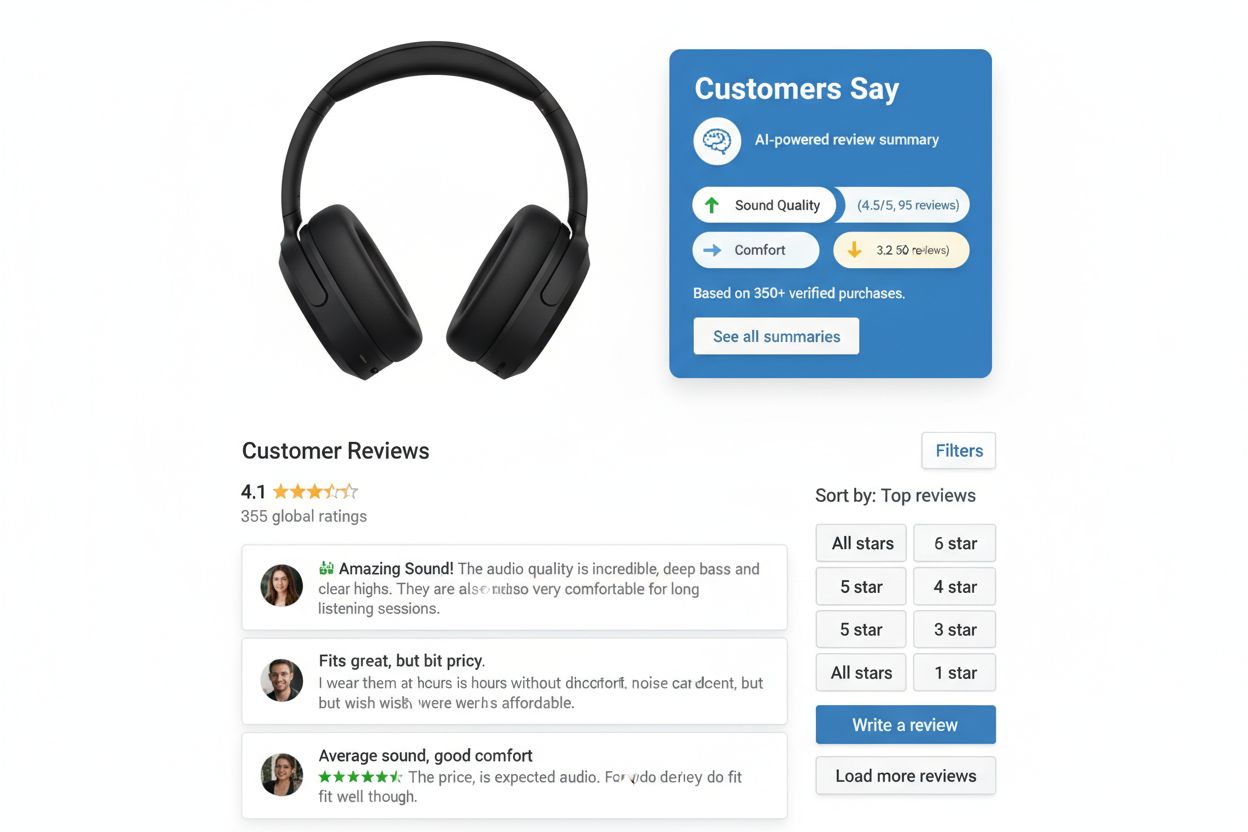
Despite its benefits, AI review aggregation faces significant technical and practical challenges that businesses must address. AI accuracy remains imperfect, particularly when processing sarcasm, context-dependent language, or reviews that discuss multiple products simultaneously. Summaries can sometimes become vague or overly generalized, losing important details that matter to specific customer segments or use cases. The technology may miss critical details that appear in only a few reviews but are crucial for certain customer types, such as accessibility features or compatibility issues. Contradictory themes sometimes emerge when different customer segments have genuinely different experiences with the same product, and AI systems may struggle to represent this nuance effectively. User skepticism about AI-generated content persists, with some customers preferring to read authentic human reviews rather than trust algorithmic summaries. Additionally, the technology requires continuous human oversight to catch errors, prevent manipulation, and ensure that summaries remain fair and representative. Businesses implementing AI review aggregation must invest in quality assurance processes and be prepared to manually review and adjust summaries when necessary.
The future of AI review aggregation points toward increasingly sophisticated and personalized applications that will reshape how customers discover products. Multilingual capabilities are expanding rapidly, allowing global retailers to aggregate reviews across different languages and cultural contexts seamlessly. Real-time aggregation will become standard, with summaries updating instantly as new reviews arrive, ensuring customers always see the most current feedback. Personalized summaries tailored to individual customer preferences, purchase history, and priorities will replace one-size-fits-all aggregations, showing each shopper the themes most relevant to their needs. Voice commerce integration will enable customers to ask voice assistants for review summaries, making product research hands-free and conversational. Predictive insights powered by advanced AI will forecast product performance, identify emerging issues before they become widespread, and recommend products based on aggregated feedback patterns. These developments will make AI review aggregation even more central to the e-commerce experience, transforming it from a convenience feature into an essential shopping tool.
The comparison between AI-powered aggregation and traditional review management methods reveals fundamental differences in speed, accuracy, and scalability that increasingly favor automated approaches. Traditional methods rely on manual curation, simple star-rating averages, or basic keyword filtering—approaches that become impractical as review volumes grow. AI aggregation processes thousands of reviews in seconds, extracting nuanced insights that would require weeks of manual analysis. While traditional methods are subject to human bias and inconsistency, AI systems provide data-driven, objective analysis based on actual customer language patterns. The scalability difference is particularly striking: traditional approaches work for small product catalogs but become impossible for retailers managing millions of SKUs. AI aggregation handles this scale effortlessly while simultaneously enabling personalization that generic summaries cannot achieve.
| Aspect | Traditional Methods | AI Aggregation |
|---|---|---|
| Speed | Manual, time-consuming | Instant, automated |
| Accuracy | Subject to bias | Data-driven, objective |
| Scalability | Limited to small datasets | Handles thousands of reviews |
| Personalization | Generic summaries | Can be tailored |
| Cost | Labor-intensive | Automated, cost-effective |
| Comprehensiveness | Limited themes | Extracts multiple themes |
AI aggregation uses machine learning to automatically extract themes and generate summaries from thousands of reviews instantly, while traditional methods rely on manual curation or simple statistical approaches like average ratings and histograms. AI systems can process complex language patterns, identify nuanced sentiment, and create coherent narratives that traditional methods cannot achieve.
AI summaries are generally accurate but can occasionally miss critical details or include contradictory themes. The accuracy depends on the quality of the underlying AI model, the diversity of reviews being analyzed, and the product category. Most platforms implement quality assurance processes and human oversight to catch errors and ensure fairness.
Yes, modern AI review aggregation systems can process and synthesize reviews from multiple languages, automatically translating and consolidating them into a unified summary. This capability is particularly valuable for global retailers and international e-commerce platforms.
Businesses use AI summaries to build customer trust, reduce decision-making time, improve product pages for SEO, gather actionable insights for product improvements, and ultimately increase conversion rates. The technology also helps identify emerging trends and customer preferences before they become obvious.
Key challenges include ensuring accuracy, avoiding vague or generic summaries, maintaining transparency about AI involvement, building user trust, properly handling negative feedback, and preventing manipulation. Businesses must invest in quality assurance processes and human oversight to address these challenges effectively.
Platforms should expose both positive and negative themes, cite sources with specific review counts and quotes, provide clear disclaimers about AI generation, and make it easy for users to verify summaries against actual reviews. Transparency about methodology and limitations is essential for building trust.
No, AI summaries complement rather than replace individual reviews. Users still want to read actual customer experiences for specific details and to verify the accuracy of AI-generated summaries. The most effective implementations use AI to help customers quickly understand key themes while preserving access to authentic human feedback.
Major e-commerce platforms like Amazon, Best Buy, Walmart, and Etsy have implemented AI review summaries. Specialized review platforms like Bazaarvoice, Okendo, and WiserReview also offer AI aggregation features. The technology is becoming increasingly standard across the e-commerce industry.
AmICited tracks how AI systems aggregate and reference your brand in product reviews and shopping recommendations across major platforms like Amazon, Google Shopping, and Perplexity.
Discover how review aggregation and AI detection work together to build consumer trust in e-commerce. Learn about fake review detection, trust signals, and the ...
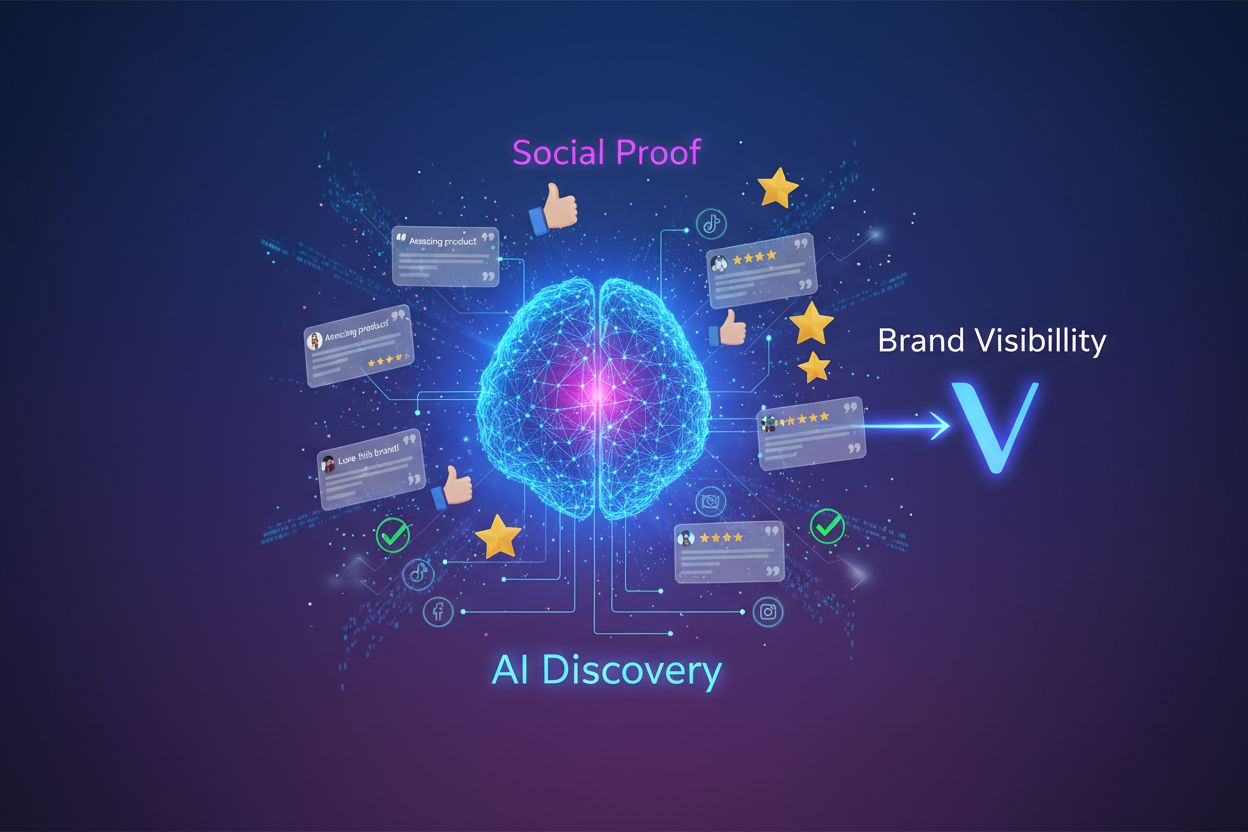
Learn how social proof aggregation consolidates testimonials and endorsements across platforms to improve AI discovery, build trust, and increase conversions. E...

Discover how customer reviews influence AI recommendation algorithms, improve recommendation accuracy, and enhance personalization in AI-powered systems like Ch...
Cookie Consent
We use cookies to enhance your browsing experience and analyze our traffic. See our privacy policy.