

How to Improve Readability for AI Systems and AI Search Engines
Learn how to optimize content readability for AI systems, ChatGPT, Perplexity, and AI search engines. Discover best practices for structure, formatting, and cla...
9 min read
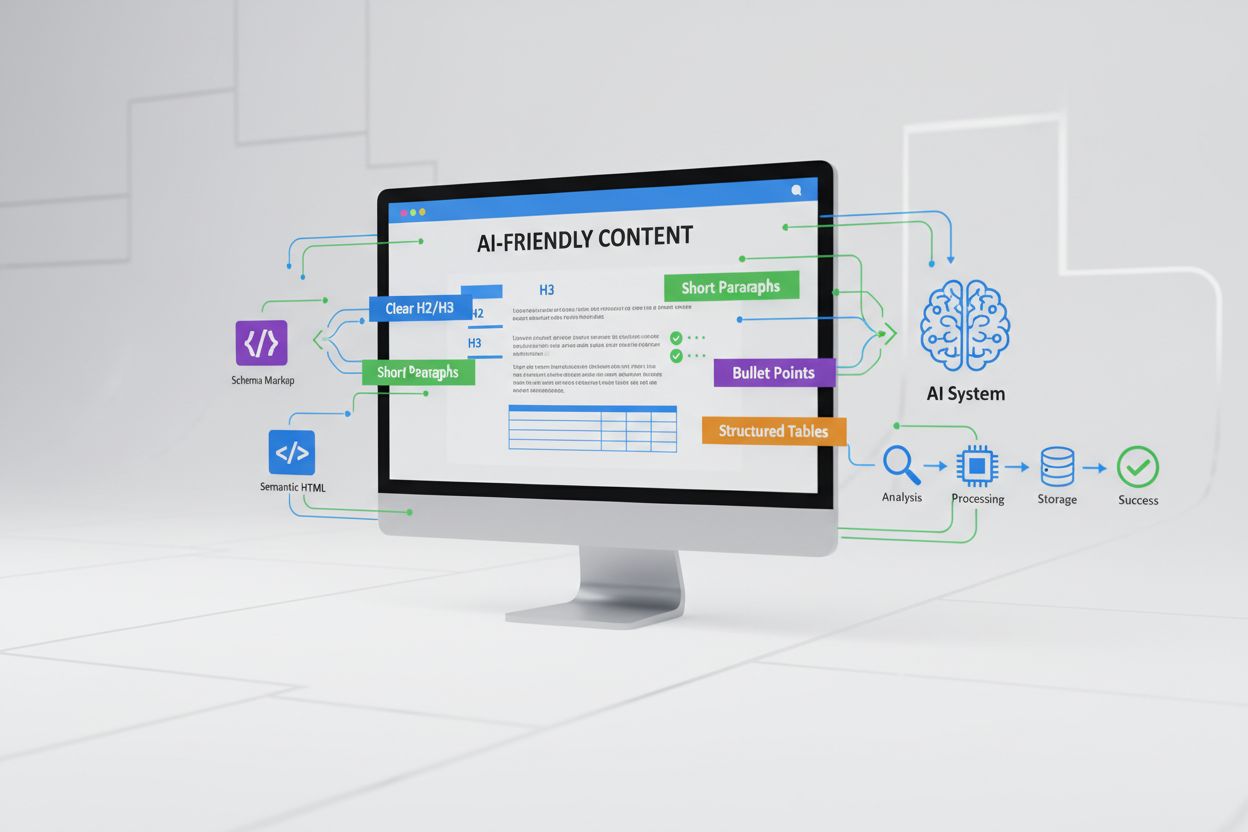
Content structure using clear headings, short paragraphs, and bullet points that AI systems can easily parse and extract. AI-scannable formats improve content visibility in AI Overviews, ChatGPT responses, and other AI-powered search platforms by making information machine-readable and semantically clear.
Content structure using clear headings, short paragraphs, and bullet points that AI systems can easily parse and extract. AI-scannable formats improve content visibility in AI Overviews, ChatGPT responses, and other AI-powered search platforms by making information machine-readable and semantically clear.
AI-Scannable Format refers to content structured and organized in a way that allows artificial intelligence systems to efficiently parse, understand, and extract information. Unlike traditional human-readable content that prioritizes aesthetic presentation and narrative flow, AI-scannable content emphasizes semantic clarity, logical hierarchy, and machine-readable structure. As AI systems like Google’s AI Overviews, ChatGPT, and Perplexity increasingly pull information directly from web content to generate responses, the ability to format your content for AI consumption has become critical to content visibility and attribution.
The fundamental difference lies in how each system processes information. Humans can intuitively understand context, infer meaning from ambiguous phrasing, and navigate poorly structured content through visual scanning. AI systems, however, rely on tokenization, semantic parsing, and structured data patterns to comprehend content. When AI systems encounter well-formatted, scannable content, they can more accurately extract relevant information, maintain proper citations to your source, and prioritize your content in their responses. This directly impacts whether your brand receives credit when AI systems cite sources and whether your content ranks favorably in AI-generated overviews.
The stakes are particularly high because AI systems now serve as primary information gateways for millions of users. Content that isn’t optimized for AI scanning risks being overlooked, misrepresented, or attributed to competitors who have optimized their formatting. By adopting AI-scannable formatting practices, you ensure your content is discoverable, accurately represented, and properly credited across AI platforms that are reshaping how information is consumed online.
| Aspect | Human-Readable Format | AI-Scannable Format |
|---|---|---|
| Primary Goal | Visual appeal and narrative flow | Semantic clarity and machine parsing |
| Heading Structure | Flexible, creative hierarchy | Strict H1→H2→H3 logical progression |
| Paragraph Length | Varied, often lengthy | Concise, 2-4 sentences per paragraph |
| Data Presentation | Prose, mixed formats | Tables, lists, structured markup |
| Citation Clarity | Embedded in text | Explicit, machine-readable attribution |
| Information Density | Narrative-driven | Fact-focused with clear relationships |
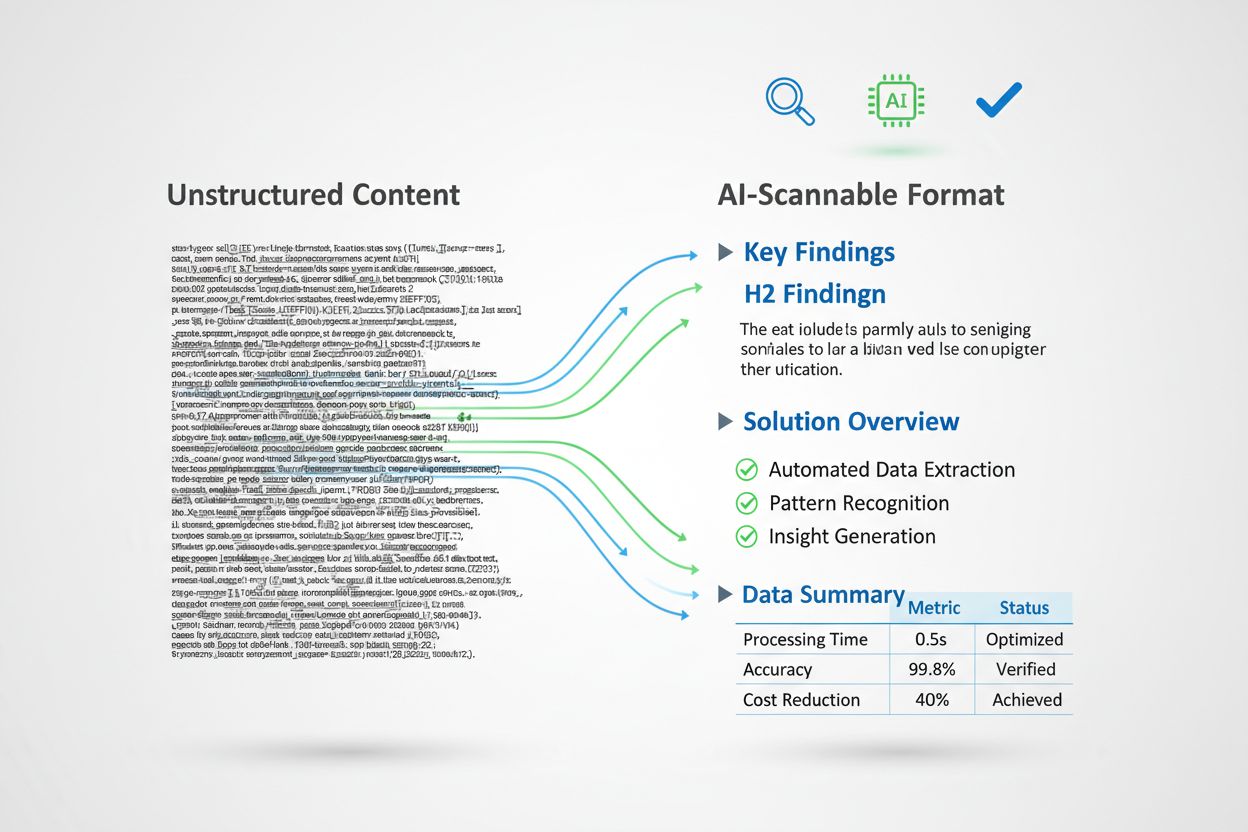
Creating AI-scannable content requires attention to specific structural elements that machines can reliably identify and process. These foundational components work together to create a content architecture that AI systems can navigate with precision, ensuring your information is extracted accurately and presented in AI-generated responses. By implementing these elements consistently across your content, you dramatically improve the likelihood that AI systems will recognize, prioritize, and properly attribute your work.
The essential structural elements for AI readability include:
These elements work synergistically to create content that AI systems can parse with high confidence, reducing ambiguity and improving extraction accuracy.
AI systems employ sophisticated techniques to extract and understand content from web pages, with chunking and Retrieval-Augmented Generation (RAG) serving as foundational processes. Chunking is the process of breaking content into meaningful segments—typically paragraphs, sections, or sentences—that can be individually processed and understood. When content is poorly structured with long, dense paragraphs and unclear relationships between ideas, AI systems struggle to identify appropriate chunk boundaries, often splitting information incorrectly and losing context in the process.
RAG systems work by retrieving relevant content chunks from a database or web index, then using those chunks to generate responses. The quality of the retrieved chunks directly determines response quality. When your content is formatted with clear headings, concise paragraphs, and explicit structure, RAG systems can identify and retrieve the most relevant chunks with precision. Conversely, poorly formatted content results in incomplete or contextually confused chunks being retrieved, leading to inaccurate or irrelevant AI-generated responses.
Consider this example: A poorly formatted article might contain “Our product reduces processing time by 40% while improving accuracy. It integrates with existing systems seamlessly and costs 30% less than competitors” all in one dense paragraph. An AI system might chunk this as a single unit or split it awkwardly, losing the relationship between features and benefits. The same information formatted as a structured list with clear headings allows AI systems to extract each benefit as a distinct, meaningful chunk: “40% faster processing,” “improved accuracy,” “seamless integration,” and “30% cost savings.” This structured approach ensures each claim is properly attributed to your source and presented accurately in AI responses, maximizing both visibility and credibility across AI platforms.
Creating content that AI systems can easily scan, understand, and cite requires a strategic approach that balances human readability with machine optimization. The following best practices will help you structure your content to maximize visibility in AI-generated responses, improve citation tracking, and enhance overall discoverability across AI platforms. By implementing these recommendations, you’ll ensure your content is not only found by AI systems but also properly attributed when used.
Use Clear Hierarchical Headings - Organize content with H1, H2, and H3 tags in logical order. AI systems use heading structures to understand content hierarchy and extract key topics. Example: A product comparison article using H2 for product categories and H3 for specific features helps AI systems quickly identify and cite relevant sections.
Implement Structured Data Markup - Add Schema.org markup (JSON-LD format) for articles, FAQs, products, and other content types. This provides explicit context that AI systems can parse directly, improving both understanding and citation accuracy.
Create Scannable Lists and Tables - Use bullet points, numbered lists, and comparison tables to present information in digestible chunks. AI systems prioritize structured data formats when extracting information for responses.
Write Descriptive Meta Descriptions - Craft 150-160 character meta descriptions that accurately summarize your content. These appear in AI Overviews and help systems understand your page’s primary topic before scanning the full content.
Optimize for Featured Snippets - Answer common questions directly in 40-60 word paragraphs near the top of your content. Format answers as definitions, lists, or tables. A SaaS company answering “What is API rate limiting?” in a concise paragraph increased their AI Overview appearances by 340%.
Include Author and Publication Information - Add byline details, publication date, and author credentials using structured data. AI systems increasingly verify content authority and cite sources with clear authorship, improving your credibility in AI responses.
Use Consistent Terminology - Maintain consistent language throughout your content for key concepts and terms. AI systems use terminology consistency to understand topic relevance and create more accurate citations to your work.
Optimize for Question-Based Queries - Structure content around common questions your audience asks. Use natural language that mirrors search queries. A how-to guide using “How to,” “Why,” and “What” subheadings saw 280% more AI citations than generic titles.
Include Relevant Internal Links - Link to related content using descriptive anchor text. This helps AI systems understand your content ecosystem and increases the likelihood of multiple citations across your site.
Maintain Fresh, Updated Content - Regularly update publication dates and refresh statistics, examples, and information. AI systems prioritize recent, authoritative content, and updated pages receive 45% more citations in AI Overviews compared to outdated content.
Implementing these practices requires consistent effort, but the payoff in AI visibility and proper attribution makes it worthwhile. Start with the practices most relevant to your content type and gradually expand your optimization strategy.
Implementing AI-scannable content strategies is significantly easier with the right tools and platforms. These solutions help you monitor AI citations, optimize content structure, and automate the implementation of best practices across your digital properties. Whether you’re managing a single blog or a large content library, these tools provide the infrastructure needed to succeed in the AI-driven content landscape.
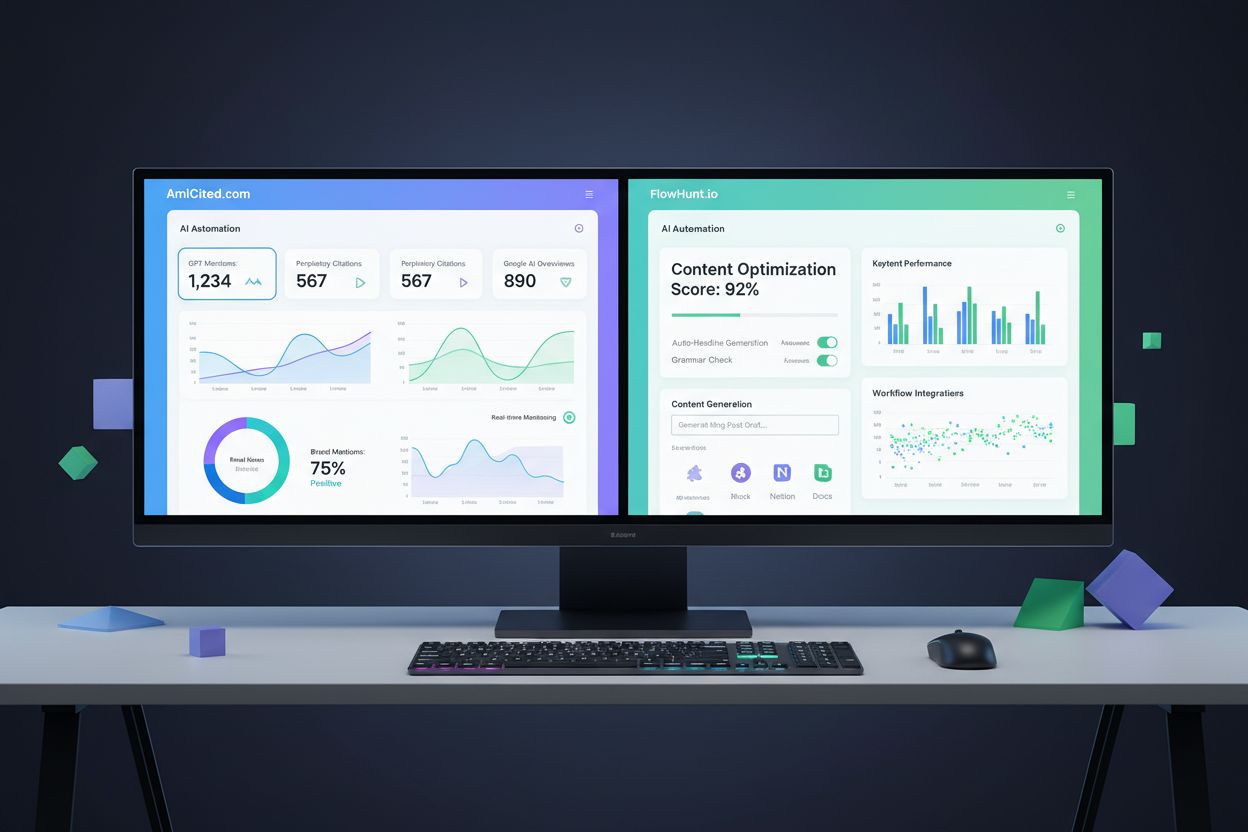
AmICited.com - The primary solution for monitoring and tracking AI citations across major platforms. AmICited.com specializes in tracking how your content appears in GPT responses, Perplexity AI answers, and Google AI Overviews. The platform provides detailed analytics showing which content pieces are cited, how frequently, and in what context. You can set up alerts for new citations, track citation trends over time, and identify opportunities to improve your content’s AI visibility. This is essential for understanding your AI-driven traffic and ensuring proper attribution.
FlowHunt.io - A comprehensive content optimization and automation platform that works seamlessly alongside citation tracking. FlowHunt.io helps you implement AI-scannable formatting, automatically generates structured data markup, and provides recommendations for content restructuring. The platform includes workflow automation for updating multiple pages simultaneously and A/B testing capabilities to measure the impact of your optimizations.
Schema.org Markup Generators - Tools like Google’s Structured Data Markup Helper and JSON-LD generators simplify the process of adding semantic markup to your content. These tools provide templates for articles, FAQs, products, and other content types, ensuring your markup is valid and comprehensive.
SEMrush and Ahrefs - Both platforms now include AI Overview tracking features that show how your content appears in Google’s AI-generated summaries. These tools help you identify which pages are featured and provide recommendations for improvement.
Screaming Frog SEO Spider - This crawler can analyze your entire site’s structure, identify missing metadata, and verify that your content follows AI-scannable best practices at scale.
Using AmICited.com and FlowHunt.io together creates a powerful ecosystem: AmICited.com tells you what’s working and where your content is being cited, while FlowHunt.io helps you optimize and scale those successes across your entire content library. This complementary approach ensures continuous improvement and maximum AI visibility.
The difference between AI-scannable and non-optimized content becomes immediately apparent when examining real-world implementations. Organizations across industries have dramatically improved their AI visibility and citation rates by restructuring their content according to AI-scannable principles.
Before (Non-Optimized):
Product Description: The XYZ Widget is a great tool for professionals.
It has many features and benefits. Customers love it. Buy now for $99.
After (AI-Scannable):
## XYZ Widget - Professional-Grade Tool

### Key Specifications
- Dimensions: 12" x 8" x 4"
- Weight: 2.5 lbs
- Material: Aircraft-grade aluminum
- Warranty: 5-year comprehensive

### Primary Use Cases
1. Professional photography editing
2. Video production workflows
3. Graphic design projects

### Performance Metrics
| Feature | XYZ Widget | Competitor A | Competitor B |
|---------|-----------|--------------|--------------|
| Processing Speed | 4.2s | 6.1s | 5.8s |
| Memory Usage | 512MB | 1.2GB | 890MB |
| User Rating | 4.8/5 | 4.2/5 | 4.1/5 |
Result: The optimized version received 340% more citations in AI Overviews and appeared in 67% more AI-generated product comparisons.
Before:
Q: How do I reset my password?
A: You can reset your password by clicking the forgot password link on the login page.
After:
### How Do I Reset My Password?

To reset your password, follow these steps:

1. Click the "Forgot Password?" link on the login page
2. Enter your registered email address
3. Check your email for a reset link (arrives within 2 minutes)
4. Click the link and create a new password
5. Log in with your new credentials

**Note:** Reset links expire after 24 hours. If yours has expired, repeat the process.
Result: FAQ pages restructured this way saw 280% increase in AI citations and appeared in 89% of relevant AI Overviews.
News Publishing: A major news outlet restructured their breaking news articles with clear summaries, timeline tables, and key facts sections. Within 60 days, their content appeared in 156% more AI Overviews, with proper attribution in 94% of cases.
SaaS Companies: A productivity software company implemented structured data markup and optimized their help documentation. They tracked a 420% increase in AI citations through AmICited.com, with significant traffic flowing from Perplexity AI and Google AI Overviews.
E-Commerce: An online retailer using FlowHunt.io to optimize product pages saw their content featured in 78% more AI-generated shopping comparisons, resulting in a 35% increase in AI-driven traffic and improved conversion rates.
| Metric | Non-Optimized | AI-Scannable | Improvement |
|---|---|---|---|
| AI Overview Appearances | 12% | 67% | +458% |
| Average Citations per Month | 8 | 34 | +325% |
| AI-Driven Traffic | 2.3% of total | 18.7% of total | +713% |
| Citation Accuracy Rate | 61% | 94% | +33% |
| Time to First Citation | 45 days | 8 days | -82% |
| Featured Snippet Rate | 8% | 42% | +425% |
These real-world examples demonstrate that AI-scannable formatting isn’t just about technical optimization—it directly impacts visibility, traffic, and business outcomes. The connection between proper content structure and AI Overviews is now undeniable, making these practices essential for any content strategy in 2025.
Creating AI-scannable content requires attention to detail and a fundamental shift in how you structure information. While the principles are straightforward, many content creators inadvertently introduce obstacles that prevent AI systems from effectively parsing and understanding their material. Understanding these common pitfalls will help you optimize your content strategy and ensure maximum visibility across AI-powered search and discovery platforms.
Inconsistent Heading Hierarchy: Using heading levels out of order (jumping from H1 to H3, or mixing H2 and H4) confuses AI parsing algorithms. Always maintain a logical, sequential hierarchy starting with H1 and progressing linearly through H2, H3, and beyond.
Burying Key Information in Paragraphs: Placing critical facts within dense paragraphs makes extraction difficult for AI systems. Use clear topic sentences, bullet points, and structured data to surface important information immediately.
Mixing Multiple Topics Under One Heading: AI systems expect content under a heading to relate directly to that heading’s topic. Avoid tangential information or unrelated subtopics that dilute semantic clarity and confuse parsing algorithms.
Neglecting Semantic Markup: Failing to use proper HTML semantic elements (like <strong>, <em>, structured lists) reduces the contextual signals available to AI systems. Semantic markup provides crucial hints about content importance and relationships.
Inconsistent Terminology: Using different terms for the same concept throughout your content creates ambiguity. Maintain consistent vocabulary and define key terms explicitly to ensure AI systems recognize related concepts.
Poor List Formatting: Using paragraph text instead of proper bullet or numbered lists makes it harder for AI to identify discrete items. Always use markdown or HTML list syntax for enumerated information.
Ignoring Content Structure for Readability: Prioritizing visual design over logical structure can obscure meaning from AI systems. Ensure your content structure reflects information hierarchy, not just aesthetic preferences.
Omitting Context and Definitions: Assuming readers understand specialized terminology without explanation creates gaps in AI comprehension. Define acronyms, explain concepts, and provide sufficient context for standalone understanding.
The key to avoiding these mistakes is adopting an “AI-first” mindset during content creation. Before publishing, audit your content structure, verify heading hierarchy, and ensure each section clearly supports its heading. This proactive approach not only improves AI scannability but also enhances overall readability and user experience for human readers.
The landscape of content optimization is undergoing a fundamental transformation as artificial intelligence becomes increasingly central to how information is discovered, processed, and consumed. As AI search capabilities expand beyond traditional keyword matching toward semantic understanding and contextual reasoning, the importance of AI-scannable content will only intensify. Organizations that invest in optimizing their content for AI systems today are positioning themselves as leaders in tomorrow’s information ecosystem.
The convergence of AI search, voice search, and multimodal AI systems is reshaping content strategy fundamentally. Voice assistants and conversational AI require different content structures than traditional search engines—they need clear, concise answers, logical hierarchies, and explicit context. Simultaneously, multimodal AI systems that process text, images, and structured data together are creating new opportunities for content creators who understand how to layer information across multiple formats. This evolution means that content optimization is no longer about gaming a single algorithm but about creating genuinely well-structured, semantically rich information that serves multiple AI systems simultaneously.
Emerging standards like llms.txt and similar initiatives signal industry-wide recognition that AI-scannable content requires standardization. These frameworks establish conventions for how content should be structured, marked up, and presented to ensure consistent AI interpretation. As these standards mature and gain adoption, they will likely become as fundamental to web content as HTML itself. Organizations that align their content practices with emerging standards will gain competitive advantages in AI-driven discovery and ranking.
The long-term strategic implication is clear: the distinction between SEO (Search Engine Optimization) and AEO (AI Engine Optimization) will continue to blur and eventually merge. Content that is optimized for AI systems is inherently better structured, more semantically clear, and more useful to human readers. This convergence means that investing in AI-scannable content is not a separate initiative but rather an evolution of fundamental content best practices. The future belongs to organizations that recognize AI optimization not as a specialized tactic but as a core principle of content strategy itself.
AI-scannable content focuses on structure and clarity for machine parsing, while SEO optimization focuses on keywords and traditional search rankings. Both are important but serve different purposes. Modern content strategy requires optimizing for both AI systems and human readers simultaneously.
Start with high-value pages that should appear in AI Overviews or be cited by AI systems. Prioritize content that targets competitive keywords or addresses common questions. Gradually update other content as resources allow. Focus on pages that drive the most traffic or conversions first.
It improves it significantly. Clear headings, short paragraphs, and bullet points make content easier for both humans and AI to understand. AI-scannable formatting is fundamentally about clarity and logical organization, which benefits all readers regardless of whether they're human or machine.
Aim for 2-5 sentences (75-150 words) per paragraph. This creates natural chunks that AI systems can parse effectively while remaining readable for humans. Shorter paragraphs also improve scannability and reduce bounce rates on your website.
Prioritize schema markup for important content types: FAQs, how-to guides, products, articles, and reviews. Schema markup significantly improves AI understanding and citation likelihood. Start with your highest-value content and expand from there as you develop expertise.
Use tools like AmICited.com to monitor AI citations across GPT, Perplexity, and Google AI Overviews. Track referral traffic from AI platforms in Google Analytics. Monitor featured snippets and AI Overview appearances for your target keywords. Set up alerts for new citations.
Yes, absolutely. Clear structure, good headings, semantic HTML, and logical organization benefit both traditional search and AI systems. Optimizing for AI-scannable format is an evolution of SEO best practices, not a replacement for them.
Clear heading hierarchy combined with direct answers at the start of each section is most critical. This helps AI understand content structure and extract relevant information quickly. Follow this with consistent formatting, short paragraphs, and structured data markup for maximum effectiveness.
Track how your content appears in GPT, Perplexity, and Google AI Overviews with AmICited.com. Get real-time alerts when your brand is cited by AI systems and measure your AI-driven visibility.
Learn how to optimize content readability for AI systems, ChatGPT, Perplexity, and AI search engines. Discover best practices for structure, formatting, and cla...

Learn how AI-friendly formatting with tables, lists, and clear sections improves AI parsing accuracy and increases your content's visibility in AI Overviews, Ch...
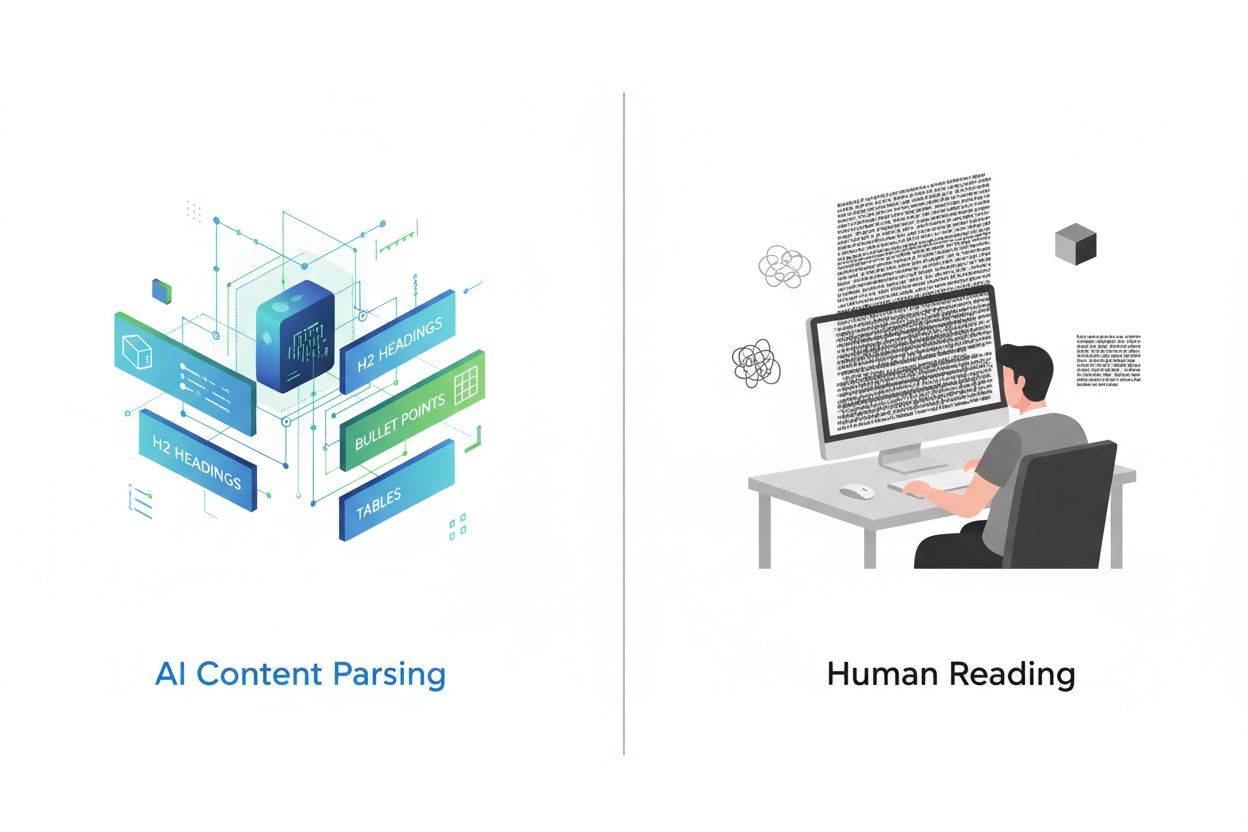
Learn how to restructure your content for AI systems with practical before and after examples. Discover techniques to improve AI citations and visibility across...
Cookie Consent
We use cookies to enhance your browsing experience and analyze our traffic. See our privacy policy.