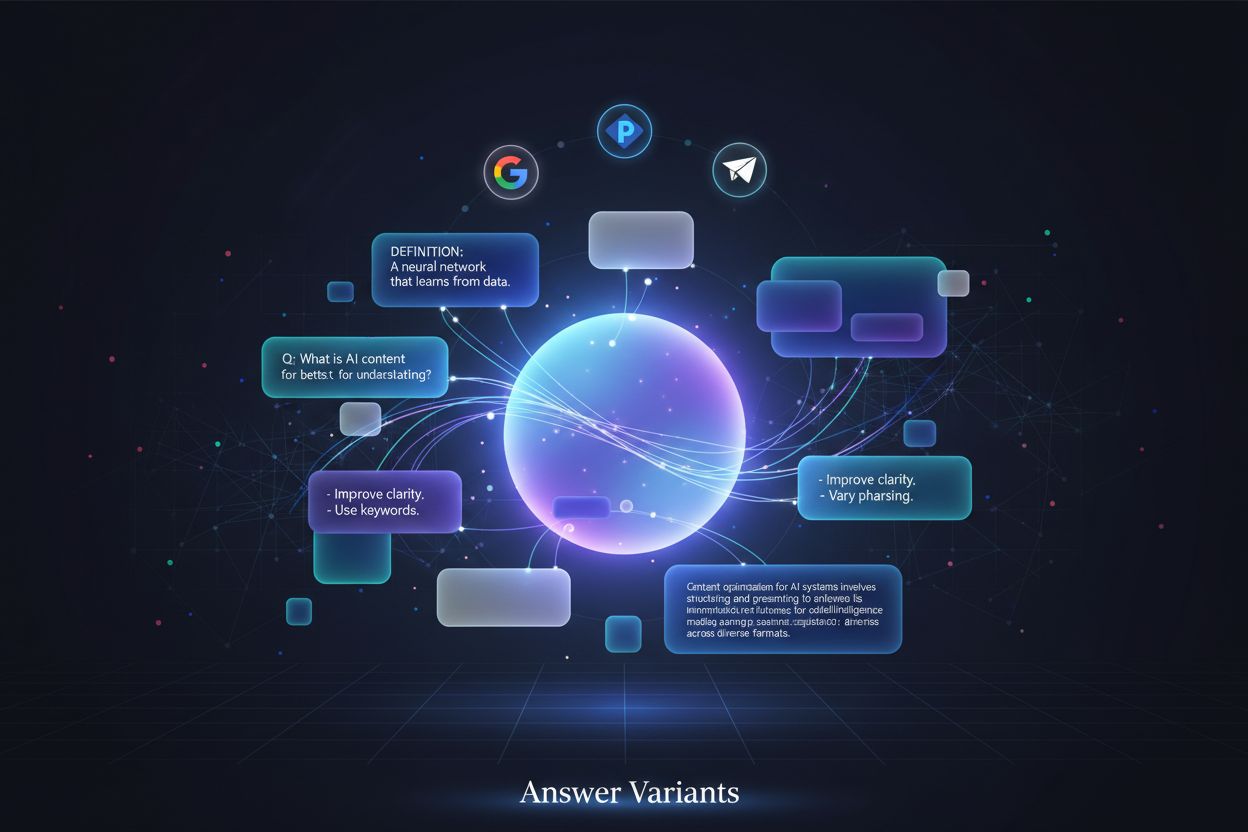
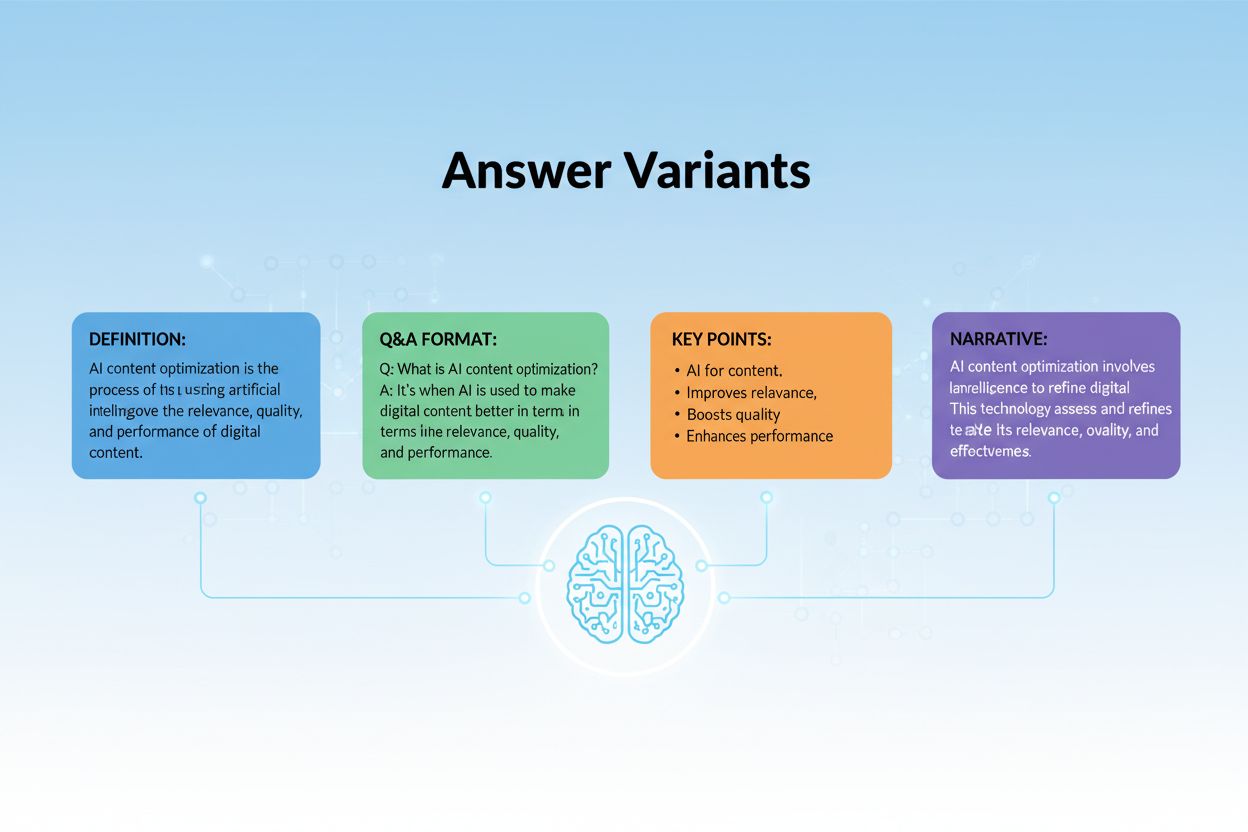
Answer variants are multiple phrasings and formulations of the same core answer designed to match the diverse ways users query AI systems. This approach increases the likelihood that AI systems will extract and cite your content by providing multiple entry points for semantic matching. Rather than relying on a single response, answer variants present information in different linguistic structures, lengths, and contexts to improve visibility across different AI platforms and query types.
Answer Variants
Answer variants are multiple phrasings and formulations of the same core answer designed to match the diverse ways users query AI systems. This approach increases the likelihood that AI systems will extract and cite your content by providing multiple entry points for semantic matching. Rather than relying on a single response, answer variants present information in different linguistic structures, lengths, and contexts to improve visibility across different AI platforms and query types.
Understanding Answer Variants in AI Content Optimization
Answer Variants are multiple phrasings and formulations of the same core answer designed to match the diverse ways users query AI systems. Rather than providing a single response to a question, answer variants present the same information in different linguistic structures, lengths, and contexts to increase the likelihood that AI systems will extract and cite your content. This approach recognizes that AI content extraction works by breaking web pages into semantic chunks and identifying answer blocks that directly respond to user queries—a process that favors content with multiple entry points. When AI systems encounter varied phrasings of the same answer, they can match them against the broader spectrum of user questions, significantly improving your content’s visibility in AI-generated responses. Research shows that content with well-structured answer variants receives 3.2x more citations when updated within 30-day cycles, demonstrating the tangible impact of this optimization strategy on AI discoverability.
How AI Systems Process Multiple Answer Phrasings
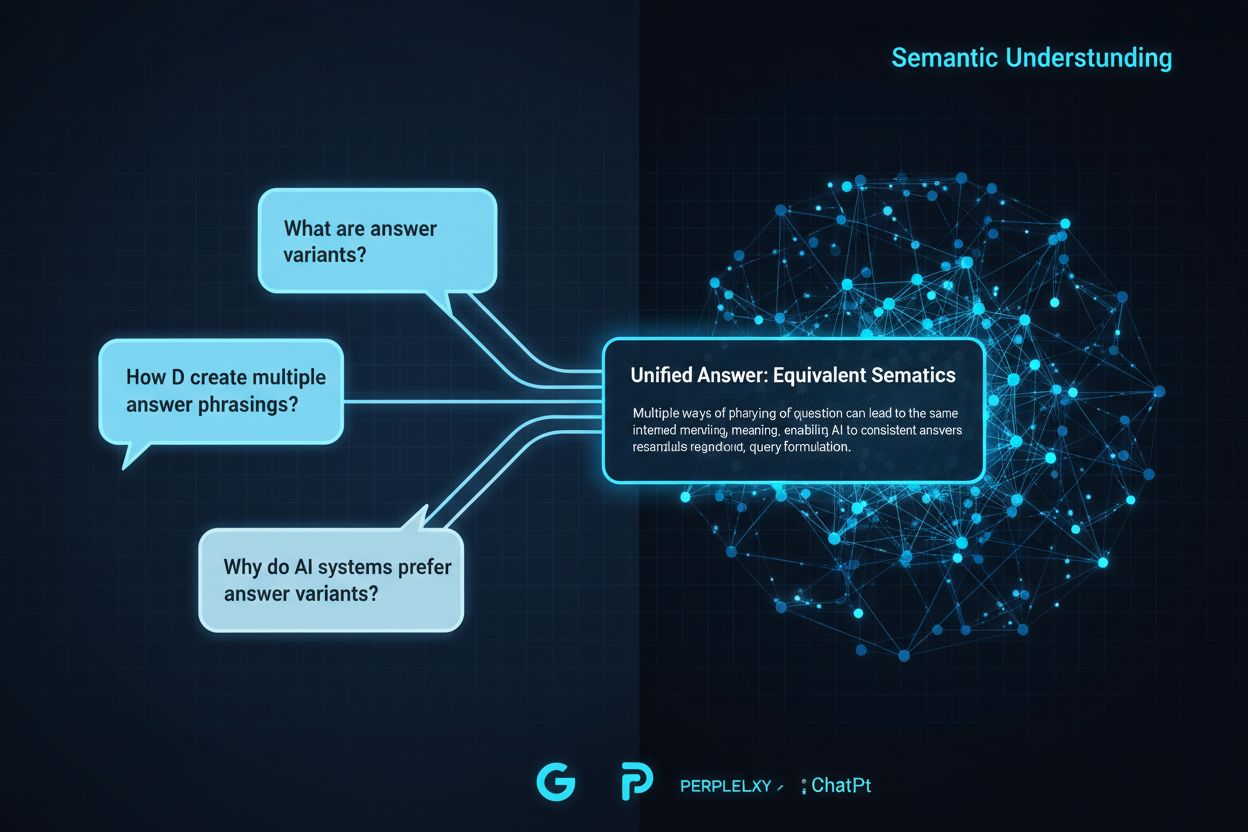
Modern AI systems employ semantic search capabilities that understand meaning, context, and intent far beyond simple keyword matching. This means that when a user asks “What is the best way to optimize for AI?” and another asks “How do I make my content AI-friendly?"—despite using completely different words—both queries are semantically similar and should ideally surface the same authoritative answer. The following table illustrates how answer variants address different query formulations while maintaining the same core information:
User Query
Query Type
Optimal Answer Variant
“What are answer variants?”
Direct definition
A concise 40-60 word explanation of the concept
“How do I create multiple answer phrasings?”
How-to/procedural
Step-by-step implementation focused on tactics
“Why do AI systems prefer answer variants?”
Explanatory/reasoning
Context-driven explanation of semantic matching
“Can answer variants improve my AI citations?”
Benefit-focused
Results-oriented phrasing highlighting ROI
“What’s the difference between answer variants and FAQs?”
Comparative
Side-by-side explanation of distinctions
By providing semantically equivalent answers tailored to these different query angles, your content becomes accessible to AI systems regardless of how users formulate their questions, dramatically expanding your potential reach across multiple AI platforms and query types.
Practical Implementation Strategies for Answer Variants
Implementing answer variants effectively requires a strategic approach to content structuring and formatting. The foundation of this strategy involves creating self-contained answer blocks of 40-60 words that directly address specific questions without requiring additional context—this length is optimal for AI extraction and citation. Beyond this core answer, you should develop complementary phrasings that approach the same concept from different angles:
Direct definition format: Start with “Answer variants are…” for users seeking straightforward explanations
Question-answer (Q&A) format: Structure content as explicit FAQ sections that AI systems naturally recognize and extract
Bullet-point summaries: Break complex answers into scannable lists that AI systems can parse as distinct answer units
Narrative explanations: Provide longer-form context that explains the “why” behind the concept for users seeking deeper understanding
Comparative frameworks: Use tables or structured data to show how answer variants differ from related concepts
Conversational variations: Include natural language phrasings that match the average 23-word length of conversational AI queries
Keyword-rich alternatives: Develop phrasings that incorporate different terminology users might employ when searching
This multi-format approach ensures that regardless of how an AI system extracts and presents your content—whether as a direct quote, a paraphrased summary, or a comparative element—you’ve optimized for maximum discoverability and citation potential.
Platform-Specific Optimization for Answer Variants
Different AI platforms exhibit distinct preferences for answer formatting and content structure, requiring nuanced optimization strategies. ChatGPT tends to favor comprehensive, well-sourced answers embedded within detailed content sections, while Perplexity prioritizes concise, directly quotable statements that can be extracted cleanly and attributed clearly. Google AI Overviews emphasize structured data and semantic markup, preferring answers that align with schema.org standards and appear in dedicated answer blocks. The variation in platform preferences means that a single answer phrasing may perform exceptionally well on one platform while underperforming on another—making answer variants not just beneficial but essential for comprehensive AI optimization. Content that provides multiple answer phrasings across different formats sees significantly higher citation rates across all major AI platforms, as each system can find a version that matches its extraction algorithms and presentation preferences. Understanding these platform-specific nuances allows you to craft answer variants that resonate with the technical requirements of each AI system while maintaining consistency in your core message.
Measuring the success of answer variants requires tracking both direct metrics and indirect performance indicators across AI platforms. Citation tracking should focus on monitoring how frequently your content appears in AI-generated responses, which AI platforms cite you most often, and which specific answer phrasings generate the most citations. Implement regular audits of your content’s appearance in AI overviews and generated responses—tools that track AI citations can reveal which answer variants perform best and which require refinement. Beyond citation counts, monitor content freshness signals by updating answer variants at least every 30 days; this practice correlates with a 3.2x increase in AI citations and signals to AI systems that your content remains current and authoritative. Track engagement metrics on pages containing answer variants, including time-on-page and scroll depth, as these indicate whether your varied phrasings are resonating with human readers—a positive signal that often correlates with better AI performance. Finally, conduct quarterly reviews of your answer variant strategy by analyzing which query types drive the most AI citations, then double down on those successful phrasings while refining underperforming variants. This data-driven approach transforms answer variants from a theoretical best practice into a measurable, optimizable component of your AI content strategy.
Frequently asked questions
What exactly are answer variants?
Answer variants are multiple phrasings and formulations of the same core answer designed to match diverse user queries in AI systems. Instead of providing a single response, answer variants present information in different linguistic structures, lengths, and contexts. This approach recognizes that AI systems break web pages into semantic chunks and extract answer blocks, so having multiple entry points significantly increases the likelihood your content will be selected and cited.
Why do AI systems need multiple answer phrasings?
AI systems use semantic search to understand meaning, context, and intent beyond simple keyword matching. When users ask similar questions with different wording—like 'What are answer variants?' versus 'How do I create multiple answer phrasings?'—AI systems recognize these as semantically similar queries. By providing answer variants, you ensure your content matches the broader spectrum of user questions, improving visibility across different AI platforms and query types.
How long should answer variants be?
The optimal length for direct answer blocks is 40-60 words. This length is ideal for AI extraction and citation—long enough to provide complete, standalone information but short enough to fit naturally into synthesized AI responses. Beyond this core answer, you can develop complementary phrasings in different formats (Q&A, bullet points, narrative explanations) that approach the same concept from different angles.
What formats work best for answer variants?
Effective answer variants include direct definitions, question-answer (Q&A) formats, bullet-point summaries, narrative explanations, comparative frameworks, conversational variations, and keyword-rich alternatives. This multi-format approach ensures that regardless of how an AI system extracts and presents your content—whether as a direct quote, paraphrased summary, or comparative element—you've optimized for maximum discoverability and citation potential.
Do different AI platforms prefer different answer formats?
Yes, different AI platforms have distinct preferences. ChatGPT favors comprehensive, well-sourced answers within detailed content sections. Perplexity prioritizes concise, directly quotable statements that can be extracted cleanly. Google AI Overviews emphasize structured data and semantic markup. Understanding these platform-specific nuances allows you to craft answer variants that resonate with each system's technical requirements while maintaining consistency in your core message.
How do I measure if my answer variants are working?
Track citation metrics across AI platforms to see how frequently your content appears in AI-generated responses. Monitor which specific answer phrasings generate the most citations and which AI platforms cite you most often. Additionally, track content freshness signals by updating answer variants every 30 days—this practice correlates with a 3.2x increase in AI citations. Conduct quarterly reviews to identify which query types drive the most citations.
How often should I update my answer variants?
Update answer variants at least every 30 days. This practice signals to AI systems that your content remains current and authoritative, correlating with a 3.2x increase in AI citations. Regular updates also allow you to refine underperforming variants based on citation data and adjust your strategy based on emerging query patterns and platform preferences.
Yes, answer variants support both AI and traditional SEO. Well-structured answer variants improve your chances of appearing in featured snippets, which are increasingly important for traditional search visibility. The same semantic clarity and multiple entry points that help AI systems also help traditional search engines understand and rank your content more effectively.
Monitor Your AI Citations with AmICited
Track how your answer variants perform across ChatGPT, Perplexity, Google AI Overviews, and other AI systems. Get real-time insights into your brand mentions, citations, and visibility in AI-generated answers.
How to Add Variety to Content for AI - Strategies for Better AI Visibility
Learn how to add variety to content for AI systems. Discover strategies for diverse data sources, semantic richness, content structure, and optimization techniq...
How Do I Structure Content for AI Citations? Complete Guide for 2025
Learn how to structure your content to get cited by AI search engines like ChatGPT, Perplexity, and Google AI. Expert strategies for AI visibility and citations...
Should You Use AI to Create Content for AI Search Engines?
Learn whether AI-generated content is effective for AI search visibility, including best practices for content creation, optimization strategies, and how to bal...
6 min read
Cookie Consent We use cookies to enhance your browsing experience and analyze our traffic. See our privacy policy.