
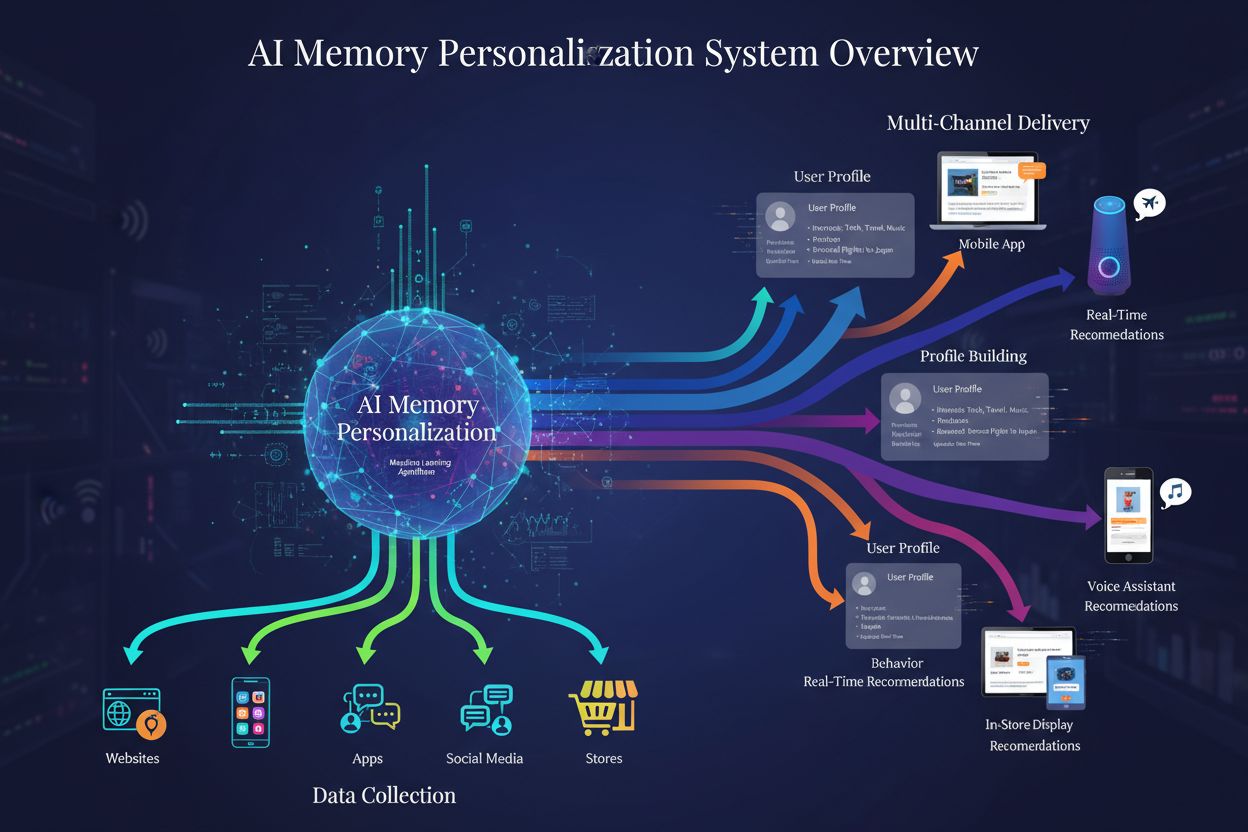
AI Memory Personalization
Learn how AI memory personalization systems build detailed user profiles to deliver personalized brand recommendations. Understand the technology, benefits, pri...
14 min read
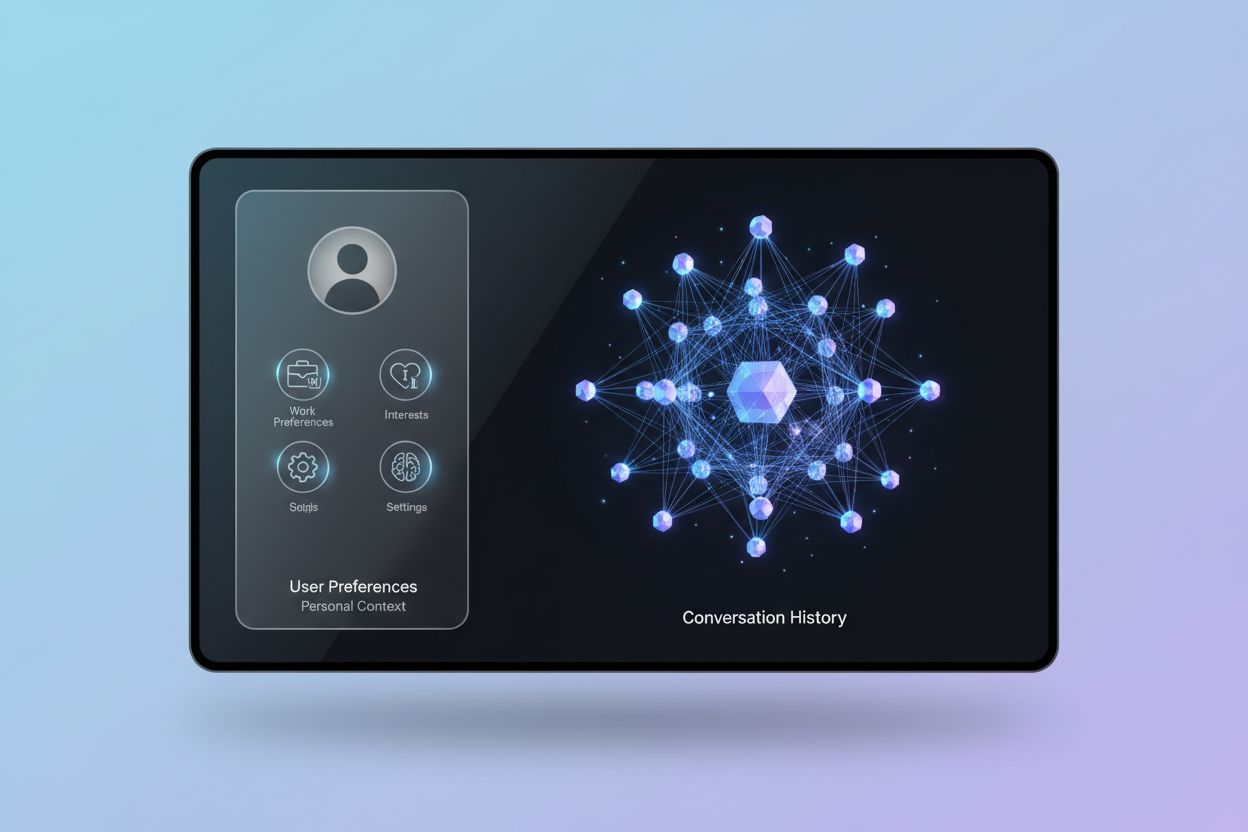
OpenAI’s feature that allows ChatGPT to retain and recall information from previous conversations, creating personalized experiences across multiple chat sessions. It enables the AI to remember user preferences, interests, and context without requiring users to repeat information. The system automatically detects and stores memory-worthy information while giving users full control over what is remembered. This personalization mechanism improves user experience by making ChatGPT increasingly tailored to individual needs and working styles.
OpenAI's feature that allows ChatGPT to retain and recall information from previous conversations, creating personalized experiences across multiple chat sessions. It enables the AI to remember user preferences, interests, and context without requiring users to repeat information. The system automatically detects and stores memory-worthy information while giving users full control over what is remembered. This personalization mechanism improves user experience by making ChatGPT increasingly tailored to individual needs and working styles.
ChatGPT Memory is OpenAI’s personalization feature that enables the AI assistant to retain and recall information from previous conversations, creating a continuous user experience across multiple chat sessions. Rather than treating each conversation as isolated, this feature allows ChatGPT to build a profile of user preferences, interests, communication styles, and contextual information over time. The memory system functions as a personalization mechanism designed to improve user experience by reducing the need to repeatedly provide the same background information or preferences. By remembering details about who users are and what matters to them, ChatGPT Memory transforms the AI from a stateless tool into a more contextually aware assistant that can provide increasingly tailored and relevant responses.
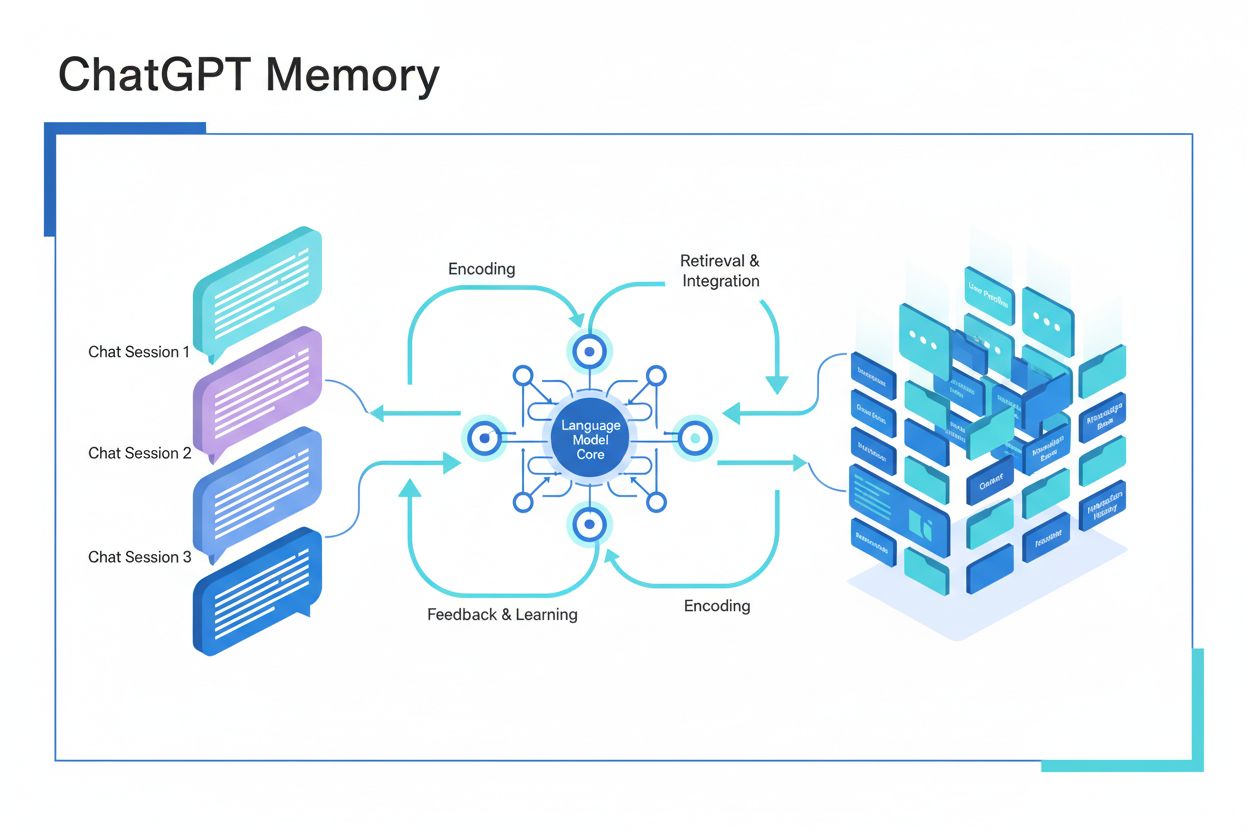
ChatGPT Memory operates through a sophisticated process that identifies, stores, and retrieves user-relevant information from conversations. When users interact with ChatGPT, the system continuously analyzes the conversation content to detect information worth remembering—such as stated preferences, personal details, work context, or communication preferences—and automatically stores these insights in a user-specific memory store. The technical implementation leverages retrieval-augmented generation (RAG) principles, where the system indexes relevant conversation segments into a searchable database that can be quickly accessed during future interactions. When a user begins a new conversation, ChatGPT queries this memory store to retrieve contextually relevant information, which is then integrated into the current conversation’s context window to inform responses. The system employs intelligent filtering to determine what’s worth remembering versus what’s temporary or session-specific, using natural language understanding to extract meaningful patterns rather than storing raw conversation transcripts. This integration happens seamlessly within ChatGPT’s standard context management, allowing the model to reference remembered information as naturally as if it were part of the current conversation. The memory system respects token limits and context window constraints by prioritizing the most relevant and recent memories while maintaining the ability to access older information when contextually appropriate.
| Aspect | With Memory | Without Memory |
|---|---|---|
| Context Retention | Remembers preferences across sessions | Starts fresh each conversation |
| Personalization | Highly tailored responses | Generic responses |
| Setup Time | Minimal after initial context | Requires repeated information |
| User Profile | Builds detailed preference profile | No persistent user model |
| Response Relevance | Increases over time | Consistent baseline |
| Privacy Control | User-managed memories | No memory to manage |
ChatGPT Memory can retain a diverse range of information that enhances personalization and user experience. The system remembers:
These memories enable ChatGPT to provide increasingly customized responses—for example, remembering that a user prefers concise bullet-point answers over lengthy paragraphs, or that they work in healthcare and appreciate medical terminology. The feature is particularly valuable for ongoing projects where context accumulates over multiple sessions, such as writing a book, developing software, learning a new skill, or managing complex professional tasks. Different use cases benefit distinctly: researchers can have ChatGPT remember their field and previous research directions; creative professionals can maintain consistent character voices and project parameters; and business users can have the AI remember company-specific terminology and strategic priorities. The capability extends to understanding nuanced preferences that users might not explicitly state, such as recognizing when a user values practical examples over theoretical explanations or prefers a collaborative versus directive approach.
OpenAI has designed ChatGPT Memory with explicit user control mechanisms that prioritize transparency and autonomy. Users can view, manage, and delete individual memories at any time through their ChatGPT settings, allowing granular control over what the system retains. The feature includes options to clear all memories with a single action, providing users with a complete reset if desired, and users can disable memory entirely if they prefer ChatGPT to operate without personalization across sessions. From a privacy perspective, OpenAI has committed to storing memory data securely and separately from conversation logs, with memories subject to the same data protection standards as other user data. Users maintain full visibility into what ChatGPT has remembered about them, addressing concerns about hidden profiling or undisclosed data collection. The transparency extends to OpenAI’s privacy policy, which explicitly addresses how memory data is used, retained, and protected. This approach reflects a balance between enabling personalization benefits and respecting user privacy rights, though users should remain aware that any information shared with ChatGPT—whether remembered or not—is subject to OpenAI’s data handling practices and terms of service.
ChatGPT Memory delivers substantial value across diverse professional and personal use cases. For professionals, the feature enables more efficient workflows by remembering project context, client preferences, and industry-specific requirements—a consultant can have ChatGPT remember their client’s business model and strategic challenges, reducing setup time for each interaction. In educational contexts, memory allows ChatGPT to adapt to a learner’s level, learning pace, and knowledge gaps, creating a more personalized tutoring experience that evolves as the student progresses. Creative professionals benefit from ChatGPT remembering character details, narrative elements, style preferences, and project specifications across multiple writing sessions, maintaining consistency without manual reminders. For customer service and support roles, memory enables representatives to provide more informed assistance by having ChatGPT remember customer history, preferences, and previous issues. Researchers can maintain continuity across extended research projects, with ChatGPT remembering their research questions, methodologies, and previous findings. The productivity gains are particularly pronounced for users who engage with ChatGPT regularly for ongoing work, as the system becomes increasingly attuned to their specific needs and working style. These applications demonstrate how memory transforms ChatGPT from a general-purpose tool into a more specialized assistant that understands individual user contexts and can operate with greater efficiency and relevance.

While ChatGPT Memory enhances personalization, users should understand its constraints and limitations. The system operates within context window limitations, meaning that while it can remember information across sessions, the amount of memory it can actively reference in any single conversation is constrained by token limits—very extensive memory stores may not be fully accessible in every interaction. Memory accuracy depends on the quality of information extraction from conversations; if users provide contradictory information or if the system misinterprets context, memories may become outdated or inaccurate. The feature cannot remember information from conversations before the memory feature was enabled, and memories may degrade or become less relevant over extended periods if user circumstances change significantly. Users should not rely on ChatGPT Memory as a substitute for formal documentation or critical record-keeping, as the system is designed for convenience rather than guaranteed accuracy or completeness. Best practices include periodically reviewing and updating memories to ensure they remain current, explicitly correcting ChatGPT if it misremembers something, and maintaining separate documentation for information that requires guaranteed accuracy or legal significance. Understanding these limitations helps users leverage memory effectively while maintaining appropriate expectations about its reliability and scope.
ChatGPT Memory represents one approach to persistent personalization in AI systems, but it differs meaningfully from memory implementations in competing platforms. Some AI assistants like Claude offer conversation history within a session but lack cross-session memory capabilities, while others like Google’s Bard have implemented memory features with different technical architectures and user control mechanisms. ChatGPT Memory distinguishes itself through its automatic detection and storage of relevant information without requiring explicit user tagging or manual memory creation, making personalization more seamless than systems requiring users to manually designate what should be remembered. The transparency and user control mechanisms in ChatGPT Memory—including the ability to view, edit, and delete specific memories—exceed the memory management capabilities of some competing systems. However, the implementation raises important considerations relevant to platforms like AmICited.com that track AI citations and personalization: as AI systems increasingly remember and reference user information, questions emerge about how these systems cite or acknowledge the sources of their personalized responses, whether they transparently indicate when they’re drawing on remembered user context versus general training data, and how users can verify the accuracy of what AI systems claim to remember about them. This distinction matters because personalized AI responses that reference remembered user context should ideally be transparent about that personalization, allowing users to understand how their previous interactions are influencing current outputs. The evolution of memory features across AI platforms underscores the importance of monitoring how these systems implement personalization and maintain accountability in their use of user-specific information.
No, ChatGPT Memory is completely isolated to individual user accounts. The system cannot access or reference memories from other users' conversations. Each user's memory store is private and separate, ensuring that personal information and preferences remain confidential and are not shared across different user accounts.
OpenAI has not specified a fixed retention period for ChatGPT memories. Memories persist until users manually delete them or clear all memories from their settings. However, users should be aware that very old memories may become less relevant if their circumstances change significantly, and they should periodically review and update their memory settings.
ChatGPT Memory is available to ChatGPT Plus and Team subscribers through the web interface and mobile apps. The feature may not be available on all third-party integrations or API implementations. Users should check their specific ChatGPT subscription level and platform to confirm memory feature availability.
Currently, OpenAI does not provide a built-in feature to export memories in a structured format. Users can view their memories in the ChatGPT settings interface, but exporting them requires manual documentation. This is an important consideration for users who want to maintain backups of their personalization data.
Memory can improve response relevance and personalization, but it doesn't necessarily improve factual accuracy. ChatGPT's core knowledge and reasoning capabilities remain the same. However, by remembering user context and preferences, the system can provide more appropriately tailored responses. Users should still verify important factual claims regardless of memory features.
When a user deletes their ChatGPT account, all associated memories are permanently deleted along with the account. OpenAI does not retain memory data after account deletion. Users who want to preserve important information should export or document their memories before deleting their accounts.
OpenAI has stated that user conversations and memories are not used to train ChatGPT models by default. However, users can opt into sharing data for model improvement through OpenAI's settings. Users who prefer not to contribute to model training should disable this option in their privacy settings.
ChatGPT uses natural language understanding to automatically identify information worth remembering, such as stated preferences, personal details, work context, and communication styles. The system filters out temporary or session-specific information. While the exact algorithm is proprietary, the goal is to capture meaningful patterns that enhance personalization without storing unnecessary data.
AmICited.com tracks how AI systems like ChatGPT reference and personalize responses based on user information. Understand how your brand appears in AI-generated content and personalized recommendations.
Learn how AI memory personalization systems build detailed user profiles to deliver personalized brand recommendations. Understand the technology, benefits, pri...

ChatGPT is OpenAI's conversational AI assistant powered by GPT models. Learn how it works, its impact on AI monitoring, brand visibility, and why it matters for...
Learn how ChatGPT Search retrieves real-time information from the internet using web crawlers, indexing, and partnerships with data providers to deliver accurat...
Cookie Consent
We use cookies to enhance your browsing experience and analyze our traffic. See our privacy policy.