
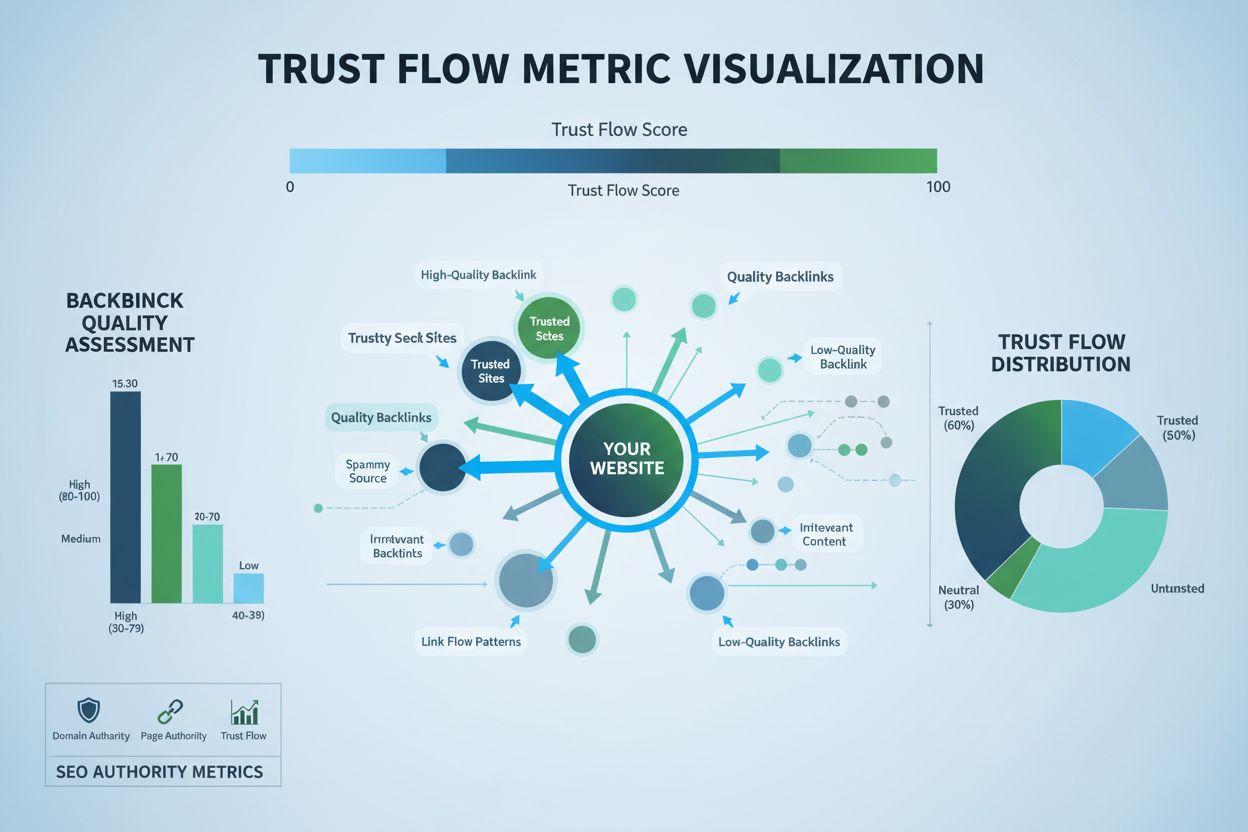
Trust Flow
Trust Flow is a Majestic SEO metric (0-100 scale) measuring backlink quality and trustworthiness. Learn how it works, differs from Citation Flow, and impacts yo...
9 min read
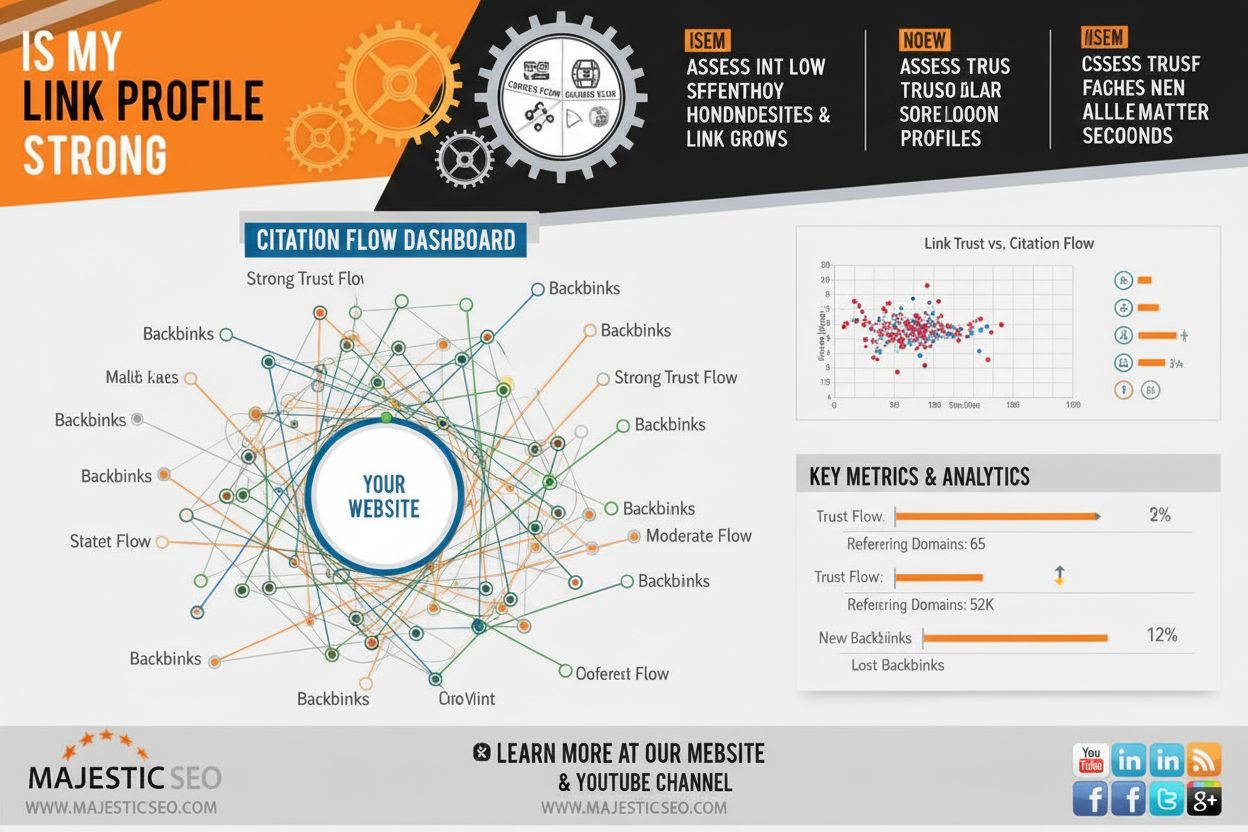
Citation Flow is a metric developed by Majestic that measures a website’s link influence and authority on a scale of 0-100 based on the quantity and link equity of backlinks pointing to it. It predicts how influential a URL might be by analyzing the number of sites linking to it and the flow of authority through the web graph.
Citation Flow is a metric developed by Majestic that measures a website's link influence and authority on a scale of 0-100 based on the quantity and link equity of backlinks pointing to it. It predicts how influential a URL might be by analyzing the number of sites linking to it and the flow of authority through the web graph.
Citation Flow is a proprietary SEO metric developed by Majestic that measures a website’s link influence and authority on a scale ranging from 0 to 100. Rather than simply counting the number of backlinks pointing to a URL, Citation Flow analyzes the quantity of backlinks and the link equity (or “link juice”) they pass through the web graph. This metric predicts how influential a URL might be based on the cumulative effect of all sites linking to it, considering that links from authoritative sources carry more weight than links from low-authority sites. Citation Flow is fundamentally different from traditional link counting because it uses an iterative algorithm that flows through the web’s interconnected network, measuring how authority propagates from one page to another through multiple linking paths. Understanding Citation Flow is essential for SEO professionals, content marketers, and brand managers who need to assess their website’s competitive positioning and link-building effectiveness.
Majestic introduced Citation Flow as a replacement for their earlier ACRank metric, representing a significant advancement in how link authority is measured and understood. The metric emerged from Majestic’s recognition that traditional link counting methods failed to capture the nuanced way authority flows through the web. By implementing a logarithmic scale from 0 to 100, Majestic created a more granular and mathematically sophisticated approach to measuring link influence compared to Google’s deprecated PageRank toolbar (which only ranged from 0-10). The development of Citation Flow coincided with growing industry recognition that backlinks remain one of the most important ranking factors in search engine algorithms—research shows that the number one ranking position in search results has approximately 3.8 times more backlinks than positions 2-10, underscoring the critical importance of link authority metrics. Since its introduction, Citation Flow has become a standard metric in the SEO industry, with over 78% of enterprises now using AI-driven content monitoring and backlink analysis tools to track their domain authority and competitive positioning. The metric’s evolution reflects the broader shift toward more sophisticated, data-driven approaches to understanding website authority in an increasingly complex digital landscape.
Citation Flow operates through a sophisticated algorithmic process that analyzes the entire web graph to determine link influence. The metric uses a logarithmic scale, which means the distance between consecutive numbers is not equal—it becomes progressively harder to achieve higher scores. For example, improving from a Citation Flow of 10 to 20 is significantly easier than improving from 40 to 50, or from 50 to 60. This logarithmic approach reflects the reality that acquiring high-authority backlinks becomes exponentially more difficult as your domain authority increases. The algorithm works by flowing through multiple linking paths, measuring how authority passes from one page to another through interconnected links. When a high-authority site links to your page, that link carries more weight than a link from a low-authority site, and this weighted value propagates through your site’s internal linking structure as well. Majestic’s Fresh Index, which contains over a billion unique URLs and is refreshed approximately three times daily, continuously recalculates Citation Flow scores as new links are discovered, existing links are removed, or linking sites’ own authority changes. The metric considers not just direct links to your URL but also how authority flows through your internal linking architecture, meaning a strong homepage can influence the Citation Flow of pages within the same site. This sophisticated calculation process is why Citation Flow provides a more accurate representation of link influence than simple link counting methods.
| Metric | Citation Flow | Trust Flow | Primary Use |
|---|---|---|---|
| Definition | Measures quantity of backlinks and link equity | Measures quality and trustworthiness of backlinks | Assessing link profile health |
| Scale | 0-100 (logarithmic) | 0-100 (logarithmic) | Both use same scale |
| Focus | Volume and influence of links | Credibility of linking sources | Combined analysis required |
| Calculation | Based on number of linking sites and their authority | Based on manually reviewed trusted seed sites | Different algorithms |
| Ideal Ratio | Should be balanced with Trust Flow | Should be balanced with Citation Flow | 1:1 ratio is optimal |
| High Score Indicates | Many backlinks from various sources | Links from authoritative, trustworthy domains | Strong authority |
| Low Score Indicates | Few backlinks or low-authority sources | Links from low-quality or spammy sites | Weak authority |
| Manipulation Risk | Can be inflated through link farms | More resistant to manipulation | Trust Flow more reliable |
| SEO Impact | Indirect (vendor metric, not ranking factor) | Indirect (vendor metric, not ranking factor) | Both inform strategy |
The relationship between Citation Flow and Trust Flow is complementary and essential for comprehensive backlink analysis. A website might have a high Citation Flow (indicating many backlinks) but a low Trust Flow (indicating those backlinks come from low-quality sources), which suggests a potentially problematic link profile. Conversely, a site with low Citation Flow but high Trust Flow has fewer backlinks but from highly authoritative sources, which is generally more valuable for SEO. The ideal scenario is high Citation Flow combined with high Trust Flow, indicating both quantity and quality in the backlink profile. Industry data suggests that the average Citation Flow to Trust Flow ratio is approximately 2:1 (or 50%), meaning most websites have twice as many backlinks as their trust score would suggest. Websites performing better than this ratio have more trustworthy link profiles, while those below this ratio may need to focus on acquiring links from higher-authority sources.
Citation Flow serves as a critical diagnostic tool for link-building professionals and SEO strategists seeking to understand their competitive positioning and identify link-building opportunities. By comparing your Citation Flow score with those of your top competitors, you can quickly assess whether your backlink profile is competitive within your industry or niche. If competitors consistently have Citation Flow scores 20-30 points higher than yours, this indicates a significant gap in your link-building efforts that needs to be addressed. Citation Flow also helps identify which websites are worth pursuing for backlinks—sites with high Citation Flow scores are generally more influential and can pass more authority to your site when they link to you. This allows link prospectors to prioritize their outreach efforts toward high-impact opportunities rather than wasting time on low-authority sites. Additionally, Citation Flow can reveal which types of content attract the most high-quality backlinks by analyzing which pages or sections of your site have the highest Citation Flow scores. Research indicates that longer content receives 77.2% more links than shorter content, and by analyzing Citation Flow distribution across your content, you can identify patterns about what resonates with authoritative sites in your industry. The metric also helps with risk management by identifying potentially harmful backlinks—sites with very low Citation Flow scores might be spammy or low-quality, and acquiring links from such sources could damage your site’s credibility and SEO performance.
In the emerging landscape of AI monitoring and brand tracking across platforms like ChatGPT, Perplexity, Google AI Overviews, and Claude, Citation Flow has become increasingly relevant for understanding domain authority and visibility. When AI systems generate responses and cite sources, they typically prioritize domains with higher authority metrics, including backlink profiles reflected in Citation Flow scores. A domain with a strong Citation Flow indicates to AI systems that the site is influential and trustworthy, making it more likely to be cited in AI-generated content. This connection between Citation Flow and AI visibility is particularly important for brands using platforms like AmICited to monitor where their domain appears in AI responses. Higher Citation Flow correlates with greater visibility not just in traditional search results but also in AI-generated citations and recommendations. As AI systems become more sophisticated in evaluating source credibility, metrics like Citation Flow will play an increasingly important role in determining which domains are recommended or cited. Organizations tracking their brand mentions in AI systems should monitor Citation Flow alongside other authority metrics, as improvements in link profile strength directly translate to improved visibility across multiple discovery channels. The metric essentially serves as a proxy for domain authority that AI systems recognize and value when determining which sources to cite or recommend to users.
Effective Citation Flow optimization requires a strategic, long-term approach focused on acquiring high-quality backlinks from authoritative sources rather than pursuing quick wins through low-quality link schemes. Here are essential practices for improving and maintaining a healthy Citation Flow:
While Citation Flow is a valuable metric for understanding link influence, it has important limitations that SEO professionals must recognize. The metric measures quantity over quality—a website with numerous low-quality backlinks can achieve a high Citation Flow score despite having a weak link profile from an SEO perspective. This is why Citation Flow must always be evaluated alongside Trust Flow to get a complete picture of backlink health. Additionally, Citation Flow does not account for contextual relevance—a backlink from a completely unrelated website counts the same as a link from a topically relevant source, even though the relevant link typically provides more SEO value. The metric is also susceptible to manipulation through black-hat SEO techniques such as link farms, private blog networks (PBNs), and other spammy link-building practices, meaning a high Citation Flow score alone doesn’t guarantee a healthy link profile. Furthermore, Citation Flow is an SEO vendor metric rather than a Google ranking factor, so it doesn’t directly influence search rankings—it’s useful for tracking and analysis but shouldn’t be confused with actual ranking signals. The logarithmic scale, while mathematically sophisticated, can also be confusing for beginners who might not understand why improving from 50 to 60 is exponentially harder than improving from 10 to 20. Finally, Citation Flow provides limited insight without other metrics—domain authority, page authority, referring domain count, and other complementary metrics are necessary for comprehensive SEO analysis and strategy development.
The future of Citation Flow and similar link authority metrics will likely evolve in response to changing search engine algorithms, the rise of AI-driven content discovery, and increasing sophistication in how authority is measured across the web. As artificial intelligence becomes more central to content discovery and recommendation systems, metrics like Citation Flow may be adapted or supplemented with new measurements that better reflect how AI systems evaluate source credibility and authority. Search engines are continuously refining their understanding of link quality, moving beyond simple authority metrics toward more nuanced evaluations of link context, relevance, and user intent. This suggests that future iterations of Citation Flow or successor metrics may incorporate more sophisticated contextual analysis. Additionally, as the web becomes increasingly interconnected through social signals, user behavior data, and entity relationships, link authority metrics may need to account for these additional factors beyond traditional backlinks. The rise of zero-click searches and AI-generated answers means that traditional link-based authority metrics may need to be supplemented with new measures of visibility and influence in AI systems. Organizations using platforms like AmICited to monitor brand visibility in AI responses will likely see new metrics emerge that specifically measure how domains are perceived and cited by AI systems. The integration of Citation Flow data with real-time brand monitoring, AI citation tracking, and competitive intelligence will create more comprehensive authority assessment frameworks. As the SEO industry matures, Citation Flow will likely remain relevant but will be increasingly used in conjunction with emerging metrics that capture the full complexity of domain authority in an AI-driven digital landscape.
Citation Flow measures the quantity of backlinks pointing to a website on a 0-100 scale, while Trust Flow measures the quality and trustworthiness of those backlinks. Citation Flow focuses on how many sites link to you, whereas Trust Flow evaluates whether those linking sites are credible and authoritative. Together, these metrics provide a comprehensive view of a website's backlink profile and authority.
A good Citation Flow score generally falls between 40-60, indicating a strong and influential backlink profile. Scores above 60 are considered excellent and reflect high authority with numerous quality backlinks. However, Citation Flow should always be evaluated in relation to Trust Flow and your competitors' scores. A balanced ratio between Citation Flow and Trust Flow (ideally close to 1:1) is more important than the absolute number.
Citation Flow uses a logarithmic scale algorithm that analyzes the number of backlinks pointing to a URL and the authority of those linking sites. The metric flows through the web graph, measuring how authority passes from one page to another through links. It's harder to achieve higher scores on the logarithmic scale—for example, improving from 10 to 20 is easier than improving from 40 to 50. Majestic updates Citation Flow scores regularly as their index updates.
Yes, you can improve Citation Flow by acquiring more high-quality backlinks from authoritative websites. Focus on link-building strategies like guest posting, broken link building, and creating linkable content. However, remember that Citation Flow measures quantity, so quality matters more than volume. Disavow low-quality or spammy links that could harm your profile, and monitor your backlink profile regularly using tools like Majestic or SEO platforms.
No, Citation Flow is not a direct Google ranking factor. It's an SEO vendor metric created by Majestic to help webmasters track and analyze their backlink profiles. While Google uses backlinks as a ranking signal, it doesn't use Citation Flow specifically. However, Citation Flow is useful for understanding your link profile's strength and comparing it with competitors, making it valuable for SEO strategy development.
Citation Flow is updated regularly by Majestic, typically on a monthly basis or whenever their index updates. Since Majestic crawls over a billion unique URLs in their Fresh Index (refreshed around three times daily), Citation Flow scores can change frequently as new links are discovered or old links are removed. This regular updating ensures that Citation Flow scores reflect the current state of the web.
Monitoring Citation Flow is essential for brand tracking and AI monitoring because it reveals how your domain's authority is perceived across the web. By tracking Citation Flow changes, you can identify when your brand gains or loses influential backlinks, which impacts your visibility in search results and AI-generated responses. This is particularly important for platforms like AmICited that monitor brand mentions in AI systems, as higher Citation Flow correlates with greater domain authority and visibility.
Start tracking how AI chatbots mention your brand across ChatGPT, Perplexity, and other platforms. Get actionable insights to improve your AI presence.
Trust Flow is a Majestic SEO metric (0-100 scale) measuring backlink quality and trustworthiness. Learn how it works, differs from Citation Flow, and impacts yo...
Learn what citation trend analysis is, why tracking AI citation patterns matters for your brand, and how to use trend data to identify growth opportunities and ...
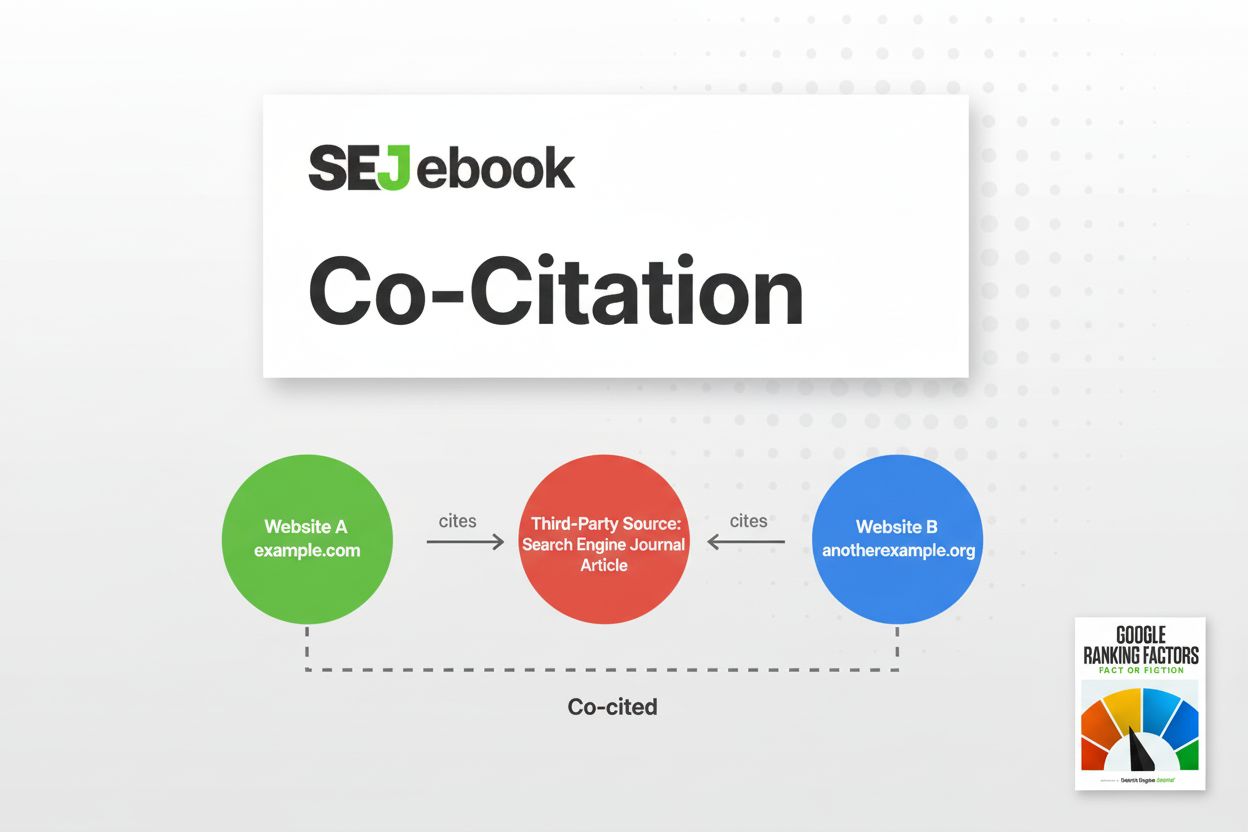
Co-citation is when two websites are mentioned together by third parties, signaling semantic relatedness to search engines and AI systems. Learn how co-citation...
Cookie Consent
We use cookies to enhance your browsing experience and analyze our traffic. See our privacy policy.