
Search Intent
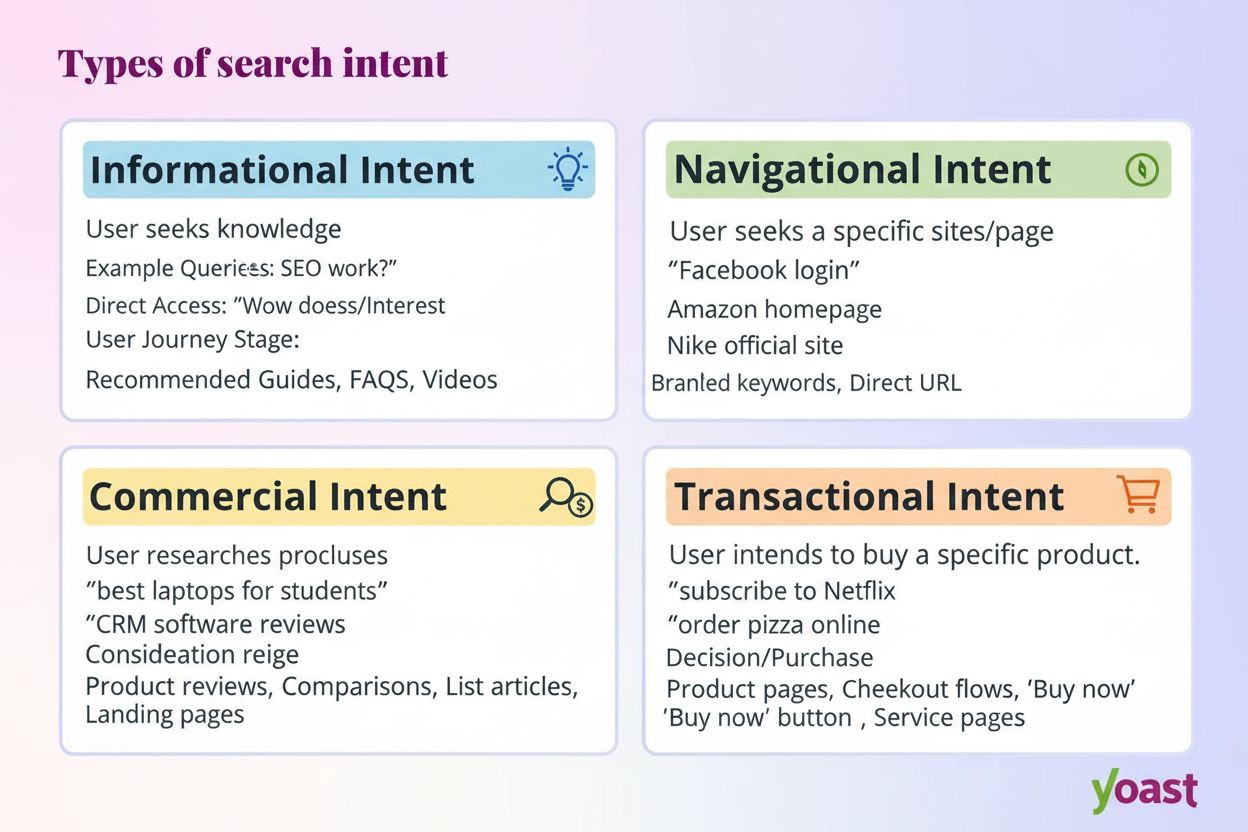
Search intent is the purpose behind a user's search query. Learn the four types of search intent, how to identify them, and optimize content for better rankings...
13 min read
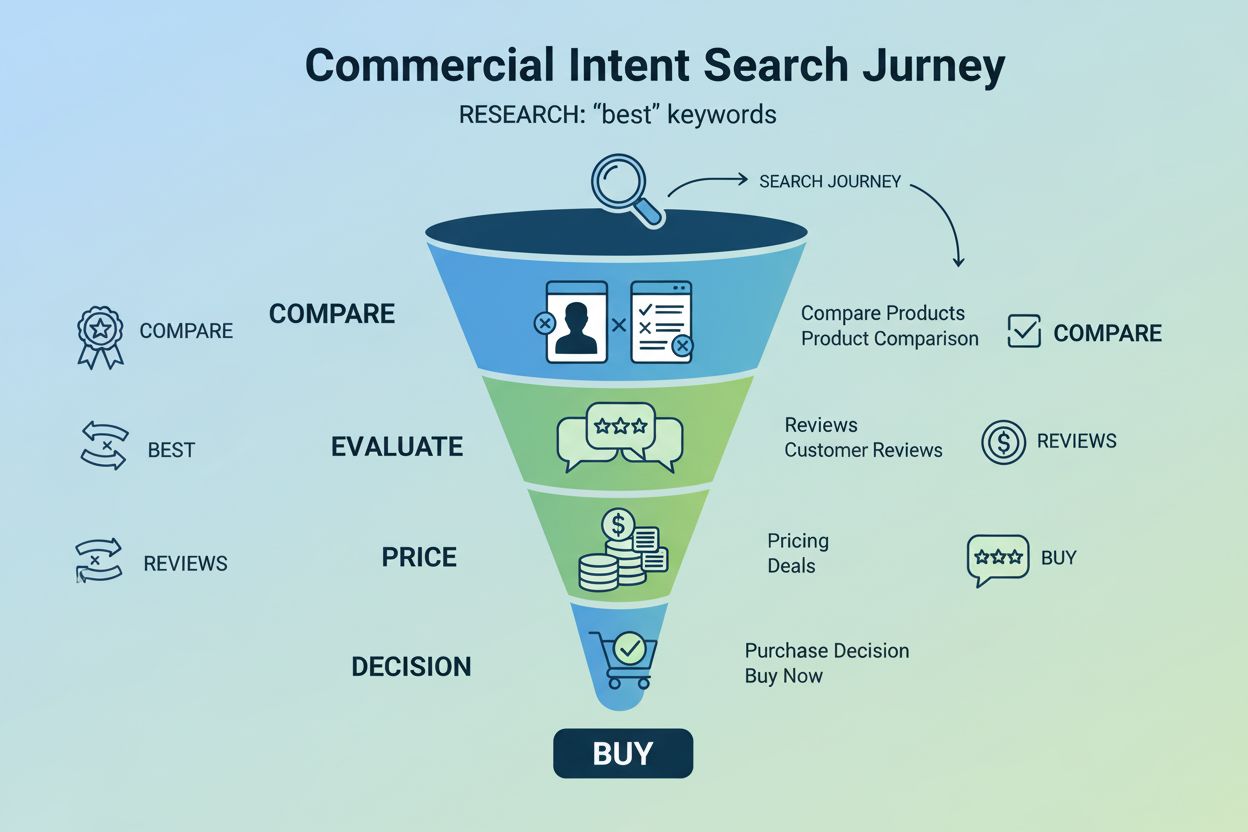
Commercial intent refers to search queries where users are actively researching, comparing, and evaluating products or services before making a purchase decision. These searches indicate a strong likelihood of conversion and represent users in the mid-to-late stages of the buying journey.
Commercial intent refers to search queries where users are actively researching, comparing, and evaluating products or services before making a purchase decision. These searches indicate a strong likelihood of conversion and represent users in the mid-to-late stages of the buying journey.
Commercial intent is a classification of search queries where users are actively researching, comparing, and evaluating products or services before making a purchase decision. These searches represent users in the mid-to-late stages of the buying journey who have already identified a need and are now narrowing down their options. Unlike informational searches where users seek general knowledge, commercial intent searches indicate a strong likelihood of conversion and represent some of the most valuable traffic for businesses. Users conducting commercial intent searches are typically asking questions like “best project management software,” “compare electric vehicles,” or “top-rated home security systems”—queries that demonstrate active consideration and readiness to invest in a solution.
The significance of commercial intent in digital marketing cannot be overstated. According to 2025 search intent statistics, approximately 14.51% of all Google searches have commercial intent, making it the second-largest category after informational searches. While this percentage may seem modest compared to informational queries (52.65%), the conversion value of commercial intent traffic is substantially higher. A single visitor from a commercial intent search is far more likely to convert into a paying customer than a visitor from an informational search, making these keywords disproportionately valuable for business growth and revenue generation.
The concept of search intent emerged as search engines evolved from simple keyword-matching systems to sophisticated algorithms designed to understand user needs. Google’s emphasis on search intent fundamentally changed how marketers approach keyword research and content strategy. In the early days of SEO, marketers focused primarily on search volume—the raw number of monthly searches for a keyword. However, this approach often resulted in high traffic with minimal conversions, as many searches were from users simply seeking information rather than preparing to make a purchase.
The recognition of commercial intent as a distinct category transformed keyword research methodology. Marketing professionals and SEO experts began categorizing searches into four primary types: informational, commercial, transactional, and navigational. This framework allowed businesses to allocate resources more strategically, focusing on keywords that aligned with their revenue goals. Research from industry leaders like Backlinko and Semrush demonstrated that commercial intent keywords, while sometimes having lower search volume than informational keywords, consistently delivered superior ROI and conversion rates. This insight led to a paradigm shift where quality of traffic became prioritized over quantity.
The evolution of commercial intent analysis has been further accelerated by the rise of artificial intelligence and generative search engines. Platforms like ChatGPT, Perplexity, and Google AI Overviews have introduced new dimensions to how users express commercial intent. Rather than typing simple keyword phrases, users now ask conversational questions like “which laptop should I buy for video editing?” or “what’s the best CRM for small businesses?” These AI-powered searches still represent commercial intent, but they require different optimization strategies than traditional keyword-based SEO. The emergence of AI search has made monitoring brand visibility for commercial intent queries increasingly critical for businesses seeking to maintain competitive advantage.
Commercial intent manifests in several distinct keyword categories, each representing different stages within the buying consideration phase. Understanding these categories is essential for developing a comprehensive keyword strategy that captures users at various points in their decision-making journey.
Investigative commercial intent keywords represent the earliest stage of commercial consideration. These keywords include modifiers such as “best,” “compare,” “reviews,” “top 10,” and “vs.” Users conducting these searches have identified a product category they’re interested in but haven’t yet decided which specific option to purchase. Examples include “best project management software,” “compare electric SUVs,” “top-rated home security systems,” and “Salesforce vs HubSpot.” The search engine results pages (SERPs) for these keywords typically feature comparison articles, buying guides, and review roundups from both brand websites and third-party aggregators. These keywords are valuable because they capture users who are actively evaluating options and are likely to convert within days or weeks.
Buy now commercial intent keywords represent the final stage of commercial consideration, where users are prepared to complete a transaction. These keywords include modifiers such as “buy,” “order,” “purchase,” “coupon,” “discount,” and “deal.” Examples include “buy custom wedding invitations,” “order organic coffee beans online,” and “purchase home gym equipment.” The SERPs for these keywords are dominated by product pages, shopping results, and e-commerce platforms where users can immediately complete their purchase. These keywords typically have lower search volume than investigative keywords but significantly higher conversion rates, as users are literally ready to hand over their credit card.
Local commercial intent keywords target users who are ready to visit a physical location or hire a local service. These keywords include modifiers such as “near me,” “nearby,” “[city name],” and “[neighborhood].” Examples include “best birthday cake Seattle,” “car repair near me,” and “buy fresh flowers downtown.” Google’s Local Pack—the three business listings that appear at the top of location-based searches—is a prominent SERP feature for these keywords. Local commercial intent is particularly valuable for service-based businesses, restaurants, retail stores, and professional services that operate in specific geographic areas.
Product/service commercial intent keywords are highly specific searches for particular products, brands, or services. These keywords often include specific product names, model numbers, or service details. Examples include “black iPhone 15 phone case,” “buy non-toxic laundry detergent,” and “private reformer Pilates sessions.” Users searching these terms have already decided on a specific solution and are looking for the best place to purchase it. The SERPs for these keywords are typically dominated by Google Ads and product pages from retailers and manufacturers.
| Search Intent Type | User Stage | Common Modifiers | SERP Features | Conversion Likelihood | Content Type |
|---|---|---|---|---|---|
| Commercial Intent | Mid-to-late funnel | Best, compare, reviews, vs, top | Product comparisons, buying guides, reviews | High (14.51% of searches) | Comparison articles, roundups, guides |
| Informational Intent | Early funnel | How, what, why, tips, guide | Answer boxes, featured snippets, knowledge graphs | Low (52.65% of searches) | Blog posts, educational content, FAQs |
| Transactional Intent | Bottom funnel | Buy, order, purchase, coupon | Shopping results, product pages, ads | Very High (0.69% of searches) | Product pages, checkout pages, deals |
| Navigational Intent | All stages | Brand name, specific site | Sitelinks, official website | Medium (32.15% of searches) | Homepage, branded pages, official profiles |
The relationship between commercial intent and business revenue is direct and measurable. When users conduct commercial intent searches, they have already invested time and mental energy into understanding their problem and identifying potential solutions. They are no longer in the awareness phase—they are in the active consideration phase, comparing options and evaluating which solution best meets their needs. This psychological positioning makes them exponentially more likely to convert compared to users arriving from informational searches.
Consider a practical example: an e-commerce company selling high-end coolers might receive 10,000 monthly visitors from the informational keyword “how to keep drinks cold on camping trips.” However, only 2-3% of these visitors might convert to customers, as many are simply seeking general advice and may not be ready to purchase. In contrast, the same company might receive only 500 monthly visitors from the commercial intent keyword “best soft coolers for camping,” but 15-20% of these visitors convert to customers. The commercial intent traffic, despite being 5% of the volume, generates 3-4 times more revenue.
This principle explains why commercial intent keywords are often prioritized in SEO strategies despite having lower search volume. Industry research consistently shows that commercial intent keywords drive 25-58% of organic traffic for major e-commerce and service-based websites. For Best Buy, a major electronics retailer, commercial intent keywords drive 58.1% of organic visits. For Kay Jewelers, a luxury jewelry retailer, commercial intent keywords drive 57.3% of organic visits. These statistics demonstrate that businesses cannot afford to ignore commercial intent in their keyword strategy, as it represents a disproportionate share of revenue-generating traffic.
Identifying commercial intent requires both automated tools and manual analysis. Keyword research tools like Semrush, Moz, and Ahrefs use machine learning algorithms to classify keywords by intent, allowing marketers to filter for commercial keywords in their databases. These tools analyze historical search data, SERP features, and advertiser behavior to assign intent classifications. However, automated classification is not always perfect, which is why manual SERP analysis remains essential.
Manual SERP analysis involves examining the top-ranking pages for a keyword to understand what Google considers most relevant for that query. For commercial intent keywords, you’ll typically observe several consistent patterns. First, the top organic results are often from third-party websites rather than brand websites—users trust impartial sources when making purchase decisions. Second, SERP features like “Popular Products,” “Refine By” filters, and Google Shopping results are prominently displayed. Third, Google Ads are typically abundant, indicating that advertisers recognize the commercial value of the keyword. Fourth, the content format is usually comparison-focused, featuring side-by-side product comparisons, buying guides, or review roundups.
Cost-per-click (CPC) data from Google Ads provides objective evidence of commercial intent. If advertisers are willing to pay $15 per click for a keyword, that keyword must be commercially valuable. CPC serves as a market-driven indicator of commercial intent that transcends subjective classification. Keywords with high CPC values are almost always commercially valuable, making CPC an excellent secondary metric to validate keyword selection alongside search volume and keyword difficulty.
The emergence of AI search platforms like ChatGPT, Perplexity, Google AI Overviews, and Claude has introduced new dimensions to commercial intent optimization. When users interact with these AI systems, they often express commercial intent through conversational queries rather than traditional keyword phrases. A user might ask ChatGPT “I’m looking for project management software that integrates with Slack and has strong reporting features—what would you recommend?” This query expresses strong commercial intent, but it’s fundamentally different from the keyword “best project management software with Slack integration.”
AI search platforms are increasingly influential in the buying journey, particularly for complex or high-value purchases. Research indicates that users are turning to AI systems to get personalized recommendations and comparative analysis before making purchase decisions. When an AI system recommends a competitor’s product instead of yours, or fails to mention your brand entirely, you lose a critical opportunity to influence the buying decision. This is where brand monitoring becomes essential.
AmICited specializes in tracking how brands appear in AI responses for commercial intent queries. The platform monitors when your brand is mentioned, recommended, or compared in AI-generated responses across multiple platforms. For commercial intent searches specifically, this monitoring is invaluable because it reveals whether your brand is being considered during the decision-making phase. If your brand is consistently absent from AI responses to commercial intent queries like “best CRM for small businesses” or “compare email marketing platforms,” you’re losing visibility during the most critical moment in the customer journey.
Creating content that ranks for commercial intent keywords requires understanding what users are actually looking for and delivering it in the format they expect. The most successful content for commercial intent follows several key principles.
First, content should directly address comparison and evaluation needs. Users conducting commercial intent searches want to understand the differences between options, the pros and cons of each solution, and which option best fits their specific requirements. Content that provides side-by-side comparisons, feature matrices, and honest assessments of strengths and weaknesses performs exceptionally well. For example, a buying guide for project management software should include detailed comparisons of features, pricing, ease of use, and customer support across multiple platforms.
Second, content should include social proof and credibility signals. Users evaluating options want to know what other customers think. Including customer reviews, testimonials, case studies, and expert opinions significantly increases the persuasiveness of commercial intent content. Third-party review sites rank highly for commercial intent keywords precisely because they aggregate customer feedback and provide impartial assessments. If you’re creating content on your own website, including customer testimonials and case studies helps establish credibility.
Third, content should be comprehensive and detailed. Commercial intent users are willing to invest time reading longer, more detailed content because they’re making an important decision. A 3,000-word buying guide that thoroughly explores options, pricing, and use cases will typically outrank a 500-word product description for commercial intent keywords. The content should answer common questions users have during the evaluation phase, such as “Is this solution worth the price?” “How does this compare to competitors?” and “What are the potential drawbacks?”
Fourth, content should include clear calls-to-action and next steps. While commercial intent users are not yet ready to purchase, they are ready to take the next step in their evaluation process. This might be requesting a demo, signing up for a free trial, downloading a comparison guide, or visiting a product page. Clear, strategically placed calls-to-action guide users toward conversion without being overly aggressive.
The definition and optimization of commercial intent is evolving rapidly as AI search platforms mature and user behavior adapts to new search paradigms. Several trends are likely to shape the future of commercial intent optimization.
First, conversational commercial intent will become increasingly important. As users become more comfortable with AI search, they will express commercial intent through natural language conversations rather than keyword phrases. AI systems will need to understand nuanced preferences, budget constraints, and specific use cases embedded within conversational queries. Brands will need to optimize not just for keywords, but for the conceptual understanding of their value proposition and how it addresses specific user needs expressed conversationally.
Second, personalized commercial intent will drive more targeted recommendations. AI systems are becoming increasingly sophisticated at understanding individual user preferences, past behavior, and stated requirements. Future AI search will likely deliver highly personalized recommendations based on a user’s specific situation, rather than generic “best of” lists. This means brands will need to ensure their products and services are positioned to appeal to diverse user segments and use cases.
Third, multimodal commercial intent will expand beyond text. As AI systems integrate video, images, and other media types, users will express commercial intent through multiple modalities. A user might show an AI system a photo of a product they like and ask “find me something similar but cheaper,” expressing commercial intent through visual input rather than text. Brands will need to optimize their visual content and product imagery for AI systems that can analyze and compare visual characteristics.
Fourth, real-time commercial intent monitoring will become standard practice. As AI search platforms proliferate and influence purchasing decisions, brands will need real-time visibility into how they’re being positioned in AI responses for commercial intent queries. Tools like AmICited will become essential infrastructure for competitive intelligence, allowing brands to understand their positioning relative to competitors in AI-generated responses and adjust their strategies accordingly.
The evolution of commercial intent from a simple keyword classification to a complex, multi-platform, AI-driven phenomenon represents both a challenge and an opportunity for businesses. The fundamental principle remains unchanged: users expressing commercial intent are actively considering a purchase and represent high-value traffic. However, the methods for identifying, reaching, and influencing these users continue to evolve. Businesses that stay ahead of these trends and invest in comprehensive commercial intent strategies—spanning traditional SEO, AI search optimization, and brand monitoring—will maintain competitive advantage in an increasingly AI-driven search landscape.
Commercial intent represents the research and comparison phase where users are evaluating options before deciding to purchase, while transactional intent indicates users are ready to complete a purchase immediately. Commercial intent keywords include modifiers like 'best', 'compare', and 'reviews', whereas transactional keywords include 'buy', 'order', and 'purchase'. Commercial intent typically has higher search volume but slightly lower conversion rates than transactional intent, making it valuable for capturing users earlier in the decision-making process.
According to 2025 search intent statistics, approximately 14.51% of all Google searches have commercial intent, making it the second-largest category after informational searches (52.65%). This represents a significant opportunity for businesses, as these searches indicate users are actively considering a purchase. While commercial intent searches represent a smaller percentage than informational queries, they drive substantially higher conversion rates and ROI for e-commerce and service-based businesses.
Effective commercial intent keywords include modifiers such as 'best', 'compare', 'reviews', 'top 10', 'vs', 'cheap', 'affordable', and specific product names. Examples include 'best project management software', 'compare electric SUVs', 'top-rated home security systems', and 'affordable web hosting'. The most valuable commercial keywords are those with moderate to high search volume, lower keyword difficulty, and high cost-per-click (CPC) values in Google Ads, indicating strong commercial value and buyer intent.
Commercial intent is increasingly important in AI search platforms like ChatGPT, Perplexity, and Google AI Overviews, where users ask comparative and evaluative questions. Brands that optimize for commercial intent keywords are more likely to be cited and recommended by AI systems when users ask for product comparisons or buying advice. Monitoring your brand's appearance in AI responses for commercial intent queries is critical for maintaining visibility in the evolving AI search landscape, which is why tools like AmICited track brand mentions across AI platforms.
Commercial intent keywords are more valuable because they target users who are actively ready to make a purchase decision, resulting in significantly higher conversion rates. While informational keywords may drive thousands of visitors, most are not prepared to buy. Commercial intent users are further down the sales funnel and have already decided they need a solution—they're just comparing options. This means fewer visitors from commercial keywords often generate more revenue and measurable ROI than high-volume informational traffic.
You can identify commercial intent by analyzing SERP features and content types. Commercial intent searches typically display product comparison articles, buying guides, review roundups, and product pages in the top results. Look for SERP features like 'Popular Products', 'Refine By' filters, and Google Shopping results. Additionally, check if Google Ads are prominently displayed, as high advertiser competition indicates strong commercial value. Manual SERP analysis combined with keyword research tools that classify intent can help you accurately identify commercial keywords.
Content formats that perform best for commercial intent include product comparison articles, detailed buying guides, review roundups, feature comparison tables, and product category pages. These formats directly address the user's need to evaluate and compare options before purchasing. Aggregator websites and third-party review sites often rank highly for commercial keywords because users trust impartial sources. Including visual elements like comparison charts, product images, and pricing tables significantly improves engagement and conversion rates for commercial intent content.
Start tracking how AI chatbots mention your brand across ChatGPT, Perplexity, and other platforms. Get actionable insights to improve your AI presence.
Search intent is the purpose behind a user's search query. Learn the four types of search intent, how to identify them, and optimize content for better rankings...
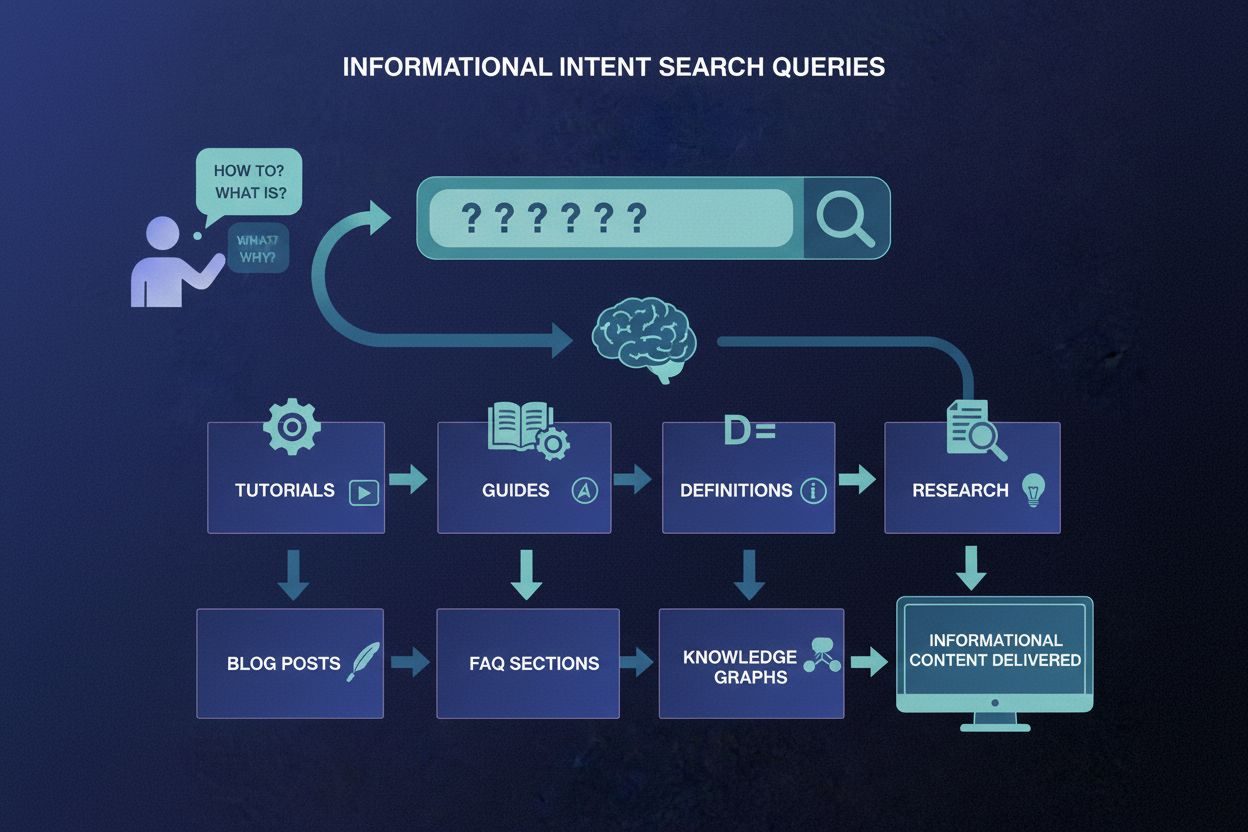
Informational intent is when users search for knowledge or answers. Learn how to optimize content for informational queries and understand its role in AI search...

Learn how to align your content with AI query intent to increase citations across ChatGPT, Perplexity, and Google AI. Master content-prompt matching strategies ...
Cookie Consent
We use cookies to enhance your browsing experience and analyze our traffic. See our privacy policy.